Best Copy Trading Bot: 7 Platforms Compared
compare the best copy trading bot options across custody, fees, execution, controls, and transparency, including why non-custodial design matters.

A leaderboard doesn't identify the best copy trading bot by itself. It shows who traded well under a particular set of market conditions. It doesn't tell you where your funds stay, how quickly your order follows, whether exits are copied, or how much control you retain when execution goes wrong.
Start with the operating model. Custodial exchange products keep the process inside an exchange. API-connected automation leaves funds at your exchange but gives software trading permissions. Managed platforms execute within their own environment. Wallet-based non-custodial mirroring sends trades to your wallet while you retain asset control. Those models carry different custody, execution, fee, transparency, and regional-availability trade-offs.
This comparison focuses on custody, entry and exit replication, sizing controls, execution latency, fees, transparency, and availability. Copy trading carries market, platform, execution, and capital-loss risk. Your fills can differ from the source trader's fills, especially in volatile or thin-liquidity markets. Past performance does not predict future results, and copy trading doesn't guarantee profits, as CMC Markets explains in its copy-trading risk guidance.
copyfomo is a Telegram-based option for traders who already use or know fomo. It mirrors selected activity into the user's wallet, but it doesn't turn trading into passive income or remove the need to understand permissions, sizing, and execution risk.
Table of Contents
- 1. copyfomo
- 2. eToro CopyTrader
- 3. Bybit Copy Trading
- 4. OKX Copy Trading
- 5. KuCoin Copy Trading
- 6. 3Commas
- 7. Zignaly
- Top 7 Copy Trading Bots Comparison
- Choose the Operating Model, Not the Leaderboard
1. copyfomo
copyfomo is a Telegram-based, non-custodial copy trading bot for traders who follow the fomo leaderboard. It mirrors selected traders' filled entries and exits into your wallet at a size you set. Funds remain in your wallet, while the service uses a revocable spending allowance rather than taking custody. Non-custodial design limits platform custody risk, but it does not remove smart-contract, wallet, approval, market, or execution risk.
The bot copies buys and sells, so users can follow exits rather than only opening positions. It aims to operate roughly one second behind the source trader's on-chain fill and displays slippage for each copied swap. That delay can still change the result. A fast price move may occur before the copied transaction settles.
Practical rule: Treat displayed slippage as an execution record, not proof that your result will match the source trader's result.
Controls and transparency
Users can choose a fixed ticket size or proportional sizing based on the source trade. Optional per-trade caps limit exposure to one copy. A one-tap kill switch stops new copies, while an optional one-tap close can close open mirrored positions.
The public data layer shows more than a leaderboard ranking. copyfomo provides a live feed of mirrored swaps with timestamps and slippage, plus a public dataroom with refreshed metrics such as total value locked and buyback and burn figures. Its sizing example maps a large source position to a much smaller user ticket, showing that users can define exposure instead of replicating the full trade. The website does not fully disclose a public subscription or fee table, so users should check the bot or documentation for current pricing and network fees.
The fomo leaderboard includes traders with multi-million-dollar realized PnL, including Unipcs, also known as Conviction Capital, DumbCrayonEater, and frank. Those figures describe historical on-chain activity. They do not establish future performance, suitability, or the quality of every copied fill. Past performance does not predict future results, and copy trading does not guarantee profits.
Who gets the most value
copyfomo suits retail DeFi traders who already follow fomo, part-time traders who cannot monitor a leaderboard continuously, and users who prefer wallet control over exchange custody. It can also resolve trader addresses from handles or screenshots, extending discovery beyond the leaderboard's top 100.
The trade-offs are direct. Users remain responsible for wallet security and allowance permissions. The service says it cannot withdraw funds, but a token approval is still a permission to understand and revoke when appropriate. Listed traders are not affiliated with copyfomo, and some may explicitly tell people not to copy them.
For setup guidance, see how to copy trade on fomo. The copyfomo Telegram bot handles onboarding and ongoing controls.
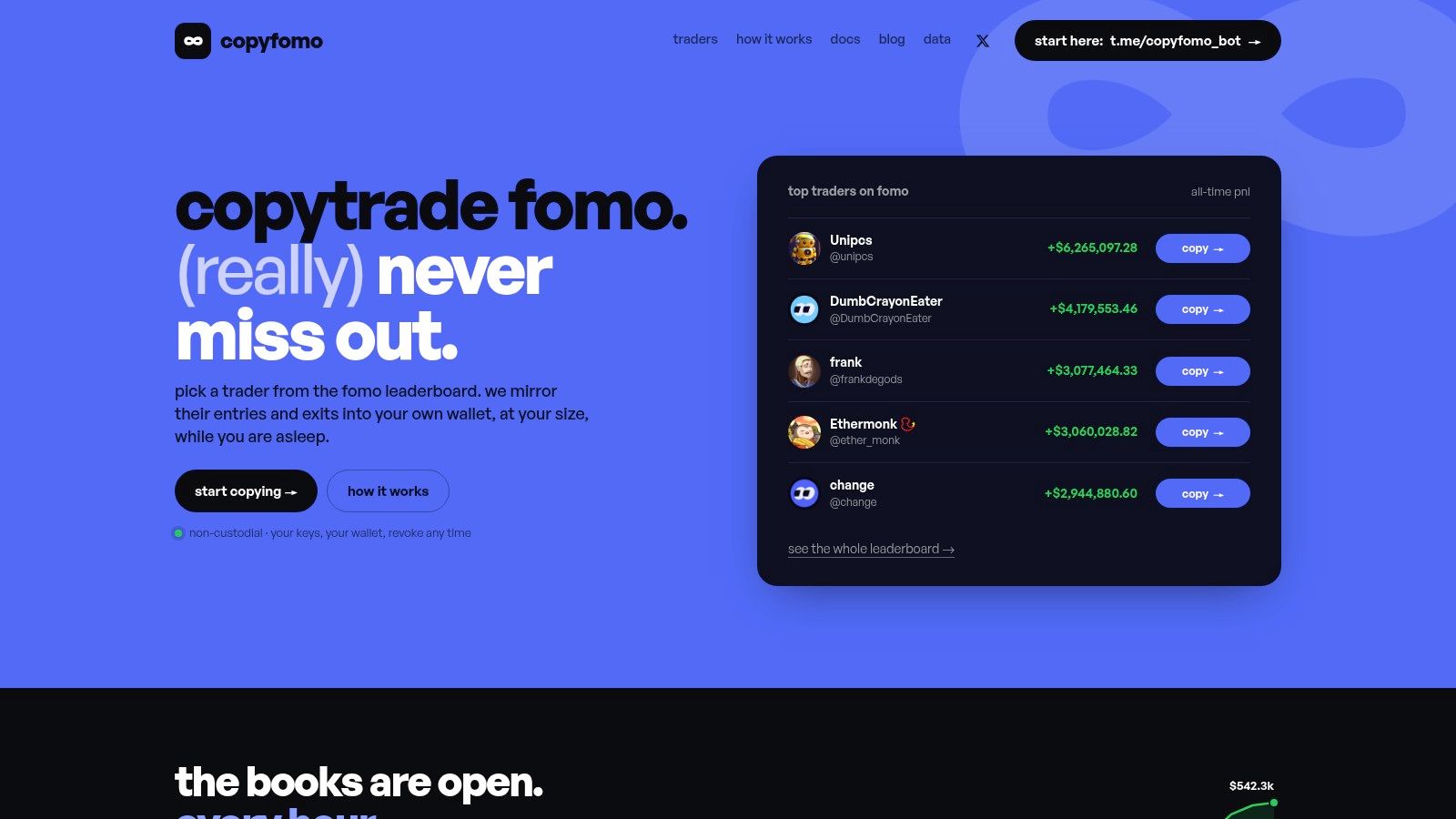
Best fit: Wallet-based, on-chain mirroring with configurable sizing, copied exits, Telegram controls, and visible per-trade slippage.
2. eToro CopyTrader
eToro CopyTrader uses a custodial, platform-based model. Users select investors and mirror their activity inside eToro rather than sending on-chain transactions to a personal wallet. The product is built around discovery, profiles, performance information, risk scores, and a social investing environment.
Users can adjust the amount allocated to a selected investor and configure stop-loss guardrails. Asset access depends on the user's country and account setup. Crypto is available in the United States, but availability and product features vary by region. The relevant comparison is not just the number of profiles. It's whether the user accepts eToro's custody and execution environment.
CopyTrader doesn't add a separate copying fee. Standard trading costs and spreads still apply. Those costs can affect the follower's result even when the selected investor's displayed performance looks strong. The copied transaction also occurs within eToro's system, so it isn't an on-chain mirror of the investor's wallet activity.
Trade-offs for social discovery
The strength is convenience. A user can browse investor profiles, review platform-provided metrics, and start copying without building an external automation setup. The social layer also gives the product a clear discovery workflow.
The cost is control over custody and venue. Users don't hold the copied position in a personal DeFi wallet through this product. They also need to check regional restrictions before assuming that a particular asset or feature is available.
Copying a profile is easy. Verifying what the profile's numbers include is harder.
For the legal and jurisdiction questions that surround automated copying, consult this copy trading legality guide. eToro's CopyTrader product page provides the platform's current feature and availability details.
Best fit: Users who prioritize a mature social discovery experience and one-click mirroring within a custodial multi-asset platform.
3. Bybit Copy Trading
Bybit Copy Trading is primarily designed around exchange-based derivatives activity. It offers Classic and Pro copy-trading modes, with follower settings that can use proportional balance sizing or fixed margin per trade. Users can also configure borrowing capacity, margin mode, take-profit, and stop-loss settings.
That control changes the operating risk. A follower's result can diverge from the master's result because of settings, timing, slippage, and market conditions. Bybit also provides a price-protection mechanism intended to reduce slippage during order creation, but protection doesn't guarantee identical fills.
Follower controls versus execution differences
The dashboard gives followers editable settings for each master. That is useful when the follower wants to limit exposure rather than accept every parameter unchanged. Masters can earn a profit share from followers' net profits, creating a defined settlement relationship between the two sides.
The model remains custodial and exchange-executed. It isn't a wallet-based mirror of the master's on-chain transaction. Products and access can also be restricted by jurisdiction, particularly where derivatives availability is limited.
Bybit's Copy Trading marketplace is the appropriate place to verify current product scope, settings, and availability. Review the master's method and the follower-side controls separately. A high displayed return doesn't tell you how your chosen margin mode will behave.
Best fit: Exchange users who want detailed follower-side controls for derivatives and accept exchange custody, financial risk, and possible regional limits.
4. OKX Copy Trading
OKX operates a copy-trading marketplace covering lead-trader profiles and multiple product types. Followers can access spot, futures, and bot strategies through the exchange's workflow. The platform also provides filters, trader information, risk controls, and an integrated mobile path through its trading and copy features.
The fee model uses profit sharing. Followers pay a share to lead traders on net profitable copied trades and still pay standard trading fees. That is different from a fixed copy fee, but it doesn't make the activity cheap by default. Trading costs, spreads, slippage, and the profit share all affect the follower's net outcome.
Marketplace breadth has a cost
A broader marketplace gives users more ways to filter and compare lead traders. It also creates more choices to evaluate. Spot, futures, and bot strategies don't carry the same exposure, and a profile's historical results won't automatically translate across them.
Execution stays inside OKX's custodial exchange environment. Followers aren't directly mirroring a lead trader's wallet transaction on-chain. Their fills can differ because orders are created for separate accounts under separate conditions.
Execution question: Ask whether the copied order, not just the lead profile, matches the risk you intended to take.
Product access varies by jurisdiction. Check the current OKX copy-trading page for available markets, fee rules, and account requirements before relying on a specific mode.
Best fit: Exchange users who want a marketplace spanning spot, futures, and bot strategies, with profit sharing applied to profitable copied trades.
5. KuCoin Copy Trading
KuCoin Copy Trading offers two basic sizing approaches, fixed ratio and fixed amount. Fixed-ratio copying scales the follower's position in relation to the lead trader. Fixed-amount copying uses a defined amount for each copied trade. That distinction is useful for users who want predictable allocation instead of direct exposure to the lead trader's account size.
Lead-trader cards display PnL and follower information. Setup takes place inside the exchange, with help-center documentation supporting onboarding and common questions. Leaders receive profit sharing on followers' profits, while execution and settlement remain tied to KuCoin's exchange environment.
Simple setup, familiar constraints
The main advantage is integration for existing KuCoin users. Discovery, account access, and copying sit in one workflow. Users don't need to manage a separate bot interface or connect an external wallet for the basic exchange-based process.
The trade-off is that convenience doesn't remove execution differences. Timing, liquidity, and trading fees can separate a follower's outcome from the leader's displayed outcome. The platform is custodial, and regional restrictions may apply.
KuCoin's official exchange website is the place to verify current copy-trading access and program terms. Treat PnL and follower counts as selection information, not as a forecast.
Best fit: Existing KuCoin users who want simple in-app discovery, fixed or proportional sizing, and exchange-level profit sharing.

6. 3Commas
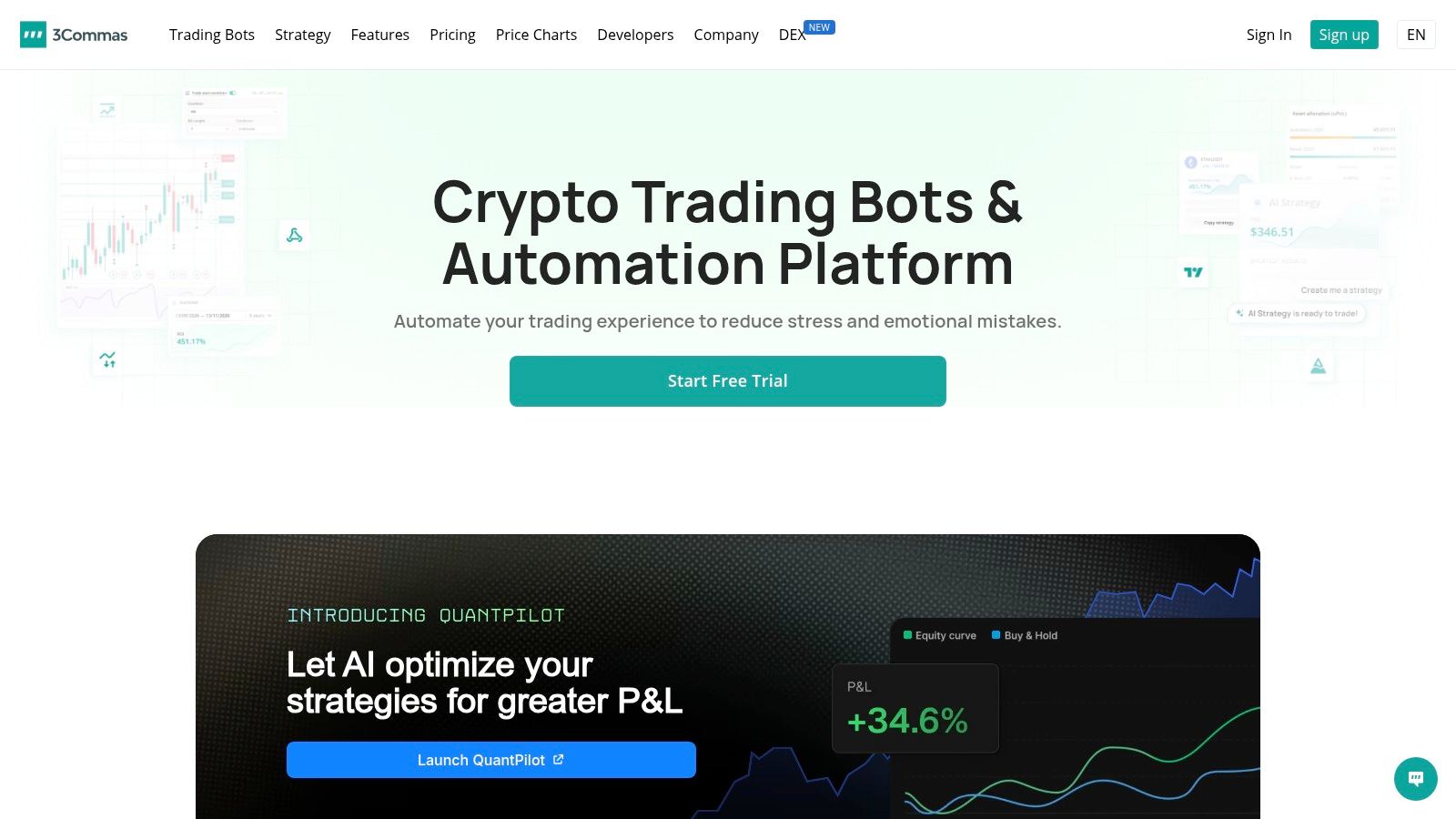
3Commas uses an exchange-connected automation toolkit model. Users connect exchange accounts through API keys. Funds stay on the exchange, while 3Commas runs configured DCA, grid, signal, and trade-management tools. The design is non-custodial from 3Commas' perspective, but API permissions still create security exposure.
Users can set take-profit, stop-loss, and trailing rules through SmartTrade and bot tools. Mobile apps support monitoring, while the strategy marketplace lets users review and copy bot configurations and performance information. Backtesting shows how a configuration behaved with historical data. It cannot predict live execution or returns.
Flexibility requires operational work
The main advantage is control across supported exchanges. Users choose the automation type, set allocation and exit rules, and apply exchange security controls such as IP whitelisting where available. This suits traders who want automation linked to existing exchange accounts rather than a separate custodial marketplace.
The trade-off is operational responsibility. Users must check strategy logic, API permissions, exchange compatibility, and configuration errors. Subscription costs also sit apart from trading fees, slippage, and losses, so the model may be difficult to justify for a small account.
Copying a bot differs from copying a trader directly. The user controls the connected account, but execution depends on exchange conditions and the rules configured in 3Commas. Past bot performance does not predict future results, and copy trading carries risk.
Check the 3Commas website for current exchange support and plan details. For a broader explanation, read this guide to crypto copy-trading bots explained, while the 3Commas interface illustrates the workflow.
Best fit: Experienced users who want configurable, multi-exchange automation and can manage API permissions and strategy settings.
7. Zignaly
Zignaly uses a managed profit-sharing model. Wealth managers trade for followers inside Zignaly's environment. Followers pay success fees on net profits under a high-water-mark approach, with scheduled settlements. Zignaly discloses a 5% platform share, as described in its product material.
No exchange API keys are required for the core setup. Trading occurs on Zignaly's platform, which simplifies onboarding compared with API-connected tools. Users browse managers and strategy information through the marketplace, then decide how much capital to allocate within the platform's structure.
Performance-linked fees don't remove risk
The fee model links payment to net profitable results. That can be easier to understand than paying a separate subscription, but it doesn't eliminate market risk, execution risk, custody risk, or manager risk. A manager can change availability, alter a strategy, or stop participating. The follower also doesn't receive on-chain self-custody through this model.
This structure is different from both a personal-wallet mirror and an exchange-native copier. Zignaly handles execution within its environment, while the follower evaluates manager information and accepts the platform's custody and operating rules.
Check the current Zignaly platform for manager availability, settlement terms, and account requirements. Don't infer safety from the high-water-mark fee structure. It describes how fees are calculated, not whether a strategy will lose money.
Best fit: Users who prefer managed execution, no exchange API keys, and a success-fee structure, while accepting platform custody and manager availability risk.
Top 7 Copy Trading Bots Comparison
| Product | Implementation complexity | Resource requirements | Expected outcomes / | Ideal use cases | Key advantages |
|---|---|---|---|---|---|
| copyfomo | Moderate, Telegram setup, wallet allowance management, per‑trader config | Low infra; requires on‑chain gas and wallet with revocable allowance | High transparency; mirrors entries & exits ~1s behind source; performance varies with slippage | Retail DeFi users who want non‑custodial, real‑time on‑chain mirroring | Non‑custodial mirroring; exit replication; on‑chain dataroom & live swap feed |
| eToro CopyTrader | Low, one‑click in‑platform setup, simple UI | Custodial account and funds on eToro; regional availability | Reliable social mirroring inside exchange; subject to spreads/fees | Beginners and retail investors seeking social discovery and easy onboarding | Large social ecosystem; no extra copy fee; transparent Popular Investor stats |
| Bybit Copy Trading | Moderate, choose mode, configure leverage/margin and protections | Bybit account, margin/futures collateral; region/product limits | Granular follower control; results can diverge due to leverage/slippage | Derivatives traders who need fine follower‑side risk controls | Proportional/fixed modes; adjustable leverage/TP‑SL; profit‑share for masters |
| OKX Copy Trading | Low, Moderate, marketplace discovery and in‑app flows | OKX account; supports spot, futures, bots; jurisdiction limits | Broad access to strategies; custodial execution may differ from leaders | Users wanting exchange liquidity and multiple copy modes (spot/futures/bots) | Large liquidity; multiple copy modes; profit‑share model (no extra copy fee) |
| KuCoin Copy Trading | Low, in‑app setup with leader cards and simple controls | KuCoin account and funds; regional restrictions possible | Straightforward mirroring; performance may differ by timing/fees | Existing KuCoin users seeking quick, integrated copy setup | Simple onboarding; leader profiles; profit‑sharing aligns incentives |
| 3Commas | High, API key setup, bot configuration, backtesting learning curve | Exchange accounts + API keys; subscription fees; IP whitelisting recommended | Very configurable automation across exchanges; results depend on strategy quality | Advanced users who want multi‑exchange bots and deep customization | Non‑custodial via API; DCA/grid/signal bots; strategy marketplace & backtesting |
| Zignaly | Low, platform signup and follow a manager; simplified UX | Zignaly account; custodial execution on platform; success‑fee model (platform share) | Pay only on net profits (high‑water mark); hands‑off manager execution | Users preferring performance‑aligned fees and minimal setup | Success‑fee only alignment; no exchange API keys required; marketplace of managers |
Choose the Operating Model, Not the Leaderboard
The practical choice isn't “which leaderboard has the best trader?” It's which operating model matches your custody preference, execution requirements, and tolerance for control risk.
Choose a custodial exchange marketplace when you want discovery and execution inside one account. The exchange handles the copying workflow, but your positions remain subject to its custody, product availability, fees, and regional rules. Native derivatives products add amplified gains and losses and liquidation risk. Spot products avoid that specific mechanism, but they still carry market and execution risk.
Choose API-connected automation when you want funds to remain at your exchange and need configurable DCA, grid, signal, or trade-management rules. You must then manage API permissions, exchange compatibility, configuration, and security. A managed platform can simplify setup and use performance-linked fees, but execution and custody remain inside that platform.
copyfomo is the relevant model when the requirements are wallet control, on-chain execution, mirrored exits, configurable sizing, slippage visibility, and Telegram operation. It mirrors selected fomo leaderboard activity into the user's wallet through a revocable allowance. It offers fixed or proportional sizing, per-trade caps, a kill switch, optional position closure, and a live feed showing copied swaps and slippage.
That doesn't make copyfomo risk-free. A roughly one-second delay can produce a different fill. Smart-contract permissions require attention. On-chain assets can lose value, liquidity can disappear, and a source trader's historical activity can stop being useful. Copy trading carries capital-loss risk, and past performance does not predict future results.
Before using any service, verify current fees, jurisdiction, permissions, custody arrangements, execution assumptions, and kill-switch behavior. Check whether entries and exits are both copied. Confirm how sizing works, what happens when liquidity is thin, and whether the platform's displayed performance includes costs that you'll also pay.
For traders who want to assess wallet activity rather than rely only on a profile, copyfomo's public data and swap history offer a more direct transparency layer. Start by reviewing the operating model and permissions, not by assuming the highest leaderboard result is the right target. To use the Telegram-based wallet mirroring model, visit copyfomo and start the bot.
copyfomo mirrors selected fomo trader entries and exits into your own wallet through Telegram, with configurable sizing, per-trade slippage visibility, and controls to pause or close copied positions. If wallet control and on-chain transparency matter more than a custodial leaderboard interface, visit copyfomo to start the bot.
stop reading. start copying.
pick a trader from the fomo leaderboard, set your size, and the entries and the exits land in your own wallet while you sleep.
open copyfomo on telegram →