Copy Trading Software: A Complete Guide for 2026
discover how copy trading software works and how to select the right platform in 2026. start copying top traders with confidence today.
You know the setup. A trader on fomo catches a move while you're asleep, at work, or away from the screen. You see the result later. The entry is gone. The exit is already done. You weren't wrong about the trader. You were late.
That gap is where copy trading software sits.
At the simplest level, copy trading software mirrors another trader's filled entries and exits into your own wallet at rules you choose. Size can be fixed. It can be proportional. You can cap it. Good software also handles exits, not just buys, so you aren't left with half an automation flow and the hard part still manual.
This isn't a small side feature anymore. One industry estimate put the copy trading software market at $4.27 billion in 2024 and projected $15.42 billion by 2033, implying a 17.8% CAGR over that period, while another estimate in the same research set placed the related copy trading platform market at $4.3 billion in 2024 rising to $18.1 billion by 2033 at a 19.7% CAGR (market estimates discussed here). The reason is plain enough. Traders want less screen time, faster reaction, and a way to participate without hand-copying every move.
Table of Contents
- Introduction to Copy Trading Software
- How Copy Trading Software Actually Works
- Core Components Inside Every Copy Trading System
- Integration Methods APIs Bots and Telegram Workflows
- Hidden Costs in Mirrored Execution: Slippage, Latency and Sizing
- Security Checklist for Choosing Copy Trading Software
- Final Takeaways and Next Steps With copyfomo
Introduction to Copy Trading Software
If you already follow the fomo leaderboard, you know the routine. You check rankings. You open trader profiles. You try to work out which wins were real fills and which ones came from conditions that won't repeat. Then life gets in the way and you miss the trade anyway.
That's why copy trading software matters. It turns “I need to watch this trader” into “mirror that trader at my preset size if a trade fills.” The core job is execution, not prediction.
What the software is actually doing
Think of it like a relay.
One trader enters and exits positions. The software watches those filled trades. It then places corresponding trades from your wallet using your rules. If the leader buys and later sells, the follower flow should handle both sides. If it only handles entries, it isn't a full copy system.
A clean setup usually includes:
- Trade mirroring: Filled buys and sells are copied into your wallet.
- Sizing rules: You decide fixed size, proportional size, and any cap per trade.
- Unattended operation: The tool runs without needing you to approve each move manually.
- Basic controls: Pause, stop, and close copied positions when needed.
What software solves and what it doesn't
It solves time and attention.
It doesn't remove risk.
Copy trading carries market risk, and past performance is not a reliable indicator of future results (risk reminder from Weex). A trader's old gains may have come from conditions that aren't there anymore. Software also doesn't give you the leader's exact result. Timing, slippage, fees, and sizing get in the way.
Copying a trader removes some manual work. It doesn't remove the need to think about execution quality.
That's the part most traders skip. They spend all their time picking leaders and almost none checking how the software handles the copy itself. That's backwards.
How Copy Trading Software Actually Works
The easiest way to understand it is to start with a mirror.
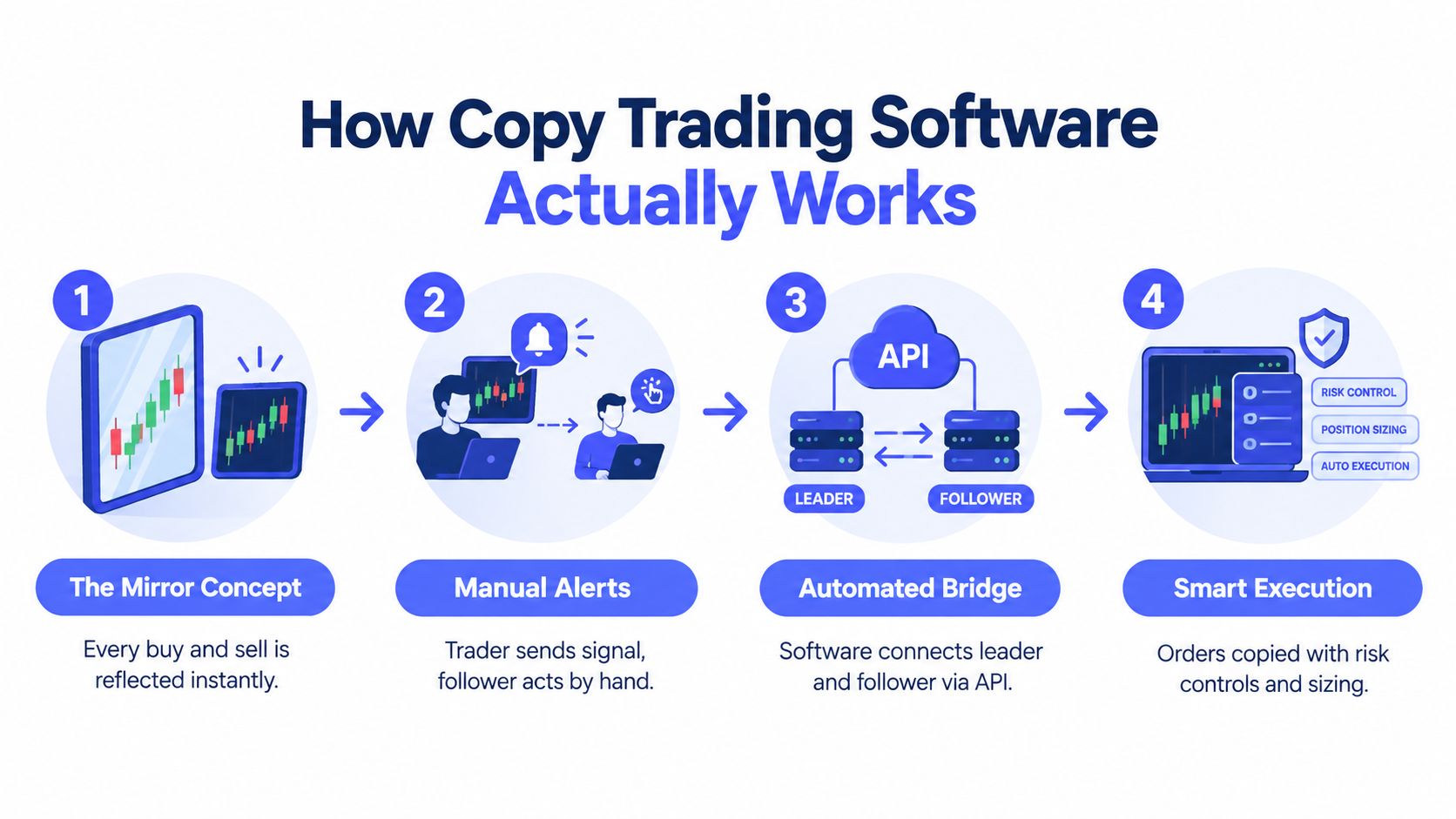
A mirror doesn't invent anything. It reflects what's already there. Copy trading software does the same job with trades. A source trader opens or closes a position. The software reflects that action into follower accounts or wallets based on preset rules.
From manual alerts to actual automation
The first version is crude. A trader posts an alert. You read it and act. That isn't really copy trading software. It's manual following with delay.
The next step is software that detects the source trade and sends the follower order automatically. That's where the category started to become useful. The historical path matters here. Tradency's Mirror Trader is widely cited as launching in 2005, then eToro's OpenBook and CopyTrader arrived in 2010 and helped push one-click social replication into the retail mainstream. MetaTrader Signals was embedded in MT4 and MT5 in 2012, with other signal marketplaces appearing in the 2011 to 2014 period (timeline overview from ForTraders).
That progression changed the product itself. Early systems were close to signal mirroring. Modern ones combine discovery, automation, and risk controls.
The modern execution flow
A current copy flow usually looks like this:
- A source trade fills
The leader buys or sells. Filled trades matter more than posted ideas.
The software reads the event
The system recognizes the fill and prepares a matching follower action.
Sizing rules are applied
The follower trade is adjusted to fixed size, proportional size, or a capped amount.
The follower order executes
The copy trade goes live from the follower wallet or account.
Traders often get confused. They think the software is “copying a strategy.” Usually it's copying executed actions. That's a different thing.
A second confusion is exits. Some tools make buys easy and sells messy. Proper copy trading software mirrors both sides so the follower doesn't need to babysit the position.
Later in the flow, execution details start to matter. This walkthrough helps visualize the handoff from source to follower before those costs show up:
Practical rule: If the software can't explain how it handles entries, exits, and sizing, it's not finished enough to trust with unattended copying.
Core Components Inside Every Copy Trading System
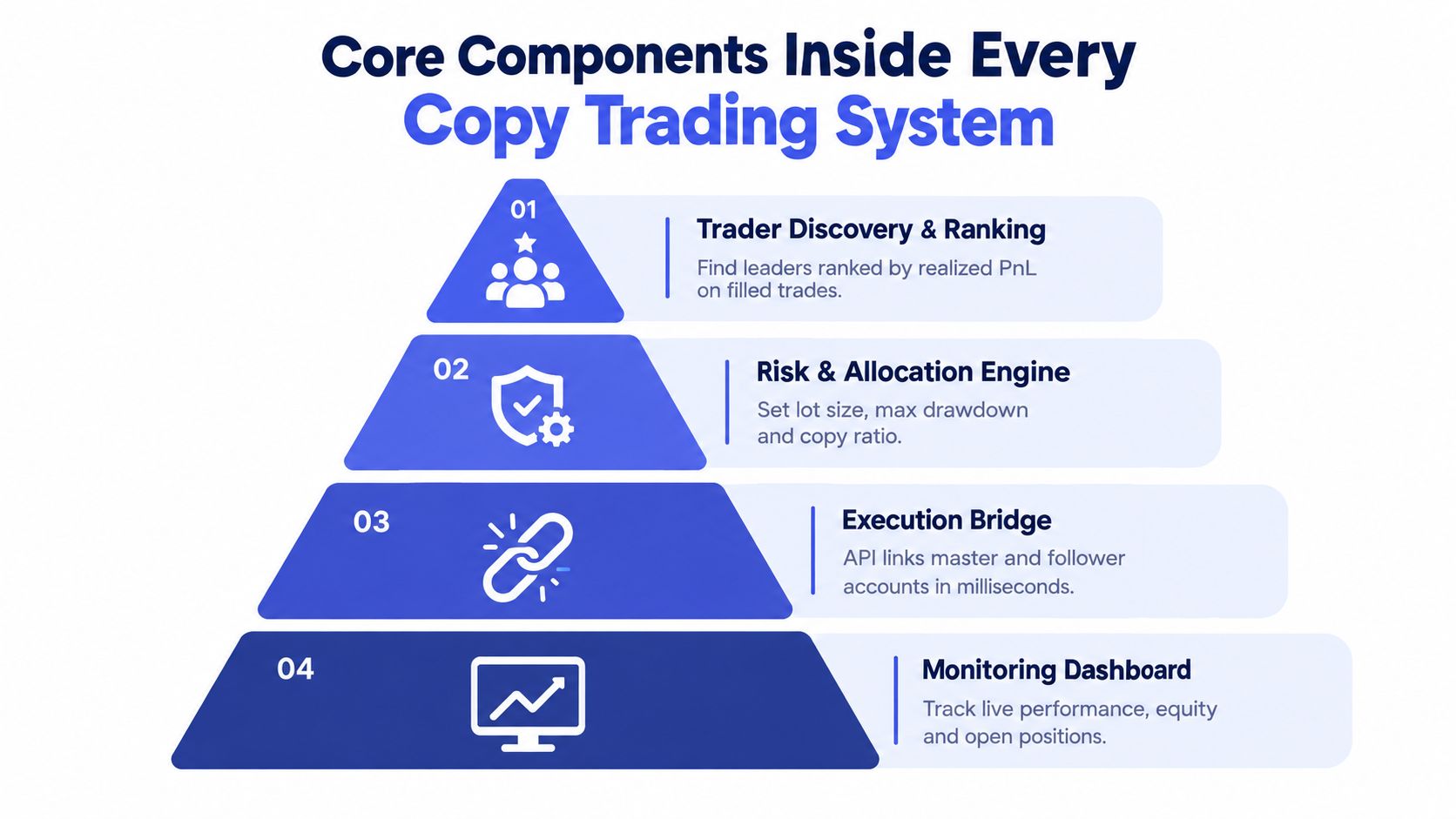
Marketing copy tends to flatten everything into one promise. The software doesn't work that way. It's a stack. If one layer is weak, the whole thing is weak.
Discovery and ranking
The first component is trader discovery.
You need a way to find traders worth watching, usually through a leaderboard, trader pages, or a ranked feed. The key detail is what the ranking is based on. Realized PnL from filled trades is harder to game than screenshots or selective posts. If you're doing due diligence, public trader pages and performance records matter.
Signal and trade verification
The second component is the feed itself.
A copy system should be based on verified trades, not chat calls, not claimed entries, and not delayed summaries. Traders often miss this distinction. If the source isn't a real filled trade, the rest of the automation doesn't mean much.
What you want to see is a live feed that shows what happened and when it happened. Timestamps matter. Without them, you can't evaluate drift later.
Sizing and risk controls
Then comes the allocation engine.
Your copy rules live here. Fixed ticket size is simple. Proportional sizing tracks the source more closely. Per-trade caps help stop one oversized source trade from forcing a follower into more exposure than intended. Good software also gives you pause controls and the option to stop taking new trades without tearing down the whole setup.
Non-custodial execution
This is the line that matters most for wallet safety.
Keep the funds in your own wallet.
Non-custodial copy trading can work through revocable on-chain permissions instead of transferring assets away. ERC-style wallet permission systems let a dApp receive execution authority that the user can revoke, and revocation is recorded on-chain so later spend attempts fail. Security guidance also notes that disconnecting a site does not itself revoke a token allowance, so allowance management has to be explicit (ERC-style smart wallet permissions explained here).
That means the software can trade from your wallet without taking custody, but you still need to manage approvals properly.
Exit mirroring and monitoring
The last layer is operational visibility.
A working system should mirror sells as well as buys. It should also show a live activity feed, timestamps, and visible slippage on copied trades. If you can't inspect what happened after the fact, you can't tell whether the issue was trader selection or poor execution.
A basic evaluation checklist looks like this:
- Discovery layer: Real trader pages, rankings, and filled-trade context.
- Execution layer: Verified trade feed and clear mirror logic.
- Control layer: Sizing choices, caps, pause, and close-position controls.
- Monitoring layer: Live feed, timestamps, and slippage display.
One Telegram workflow built for this use case is copyfomo, which mirrors filled entries and exits from traders on the fomo app into the user's own wallet at a configured trade size, with transparent trade reporting and non-custodial execution.
Integration Methods APIs Bots and Telegram Workflows
The same copy logic can reach the market in different ways. That changes how much manual work stays on your side.
Three common integration styles
Some setups are direct API connections inside a trading platform. Some are standalone bots. Some sit inside a Telegram workflow and handle setup, controls, and status updates there.
The choice isn't mainly about convenience. It's about control, unattended operation, and custody.
| Integration Method | User Control | Execution Style | Best For |
|---|---|---|---|
| API-based platform integration | High inside the connected platform | Direct platform-level mirroring | Traders already operating inside a broker or exchange stack |
| Standalone bot | Varies by tool design | Automated copying through an external workflow | Traders who want less platform friction |
| Telegram bot workflow | High on setup and ongoing controls through chat commands | End-to-end mirroring with simple control surface | Traders who already manage activity through Telegram |
What changes between them
API-based setups usually feel native. If you already live inside a platform, that can be efficient. The tradeoff is that control and visibility often stay tied to that platform's design.
Standalone bots reduce that dependency. They can also support unattended operation better than alert-based tools. But the control surface may be thinner, and transparency depends on whether the bot exposes timestamps, fills, and slippage.
Telegram workflows are different again. The main benefit is operational simplicity. Setup, trader selection, sizing, pause controls, and status checks can all sit in one interface traders already use. For crypto traders following fast-moving on-chain activity, that matters more than people admit.
Where Telegram fits for fomo users
If you already know fomo, the Telegram model is straightforward. You pick a trader, set size rules, and let the bot mirror swaps without needing to sit on the leaderboard all day.
A few points matter more than the interface itself:
- Always-on behavior: The workflow should run without manual confirmations on each trade.
- Wallet matching: It helps if the tool can identify traders beyond just a short public list.
- Reporting: You want a visible record of mirrored swaps, not a black box.
- Custody: The wallet should stay yours.
For a broader breakdown of bot-based workflows, this explainer on crypto copy trading bots is worth reading.
The best integration style is usually the one that removes the most manual delay without taking custody away from you.
Hidden Costs in Mirrored Execution: Slippage, Latency and Sizing
Two traders copy the same wallet. One gets close to the source result. The other lags by enough to turn a good trade into a flat one. The gap usually comes from the execution system, not the trade idea.
That distinction matters. Copy trading software is not only a way to select a leader. It is also a routing layer with measurable costs. Delay changes entry price. Sizing rules change exposure. Token allowances can also shape risk if the software needs approval to trade from your wallet.
Latency changes the trade you actually get
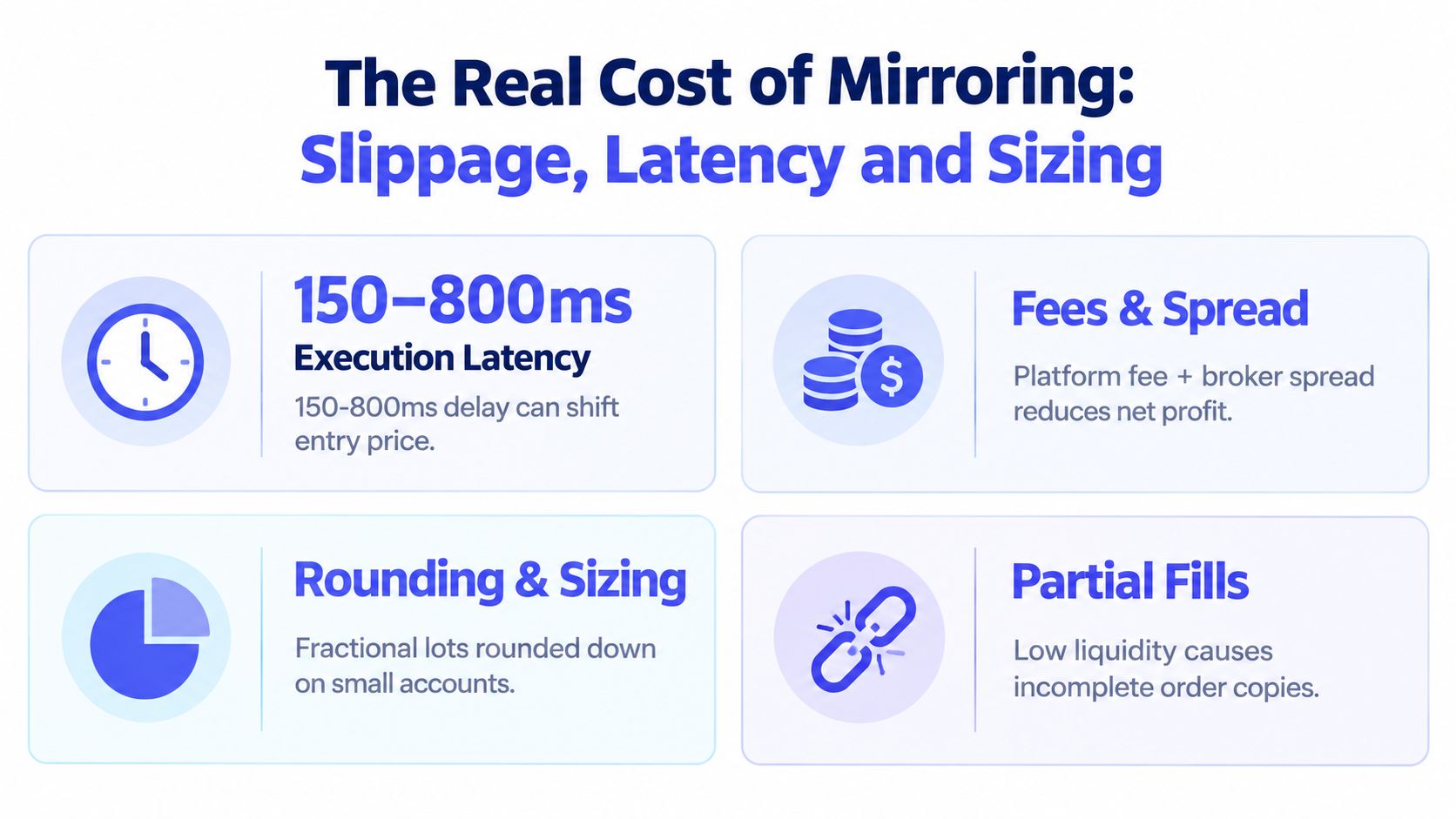
A copy system works like a relay race. The source trade happens first. Then the software detects it, processes the signal, sends the follower order, and waits for that order to fill. Each step adds time. In a fast market, a small delay is enough to produce a meaningfully different fill.
One industry benchmark describes a typical 150 to 300 millisecond end-to-end routing delay across signal generation, bridge routing, and follower execution, which is why even calm market setups can still show measurable slippage instead of identical fills (latency and slippage benchmark).
The practical question is simple. How many steps sit between the leader fill and your fill?
Slippage, sizing, and fills form a cost stack
Price drift is only one part of the problem. Mirrored execution can diverge in several ways at once:
- Slippage: Your order lands after the source and hits a worse price.
- Sizing rules: Fixed size, proportional size, and balance-based size all produce different exposure.
- Rounding: Small accounts often cannot match the source position exactly.
- Partial fills: Thin liquidity can leave you with less size or a different average entry.
- Fees and spread: Friction reduces net performance even if the trade direction was right.
Sizing is easy to underestimate. If a leader buys 2 percent of their account and your software rounds that up or down badly, you are no longer copying the same risk. You are copying the signal with altered position logic.
IOSCO notes that copy trading can produce high turnover, timing risk, and execution differences between leader results and follower results once pricing and copying costs are included (IOSCO discussion of copy trading risks and divergence).
Allowance risk belongs in the cost discussion
On-chain copy tools often need token approvals before they can mirror swaps. That is not a fee, but it is still part of the execution design.
A broad allowance lets the software act quickly because it does not need a fresh approval on every trade. The tradeoff is larger wallet exposure if permissions are too wide or hard to revoke. A narrow allowance reduces that exposure, but it can interrupt copying when limits run out. In practice, you are balancing speed, continuity, and permission risk.
That is why software evaluation should include more than fills. Check how approvals work, how easy they are to revoke, and whether allowance limits can be adjusted without breaking the strategy.
What to inspect before you trust the numbers
A usable audit trail should show enough detail to separate market risk from software drag.
| What to log | Why it matters |
|---|---|
| Source timestamp | Shows when the original trade filled |
| Follower timestamp | Shows delay added by the copy path |
| Source price and follower price | Shows actual slippage |
| Position sizing rule | Shows whether exposure matched the source logic |
| Fill status | Shows full fills, partial fills, or failed copies |
If the software cannot show those fields, you are judging the trader and the execution layer as one blended result. That hides the source of underperformance.
For a trader-focused comparison of execution features, this guide to the best copy trading bot for inspecting mirrored fills and control settings is a useful reference.
Security Checklist for Choosing Copy Trading Software
Speed matters. Security matters first.
A tool can look clean on the surface and still create avoidable risk if you don't check permissions, controls, and failure modes.
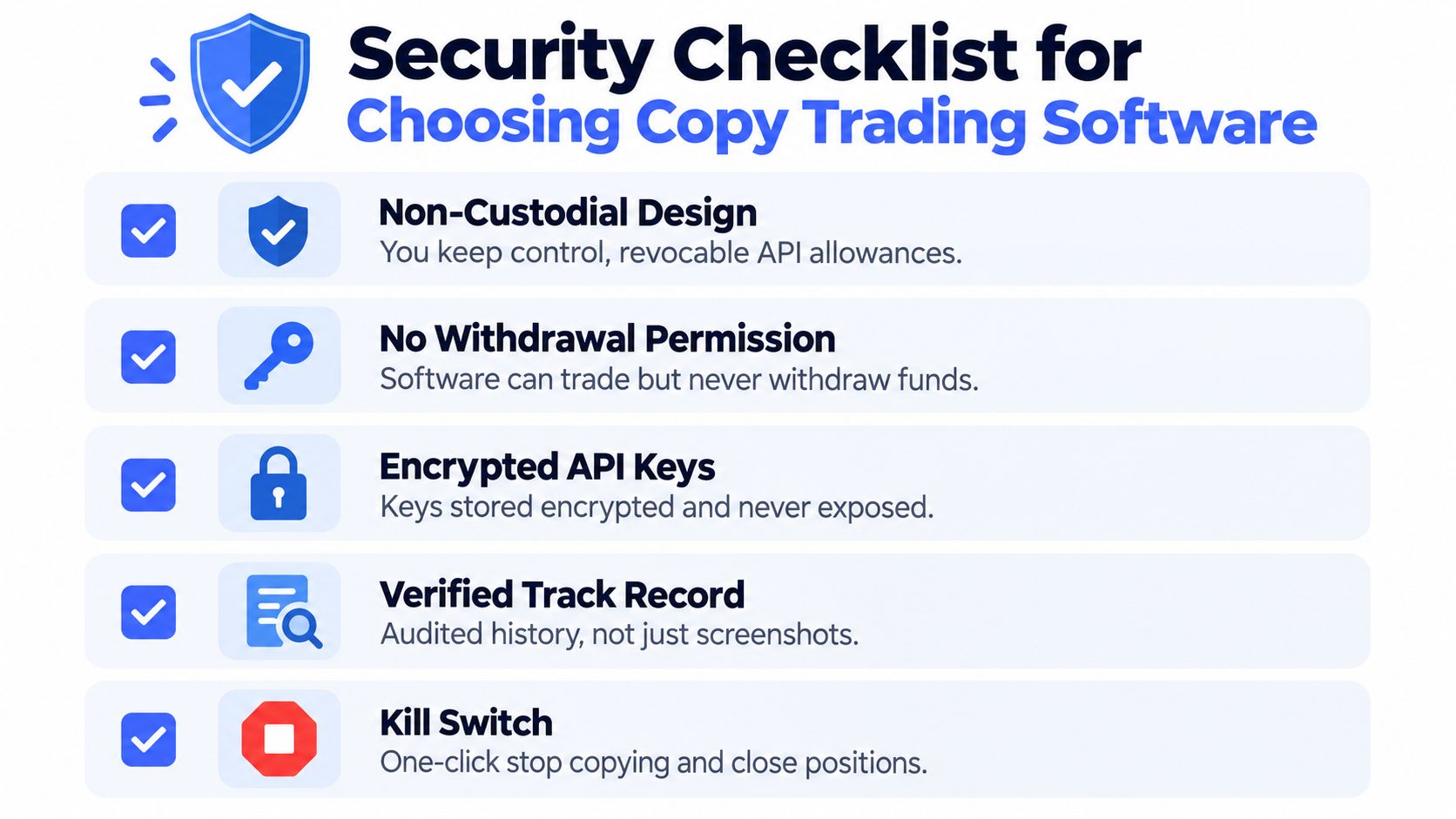
The pass or fail checks
Run through this before you fund anything:
Check custody
If the software asks you to send funds away, stop there. Copy trading doesn't need custody transfer to work.
Check revocation
If permissions are allowance-based, make sure you can revoke them directly. Don't assume disconnecting a site does the job.
Check operational controls
You want a pause function and a clear way to stop new copies. A one-tap close for open mirrored positions is even better.
Check transparency
The software should expose live activity, timestamps, and enough reporting to inspect copied execution.
Check documentation
Read the docs, review public metrics if they exist, and make sure the risk language is direct.
Operational risk is part of the deal
Copy trading and automated trading add risks that have nothing to do with market direction. Software defects, signal delays, execution differences, connectivity failures, and third-party outages all sit in the stack (operational risk overview from Stax Investing).
That's why glossy performance pages aren't enough.
Copy trading platforms often show track record, strategy, and risk metrics before you commit funds, but those disclosures don't remove the risk of loss or make future results predictable (Pepperstone guide on what copy trading shows users).
Good security checks don't tell you whether a trader will win. They tell you whether the tool can fail in a way you can still control.
A short due diligence routine
Before using any copy setup, pull these up and inspect them in order:
- Trader pages: Review the public trader records under the copyfomo traders directory.
- Public metrics: Check the copyfomo data page for operating context and published metrics.
- Documentation: Read the copyfomo blog for workflow details, controls, and limitations.
If any tool can't show you its control model, copy flow, and risk boundaries in plain language, skip it.
Final Takeaways and Next Steps With copyfomo
Copy trading software isn't just a leaderboard wrapped in automation. It's an execution system.
That changes how you should evaluate it. The first question isn't only “who should I follow.” It's also “what happens between their fill and mine.” That means checking latency, slippage visibility, sizing controls, exit mirroring, and whether permissions are revocable without giving up custody.
For fomo users, the practical problem is simple. Good traders move when you're offline. Manual copying breaks on time zones, sleep, and hesitation. Software can close that gap, but only if the hidden mechanics are clean.
A few decision rules are enough:
- Use verified trades, not screenshots
- Prefer non-custodial permission models
- Treat visible timestamps and slippage as required
- Make sure exits are mirrored, not just entries
- Read past PnL as context, not prediction
Past performance does not predict results. Copy trading carries risk. That stays true even when the tooling is solid.
If you want a practical walkthrough focused on the fomo workflow itself, read this guide on how to copy trade on fomo.
copyfomo gives fomo traders a Telegram bot for non-custodial trade mirroring with configurable sizing, exit replication, and transparent reporting on copied swaps. If you want to apply the checks in this guide to a live workflow, start the bot through copyfomo.
stop reading. start copying.
pick a trader from the fomo leaderboard, set your size, and the entries and the exits land in your own wallet while you sleep.
open copyfomo on telegram →