Crypto Auto Trading Explained and How to Use It Safely
learn how crypto auto trading works, from bots to copy trading, plus risks, security controls and how to automate safely.

You wake up, check fomo, and the move already happened. The trader you follow entered while you were asleep, scaled out before breakfast, and your alert was still sitting there unread. That's the appeal of crypto auto trading. It watches when you can't and acts when you're offline.
What it doesn't do is create edge by itself. It automates execution. Sometimes signal handling too. It doesn't remove market risk, and it doesn't turn a weak setup into a good one. In copy trading, that matters more than market participants often admit. You're not copying a result. You're copying a process that still has to survive latency, slippage, liquidity, and bad market conditions.
The market for this has grown fast. One recent report values the global crypto trading bot market at USD 4.02 billion in 2025 and projects USD 30 billion by 2035, implying 22.3% CAGR over the decade, while another estimate places the market at USD 47.43 billion in 2025, rising to USD 54.07 billion in 2026 and USD 200.1 billion by 2035 (Wise Guy Reports market estimates). The exact number matters less than the direction. Automated execution is no longer niche tooling.
That growth also creates confusion. People lump very different tools into one bucket and call them bots.
Table of Contents
- Introduction to Crypto Auto Trading Without the Hype
- How Automated Crypto Trading Actually Works
- Three Main Approaches to Automating Crypto Trades
- Hidden Costs and Automation Pitfalls That Eat Your Edge
- Security and Governance for Non Custodial Automation
- Real World Example of Mirroring Trades With copyfomo
- Final Takeaways and How to Start Copying Safely
Introduction to Crypto Auto Trading Without the Hype
You follow a trader who moves fast. They enter while you are at work, trim the position an hour later, and exit before you even open the app. Automation solves that timing problem. It does not solve the control problem.
That distinction matters early.
A part-time trader usually wants one of three things. They want their own rules executed automatically. They want software to react to a market trigger without a manual click. Or they want trades from another account mirrored into theirs. Those are related tools, but they fail in different ways and need different controls.
What automation actually does
At the simplest level, crypto auto trading is software that watches for a trigger and submits a trade. The trigger might be your rule, a model output, or another trader's buy or sell. The software handles repetition. You still set the boundaries.
Those boundaries are the story.
Automation without limits works like a standing instruction tied to a live account. If the signal is wrong, delayed, spoofed, or copied into a thin market, the software can keep doing the wrong thing faster than you would by hand. In that setup, speed becomes a cost amplifier.
So the useful question is not just, "Can this bot place trades?" It is, "What can it do, how much can it do, and how fast can I stop it?"
Good setups usually start with controls such as:
- Size caps: limits on trade size, daily exposure, or maximum open positions
- Revocable permissions: approvals you can reduce or remove without rebuilding everything
- Kill switches: a fast way to pause new trades when behavior looks off
- Verifiable execution: logs, timestamps, and fill records you can check later
Where beginners usually get tripped up
A common mistake is treating automation as strategy, execution, and risk management all at once. It is closer to an autopilot with guardrails than a machine that produces judgment.
If you write indicator rules, your problem is rule quality. If you copy another trader, your problem shifts to governance and execution quality. Can your account copy only approved assets? Is there a cap per trade? Can you revoke permissions quickly? Can you confirm that your fill was close enough to the source trade to make the copy worth doing?
Copy trading also carries plain old market risk. Past performance doesn't predict results. IOSCO warns that imitative trading practices can expose retail investors to significant losses, especially when borrowed funds and transaction costs are involved (IOSCO guidance on copy trading risk).
Use that frame when you evaluate any auto trading tool. Start with the controls. Then look at the bot features.
How Automated Crypto Trading Actually Works
Manual trading is the baseline. You watch a chart, wait for a trigger, choose size, click buy or sell, then manage the position. That process is slow, inconsistent, and hard to maintain around the clock.
Automation breaks that job into parts.
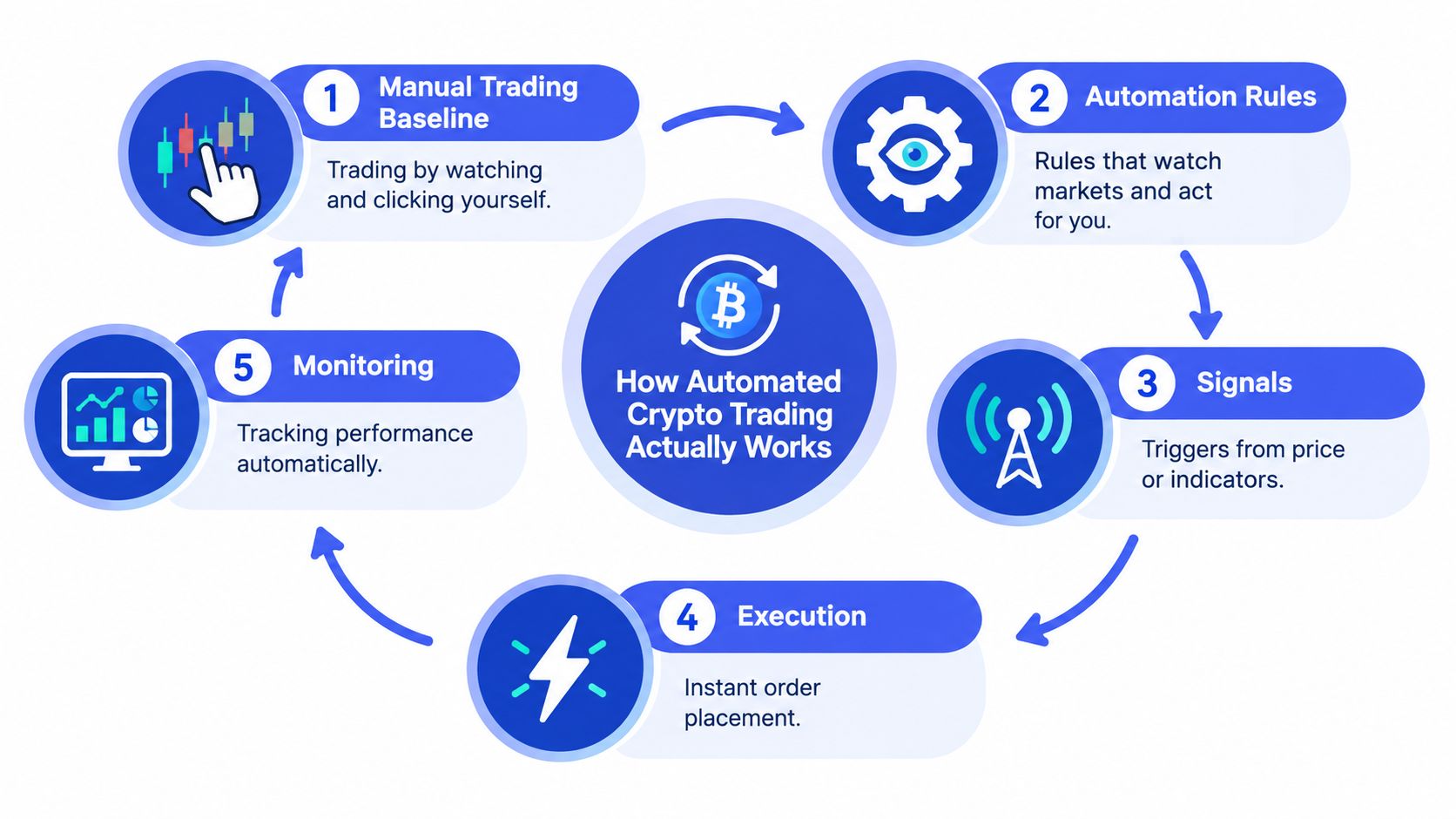
The four moving parts
Every auto trading setup has the same basic structure.
Signal
Something says “act now.” That might be a price level, an indicator crossover, a wallet trade, or a predefined event.
Condition
The system checks whether the trade is allowed. Size limits, token filters, time windows, or wallet permissions sit here.
Execution
The software submits the transaction. Routing, timing, and slippage start to matter.
Monitoring
The system records what happened. Good setups show fills, timestamps, trade status, and whether the copied action matched the original one closely enough.
Core idea: automation copies actions, not outcomes.
That distinction saves people a lot of pain. Two users can copy the same source trader and get different results if their sizes, timing, permissions, or fills differ.
A plain way to think about it
Think of manual trading like driving yourself. You steer, brake, and react in real time.
Rule-based automation is cruise control with lane assist. You define boundaries and let the system handle repetitive inputs.
Copy trading is different. It's closer to following another car through traffic. If they turn, you turn. If they exit, you exit. But if there's delay between their move and yours, you may hit a worse route.
A short explainer helps if you want a focused breakdown of the copy side of this stack: crypto copy trading bots explained.
Later in the workflow, visibility matters as much as execution. This walkthrough gives the high-level shape:
Why this category keeps expanding
The tooling has split into more specialized segments over time. One 2025 estimate values the AI crypto trading bot segment at USD 944 million and projects USD 5.52 billion by 2033 at 24.7% CAGR, while broader automated-trading research estimates the AI crypto trading bot market at about USD 1.8 billion in 2025 and USD 9.4 billion by 2034 at 20.1% CAGR (Verified Market Research segment estimates). That tells you the category now spans basic rule systems, AI-assisted signal tools, and copy workflows.
For a trader, the practical takeaway is simpler. Before using any automation, identify which part is being outsourced. Signal, execution, or both.
Three Main Approaches to Automating Crypto Trades
Not all automation asks the same thing from you. Some setups want coding skill. Some want clear rules. Some want a reliable way to mirror a trader you already watch on fomo.
A quick comparison
| Approach | Best For | Control Level | Key Risk |
|---|---|---|---|
| Algorithmic trading | Traders building their own logic and signals | High | Strategy failure and model drift |
| Rule-based bots | Traders who know their entry and exit rules | Medium to high | Bad rules executed consistently |
| Copy or mirror trading | Traders who want to follow another trader's filled actions | Medium | Fill mismatch, delay, and source dependence |
Algorithmic trading
This is the most custom path. You define the logic or model and let the system act on it.
The upside is control. You own the signal layer and the execution layer. The downside is that every mistake is also yours. A bad assumption doesn't get filtered out by experience. It just gets executed repeatedly.
This approach fits traders who can test, monitor, and revise systems over time.
Rule-based bots
These sit in the middle. You're not building a full model, but you are formalizing your process.
A rule might be simple. Buy only when a set condition is true. Sell when the move invalidates. Size every trade the same way. That reduces hesitation. It also reduces flexibility. If your rule is weak in a changing market, the bot won't save you from it.
A disciplined bad rule is still a bad rule.
Copy or mirror trading
This suits traders who already spend time on leaderboards, wallet activity, or public trade feeds. Instead of reading the action and placing each trade by hand, you mirror the source trader's filled entries and exits.
That “and exits” part matters. Many users think copy trading means entry alerts plus manual cleanup later. That isn't real mirroring. If the source sells and you don't, you're no longer following the same trade.
Who this suits:
- Time-constrained users: You want exposure to a trader's flow without watching every move live.
- Users of public rankings: You already use fomo and care about realized PnL based on filled trades, not marketing claims.
- Non-custodial users: You want automation without handing over wallet custody.
A broader look at trader selection issues is in top copy trading.
The main failure mode here isn't only “picked the wrong trader.” It's often more mechanical than that. Delay, liquidity gaps, and weak controls can turn a decent source into bad copied execution.
Hidden Costs and Automation Pitfalls That Eat Your Edge
A bot can follow your rules perfectly and still drain your edge.
That usually happens through small costs that look harmless one by one. A worse fill here. A delayed exit there. An approval that stays open longer than you expected. Automation turns those into a process. If the process is weak, repetition makes it expensive.
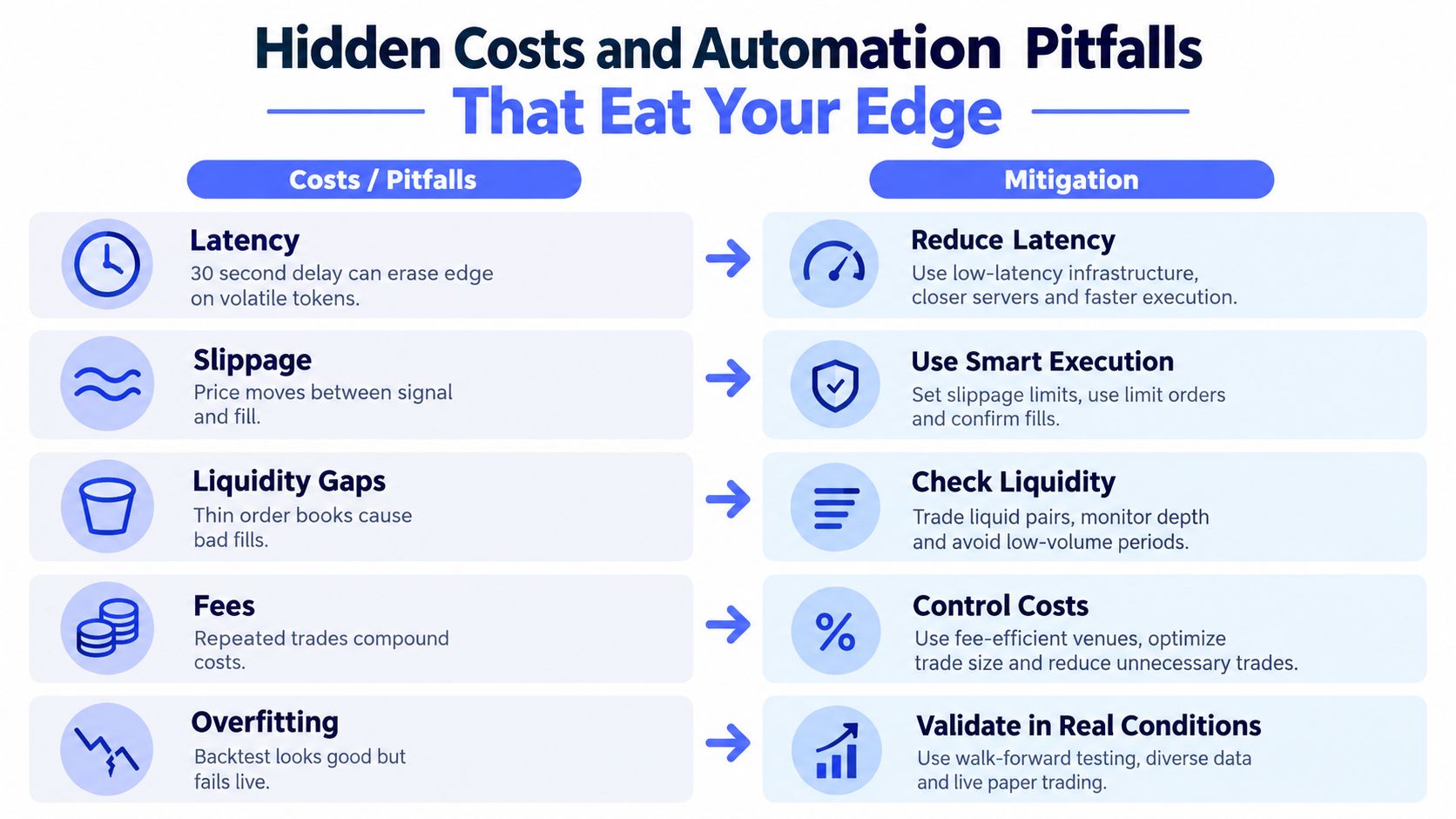
Latency changes the trade
In copy systems, time delay is not a side detail. It can change the trade itself.
If a source wallet buys before a breakout and your order lands after the move is already obvious, you did not copy the same opportunity. You copied the aftermath. Analysis of on-chain copy trading notes that even short delays can erase the edge in fast markets, which is why reaction speed and routing efficiency matter as much as signal quality (Tekedia analysis of on-chain copy trading latency).
This matters more in crypto than many beginners expect. Some setups work only because they are early. Arrive late, and the same trade can flip from favorable to poor.
Slippage and liquidity gaps
Price drift creates a second leak.
Copy trading guides from BitMEX note that followers often get different fill prices than the lead trader because of slippage, execution delay, and thin liquidity (BitMEX guide on copy trading execution risk). The software may have done its job. The market still gave you a different result.
A simple chain of events looks like this:
- The source trader buys a thin token.
- Their order moves the price.
- Your mirrored order arrives after that move.
- You enter at a worse level.
- The same gap can happen again when the source exits.
Direction matched. Outcome did not.
Fees, churn, and the cost amplifier effect
Automation also removes the pause that sometimes saves manual traders from overtrading.
A strategy with frequent entries and exits can look active and precise, yet fees and spread costs keep shaving the result. That is easy to miss when you review trades one by one. It becomes obvious only when you look at the full stream. Ten small frictions across ten trades are still ten frictions.
This is the point many bot dashboards blur. They show speed, alerts, and copied wins. They spend less time on how often the system trades, how much size it pushes into weak liquidity, and whether the edge survives after costs.
Outages break more than entries
A broken mirror is often an exit problem first.
If the platform, node, RPC, or exchange connection fails at the wrong moment, the system may miss a sell, size the trade incorrectly, or leave the position open after the source has already closed. Overviews of copy trading risk point out that outages and execution failures can leave followers exposed in ways the lead trader is not (CryptoSlate overview of copy trading risks).
That mismatch is easy to underestimate. Missing an entry is annoying. Missing an exit can rewrite the whole trade.
MEV exposure starts with your settings
On decentralized exchanges, slippage tolerance is not just a convenience setting. It is part of your security model.
Public mempools let other actors inspect pending swaps. If your order is large enough and your slippage range is loose enough, a sandwich attacker can step in, move price before your fill, then close after you trade. Guidance on sandwich attacks explains how visible orders and permissive settings create that opening (MEV sandwich guide).
A bot that executes fast but accepts wide slippage can become a better target, not a better trader.
The control problem behind the trading problem
The sales pitch usually breaks down here. A copied system can still degrade when conditions change, and weak controls make that degradation expensive.
Watch for a few patterns:
- Crowded flow: Many followers pile into the same thin trade and worsen each other's fills.
- High churn: Fees, slippage, and spread costs stack up across constant entries and exits.
- Loose permissions: Broad token allowances let the automation keep acting long after you would have stopped it manually.
- No hard caps: Position size, daily loss, or per-trade spend limits are missing, so one bad loop can repeat.
- Weak verification: You can see that an order fired, but not whether it matched the intended route, size, and exit logic.
- Regime change: The source trader's edge depended on a market condition that no longer exists.
Automation works like a standing instruction at a bank. Useful when the instruction is right. Costly when it keeps firing after the reason is gone.
That is why governance belongs in the discussion before features. Speed helps. Control decides whether speed protects you or multiplies your mistakes.
Security and Governance for Non Custodial Automation
Once a trading system can act from your wallet without asking you every time, the question changes. It's no longer “can it trade.” It's “what stops it from doing the wrong thing repeatedly.”
That's where governance matters.
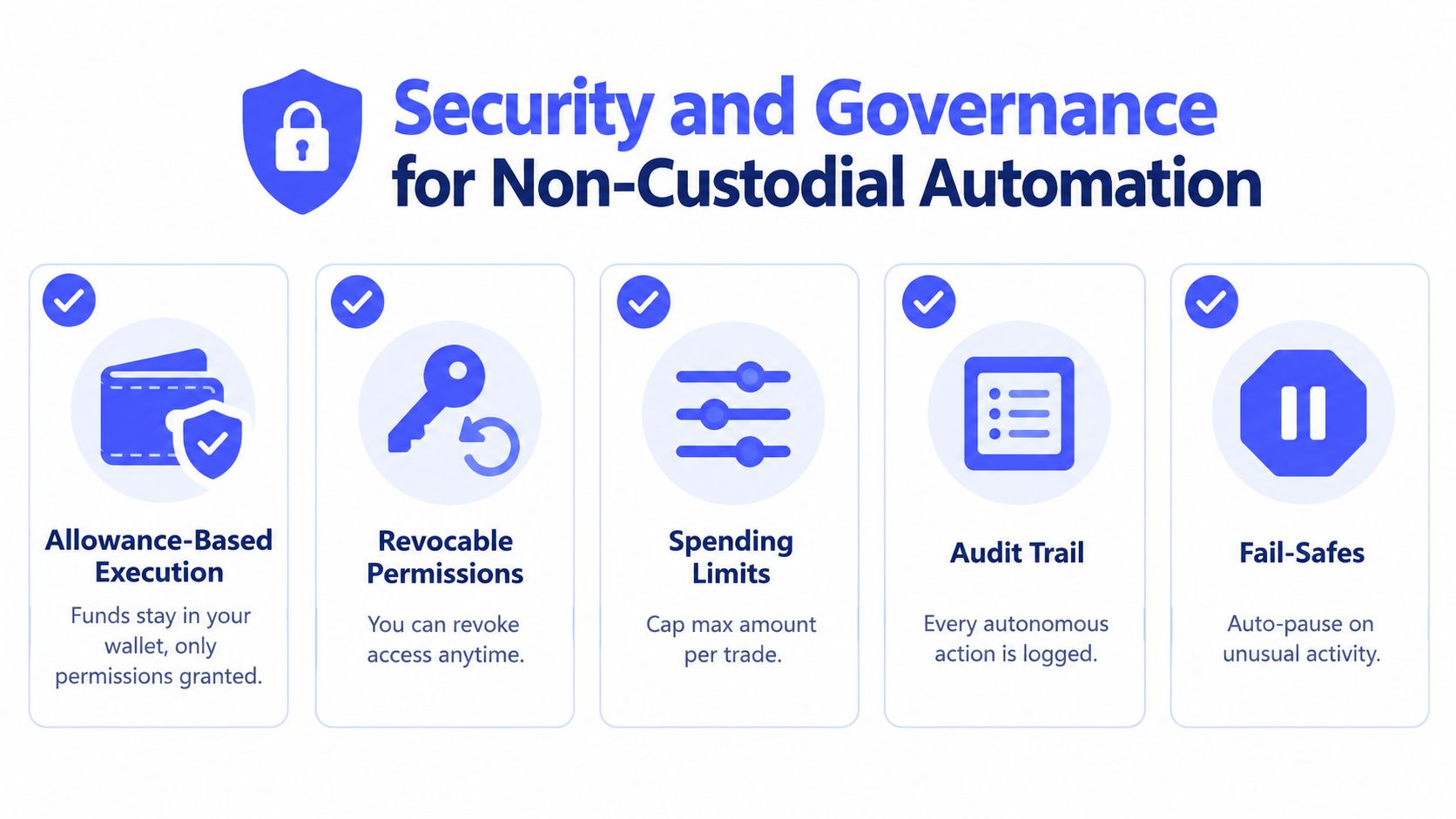
The control layer most users ignore
Recent coverage of autonomous trading systems points to a different set of failure modes once software can hold funds or trigger transactions on its own. The main risks shift toward prompt injection, policy misconfiguration, compromised keys, and memory or context poisoning, and ESMA's 2026 risk monitor notes that AI-generated signals, algorithmic strategies, and automated bots can exacerbate information asymmetries in markets (KuCoin discussion of autonomous trading agent risks).
You don't need an AI agent to care about that list. Plain automation has the same governance problem in smaller form. A wallet-connected system with broad permissions can keep making bad on-chain decisions until you stop it.
Practical controls that matter
For non-custodial automation, a usable checklist looks like this:
- Revocable allowances: The system should work through permissions you can revoke. Funds stay in your wallet.
- Per-trade caps: Set a hard ceiling so one bad mirrored action can't size far beyond your intent.
- Fixed or proportional sizing: Decide whether each trade uses a fixed ticket or scales relative to the source.
- Pause for new copies: You should be able to stop fresh entries without scrambling through every setting.
- One-tap closure: If you need out, closing mirrored positions should be simple and immediate.
- Visible audit trail: You need timestamps, trade records, and displayed slippage so you can verify what happened.
Verifiable execution beats black boxes
A good automation setup should let you answer plain questions.
Did it buy when the source bought. Did it sell when the source sold. How far apart were the timestamps. What slippage was shown. Were the copied sizes within the limits you set.
If you can't verify an autonomous action after it happens, you can't govern it before the next one.
That matters because on-chain mistakes are often irreversible. A trader can recover from a bad idea. It's harder to recover from a bad permission model.
Real World Example of Mirroring Trades With copyfomo
A practical case helps more than theory. Say you already use fomo, you have a short list of traders you watch, and you're tired of catching entries late or forgetting to exit when they sell.
In that setup, copyfomo is a Telegram bot that mirrors the filled entries and exits of traders on the fomo app into your own wallet at a size you configure. It's non-custodial. Funds stay under your control through a revocable allowance.

How the flow looks in practice
You start with trader selection. The source can come from the public fomo leaderboard, where traders are ranked by realized PnL on filled trades, or from wallet discovery tied to a handle or profile screenshot for traders outside the top segment.
Then you choose sizing.
Some users want a fixed ticket per copied trade. Others want proportional sizing relative to the source. Caps matter here. If the source takes a larger swing than you're comfortable with, a hard cap keeps your copied trade inside your own limits.
What the user gets
The main user-facing points are operational, not magical.
- Speed: Mirrored on-chain swaps execute about a second behind the source trade.
- Exit replication: Both buys and sells are mirrored, not just entries.
- Transparency: A live feed shows copied swaps with timestamps and displayed slippage.
- Control: You can pause new copies and close mirrored positions if needed.
A walkthrough of the setup flow is in how to copy trade on fomo.
For verification, the useful habit is simple. Check trader pages and public data instead of relying on claims. The trader pages show who is being tracked, and the public data section gives additional transparency around the service.
One point to keep clear. The service uses public on-chain data and the fomo leaderboard. It isn't affiliated with the listed traders. That separation matters because copying a trader is not the same as receiving a managed account or an endorsement.
Final Takeaways and How to Start Copying Safely
The lazy story about crypto auto trading is that it replaces work with passive income. That story falls apart fast in live markets.
A 2026 academic preprint reviewing automated investing found that anomaly decay, multiple-testing risk, timestamp corrections, and cost and capacity sensitivity often erase apparent backtest profits, and it concluded that current evidence doesn't establish a general AI architecture that produces persistent, cross-regime, capacity-aware net alpha (academic review on limits of automated investing). That lines up with what traders already see in practice. Frequent trading, shifting liquidity, and crowded setups can turn automation into a fee and slippage amplifier.
A safer way to think about it is narrow and operational.
A short checklist before you automate
- Set size first: Decide what one copied trade is allowed to risk.
- Use caps: Hard limits matter more than optimism.
- Keep a kill switch ready: You should be able to pause new trades immediately.
- Verify fills, not stories: Timestamps and slippage tell you more than screenshots.
- Remember the baseline risk: Copy trading carries risk, and past performance doesn't predict results.
If a setup can't show you what it did, when it did it, and under what limits, it's not mature enough for unattended use.
If you already trade around the fomo leaderboard, copyfomo gives you a Telegram bot for non-custodial trade mirroring with configurable sizing, caps, exit copying, and revocable permissions. That's the part of crypto auto trading that matters in practice. Faster execution, visible records, and controls you can shut off when needed.
stop reading. start copying.
pick a trader from the fomo leaderboard, set your size, and the entries and the exits land in your own wallet while you sleep.
open copyfomo on telegram →