7 Top Copy Trading Options Compared in 2026
compare 7 top copy trading options, from non-custodial copyfomo to exchange platforms, with feature differences, risks, and practical selection criteria.

The usual advice on top copy trading is too simple. Traders ask which platform is best, then skip the setup decisions that decide how the product behaves once live. That misses the core issue.
Copy trading is a structure choice. You need to know where funds sit, which markets are available, how entries and exits get mirrored, how sizing is set, what fees or profit sharing apply, and how much control you keep after turning automation on. Those questions matter more than leaderboard screenshots.
That matters even more now because copy trading has moved into the retail mainstream. A GraniteShares-reported 2024 survey found that 16% of retail investors use copy trading, and many users were relatively new to it rather than long-term veterans (copy-trading market survey summary). Growth projections point the same way. Industry research cited in 2025 and 2026 projected multi-year expansion across copy-trading platforms and the broader market, which tells you this isn't a side feature anymore (copy-trading market growth projections).
None of that makes it safe. IOSCO's 2025 review says copy trading can expose users to timing and pricing risk, turnover-driven fee drag, and crowding when many followers mirror the same trader at once (IOSCO copy trading risk review). Copy trading carries risk, and past performance does not predict results.
These seven options suit different operating models. copyfomo stands out for crypto traders who already use or know fomo. Exchange-native services fit a different model, usually with custodial balances, regional rules, and profit-share mechanics.
Table of Contents
- 1. copyfomo
- 2. eToro CopyTrader
- 3. Binance Spot Copy Trading
- 4. OKX Copy Trading
- 5. Bitget One-Click Copy Trade
- 6. Bybit Copy Trading
- 7. BingX Copy Trading
- Top 7 Copy-Trading Platforms Comparison
- Choose the Operating Model You Can Control
1. copyfomo
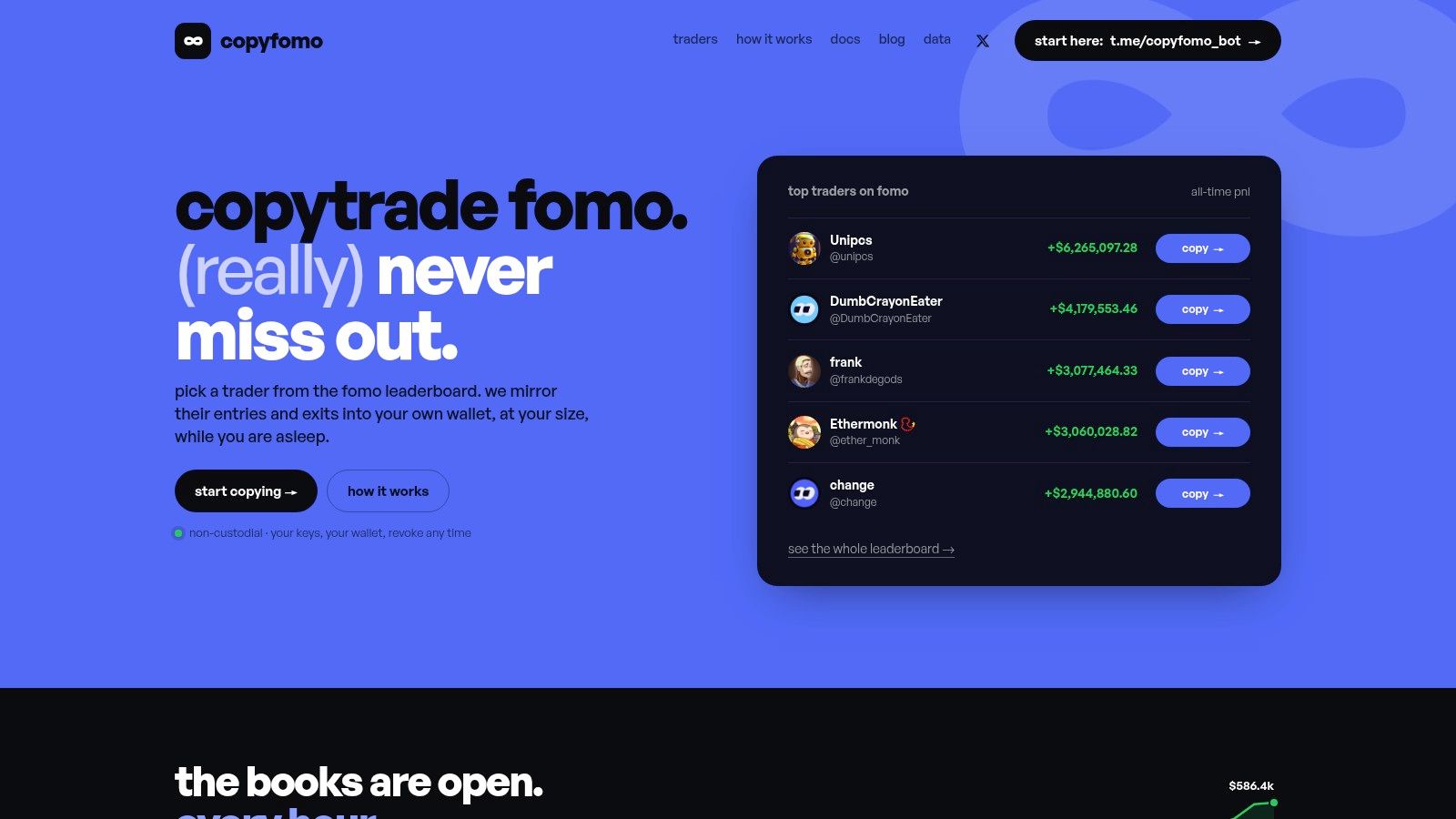
Leaderboards get too much attention. The harder question is operating model. copyfomo matters here because it approaches copy trading as non-custodial execution automation for fomo traders, not as a broker account with a social layer.
The distinction is practical. copyfomo runs through Telegram and mirrors filled buys and sells from tracked fomo traders into your own wallet at user-defined size. That puts it in a different bucket from exchange-native copy products covered later. Market access is on-chain token swaps. Custody stays with the user. Discovery starts from public fomo traders rather than an internal investor directory.
Custody and control
copyfomo uses an allowance-based setup instead of requiring a balance transfer to a centralized account. Your assets remain in your wallet, and permissions can be revoked. That improves custody control, but it does not reduce trading loss. The copied sleeve can still draw down, and the user still carries wallet security and permission-review work (allowance-based copy trading risk discussion).
That separation matters. Platform design and market risk are different problems.
Practical rule: Non-custodial copy trading changes who holds the assets. It does not change entry quality, exit quality, or position risk.
Replication model and sizing
The stronger point in copyfomo's setup is that it mirrors exits as well as entries. Many retail copy flows solve trader discovery and buy replication, then leave the follower to manage the unwind manually. That creates a gap between signal following and actual trade completion. copyfomo closes more of that gap by copying the sell side too.
Sizing controls also matter more than trader leaderboards suggest. Users can set fixed ticket sizes or proportional sizing, and can cap trade size. That is a cleaner fit for followers who want exposure to a trader's actions without inheriting the trader's full notional or wallet concentration.
The operating details are visible enough to audit day to day:
- Filled-trade replication: The bot mirrors executed buys and sells rather than posting watchlist-style alerts.
- User-defined sizing: Followers can use fixed or proportional copy logic instead of matching source size one-for-one.
- Execution visibility: Mirrored swaps are shown with timestamps and displayed slippage.
- Trader lookup: Users can start from the public fomo leaderboard or identify traders by handle or screenshots inside the bot.
Execution and trade-offs
copyfomo improves the manual fomo workflow because it automates both monitoring and order submission. It does not remove on-chain execution frictions. Follower orders still depend on transaction detection, processing, and a new on-chain submission, so replication usually arrives later than the lead trade and remains exposed to slippage and fast price movement (on-chain copy trading execution guide).
That makes copyfomo more useful for users who want process control than for users expecting exact path matching. The product gives a clear combination of features: self-custody, entry and exit replication, adjustable sizing, and an execution trail inside Telegram. Start with the copyfomo website.
2. eToro CopyTrader

eToro is the old guard version of top copy trading. The product is built around copying named investors inside a mature social investing interface, not around chasing wallets on-chain. That changes who it's for.
If you want a broad public social layer with portfolio-style copying across supported assets, eToro is a clean fit. If you want non-custodial wallet control or direct on-chain token rotation, it isn't.
Best fit and operating model
eToro's CopyTrader mirrors a chosen investor proportionally in real time, and the platform says it doesn't charge an extra CopyTrader management fee on top of its standard trading fees and spreads. The platform also states a minimum copy amount of $200 per trader (eToro CopyTrader).
That minimum matters more than it sounds. Small allocations can miss tiny positions or create imperfect replication when a copied portfolio holds many fractional pieces. That's normal for portfolio-copy products.
A useful contrast with crypto-native tooling is that eToro is less about raw speed and more about packaging discovery, social proof, and easy account-level allocation. If you're comparing platform design, the trade-off is straightforward. Better investor discovery. Less direct control over custody and execution path.
For a broader view of software design differences, see this breakdown of copy trading software.
eToro suits traders who want a managed social-investing interface. It suits DeFi-native users less well because the account model is the product.
Where it falls short
Asset availability varies by region. So does copyability. That's not unusual for regulated platforms, but it matters because many traders assume the same profile can be copied globally in the same way.
The other limit is market shape. eToro is better for account-level copying than for fast token rotation. If your benchmark for top copy trading is a live on-chain trader entering and exiting volatile names quickly, this is a different category.
3. Binance Spot Copy Trading
Binance takes the exchange-native route. Funds sit inside the exchange account, lead traders publish copyable activity, and followers choose how they want replication to happen. The attraction is scale, market access, and integrated liquidity.
That model works best if you already keep balances on a large exchange and want spot copy trading without adding another venue. It works less well if your priority is keeping funds in a self-custodied wallet.
Structure first, not leaderboard first
Binance offers Spot Copy Trading separately from its futures copy products. The practical comparison point is mode selection. Users can choose Fixed Amount or Fixed Ratio copy logic, which is a real operational decision, not a cosmetic setting. Fixed Amount controls ticket size tightly. Fixed Ratio tracks the lead trader more closely.
The exchange-native format also changes how compensation works. Built-in profit sharing compensates lead traders, which can help attract active signal providers, but it also means your net outcome is reduced relative to doing the same trades yourself.
- Market access: Broad spot-pair access inside a major exchange ecosystem.
- Sizing choice: Fixed Amount and Fixed Ratio support different risk budgets.
- Lead-trader incentives: Built-in profit sharing is part of the product, not an optional side arrangement.
- Platform dependency: Regional access and eligibility can limit whether the feature is available at all.
If you want a stricter comparison of bot workflows versus exchange-native copying, this piece on the best copy trading bot is useful.
Main trade-off
Binance is convenient because discovery, balances, and order flow live in one venue. The cost is reduced operational independence. You're using the exchange's rules, eligibility screens, and fee logic.
For many traders, that's a fair trade. For others, it's the exact reason to stay with a non-custodial workflow.
Use the Binance platform if that account-based model matches how you already trade.
4. OKX Copy Trading
OKX is the documentation-heavy option. That's a compliment. Most copy trading products bury the important details under lead-trader marketing. OKX tends to publish structure clearly, including product types, trader tiers, and profit-share rules.
That matters if you care more about operating terms than about social buzz.
Product range and transparency
OKX supports copy trading across spot, futures, and strategy bots through one exchange framework. That's broader product coverage than many retail users need, but it's useful for traders who want one venue for different risk types.
The platform also separates public and private copy modes and documents trader-tier structures. That's a practical advantage because it tells you what kind of market you're entering. Some copy systems look simple until settlement terms or leader restrictions start affecting live behavior.
Operating insight: Copy products with clearer docs are usually easier to size correctly. Hidden rules are often a bigger problem than visible fees.
The actual compromise
The compromise is the same one you see on most centralized exchange copy systems. Profit sharing reduces the copier's share of gains, and regional availability narrows who can use what. The upside is standardized infrastructure and published rules.
If you're comparing top copy trading options by operating discipline instead of by marketing, OKX ranks well on clarity. It isn't the most flexible custody model, but it is one of the easier products to understand before you fund it.
See the OKX copy trading pages for the current product terms.
5. Bitget One-Click Copy Trade
Bitget leans harder into catalog depth. The pitch is simple. A broad menu of traders, futures-heavy copy options, and a separate bot-copy marketplace for users who want a more hands-off route.
That makes Bitget relevant if your definition of top copy trading includes both human leads and packaged automated strategies. It also means you need to read the fine print carefully, because more product types usually mean more failure modes.
Where Bitget differs
Bitget offers copy trading for both futures and spot, plus Bot Copy Trading. That's a meaningful distinction from platforms that only mirror discretionary traders. Some users want a person to follow. Others want a structured system feed. Bitget tries to host both.
Its support material also tends to explain copy failures, mode differences, and futures logic in practical terms. That's useful because futures copying has more ways to diverge from the lead account than spot copying does.
- Broader catalog: Human trader copying and bot-copy products sit side by side.
- Futures emphasis: Stronger fit for users comfortable with derivatives workflows.
- Signal-provider incentives: Elite trader programs can expand the lead-trader pool.
- Net-result drag: Profit share and standard trading or funding costs still sit on top of the copied strategy.
The risk profile
This isn't a beginner-safe shortcut. Futures-focused copy trading raises the complexity. Sizing mistakes, liquidation mechanics, and mode selection can all create very different outcomes from what the lead trader sees.
Copy trading risk isn't just market direction. It also includes sizing risk, execution risk from bot latency and slippage, and custody risk if a wallet or keys are compromised (copy trading risk overview). That framing applies here more than most.
Use the Bitget copy trading platform if you want that deeper menu and you understand the product mix.
6. Bybit Copy Trading
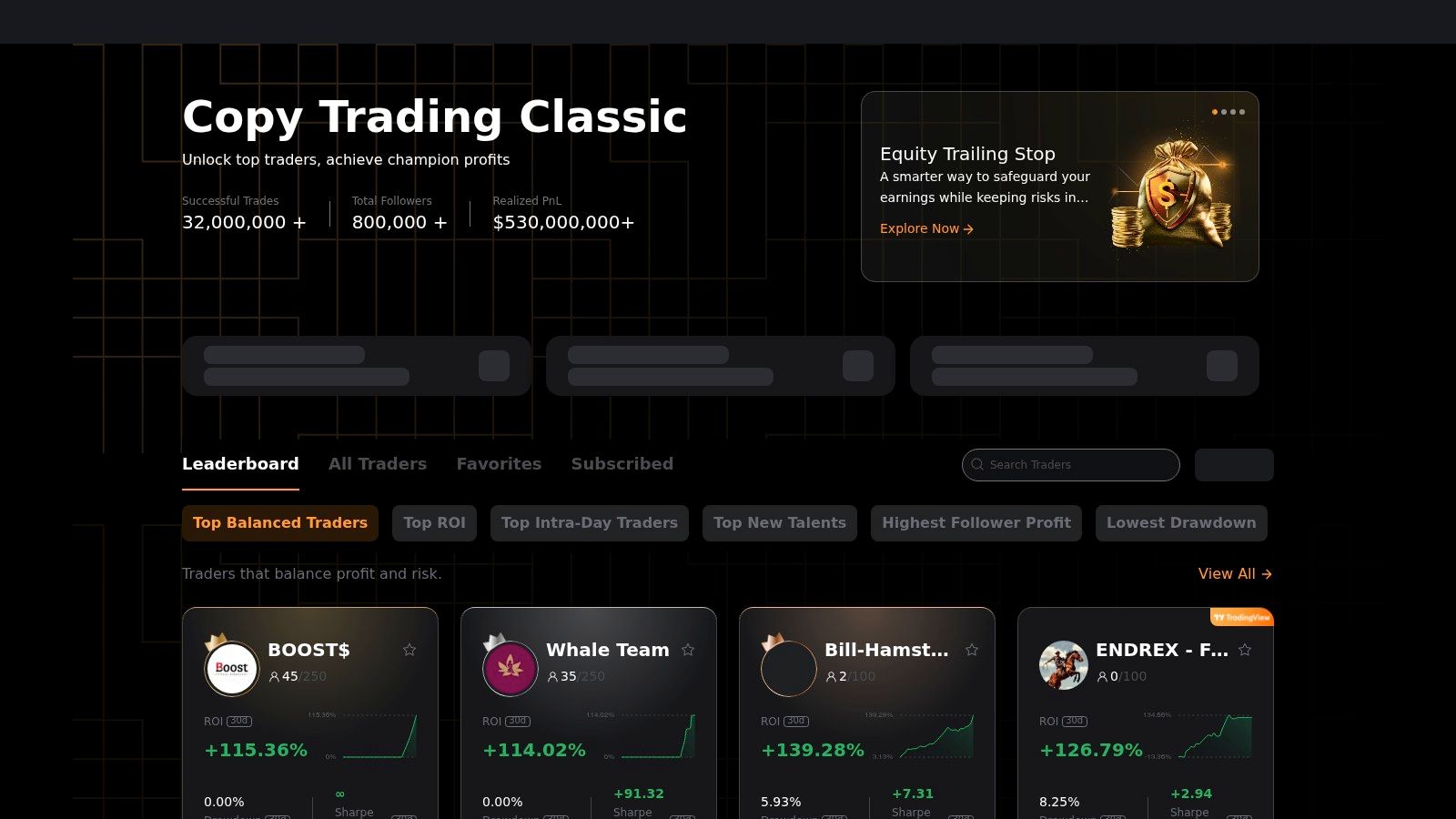
Bybit's main advantage is separation. It doesn't force one copy format onto every user. It splits the product into Classic and Pro, which is a cleaner design than most rivals.
Classic is for following individual master traders on USDT perpetuals. Pro is closer to managed strategy allocation with NAV-style accounting and high-water-mark profit sharing. Those are different behaviors, so putting them in separate lanes helps.
Why the split matters
Many copy platforms mix direct trader following and managed strategy structures under one label. That confuses users because the settlement logic, risk controls, and expectations aren't the same. Bybit is more explicit.
It also offers fixed or proportional copy modes and documents its settlement and profit-share mechanics in more detail than some competitors. That won't remove risk, but it does reduce ambiguity.
If you're trying to understand the difference between derivative copy products and on-chain automation, this guide to crypto copy trading bots is a useful companion.
Best use case
Bybit makes the most sense for traders who are already comfortable with derivatives and want clearer product segmentation. It makes less sense for someone who just wants wallet-level, non-custodial copying of token buys and sells.
The futures-only orientation of Classic also matters. It can be too aggressive for users who are new to copy trading and assume copying a person removes the need to understand the instrument.
Start with the Bybit copy trading portal.
7. BingX Copy Trading
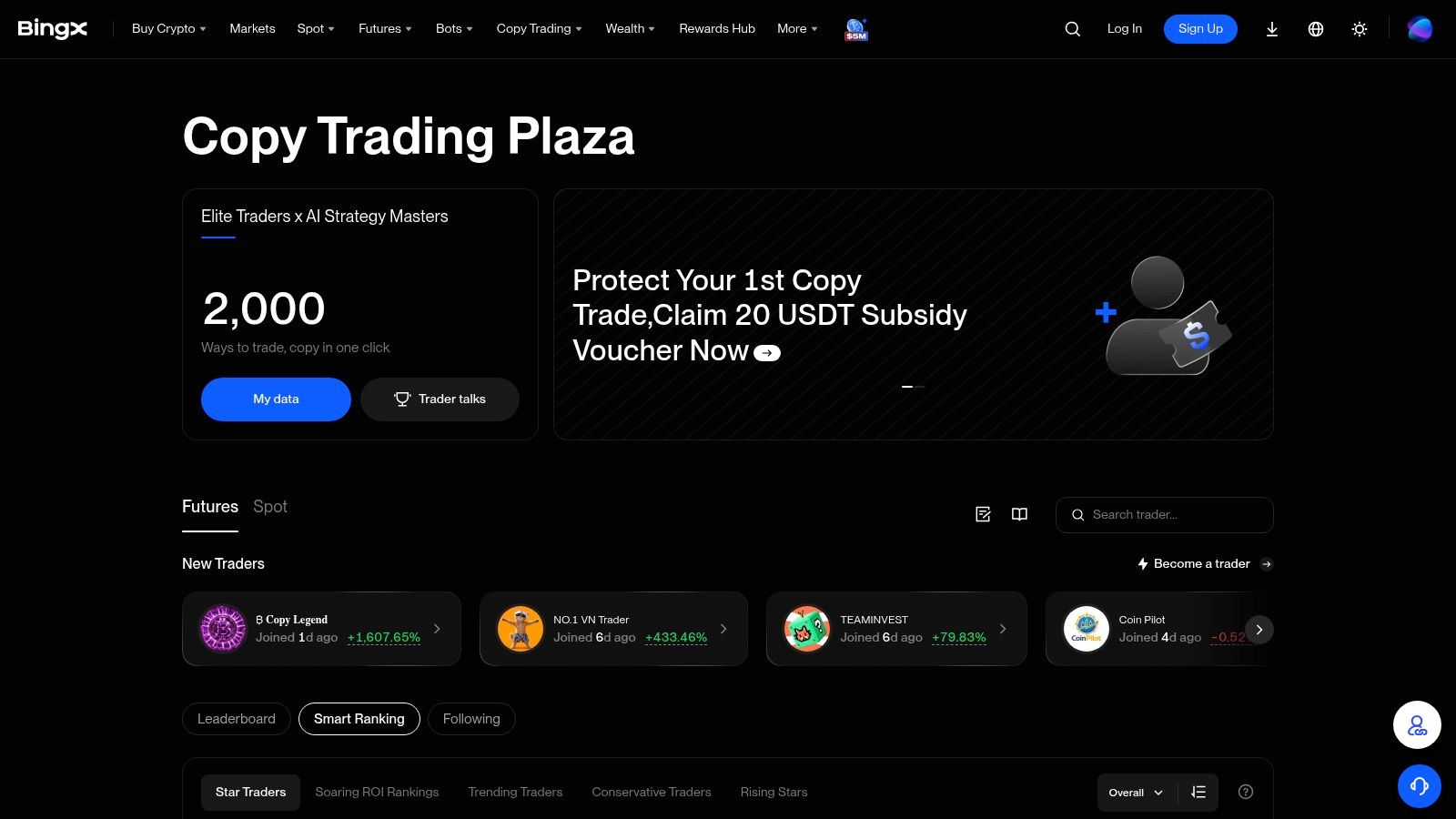
BingX is one of the better examples of copy trading at scale. A widely cited platform-level benchmark reported that BingX reached 40 million users by the end of 2025, with more than 335,000 lead traders, 2 million copiers worldwide, and $580 billion in cumulative copy-trading volume (BingX adoption benchmark). You shouldn't treat that as a quality guarantee. You should treat it as evidence that copy trading is already deep enough to support large participation networks.
That scale matters for one reason. Bigger lead-trader pools usually mean more strategy variety. They can also mean more crowding.
What BingX offers
BingX supports both spot and futures copy trading with fixed and proportional modes. It also runs formal lead-trader programs with tiering and documented copier rules. Compared with smaller venues, that gives users more structure up front.
The weekly profit-share settlement model is standard for this category. So are regional limitations. The more important point is that BingX publishes detailed manuals around parameters, margin rules, and settlement scope, which helps reduce surprises.
Large copy networks solve discovery better than they solve execution. A crowded trade can still give the copier a worse fill than the lead.
The real comparison point
BingX is strongest when you want exchange-native breadth and formal trader programs. It is weakest if you care most about self-custody or if you want direct replication of public on-chain token activity.
That distinction is the pattern across this whole list. The top copy trading product depends less on who has the loudest leaderboard and more on whether you want wallet control, exchange balance convenience, or derivatives-heavy product range.
Use the BingX copy trading platform.
Top 7 Copy-Trading Platforms Comparison
| Item | Implementation Complexity | Resource Requirements | Expected Outcomes | Ideal Use Cases | Key Advantages |
|---|---|---|---|---|---|
| copyfomo | Moderate, Telegram bot + wallet approvals; non‑custodial on‑chain mirroring | Low capital flexible sizing; on‑chain gas fees across chains; wallet + revocable allowances | , near‑real‑time mirroring (~1s) but results vary with slippage and leader quality | Retail DeFi users, time‑constrained traders, newcomers wanting non‑custodial exposure | Non‑custodial control, flexible sizing, public dataroom/leaderboard transparency |
| eToro, CopyTrader | Low, platform‑managed, UX-centric setup | Minimum $200 per copied trader; standard trading fees/spreads | , proportional real‑time mirroring for supported asset classes | Investors wanting mature discovery tools for stocks/ETFs/crypto | Mature UX, investor discovery, no extra CopyTrader fee |
| Binance, Spot Copy Trading | Moderate, exchange account + KYC; choose copy modes | Exchange account, capital per pair, profit‑share to lead traders | , deep liquidity and many signal providers; performance depends on leads | Users seeking wide spot pair selection and integrated exchange liquidity | Large pool of pairs/providers, structured profit‑share mechanics |
| OKX, Copy Trading | Moderate, account/KYC; supports multiple product types | Account + capital; spot, futures, bots available; known profit‑share rates | , multi‑product copying with transparent rules; outcomes depend on strategy | Users wanting spot, futures, and bot strategies with clear docs | Clear documentation, multiple product types, transparent profit‑share |
| Bitget, One-Click Copy Trade | Moderate, exchange onboarding; bot marketplace integration | Account, profit‑share fees (often higher), funding fees for futures | , strong futures catalog and bot options; net returns reduced by fees | Followers of futures strategies and bot‑based automation seekers | Bot copy marketplace, active incentives for elite traders |
| Bybit, Copy Trading (Classic & Pro) | Moderate‑High, derivatives focus; Classic vs Pro setup | Derivatives margin requirements, KYC restrictions in many regions | , clear NAV and high‑water‑mark maths for Pro; strong derivatives outcomes for matched risk | Derivatives traders preferring structured copy tracks and transparent settlement | Transparent profit‑share math, two tracks (Classic/Pro) to match sophistication |
| BingX, Copy Trading | Moderate, account/KYC; tiered lead‑trader programs | Account, capital, weekly profit shares; leverage rules vary by tier | , supports both spot and futures with formal trader tiers | Users wanting both spot and futures copying with step‑by‑step guides | Detailed manuals, tiered programs and granular copier/trader parameters |
Choose the Operating Model You Can Control
The cleanest way to choose among these top copy trading options is to ignore performance marketing and map the setup to your actual workflow.
Start with market access. If you want on-chain token swaps tied to traders you already watch on fomo, copyfomo is the natural fit. If you want stocks, ETFs, and supported crypto inside a social-investing app, eToro is closer. If you want exchange-native spot or futures copying with integrated account balances, Binance, OKX, Bitget, Bybit, and BingX fit that model better.
Then check custody. This is the first filter, not the last. Some traders are comfortable keeping balances on centralized exchanges because it simplifies execution and product access. Others want funds to stay in their own wallet. For fomo users comparing non-custodial workflows, copyfomo keeps funds in the user's wallet through revocable allowances, mirrors filled buys and sells, supports fixed or proportional sizing with caps, and provides a live feed with timestamps and displayed slippage.
Execution handling is the next filter. Entry-only copying creates cleanup work. Entry-and-exit replication is much closer to true automation. That's one reason copyfomo is especially relevant to traders who don't want to monitor a leaderboard all day. But even then, execution risk stays real. One guide on on-chain copying says a 30-second delay can erase the edge on volatile tokens (on-chain delay discussion). The exact number isn't the point for every setup. The point is that lag changes outcomes.
Fees need the same treatment. Some platforms rely on standard trading spreads or fees. Others layer profit sharing on top. Don't flatten those models into one mental bucket. A no-deposit, non-custodial workflow and an exchange copy product with profit share are not the same tool, even if both use the phrase copy trading.
Last, check regional eligibility and operational controls. Can you pause copying. Can you cap trade size. Can you review permissions. Can you stop new entries without closing everything. Those controls matter more in live conditions than any ranking page.
Don't treat leaderboard results as forecasts. Review wallet permissions. Test settings carefully with size you can afford to lose. If you want a non-custodial fomo-focused workflow, start the bot on Telegram through copyfomo.
If you already trade around the fomo leaderboard, copyfomo is built for that exact workflow. It mirrors filled buys and sells into your own wallet with user-set sizing, revocable allowances, and a live execution feed inside Telegram. Start with copyfomo and check whether its non-custodial model fits how you want to run copy trading.
stop reading. start copying.
pick a trader from the fomo leaderboard, set your size, and the entries and the exits land in your own wallet while you sleep.
open copyfomo on telegram →