Copy Trading App: A Clear Guide to Automated Copying
understand how a copy trading app works, from allowances vs custodial models to selecting a reliable bot like copyfomo.

You're staring at the leaderboard again. A trader you follow is moving fast, the chart is already running, and you're not sure you'll catch the next entry before it's gone. That's the point where a copy trading app stops being a theory and starts being a workaround for real life, sleep, work, and the gap between watching and acting.
The appeal is simple. A trader you trust opens or closes a position, and your account mirrors it without you babysitting every move. The hard part is everything around that simple idea, execution lag, custody, slippage, and the fact that automation doesn't remove risk. It just changes where the risk shows up.
Table of Contents
- How Automated Trading Tools Work in Practice
- How Non-Custodial Copy Apps Work
- Execution Speed and Slippage Considerations
- Getting Started with copyfomo
- Myths and Risks of Copy Trading
- Evaluating Your Copy Trading Options
How Automated Trading Tools Work in Practice
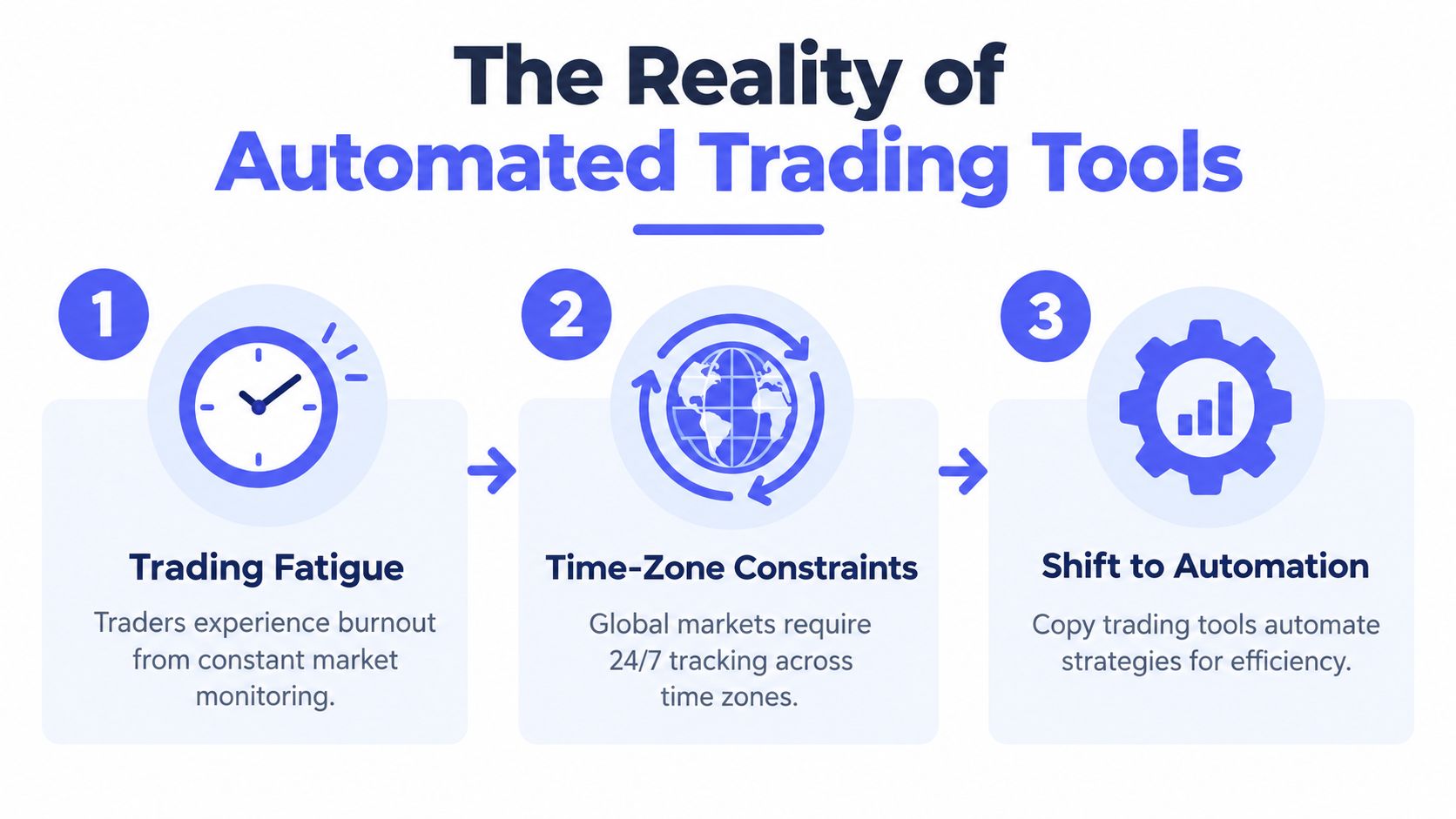
A trader can have a sound plan and still miss the entry during a work call, while asleep, or outside the followed trader's time zone. That practical constraint explains why automated copy trading has moved beyond its earlier FX niche into a broader retail market. One market report places the copy trading platform market at $2.2 billion in 2025 and projects $4.3 billion by 2034. It also reports Asia Pacific at 38.2% of regional share, with individual traders representing 73.2% of users and 61.4% of revenue in 2025.
Crypto makes the timing problem harder. Markets trade around the clock, and a manual follower may see a position only after the price has moved. A copy trading app can reduce that delay and apply the same instructions consistently.
What automation actually fixes
Automation handles repeatable actions. It can mirror an entry or exit, apply a selected position size, and reduce the need to monitor charts continuously. It cannot improve the followed trader's judgment, remove slippage, or turn a weak strategy into a reliable one.
Practical rule: use automation to remove friction, not judgment. If the trader you follow has poor timing or weak discipline, faster copying only gets you into the same bad trade sooner.
The custody model matters just as much as execution. In a crypto or DeFi app, limited allowances can let a contract act within approved boundaries while the user retains wallet control. That is different from transferring assets to a platform, and the distinction should be checked before connecting a wallet.
Automated tools are most useful when they reduce screen time and missed setups without asking users to surrender self-custody. A broader explanation of the workflow appears in this note on crypto auto trading.
How Non-Custodial Copy Apps Work
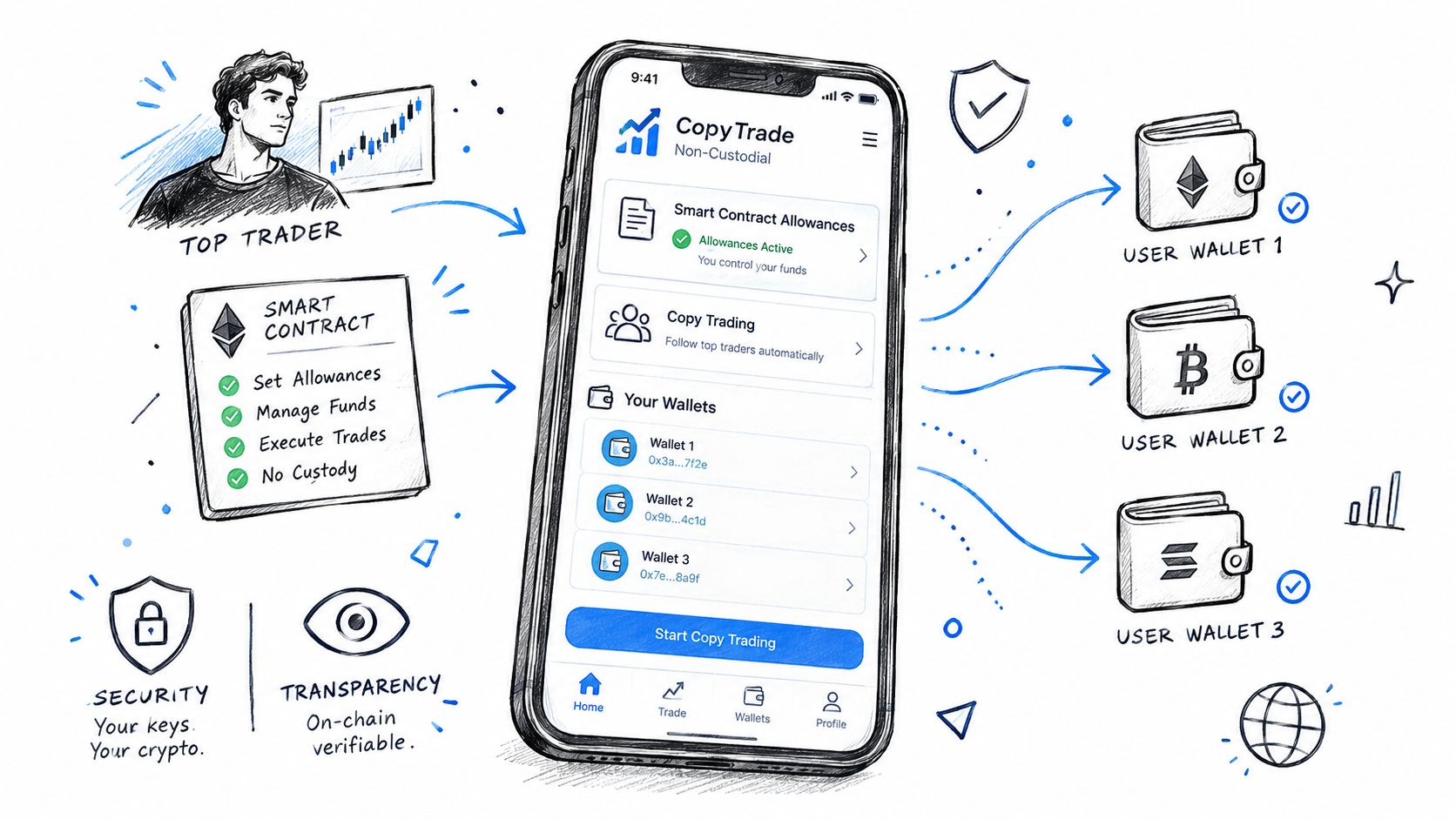
Custody is the dividing line. In a custodial setup, the platform holds the assets. In a non-custodial setup, the user keeps the assets in their own wallet, and the app only gets limited permission to act within the bounds the user set. That difference is not cosmetic. It changes who can touch the funds, who can drain them, and how much damage a bad platform can do.
On-chain non-custodial copy trading typically uses revocable allowances rather than custody transfer. The user approves a contract to spend up to a limit, the contract mirrors trades inside that limit, and the user can revoke the permission on-chain by resetting the allowance to zero (token approvals and permit explained). That is a cleaner fit for DeFi users who care about self-custody first and convenience second.
Why allowances matter more than custody promises
A lot of people hear “automation” and assume the app must also take control of the wallet. It doesn't have to. The allowance model is narrower. It lets the copier act without taking ownership, which is the whole point in a self-custody environment.
That structure also limits damage. If the copied trader performs badly, the loss still sits inside the amount the user allocated. If the user changes their mind, they can revoke access instead of waiting on support or hoping a custodial platform behaves properly. A more detailed walkthrough is available in the best copy trading bot guide, but the core idea is already clear here, control stays with the wallet holder.
Funds staying in your wallet is not a guarantee of profit. It just means the platform doesn't need to hold your assets to mirror a trade.
This is the part beginners often skip. They compare interfaces. They should compare permission models. In crypto, that's the safer habit.
Execution Speed and Slippage Considerations
Speed is the tax you pay for copying someone else's trade. No system mirrors a move at exactly the same price and time as the source trader. Independent coverage on copy trading highlights slippage and latency as structural risks, which means the copier can enter or exit at a different price and moment than the lead trader (copy trading newsroom coverage). That's not a bug. It's the trade-off.
Industry explanations describe cumulative end-to-end delays in the 120ms to 300ms+ range in brokered copy systems, and DeFi-oriented analysis shows that routing, liquidity, fee layers, route support, and position sizing all compound into worse fills when the market moves fast (fees and slippage analysis). In plain terms, the trader can be right and the copier can still get a worse price.
What changes the fill quality
The problem isn't only the clock. It's everything the clock hides. Extra hops, thin liquidity, and the size of the copied order all matter. Fast entries on thin tokens are where the gap opens up.
A useful mental model is this.
| Factor | What it does to the copier |
|---|---|
| Delay | Raises the chance of a worse entry or exit |
| Thin liquidity | Makes the copied trade move price more |
| Bigger sizing | Increases the chance the fill drifts from the source |
That's why transparent slippage reporting matters. If the app shows you the gap between source execution and your fill, you can at least see the true cost. Without that, users fool themselves into thinking they copied a setup cleanly when they paid a hidden spread through timing.
The other point is exit mirroring. Copying only entries is incomplete. If the lead trader exits and you don't, you're not copying a strategy. You're holding leftovers. Good automation mirrors both sides, because that's where the performance difference shows up.
Getting Started with copyfomo
The first mistake is overthinking setup. The second is underestimating how much cleanup happens after the first copied trade. Start with the trader selection screen, pick someone from the public leaderboard, and set the trade size before you let the bot touch anything. If the app offers a cap or a kill switch, use it from the start, not later.
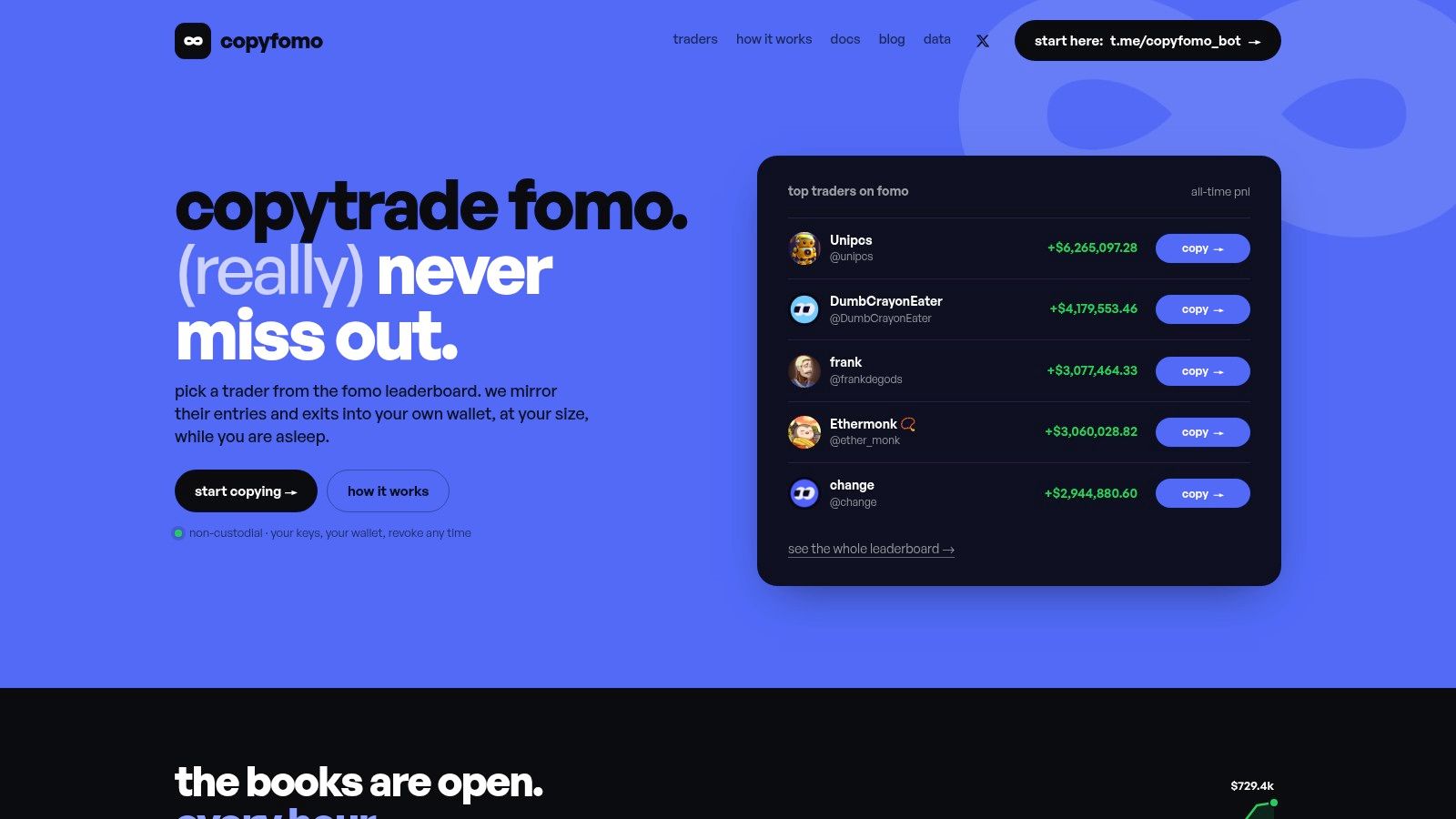
The point of copyfomo is simple. It's a Telegram bot that mirrors the filled entries and exits of traders ranked on the fomo leaderboard into the user's own wallet at a chosen size. It also supports wallet discovery from a trader's handle or screenshot, which helps when the trader isn't sitting neatly in the obvious public list. The useful part is not the novelty. It's the ability to turn public on-chain activity into something you can copy without manually rebuilding the trail.
The settings that actually matter
Start with sizing. Fixed ticket size is easier to reason about. Proportional sizing makes more sense when you want the copied trade to scale with the source. Either way, size should be the first decision, not the last.
Next, use the kill switch. Market conditions change. Traders change. A good copy flow needs a way to pause new copies immediately. A live feed of mirrored swaps with timestamps and displayed slippage is useful because it shows you what happened, not what the leaderboard implied might happen.
For setup and controls, the copyfomo docs are the place to check the current flow. The video below shows the kind of leaderboard-driven discovery traders use when they're selecting who to mirror.
Treat the first day as a calibration run. Verify that the copied trade size matches your allocation. Check whether exits mirror the way you expect. Don't assume the bot has read your mind. It hasn't.
Myths and Risks of Copy Trading
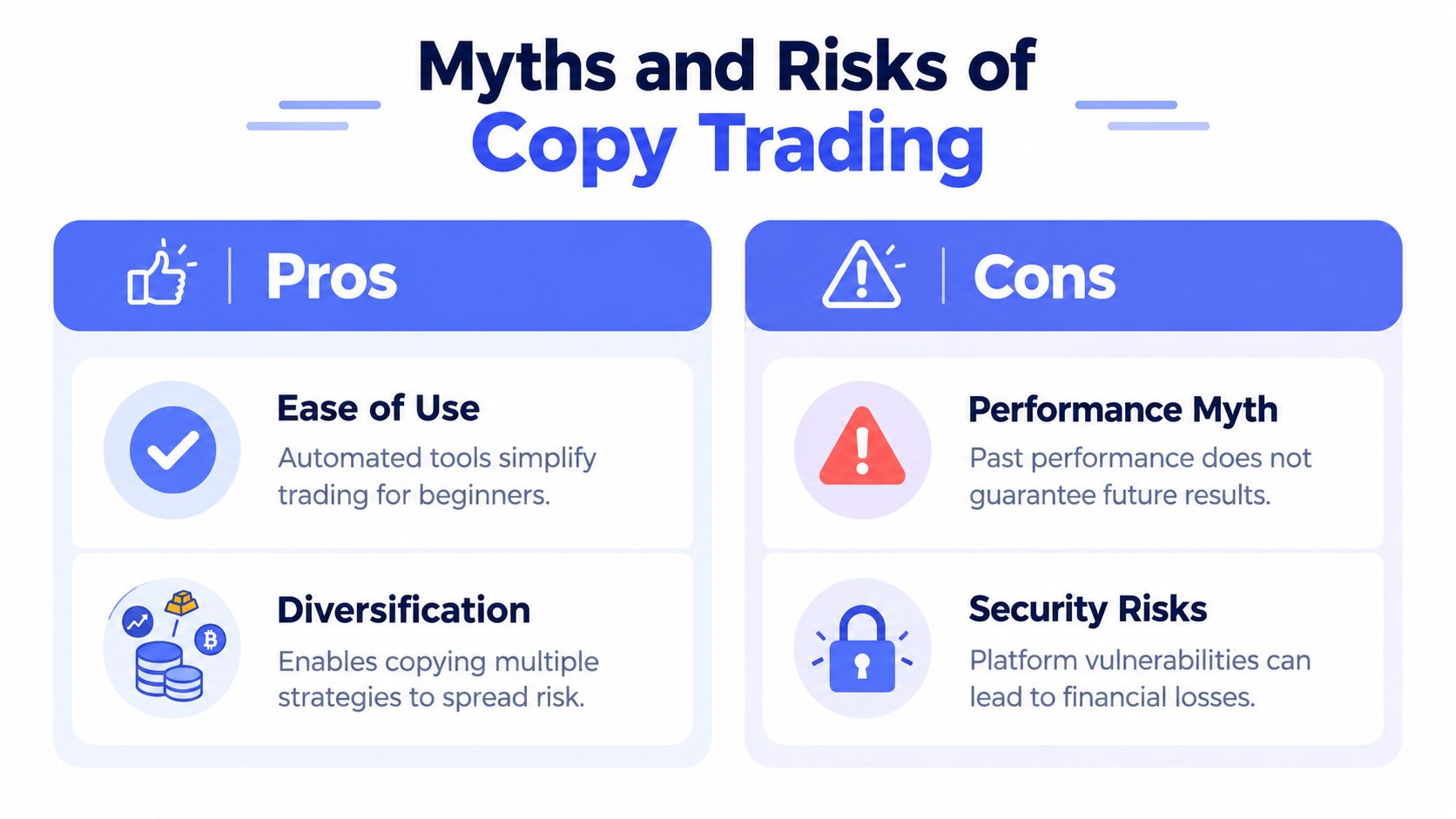
The biggest myth is that automation removes the hard part. It doesn't. It moves the hard part from manual timing to trader selection, sizing, and monitoring. The lead trader still controls the quality of the signal, and your account still takes the downside if that signal turns into a loss.
That risk isn't theoretical. European regulatory disclosure data commonly cited in industry research shows 74% to 89% of retail CFD accounts lost money across member-state samples, the French AMF client study of 14,799 active retail clients found 89% lost money with average losses of €10,887, and UK FCA disclosure figures showed 82% of retail CFD clients lost money (regulatory loss data). Copy trading often sits on top of the same high-risk, borrowing-intensive markets, so automation doesn't clean up the core risk profile.
The trap in past performance
Past performance is a data point. It isn't a promise. A trader can post a strong streak and then lose discipline when size, volatility, or crowding changes. If that trader makes losing trades, the follower's account reflects those losses too, which is exactly why the warning on copy trading platforms is so blunt (risk warning).
What people get wrong about safety
Some users think a small allocation makes the risk disappear. It doesn't. It only limits the amount exposed. Most copy trading implementations cap exposure to the capital allocated to the relationship, but the full allocated amount can still be lost if the copied trader performs badly or positions are closed at a large loss (social trading risk overview).
If you want a safer habit, look at losses first and wins second. A trader's drawdown tells you more than a flashy run.
The practical lesson is plain. Copy trading is a tool. It's not a shield, and it's not passive income. If a platform talks only about upside, it's leaving out the part that matters when trades start to go wrong.
Evaluating Your Copy Trading Options
Good copy trading apps don't just copy. They expose the trade, show the size, show the exit, and let you stop the flow when conditions change. That's the baseline. Anything less is a black box with a nice interface.
The first filter is control. Non-custodial execution is safer for users who care about wallet ownership because the platform isn't holding the assets. The second filter is execution quality. If the app can't show slippage, latency, or mirrored exits, you're guessing about your own fills. The third filter is data access. A useful product gives you enough transparency to judge the trader and the system without depending on marketing claims.
A simple checklist that holds up
- Wallet control: Keep funds in your own wallet, not in a platform balance.
- Exit mirroring: Make sure sells are copied too, not just buys.
- Trade visibility: Check whether copied swaps, timestamps, and slippage are shown clearly.
- Sizing controls: Use fixed size, proportional size, or caps only if you can see what they do.
- Kill switch: Confirm that you can pause new copies quickly.
- Trader source: Prefer public, verifiable trade data over vague performance claims.
The broader market is large enough that the product category matters. A recent industry report estimates 10 to 20 million active copy traders and says some offshore CFD and crypto brokers derive about 20% of trading volume from copy trading (industry report). That growth has also raised scam and impersonation risk, which is another reason to stay skeptical of polished interfaces without public data.
A useful copy trading app does not ask you to trust more. It asks you to verify more. That's why I'd rather see a wallet-safe, transparent setup than a flashy one with vague promises.
If you want a copy trading app that mirrors selected fomo traders into your own wallet with size controls, exit mirroring, and a kill switch, start with copyfomo. It's built for traders who care more about control and transparency than hype. Visit the Telegram bot, check the docs, and see whether the workflow fits the way you trade.
stop reading. start copying.
pick a trader from the fomo leaderboard, set your size, and the entries and the exits land in your own wallet while you sleep.
open copyfomo on telegram →