Copy Trading for Beginners: A Smart Starting Guide
learn copy trading for beginners with our practical guide. discover strategies, risks, and platforms to start smartly in 2026.

Copy trading does not remove risk, and past performance does not predict future results. In a 2020 experimental-market study, 35% of participants offered a copy option chose to copy another participant, and 88% of those copiers followed someone taking more risk than they were.
The popular advice is simple: find the trader with the biggest return, press copy, and let automation handle the rest. That advice is convenient. It's also how beginners mistake a leaderboard for a risk assessment.
For anyone learning copy trading for beginners, the useful question isn't “Which trader made the most?” It's “What happens when my entry is later, my liquidity is worse, my position is too large, or the trader changes strategy?” Copy trading is an execution method. It mirrors another person's actions. It doesn't transfer their judgment, information, timing, or ability to manage a changing market.
Table of Contents
- What Copy Trading Actually Is and Why Beginners Misunderstand It
- The Three Risks Every Beginner Must Face First
- How to Choose a Trader Beyond Realized PnL
- Setting Up Non-Custodial Copy Trading Safely
- Your First Trade A Complete Workflow
- Building Sustainable Copy Trading Habits
What Copy Trading Actually Is and Why Beginners Misunderstand It
Copy trading automatically mirrors another trader's filled executions in your account or wallet. If that trader buys, your configured system attempts to buy. If the trader sells, your system attempts to sell. Your result depends on the source trade, your size, your execution price, your costs, and what happens in the market after the copy is placed.
That makes copy trading useful as an execution tool. It doesn't make it a shortcut to profit. A trader can look successful because of a short run, concentrated positions, unrealized gains, or risks that aren't obvious from a headline leaderboard figure. When you copy the trades, you also copy the exposure and the behavior behind them.
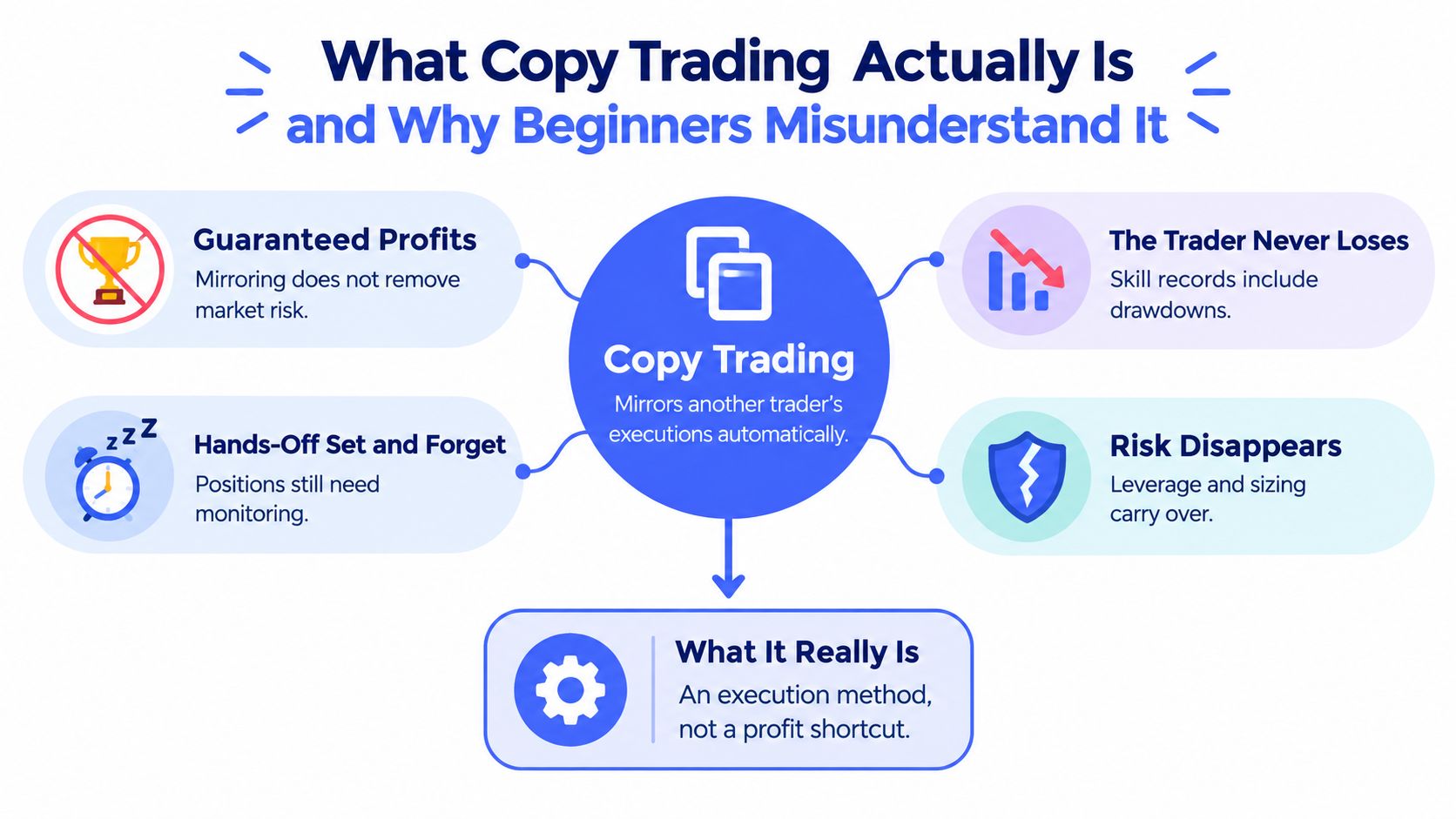
Why automation can increase risk
The experimental evidence is uncomfortable. In a peer-reviewed experimental-market study published in 2020, showing participants other traders' strategies increased risk-taking. Among participants offered a copy option, 35% chose to copy another participant, and 88% of those copiers followed someone whose choices were riskier than their own, according to the experimental copy-trading study.
The researchers concluded that copy trading can encourage excessive risk-taking even when the copied trader's past performance is visible. The mechanism is easy to understand. Another person's apparent success can make a larger position feel validated, and automation removes the pause that might have prompted a manual risk check.
Practical rule: A profitable history is evidence of what happened. It isn't evidence that the same behavior will remain profitable.
That distinction matters on fomo, where a leaderboard can help you discover active traders but can't establish repeatable skill. A sensible review includes maximum drawdown, holding periods, concentration, liquidity, turnover, slippage, and realized versus unrealized PnL. If you want the mechanics explained separately, use this guide to how copy trading apps work.
The Three Risks Every Beginner Must Face First
Before funding a copied position, separate three risks that beginners often blend together. The first concerns the trader you select. The second concerns the price you receive. The third concerns the controls you set on your own account.
Risk one is treating history as a forecast
A leaderboard ranks past activity. It doesn't show whether the trader's next position will fit the current market, whether the previous gains came from a few extreme bets, or whether open positions are carrying losses that haven't been realized. A copied trade can fail even when the source trader looked strong at the moment you selected them.
The European Securities and Markets Authority's CFD intervention analysis reported that 74% to 89% of retail investor accounts typically lost money across EU jurisdictions in its 2018 analysis. It also reported average losses per client ranging from €1,600 to €29,000, depending on jurisdiction and period.
Those figures describe CFDs, not every form of spot crypto wallet mirroring. Don't present them as a direct loss rate for crypto copy trading. Their broader lesson is still relevant: copying doesn't remove market, execution, financing, liquidity, or cost risk.
Risk two is execution divergence
The source trader's entry and your entry are different events. A delay, spread, route, gas cost, thin liquidity, larger proportional order, failed transaction, or partial fill can change the result. In a volatile token, even a short delay can turn a favorable source trade into a poor follower trade.
Track the difference instead of hand-waving about speed:
- Record timestamps: Save the source transaction time and the copied transaction time.
- Measure delay: Calculate the difference in seconds.
- Capture execution details: Record token prices, route, gas, trade size, displayed slippage, and realized slippage.
- Calculate shortfall: Compare the follower's effective execution price with the source price in basis points.
- Check exits: An entry-only system can leave you exposed after the source trader has already closed.
Risk three is starting without limits
A copied position still needs a hard size limit. Set a small fixed ticket or use proportional sizing with a per-trade cap. Add an aggregate exposure limit so several copied positions don't become one oversized bet unnoticed.
Test the kill switch before meaningful funding. Confirm that you can pause new copies, close mirrored positions if that option exists, and revoke wallet permissions when access should end. Without those controls, automation is just faster exposure.
How to Choose a Trader Beyond Realized PnL
Realized PnL is useful. It's also incomplete. A trader can rank highly after taking a concentrated position in a thin market, while a large part of the apparent performance remains unrealized or depends on an exit you may not receive at the same price.
Start with the full sequence of filled entries and exits. You're looking for behavior across wins, losses, changing market conditions, and position sizes. A short record with a few large gains deserves more skepticism than a transparent record showing how the trader manages ordinary losing trades.
The questions that matter
Ask these questions before selecting a leaderboard wallet:
- How deep are the drawdowns? Maximum drawdown tells you how far the account fell from a prior peak. It gives a better view of pain than cumulative PnL.
- How concentrated are the positions? A trader relying on one token or one oversized position may carry more risk than the ranking suggests.
- What portion of PnL is realized? Open gains can disappear. Compare closed results with unrealized positions.
- How long is the history? A brief winning sequence can be luck, favorable timing, or a temporary market regime.
- How long are positions held? Short holding periods increase sensitivity to delay and slippage. Longer holding periods create different overnight and market-regime risks.
- What happens after losses? Increasing size after a loss can change the risk profile quickly.
- Are gains driven by extreme bets? A few outsized trades may explain the entire ranking.
Research on two major cryptocurrency copy-trading platforms found that copying top-ranked leaders did not produce substantial investment profits. The study reported that leaders earned more than half to three-quarters of their total profit from commissions paid by copiers, and that copier performance could deteriorate sharply after an initially profitable period. In one example, the bottom 25% of portfolios promoted to a Gold ranking lost more than USD 15,000 within ten days, as reported in the cryptocurrency copy-trading platform study.
Trader Evaluation Checklist
| Criterion | What to Look For | Red Flag |
|---|---|---|
| Drawdown | Losses shown alongside returns | Large declines hidden by cumulative PnL |
| Concentration | Exposure spread across understandable positions | One token or one oversized bet dominates |
| PnL type | Realized results separated from open positions | Unrealized gains presented as completed performance |
| Trade history | Filled entries and exits with context | Only a headline ranking or recent winners |
| Holding period | A style you can tolerate and replicate | Your execution speed doesn't fit the strategy |
| Loss behavior | Stable sizing after losing trades | Position size increases sharply after losses |
| Liquidity | Trade sizes that the market can absorb | Thin pools and large price impact |
Use copy trading tools to inspect data, but don't outsource the judgment. A discovery tool can show candidates. It can't tell you how much risk you should accept.
Setting Up Non-Custodial Copy Trading Safely
Non-custodial copy trading means the assets remain in your wallet rather than being deposited with a service for direct custody. That reduces one type of counterparty exposure. It doesn't remove smart-contract, market, execution, allowance, or user-configuration risk.
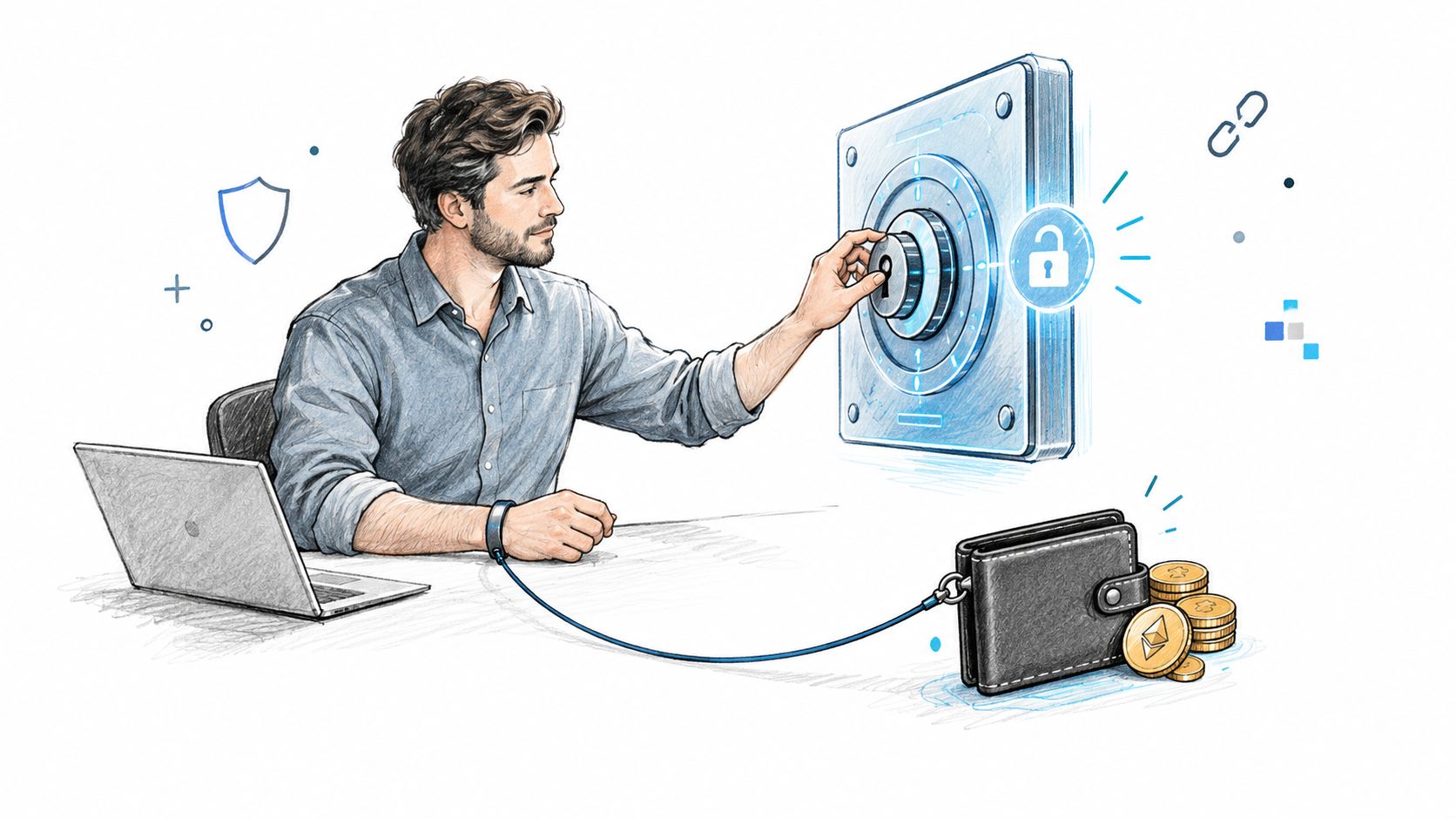
Understand the permission before using it
An Ethereum token approval is an explicit permission that lets a smart contract interact with specified tokens in a wallet. Disconnecting your wallet from an application doesn't cancel an existing approval, and permissions don't expire automatically. To end access, you need to locate the contract permission and submit a separate revoke transaction.
The Ethereum guide to revoking token access explains that revocation requires a network fee and can take roughly one minute to several minutes, depending on the network. The assets remain in your wallet, but the permission must be revoked on-chain when access should end.
Wallet rule: Disconnecting a site is not the same as revoking an allowance.
Before you enable automation, identify the contract, understand which token permissions you're granting, and confirm where the wallet displays them. Perform a test revocation with a small setup if you're unfamiliar with the process. A kill switch that pauses new copies is useful, but allowance revocation is the wallet-level action for ending contract permission.
Choose sizing that limits damage
Fixed ticket sizing is easier to understand. Each copied trade uses a set amount, subject to your limits. Proportional sizing can track the source trader's relative trade size, but it can also create unwanted exposure when the source uses a large position or trades an illiquid token.
Use these controls before activation:
- Set a small starting ticket: Keep the first allocation small enough that an execution mistake won't disrupt your finances.
- Add a per-trade cap: Never let proportional sizing exceed a fixed maximum.
- Set total exposure limits: Several open positions can combine into a concentrated portfolio.
- Mirror exits: Copying buys without sells can leave you holding a position after the source has exited.
- Review slippage reporting: Displayed estimates aren't the same as realized execution.
- Test the kill switch: Pause new trades and confirm how open positions are handled.
For on-chain users comparing setup approaches, this overview of a crypto trading bot covers the broader category. copyfomo is one Telegram-based option that mirrors filled buys and sells from traders ranked on the fomo leaderboard into a user's own wallet at a configured size. Treat its speed, verified trade feed, displayed slippage, exit mirroring, and allowance controls as operational features, not evidence of profitability.
Your First Trade A Complete Workflow
A first copied trade should be a controlled test, not a declaration that you've found a winning system. You're testing selection, sizing, execution, exits, records, and the ability to stop.
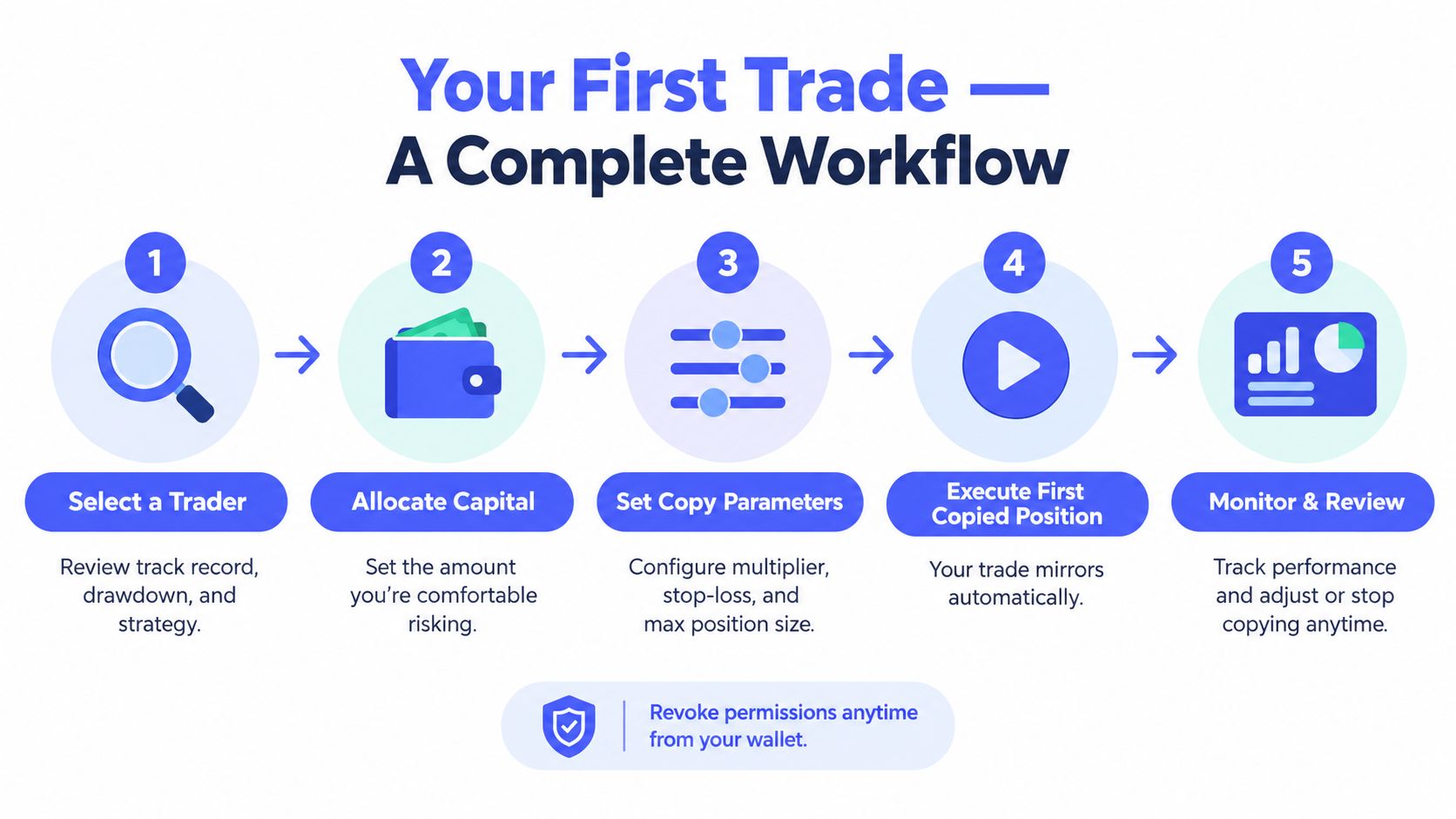
Before activation
Choose a trader only after reviewing the complete checklist. Write down why you selected them, what risk you expect, what would make you stop copying, and which positions you won't accept. Then set a fixed ticket or capped proportional size, define total exposure, enable exit mirroring, and test the kill switch.
The operational record matters. For every source and follower transaction, save:
- Source and copied timestamps.
- Delay in seconds.
- Source and follower prices.
- Trade size and route.
- Gas and transaction status.
- Displayed and realized slippage.
- Whether the exit was copied successfully.
After the copy executes
Calculate implementation shortfall as the follower's effective execution price minus the source price, expressed in basis points. Include entry slippage, exit slippage, transaction costs, failed or partial transactions, and positions you couldn't replicate.
A profitable source trade can still be a losing follower trade. Different liquidity, position sizing, spreads, fees, delay, and follower behavior can produce materially different outcomes, as discussed in the research on measuring execution divergence in crypto markets.
Use the video below as a practical visual aid, then compare its general workflow with the controls and execution data available in your own setup.
Stop automated copying after a predefined drawdown, repeated transaction failures, abnormal slippage, or a clear increase in the leader's risk profile. Don't wait for the leaderboard to confirm what your own trade log already shows.
Building Sustainable Copy Trading Habits
The durable approach is process compliance, not return chasing. Keep positions small, define loss limits before entry, limit exposure to any one leader, and review the trader and your execution records periodically.
Track net return, maximum drawdown, win/loss ratio, average win divided by average loss, realized PnL, and execution shortfall. These metrics tell you more than a single ranking number. They also give you a reason to stop copying a profitable trader before the next loss, for example when concentration rises, exits stop mirroring, or slippage becomes abnormal.
A working paper found that offering participants the option to copy increased risk-taking more than merely showing information about other traders. It also reported that copied trades could have a higher probability of positive returns than standard trades, while successful copied trades produced smaller returns on investment and losing copied trades typically produced larger losses, according to the copy-trading working paper.
A sensible benchmark: Follow your rules consistently. Don't measure yourself by whether you matched someone else's nominal return.
Copy trading carries risk. Past performance doesn't predict results. If you can't explain your sizing, exit, allowance, and stop conditions, you're not ready to automate the trade.
copyfomo gives fomo users a Telegram bot for mirroring selected traders' filled entries and exits into their own wallet at a configured trade size. Visit copyfomo to start the bot on Telegram, then configure small limits, review execution data, and test the kill switch before using meaningful size.
stop reading. start copying.
pick a trader from the fomo leaderboard, set your size, and the entries and the exits land in your own wallet while you sleep.
open copyfomo on telegram →