Trading Bot for Crypto
learn how a trading bot for crypto automates fomo leaderboard copy trades safely. explore non-custodial execution, sizing controls, and real-world on-chain
A trading bot for crypto automates on-chain trade mirroring through user-controlled permissions, without taking custody of funds. Roughly 90% of Uniswap swaps confirm in under 12 seconds, but the 99.5th-percentile wait exceeds 20 blocks, so near-real-time copying still isn't identical execution.
You may already follow a trader on fomo, watch the leaderboard, and recognize a buy before you can act. Then the alert arrives while you're away from the screen. By the time you open your wallet, check the token, set the amount, and submit the swap, the source position has changed.
That gap is the practical problem. A bot can remove manual delay, but it can't make your wallet receive the same fill as the source wallet. Your result still depends on transaction timing, pool liquidity, position size, approvals, gas, and whether the exit is copied properly.
Table of Contents
- What a Crypto Trading Bot Actually Does
- Why Copied Trades Diverge from Source Results
- Entry Only Versus Full Exit Mirroring
- Permission Design and Security Controls
- How copyfomo Automates fomo Leaderboard Trades
- How to Evaluate a Copytrading Bot Before Using It
- Start Testing Copy Trading Safely
What a Crypto Trading Bot Actually Does
A trading bot for crypto is software that follows predefined instructions and submits transactions without requiring a manual confirmation for every trade. In a copytrading setup, the instruction is usually simple: monitor a selected source trader, mirror a filled buy or sell, calculate the follower's configured size, and send the corresponding on-chain swap.
That makes copytrading different from an autonomous strategy bot. A grid or market-making system may generate its own entries from price conditions. A copytrading bot mirrors activity from another wallet or trader profile. It doesn't decide that the source trader is correct. It automates the mechanical part of following that trader.
The usual flow looks like this:
- Select a source trader. The user chooses someone whose activity is visible through the relevant leaderboard or trading interface.
- Set the follower size. The user may choose a fixed ticket or a proportion of the source trade, often with a cap.
- Grant a wallet permission. The bot uses a user-approved allowance to execute specific token actions. The wallet remains under the user's control.
- Mirror the filled trade. The bot submits an on-chain transaction for the follower wallet.
- Track the outcome. A useful system records the source event, follower submission, confirmed fill, slippage, and exit status.
The difference between automation and manual alerts matters. An alert tells you that something happened. You still need to open a wallet, estimate the swap, choose a gas setting, and submit the transaction. Automation handles those steps according to the permissions and limits you've configured. It also runs while you're offline, which is useful for part-time traders and people operating across time zones.
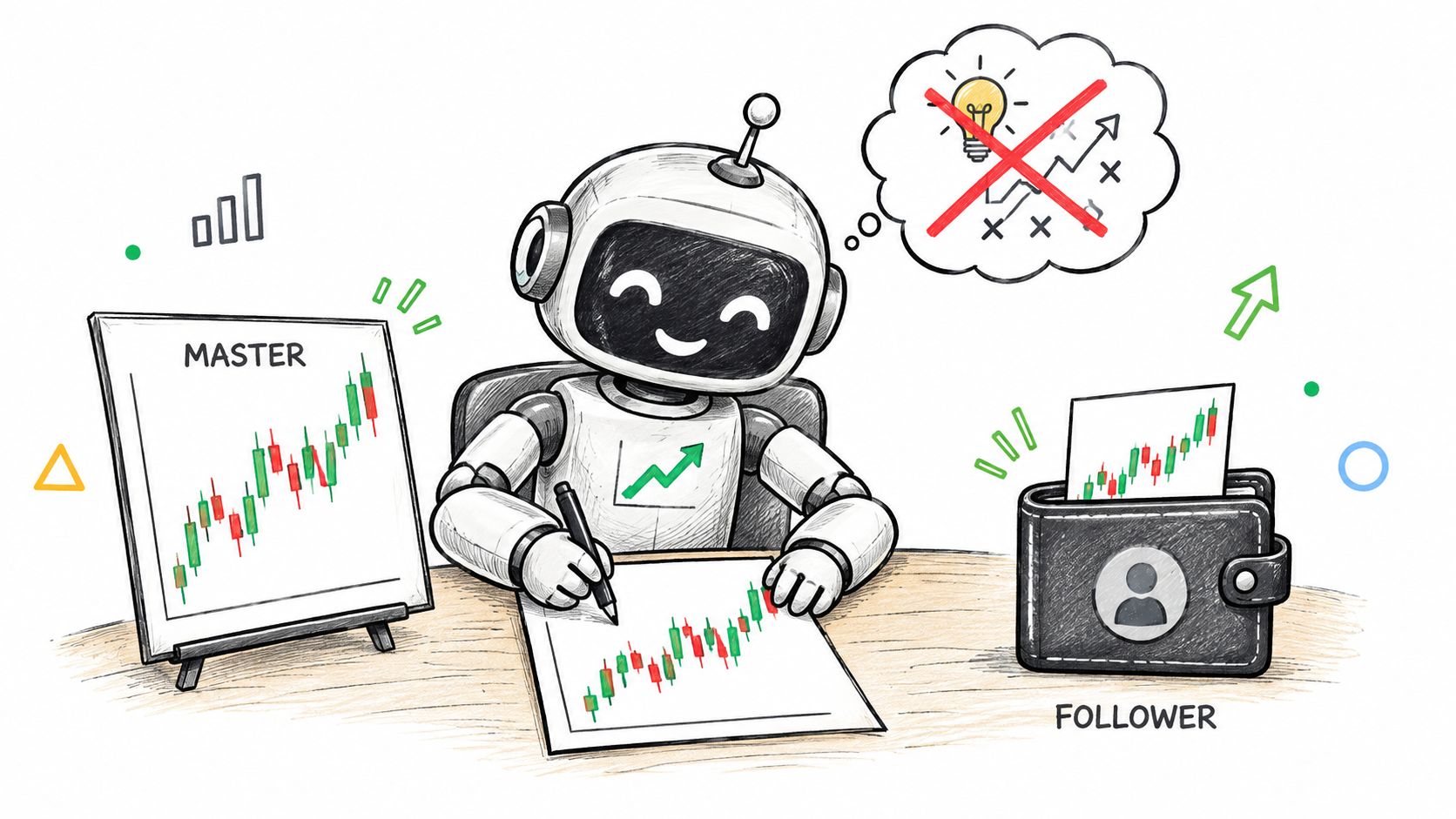
Practical rule: A bot automates execution. It doesn't remove market risk, liquidity risk, or wallet-permission risk.
A sensible beginner overview is this guide to crypto bots for beginners, but the basic limitation is more important than the setup flow. The source trader's performance doesn't transfer automatically to the follower. You can copy the same direction and still receive a different price, hold a different size, or fail to exit in the same conditions.
Copy trading carries risk. Past performance does not predict future results. A bot can make execution more consistent, but consistency isn't the same as profitability.
Why Copied Trades Diverge from Source Results
The source wallet and the follower wallet don't trade in the same state. Even when both transactions target the same token and pool, they may enter at different times, use different amounts, pay different gas costs, and face different concurrent flow.
The first source of divergence is timing. Execution speed isn't just the time between receiving an alert and calling an API. For an on-chain trade, it includes signal detection, transaction signing, mempool propagation, block inclusion, and finalization. Research on Uniswap transactions found that roughly 90% of swaps confirmed in under 12 seconds, while the 99.5th-percentile wait exceeded 20 blocks. The same research links longer mempool residence with higher slippage because delayed transactions face more price movement, competing transactions, and a greater chance of being identified as profitable MEV opportunities. See the research on transaction confirmation and slippage for the underlying analysis.
A follower can therefore receive a materially worse fill even when the copying delay is only around one second. “Near-real-time” describes timing. It doesn't promise identical economics.
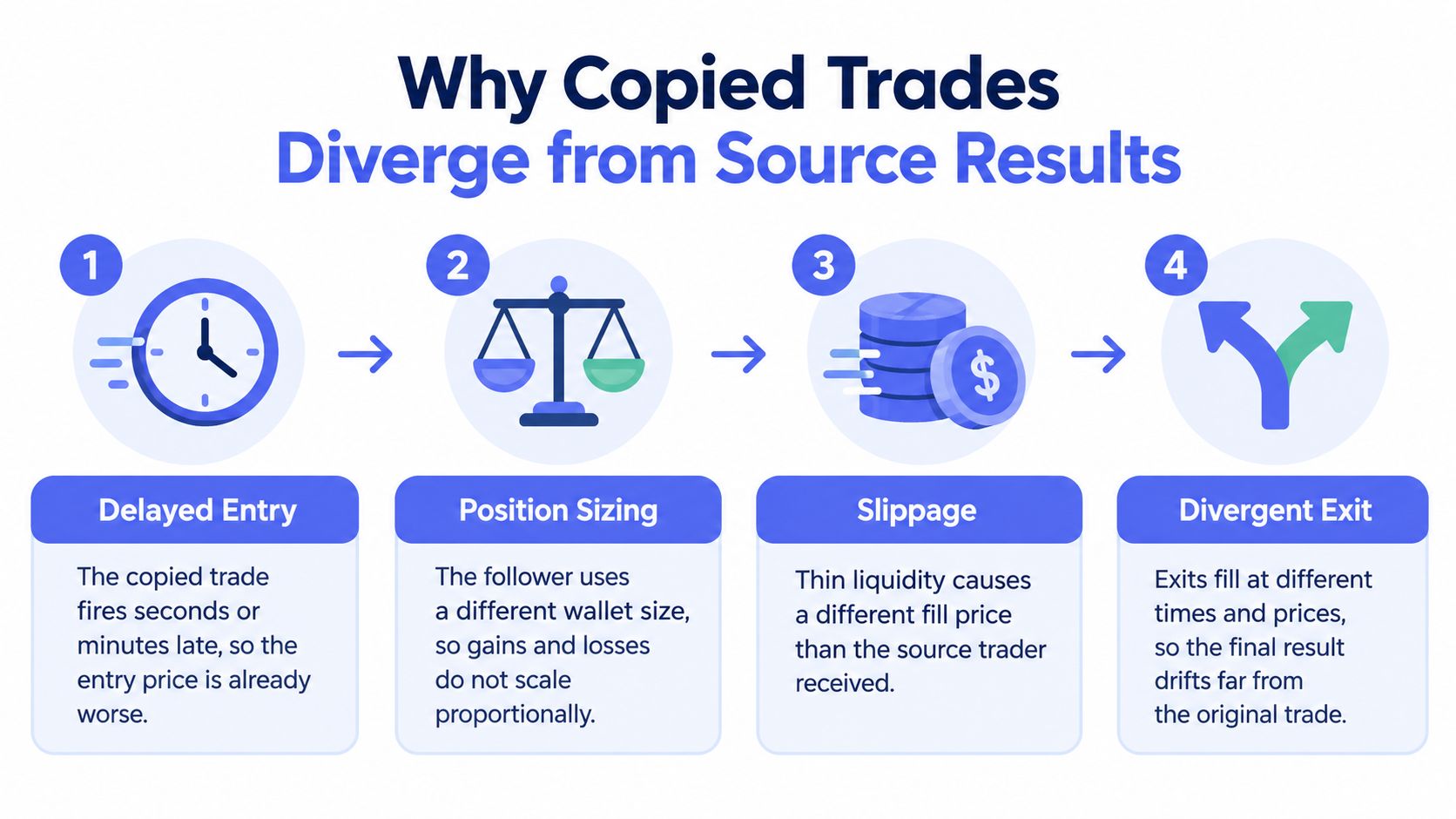
Four sources of the execution gap
Delayed entry changes the price before the follower's transaction settles. A source may buy before other participants react. The follower may buy after that demand has moved the pool.
Position sizing changes the trade's effect on the pool. The source's notional may be small relative to available liquidity. A follower using a fixed ticket can represent a much larger share of the reserves. The same percentage allocation doesn't guarantee the same price impact.
Slippage reflects the difference between the quoted output and the actual fill. In an automated market maker, reserves determine the execution curve. A copied buy can move the pool against the follower, particularly in a thin or rapidly moving market. A copied sell can meet depleted reserves after earlier participants exit. The practical mechanics are covered in what slippage means in crypto.
Divergent exit is where many comparisons fail. The source may sell while the follower still has a pending buy, a different balance, or a partial position. The source's sale can confirm while the follower's sale fails, receives a different output, or remains exposed to the market.
A post-trade record should separate these causes instead of showing only leader PnL. Useful fields include:
| Field | What it tells you |
|---|---|
| Source timestamp | When the tracked trade filled |
| Follower submission timestamp | When the bot sent the follower transaction |
| Confirmation timestamp | When the follower swap settled |
| Quoted output and minimum output | What the transaction expected and protected |
| Actual output | What the follower wallet received |
| Pool reserves | The liquidity state used for the estimate |
| Gas cost | The transaction cost charged to the follower |
| Slippage | The fill difference attributable to execution |
The relevant result is follower net PnL after execution costs, not the source trader's displayed PnL. IOSCO identifies delayed entry, execution differences, position sizing, margin, and frequent-trading fees as mechanisms that can erode retail returns. Its report on crypto and retail investor risks supports evaluating the trade at the follower level.
A practical bot should use a deadline, a maximum slippage setting, priority-fee logic, nonce management, and transaction replacement. It should also stop new submissions during abnormal confirmation delays. Position sizing needs to reflect pool liquidity and expected price impact, not the assumption that the source fill is reproducible.
Entry Only Versus Full Exit Mirroring
Entry-only copying looks simple. The source buys, the bot buys. The source's later sell is left to the follower. That design can work as an alert substitute, but it creates a separate manual strategy after the first transaction.
The follower may not know whether the source has reduced the position, closed it, or rotated into another token. A buy-only system can leave the follower holding an asset after the source trader has exited. The source's displayed result may be realized, while the follower's result remains an open gain or loss.
Full mirroring treats the exit as part of the trade. It attempts to follow both the filled entry and the filled sell, subject to the follower wallet's actual balance and the execution limits. That matters because the follower's position isn't always a clean copy of the source position.
Several things can break a simple exit instruction:
- Partial fills: The follower may have acquired less than the expected amount.
- Failed transactions: A buy can fail, leaving no balance to sell.
- Token taxes: The amount received or sold may differ from the nominal transaction amount.
- Prior positions: The follower may already hold some of the token or may have sold part of it independently.
- Different timing: The source exit can settle before the follower's entry has finalized.
- Liquidity changes: The pool may have less available output when the follower sells.
The source wallet's sell amount therefore can't always be copied as a raw number. A responsible system validates the follower's remaining balance, checks the position state, and applies the configured limits before submitting an exit.
Copying the entry creates exposure. Copying the exit determines whether that exposure is actually closed.
The choice isn't just between a feature-rich bot and a basic one. It's between accepting a new manual decision after every entry and using a flow that attempts to reproduce the full trade lifecycle. Neither approach guarantees a matching result. Full exit mirroring reduces one obvious source of drift, but it still faces confirmation delays, price impact, failed swaps, and available liquidity.
Evaluate the exit logic before connecting a wallet. Ask whether the system copies partial exits, how it handles a follower balance that differs from the source amount, and whether the user can pause new copies without creating a false impression that already-settled trades can be reversed.
Permission Design and Security Controls
Non-custodial doesn't mean permission-free. It means the service operates through permissions granted by the wallet rather than taking direct custody of the assets. The quality of that arrangement depends on what the allowance permits, which contract receives it, and how quickly the user can remove or pause access.
A token allowance lets a decentralized application interact with specified wallet assets. Ethereum.org recommends approving only what is needed, avoiding unlimited allowances, and regularly revoking access. Revocation requires a new blockchain transaction and a network fee, as explained in the Ethereum guide to revoking token access.
What to check before approval
Start with the contract. Confirm which address receives the allowance and which token the permission covers. A permission to spend an approved token isn't the same as permission to withdraw every asset in the wallet, but an overly broad allowance still expands the consequences of a faulty contract or compromised integration.
Then check the operational controls:
- Allowance scope: Determine whether the approval is limited to a needed token and amount or is unlimited.
- Contract identity: Review the approved contract address through a wallet and a public blockchain explorer.
- Revocation path: Confirm that you know how to remove the allowance and understand that revocation is an on-chain transaction.
- Kill switch: Verify whether it stops new submissions, closes open positions, or does both.
- Sizing limits: Use fixed tickets, proportional caps, and liquidity-based limits rather than leaving size open-ended.
- Transaction records: Check whether the system shows submitted time, confirmed time, output, gas, and slippage.
- Failure policy: Understand what happens after a rejected swap, missing liquidity, delayed confirmation, or compromised source wallet.
MetaMask also explains that an approval controls whether a decentralized application can access and move the approved token balance, and that revoking the approval requires gas. Its explanation of token approvals and allowances makes the important distinction clear: revocation removes future permission. It doesn't undo transfers that already happened.
You can inspect approval activity through public approval tools. OpenSea's wallet approval guidance describes reviewing approvals for ERC-20, ERC-721, and ERC-1155 assets and signing a wallet transaction to revoke access. The exact token standard matters, as does the contract associated with the permission.
A kill switch is useful but limited. It can stop new copies from being submitted. It can't reverse a swap that already settled, recover funds transferred by an earlier transaction, or guarantee that an open position can be sold. Users still need a failure policy and a clear understanding of which actions remain under their control.
For a broader operational view, this guide to DeFi trading bots is a useful reference point. The central rule remains straightforward: approve narrowly, size conservatively, log every transaction, and know how to revoke access before you start.
How copyfomo Automates fomo Leaderboard Trades
copyfomo is a Telegram-based, non-custodial copytrading bot for users who follow traders on the fomo leaderboard. It mirrors filled entries and exits into the user's own wallet at a configured trade size. The service uses allowance-based execution, so the assets remain in the user's wallet rather than being deposited with an operator.
The user chooses a trader and a sizing method. A fixed ticket applies the same configured amount to each copied trade. Proportional sizing follows the source trade more closely, but it still needs an absolute cap and a liquidity-based limit. The follower's wallet has different capital and may face a different pool state, so proportional sizing isn't a promise of matching results.

The bot mirrors on-chain swaps approximately one second behind the source trader. That is useful for reducing the manual gap between seeing an activity and submitting a transaction. It still doesn't remove block inclusion time, competing transactions, liquidity changes, or the possibility that the follower receives a different fill.
The live mirrored swap feed shows the copied activity, timestamps, and displayed slippage for each trade. Those details are more useful than a headline leader PnL because they let the user inspect what happened in the follower wallet. A review should compare source timing with follower submission and confirmation, then separate price movement from pool impact, gas, and slippage.
copyfomo also includes a kill switch for pausing new copies, with an option for one-tap closure of open mirrored positions. Closing still depends on transaction confirmation, token behavior, and available liquidity. The control is an emergency boundary, not a reversal mechanism.
Wallet discovery can use a trader's handle or a profile screenshot, allowing users to identify on-chain addresses beyond the visible top segment of a leaderboard. The source activity is public on-chain data. The bot isn't affiliated with the listed traders, and copying an address doesn't establish that its next trade will perform like its previous trades.
The practical workflow is therefore narrower than “copy a winner.” Choose the source, configure the ticket or proportional size, review the allowance, set limits, and watch the mirrored feed. If the source buys and then sells, the bot attempts to mirror both sides. If the follower's balance, entry, or confirmation state differs, the resulting economics can still diverge.
This video shows the product flow and the kind of controls a user can review before running automated copies.
The right standard is transparent execution, not a claim of identical performance. Users should be able to see what was copied, when it was submitted, what it received, and whether the exit completed.
How to Evaluate a Copytrading Bot Before Using It
Ask for mechanics, not slogans. “Fast” should lead to a definition of detection, signing, submission, confirmation, and settlement. A bot should show follower timestamps and actual fills, not only the source trader's activity.
Check these points before granting access:
- Execution: Does it show source, submission, and confirmation times?
- Slippage: Does it display quoted output, minimum output, actual output, and gas?
- Permissions: Is the allowance narrow, identifiable, and revocable?
- Sizing: Can you set fixed amounts, proportional limits, and per-trade caps?
- Exits: Does it mirror sells and handle a follower balance that differs from the source?
- Controls: Can you pause new copies quickly, and what happens to open positions?
- Measurement: Can you calculate follower net PnL after gas, slippage, price impact, and failed transactions?
Don't judge the system by leader PnL alone. Review completed follower trades and ask whether the result came from the source direction, the entry price, the exit price, or a change in liquidity. If the answers aren't visible, the performance claim isn't sufficiently testable.
Start Testing Copy Trading Safely
Start with a small configured copy size. Review the wallet allowance before signing it, then check the first mirrored entry and exit instead of leaving the bot unattended immediately.
Keep the kill switch accessible. Record the follower's fill, gas, displayed slippage, and confirmation time. Copy trading carries risk, and past performance does not predict results. A bot can automate the process, but it can't guarantee the outcome.
copyfomo offers Telegram-based mirroring of filled fomo leaderboard entries and exits through a user-controlled wallet allowance. Visit copyfomo to start the bot on Telegram, review the permission settings, and test the execution flow with a controlled copy size.
stop reading. start copying.
pick a trader from the fomo leaderboard, set your size, and the entries and the exits land in your own wallet while you sleep.
open copyfomo on telegram →