Copy Trading Signals Explained
learn how copy trading signals work, how they differ from full automation, and the execution risks involved. a direct guide for crypto traders.
You already know the feeling. A trader on fomo opens a clean entry. You see the move, you hit copy, and the market has already shifted. The leader is in. Your fill is late. That gap is where most copy trading signals break down.
Signals are useful. Execution is where the trade lives or dies. In crypto, a good call can still turn into a bad fill, and a fast mover can become a worse position by the time your order lands. That is the part most traders underestimate.
Table of Contents
- Understanding Copy Trading Signals
- Signals Versus Full Trade Mirroring
- Execution Latency and Slippage Risks
- Evaluating Signal Reliability and Trader Histories
- Non-Custodial Execution and Wallet Permissions
- Implementing Automated Signal Copying
Understanding Copy Trading Signals
A copy trading signal is a trigger, not a completed trade. It tells you that a source wallet or trader has initiated an action, usually a buy or a sell, and that the rest of the process can be mirrored if your system is fast enough. The signal contains the minimum data needed to act, such as the token, direction, and size.
That sounds simple. In practice, the signal is only the first step in a chain that still has to survive detection, allocation, and execution. If any of those steps slows down, the copied trade no longer matches the original trade in price or timing.
Raw alert versus filled order
A raw alert says, “this trader just moved.” A filled order says, “your account got the position.” Those are not the same thing. A manual copier still has to read the alert, open a wallet or exchange, and place the swap.
That manual step matters more than many traders admit. By the time a trader reacts, the source wallet may already be several steps ahead. The signal was accurate, but the fill was not.
Practical rule: treat the signal as a starting point, not as alpha. The edge only exists if the order reaches the market quickly enough to matter.
What a signal is good for
Signals help with discovery, attention, and timing. They show what experienced traders are doing, and they reduce the need to sit in front of a chart all day. That is useful, but it is not enough on its own in a fast market.
In crypto, especially on-chain, the core question is not whether the trader was right. It is whether your account can still enter before the price moves away. That is why execution quality matters more than signal quality alone.
Signals Versus Full Trade Mirroring
Traditional signals make the user do the work. Full trade mirroring removes that step. The difference is practical, not cosmetic. It changes the workflow from reactive decision-making to direct execution.
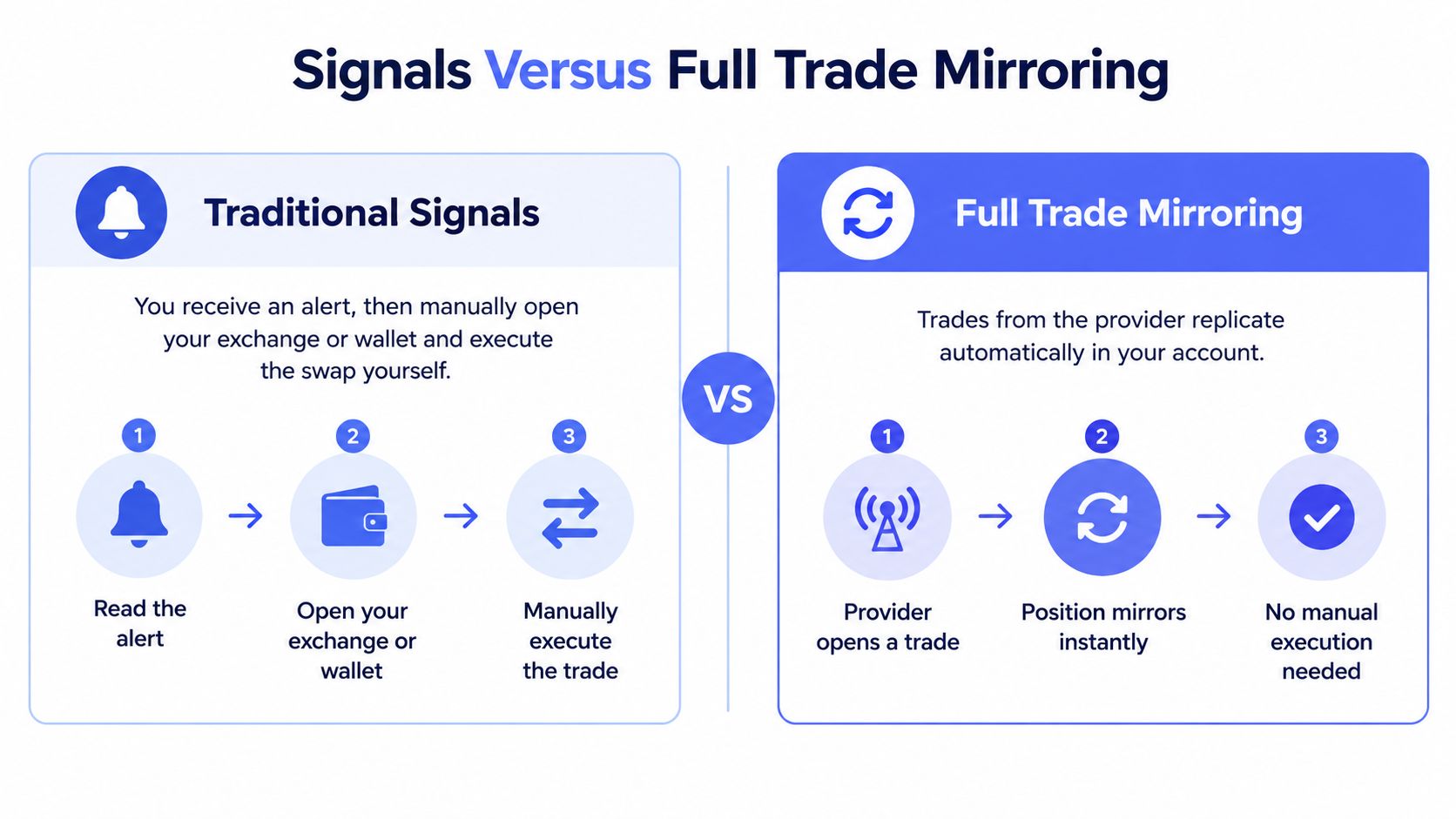
With signals, you get an alert, decide whether to act, then place the trade yourself. That gives you control, but it also adds delay, hesitation, and missed exits. The common failure point is often the sell. Manual copiers get stuck holding after the leader has already closed.
Manual copying
Manual copying depends on attention. If you are asleep, in transit, or busy with something else, the trade may be gone. That matters in crypto, where prices move fast and positions can be short-lived.
Manual flow also creates uneven behavior. Traders often catch the entry, then miss the exit because they stop watching after the buy. The position no longer matches the source trade.
Automated mirroring
Automated mirroring changes the job. The system watches the source, builds the matching swap, and sends it without waiting for a click. Both entries and exits can move through the same workflow.
That model suits traders who want the process running in the background. It does not remove risk. It removes the manual gap between noticing a signal and getting a fill.
A live example is copyfomo, a Telegram bot that mirrors chosen fomo leaderboard traders into the user's own wallet at a configured size. It copies both entries and exits, and it runs as unattended execution rather than as a push alert system. More detail sits in this copy trading app overview.
Trade mirroring is only as strong as its weakest link. If the system cannot carry the exit, the user still carries the position.
Execution Latency and Slippage Risks
The leader gets one fill. The copier gets another. That is the core problem. The follower does not receive the source trader's execution price, only a later one after the signal has travelled, the order has been built, and the trade has hit the chain.
That delay becomes slippage. In thin markets, or in fast-moving tokens, the copied order can land at a meaningfully worse price than the source trade. The copy is still technically correct, but the economics change.
Why the gap matters
The signal has to move through several steps before it becomes a fill. On-chain, that means propagation, order construction, and block inclusion. Each step adds delay. Each delay gives the market more time to move.
One published analysis of Solana and Pump.fun mechanics models this as relative latency slippage and concludes that delays of 2.0 seconds or more make copy trading mathematically loss-making across trade sizes in that setup, because the follower keeps buying at a worse average price than the leader. That is a blunt result, but it matches what traders see in fast markets. The latency analysis is worth reading for the mechanics alone.
The best signal in the world can still become a bad trade if the fill arrives late.
Where traders lose track
Many traders focus on whether the leader was profitable. That is the wrong starting point. The key question is whether the follower's fill still leaves room for the trade to work after slippage and fees.
That's why execution quality has to be measured from signal to filled order. Not from trader selection to expected return. The path matters more than the headline.
If you want a practical breakdown of price impact, this slippage guide is the right place to start. It lines up with the mechanical issue here, which is that the market does not care what the leader paid.
Evaluating Signal Reliability and Trader Histories
Past performance is a record of old conditions. It is not a forecast. A trader history only tells you what worked when the market looked a certain way, with a certain level of liquidity, volatility, and competition.
That matters because traders often pick signal providers from leaderboards and assume the past is portable. It isn't. A strategy that worked in one regime can behave differently when spreads widen, liquidity dries up, or the crowd starts copying the same account.
Leaderboards are descriptive, not predictive
A leaderboard is a snapshot. It tells you who looked strong under previous conditions. It does not tell you whether the same entries will still work after the market changes.
That distinction is important for crypto traders who chase names instead of mechanics. A strong history can still lead to weak future fills if the crowd piles in, if the token turns thin, or if the trader's style no longer fits current conditions.
The risk environment is already harsh
Historical retail trading data shows how hard this market is even before you add execution issues. A 2014 French retail forex and CFD sample of 14,799 active traders found that 89% lost money, with average losses of €10,887. A later UK CFD review found that 82% of retail clients lost money, which makes the broader point clear, even before you get into copy mechanics. The historical outcome data is a reminder that tools don't erase risk.
More recent copy-trading outcome research cited in 2026 found that only 48.48% of more than 100,000 copier outcomes were profitable over a 90-day study period. That doesn't mean copying is useless. It means the copied trade still has to survive the same market reality as any other trade.
What to watch instead
Look at the trader's behavior under current conditions. Watch turnover. Watch how often the account changes direction. Watch whether the execution style still matches the market you're in.
Useful filter: trust histories less than you trust live behavior. A clean track record can still fail the next time the market regime changes.
Non-Custodial Execution and Wallet Permissions
A copied signal is only useful if the wallet can act on it. Non-custodial setups use allowances, so the bot can execute trades without taking custody of the funds. The user keeps control of the wallet and grants bounded spending authority.
That permission layer carries significant risk. A broad allowance increases exposure. A messy revocation path leaves the user stuck, even if the bot never touches custody.
Why allowance scope matters
Standing approvals stay live until the user removes them. OWASP's smart-contract guidance recommends bounded expiry for signature-based permits because revocable or self-expiring access reduces the damage from compromised permissions. OWASP's UX security guidance makes the same practical point, revocation should be easy, not hidden.
For copy trading, the safer setup is narrow allowance, explicit revocation, and tight sizing caps. The bot should only be able to do what the user asked for, and nothing beyond that.
What good permission design looks like
- Limited allowance: grant only the spending scope needed for the configured trade size.
- Explicit revocation: make it easy to shut off access without hunting through menus.
- Tight sizing caps: keep each copied trade inside a defined limit.
- Periodic review: check permissions regularly instead of leaving them open.
The failure mode in non-custodial copying is usually not custody theft. It is overbroad spending authority combined with automated execution.
Why this matters for users
Copy trading works best when the user can step away without giving up control. That balance holds only if permissions stay narrow and revocable. If the allowance is sloppy, automation becomes a liability instead of a tool.
The same principle shows up in copy trading app design, where the product needs to keep execution simple without making the wallet opaque.
Implementing Automated Signal Copying
The setup should start with control, not aggression. Trade size, per-trade caps, and kill switches matter more than trying to mirror everything at once. If the workflow is unattended, the guardrails have to be there before the first copied fill.
The clean operating model is boring. That is a good thing. A bot should mirror the source trader, but only inside the limits the user set. If the market gets messy, the user should be able to stop new copies or close mirrored positions without reworking the whole setup.
The controls that matter
- Trade sizing: fixed size or proportional sizing, but always defined before launch.
- Per-trade caps: keep any single copied order from growing too large.
- Kill switch: pause new copies fast when the source behavior changes.
- Exit handling: make sure sells are mirrored too, not just entries.
Those controls are more important than the interface. A clean screen means nothing if the trade lands late or the position can't be shut down cleanly.
How to think about the workflow
The user picks a trader. The bot mirrors the activity. The account stays non-custodial. That is the whole logic. The only real question is whether the copied position is still acceptable after latency, slippage, and permission scope are accounted for.
For traders who want to reduce the manual gap, a Telegram bot like copyfomo is one way to automate the flow from fomo leaderboard signal to wallet execution. It mirrors filled entries and exits into the user's own wallet at a configured size, with visible slippage on copied swaps. More context sits in this copy trading tools guide.
copyfomo automates the gap between a fomo signal and a filled order. It mirrors entries and exits into your own wallet with non-custodial execution and clear trade sizing. If you want that workflow in Telegram, visit copyfomo and start the bot.
stop reading. start copying.
pick a trader from the fomo leaderboard, set your size, and the entries and the exits land in your own wallet while you sleep.
open copyfomo on telegram →