What Is Slippage in Crypto and How It Impacts Trades
learn what is slippage in crypto, how liquidity and amm pools cause execution drift, and how it compounds pnl drag when mirroring trades on-chain.

Slippage is the gap between an expected price and the actual execution price. In the provided benchmark, a trade equal to 1% of pool liquidity can create about 1% price impact, while trades equal to 5% and 10% can create approximately 5.3% and 11.1% impact respectively. It's a market-execution cost driven mainly by liquidity depth, order size, volatility, and network timing, not an exchange fee.
You submit a copy trade at the price shown on-screen. By the time the transaction fills, the pool ratio has shifted, other orders have consumed depth, or the network has included competing transactions first. The trade executes, but not at the price you expected. For a manual trader, that difference affects one entry or exit. For an automated copytrader, it can recur across every mirrored buy and sell.
That's the practical meaning of what is slippage in crypto. It isn't a mysterious charge added after the fact. It's the difference between the quoted outcome and the executed outcome, measured against the liquidity available when the trade reaches the market.
Table of Contents
- Defining Slippage and Execution Drift
- The Mechanical Causes of On-Chain Slippage
- Measuring Slippage Across Venues and Assets
- Mitigation Techniques for Retail Traders
- How Slippage Compounds in Copytrading
- Managing Execution Risk with Automation
Defining Slippage and Execution Drift
A copytrading entry can look acceptable in the interface and still fill worse on-chain. You approve the swap at a quoted output, but the transaction settles after the pool moves or available depth changes. The wallet receives fewer tokens on a buy, or less value on a sell. That difference is slippage.
The standard calculation is:
Slippage (%) = ((Executed Price − Expected Price) / Expected Price) × 100
The formula is described in MetaMask's explanation of slippage. A worse executed price produces a negative result for the trader. If the market moves favorably before settlement, execution can improve against the original quote.
Slippage is not a fee
A network fee or trading fee appears as an explicit charge. Slippage comes from the price available when the order executes. Two trades can pay the same stated fee and produce different results because their timing, liquidity, or route differed.
The distinction matters in automated copytrading. A copied trade may execute successfully and still trail the source trade because it entered later, used a different route, or reached a thinner market. On the return leg, the same execution gap can appear again. A small disadvantage on the buy and another on the sell reduce the round-trip result even if the token's market move is unchanged.
Calling that difference a fee obscures the execution problem. Compare the copied fill with the quote available at submission and with the liquidity present when the transaction settled.
Practical rule: Record expected price, executed price, asset output, venue, and transaction time for every entry and exit. A single average result cannot show whether the shortfall came from order size, timing, route selection, or market movement.
A reliable way to measure execution
Use the expected price recorded immediately before submission, then compare it with the final execution price or token output. For a buy, a higher executed price generally indicates adverse slippage. For a sell, a lower executed price indicates the same problem in the opposite direction.
This creates an execution baseline without confusing slippage with realized profit or loss. A position can recover after a poor entry, while a good fill can precede a losing trade. Slippage measures the quality of execution, not trading skill or market direction.
Crypto markets operate continuously, so a quote can become stale before inclusion. Fast movement changes the available price between signing and settlement. Thin liquidity can also create a poor fill while the chart appears calm. Repeated automated entries and exits make those small differences measurable, especially when each trade is assessed against its own pre-submission quote. The displayed price remains an estimate until settlement.
The Mechanical Causes of On-Chain Slippage
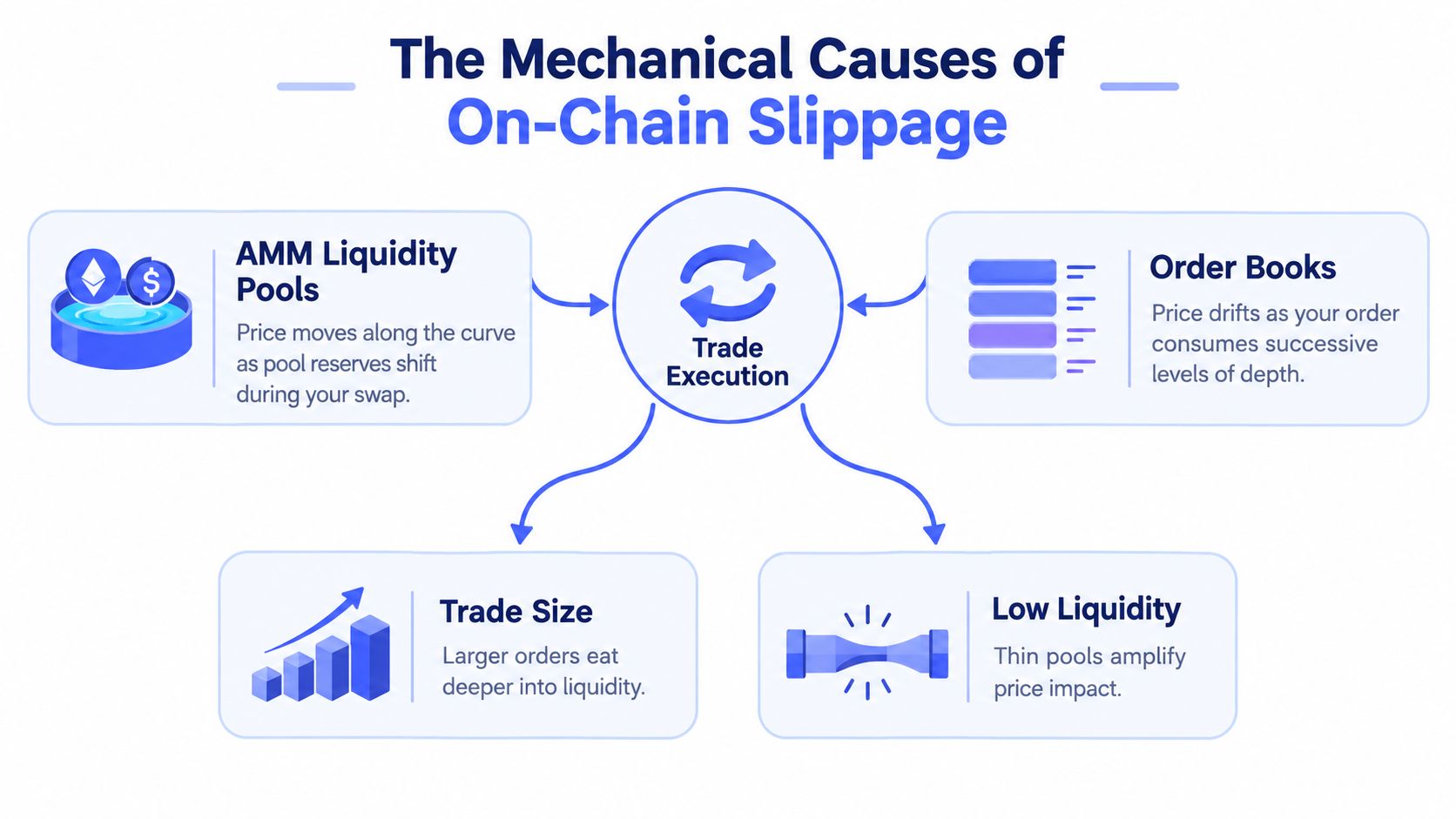
On-chain slippage begins with the way a venue supplies liquidity. Centralized exchanges generally use order books. Decentralized exchanges commonly use automated market maker pools. Both can produce execution drift, but the path differs.
An order book shows available bids and asks at successive prices. A market order consumes the best available level first. If the order is larger than the volume at that level, it continues through the next level, then the next. The final execution price becomes an average of those fills. Thin depth means the order reaches worse levels sooner.
An AMM pool works differently. The swap changes the quantities of the two assets held in the pool. That changes their ratio and therefore the price available for the rest of the transaction. The larger the order compared with the pool, the more the reserves move and the greater the deterministic price impact.
Price impact and realized slippage are different
Raydium's documentation on slippage and price impact separates two related concepts. Price impact is the deterministic effect of your own trade against the pool's reserves. Slippage is the difference between the quoted price and the final on-chain execution price, which can also reflect latency, concurrent transactions, and block inclusion order.
That distinction is useful in post-trade analysis. A large swap can have high price impact even if the transaction settles quickly. A smaller swap can have low expected impact but still receive a worse final price because another transaction changes the pool before yours is included.
Network delay expands that exposure window. A copied transaction may be submitted after the source transaction, while other traders are changing the same pool. On an order-book venue, displayed depth can disappear. On an AMM, reserves can shift. The protocol isn't imposing a penalty. The market state changed before settlement.
Why size and liquidity dominate
The relationship between size and pool depth is not linear in practice. A trade that represents a small share of available liquidity may move the price modestly. The same trade against a thin pool can move the price sharply. BIT's slippage guide gives a market-maker-style rule of thumb where 1% of pool liquidity corresponds to about 1% price impact, while 5% corresponds to about 5.3% and 10% to around 11.1%.
Those figures aren't a universal quote for every AMM or asset. They illustrate the underlying relationship. Order size must be evaluated relative to available depth, not in isolation. A trade that looks small in currency terms can still be large for a low-liquidity token.
Measuring Slippage Across Venues and Assets
Execution quality varies by venue, asset, order size, and market conditions. A liquid Bitcoin pair on a centralized exchange has different execution mechanics from an emerging token traded through a decentralized pool. Comparing their fills against one shared standard produces misleading conclusions.
Typical ranges vary by venue and asset class, as noted earlier. The figures below are practical reference points, not guaranteed outcomes for every market.
| Asset Class | Venue Type | Typical Slippage Range |
|---|---|---|
| Bitcoin | Major centralized exchange | 0.02, 0.05% |
| Ethereum | Uniswap 0.3% pool | 0.1, 0.3% |
| Emerging tokens | Uniswap | 1, 5% |
| Extremely low-liquidity tokens | Decentralized exchange | 5, 20%+ |
A single “normal slippage” setting cannot cover these markets. Pool depth, order-book liquidity, trade size, route length, and volatility all affect the fill. A low-cap token may show an attractive quote while offering little executable liquidity behind it. In automated copytrading, that difference matters on every entry and exit. Small execution gaps can accumulate across repeated round trips.
Use benchmarks as context, not targets
A benchmark can flag unusual execution, but it does not determine whether a trade should be submitted. The same token may produce different results across pools. A multi-step route may improve the final price, or create more points where reserves and transaction timing can change.
On order-book venues, inspect available depth near the current price. On AMMs, check pool size and expected price impact. Coinbase's explanation of slippage and spread defines slippage as the gap between the expected and executed price, and explains how low liquidity and volatility widen it.
One tested environment reported 0.0035% slippage on a $100k market order on a live perpetual DEX. That result cannot be transferred to every DEX, asset, or market condition. It is useful only with its venue, order size, and test context attached.
Review fills by market, route, direction, and order size. Separate entry slippage from exit slippage, then calculate the combined round-trip effect. Exit execution can be harder to control because liquidity may disappear while the position is open. In copytrading, repeated entries and exits turn that execution drag into a recurring reduction in realized returns.
Mitigation Techniques for Retail Traders
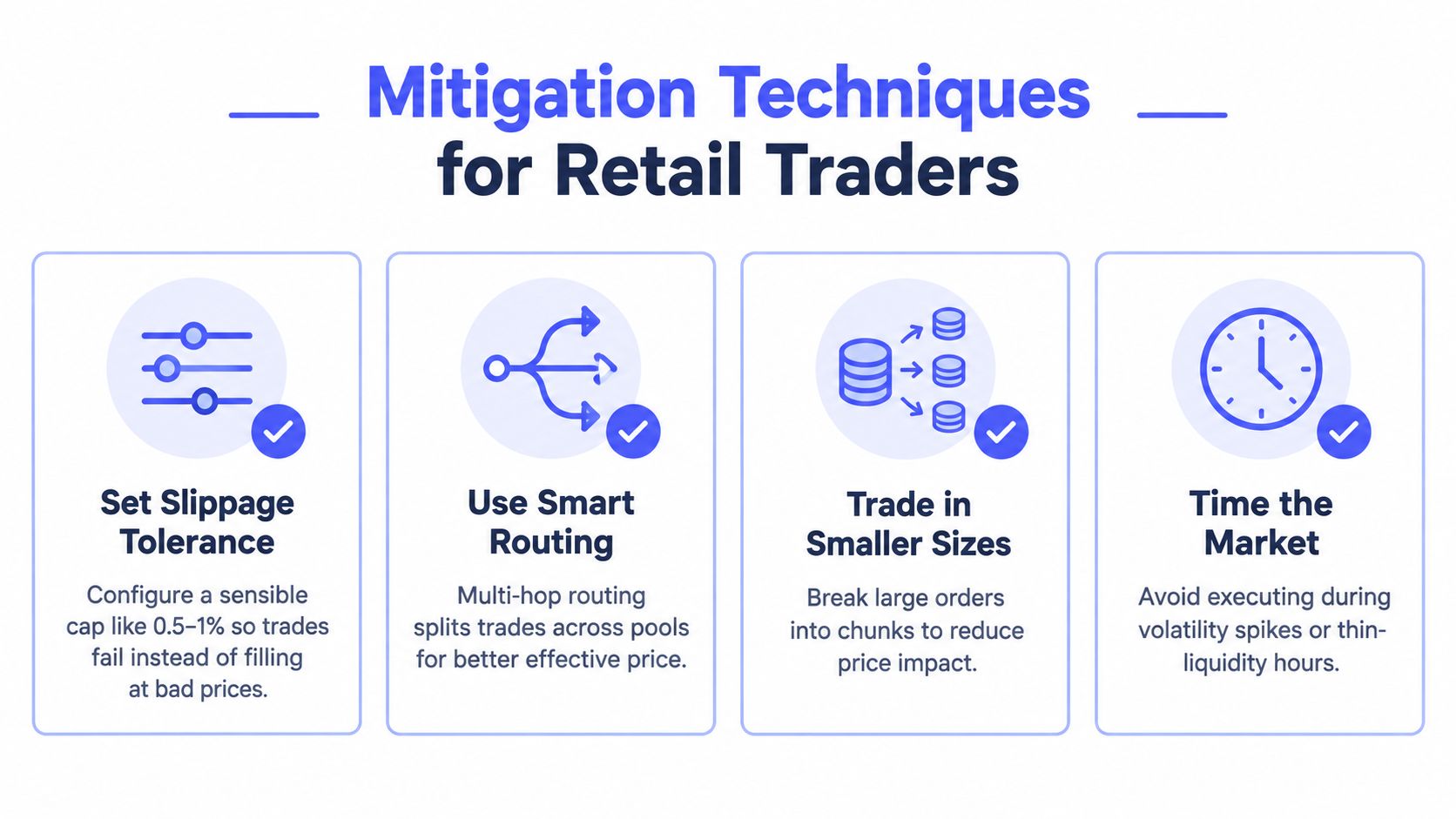
You can't remove slippage from market execution. You can control the conditions that make it worse. The objective is to reject unacceptable fills, reduce the order's effect on available liquidity, and avoid submitting into unstable market conditions.
Set a tolerance with a clear purpose
On an AMM DEX, slippage tolerance defines how far the execution may move before the transaction fails. A setting that's too tight can produce repeated failures during volatility. A setting that's too loose can accept a fill you wouldn't have chosen manually.
Start with the lowest tolerance that fits the market and transaction. Increase it only when you understand why the trade is failing. Don't treat a high tolerance as a way to guarantee execution. It trades execution certainty for price control.
Binance's glossary entry on slippage explains why AMM interfaces expose configurable tolerance. Larger swaps change the token ratio in the pool, and the transaction can be rejected if the final price moves beyond the selected limit.
Reduce the market's workload
Several practical choices improve control:
- Check depth first: Compare the intended size with order-book levels or pool liquidity. A displayed quote isn't enough.
- Split large orders: Smaller transactions can reduce the immediate price impact, although repeated trades still face changing prices and fees.
- Use limit orders where available: You gain price control, but the order may remain unfilled. That's the trade-off.
- Review the route: Multi-hop routing can improve the effective price when liquidity is fragmented, but each additional step adds execution dependencies.
- Avoid unstable windows: Fast markets and thin liquidity increase the chance that the quote will be stale before settlement.
Automation doesn't make these decisions irrelevant. It makes the rules more important because the system may submit trades while you're offline. The copytrading tools guide is relevant when comparing the execution controls and reporting a trader expects from an automated workflow.
A tolerance setting also has a security dimension. Excessively broad acceptance can expose a transaction to adverse ordering and sandwich activity. A tight setting protects the price but may fail during ordinary market movement. The right balance depends on liquidity, volatility, route, and the cost of missing execution.
How Slippage Compounds in Copytrading
A source trader buys first. The copy transaction arrives later. Even a short delay can matter when the same pool is moving quickly. The copied entry may receive fewer tokens, and the eventual copied exit can suffer another execution gap when liquidity has changed again.
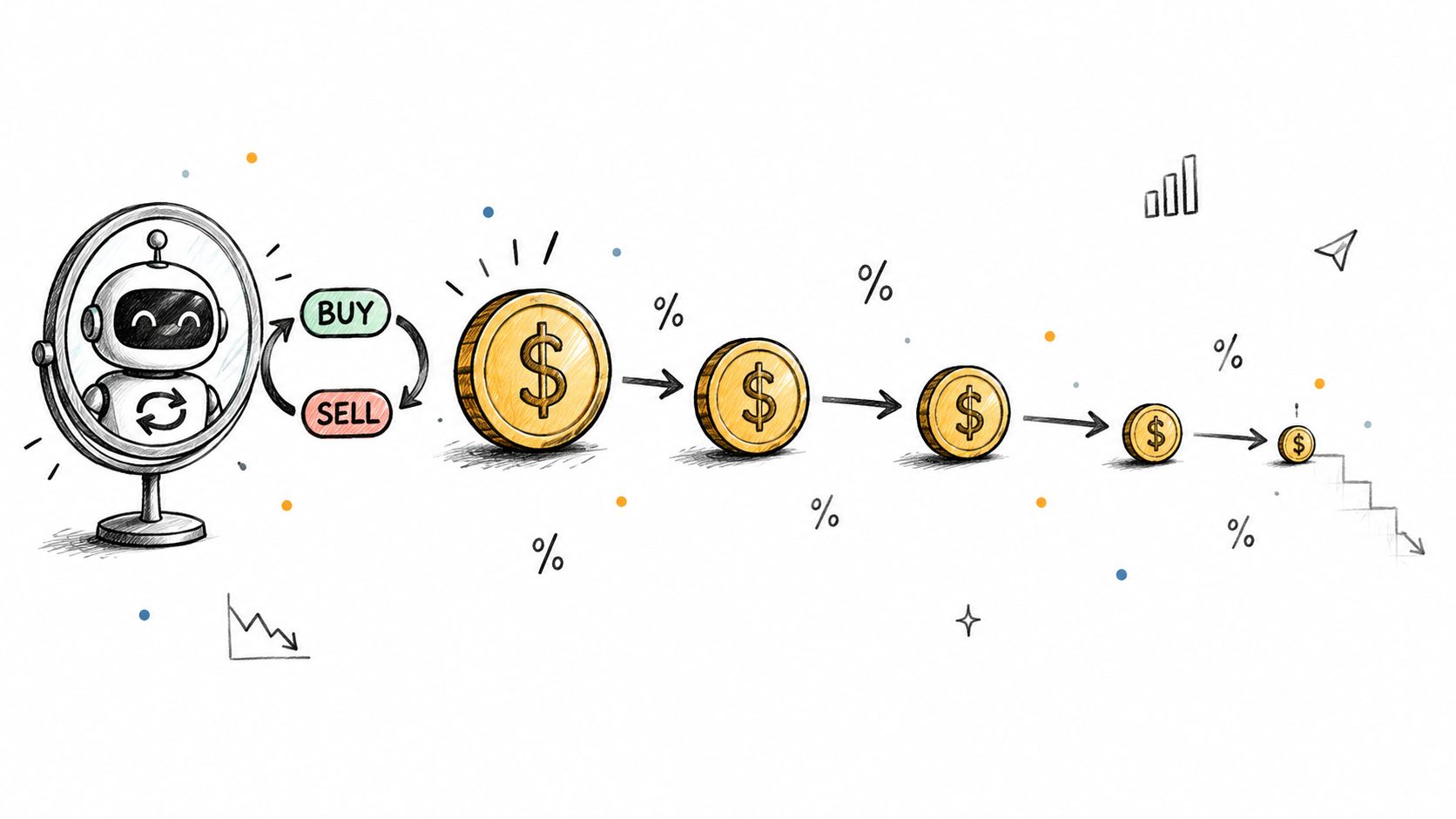
The problem isn't limited to one poor fill. Copytrading mirrors a sequence. If the system copies both entries and exits, every leg has its own expected price, execution price, route, and liquidity conditions. A small adverse difference at entry changes the position size. A later adverse difference at exit changes the amount returned. Together, those gaps create persistent execution drag.
Round-trip measurement matters
Looking only at the source trader's entry misses the main operational risk. Compare the source and copied trade at four points:
- Entry quote: What price or token output was available when the copy order was prepared?
- Entry fill: What did the copied transaction receive?
- Exit quote: What was available when the source or copy exit was initiated?
- Exit fill: What did the copied sell return?
This view separates market movement from execution quality. A copied position can move against the trader for ordinary market reasons. Slippage is the additional difference between the expected and actual fill on each leg.
A one-second delay can be enough to change the route or pool state in a fast market. A transaction can also encounter a different path from the source trade. The copied sell may then reach a thinner pool, especially if other holders exit at the same time. That's why an entry that looked close to the source doesn't prove that the round trip was close.
The meaningful unit of analysis is not one copied trade. It's the complete entry-to-exit sequence.
This guide to the best copy trading bot should be read with execution reporting in mind, not just trader selection or interface features. A system that shows each copied swap, timestamp, and displayed slippage gives you the evidence needed to evaluate whether the process is behaving as expected.
The source trader's result doesn't transfer automatically. Copy trading carries risk, and past performance doesn't predict results. Slippage is one reason. The copied account may enter later, receive a different token amount, face a changed exit route, or remain exposed after the source has already sold.
The following video provides an additional visual explanation of crypto trading execution and slippage mechanics.
Managing Execution Risk with Automation
Automation changes the operational burden, not the underlying market risk. A non-custodial system can mirror filled entries and exits into your wallet, but each copied transaction still faces liquidity, route, timing, and price-impact conditions.
The custody model matters. With allowance-based execution, funds remain in the user's wallet and permissions can be revoked. That reduces counterparty exposure compared with handing assets to an external custodian, but it doesn't protect against a poor fill, a volatile token, a failed transaction, or a losing trade.
What useful monitoring looks like
A serious execution workflow should expose more than a success notification. For each mirrored swap, review:
- Timestamp: When did the copy transaction execute relative to the source?
- Direction: Was the transaction an entry or an exit?
- Expected output: What did the quote indicate before submission?
- Final output: What did the wallet receive in the end?
- Displayed slippage: How far did the fill move from the quoted result?
- Position status: Did the copied exit close the intended exposure?
Live feeds help because execution quality is time-sensitive. Reviewing a monthly result alone can hide whether a few low-liquidity exits caused most of the drag. Per-trade reporting gives you a way to pause copying, adjust sizing, or change the trader set when the execution profile no longer fits your tolerance.
Crypto auto-trading explained also needs to be evaluated through this lens. The useful feature isn't that a bot can submit a transaction while you're away. It's whether the system makes the resulting execution visible and keeps control mechanisms available.
copyfomo is a Telegram bot that mirrors filled entries and exits from traders ranked on the fomo leaderboard into a user's own wallet at a configured trade size. It provides a live feed with timestamps and displayed slippage for copied swaps, while spending permissions remain revocable. It doesn't remove market risk, and it doesn't turn a source trader's past performance into a forecast.
The practical standard is straightforward. Choose sizing you can monitor, define what execution drift you'll tolerate, and review both buys and sells. Copy trading carries risk. Past performance doesn't predict results. Slippage control is part of the process, not a promise of a better outcome.
copyfomo mirrors fomo leaderboard trades through a Telegram bot, including both entries and exits, while funds stay in your wallet through revocable permissions. Review copied execution and displayed slippage, then visit copyfomo to start the bot on Telegram.
stop reading. start copying.
pick a trader from the fomo leaderboard, set your size, and the entries and the exits land in your own wallet while you sleep.
open copyfomo on telegram →