Crypto Bot for Beginners: A Practical Setup Guide
crypto bot for beginners explained. learn setup, security, strategy choice, and monitoring without hype or false promises of profit.
You've seen a trader on the fomo leaderboard make clean entries while you were asleep, at work, or staring at the wrong chart. Then you copied the next trade manually, entered late, missed the exit, and blamed the market. That isn't a software problem. It's an execution problem.
A crypto bot can remove some manual work. It can't remove market risk, fees, bad sizing, weak liquidity, or poor trader selection. Copy trading carries the same market risk as manual trading, and past performance doesn't predict future results. The correct beginner mindset is simple: automation is a control system, not passive income.
Table of Contents
- What a Crypto Bot Actually Does for Beginners
- How copyfomo Mirrors Trades Without Taking Custody
- Setting Up Your Wallet and Bot Permissions Safely
- Picking a Trader to Copy on the fomo Leaderboard
- Running and Monitoring Your Mirrored Trades
- Costs, Slippage, and Beginner Risk Guardrails
- Key Takeaways and Where to Start
What a Crypto Bot Actually Does for Beginners
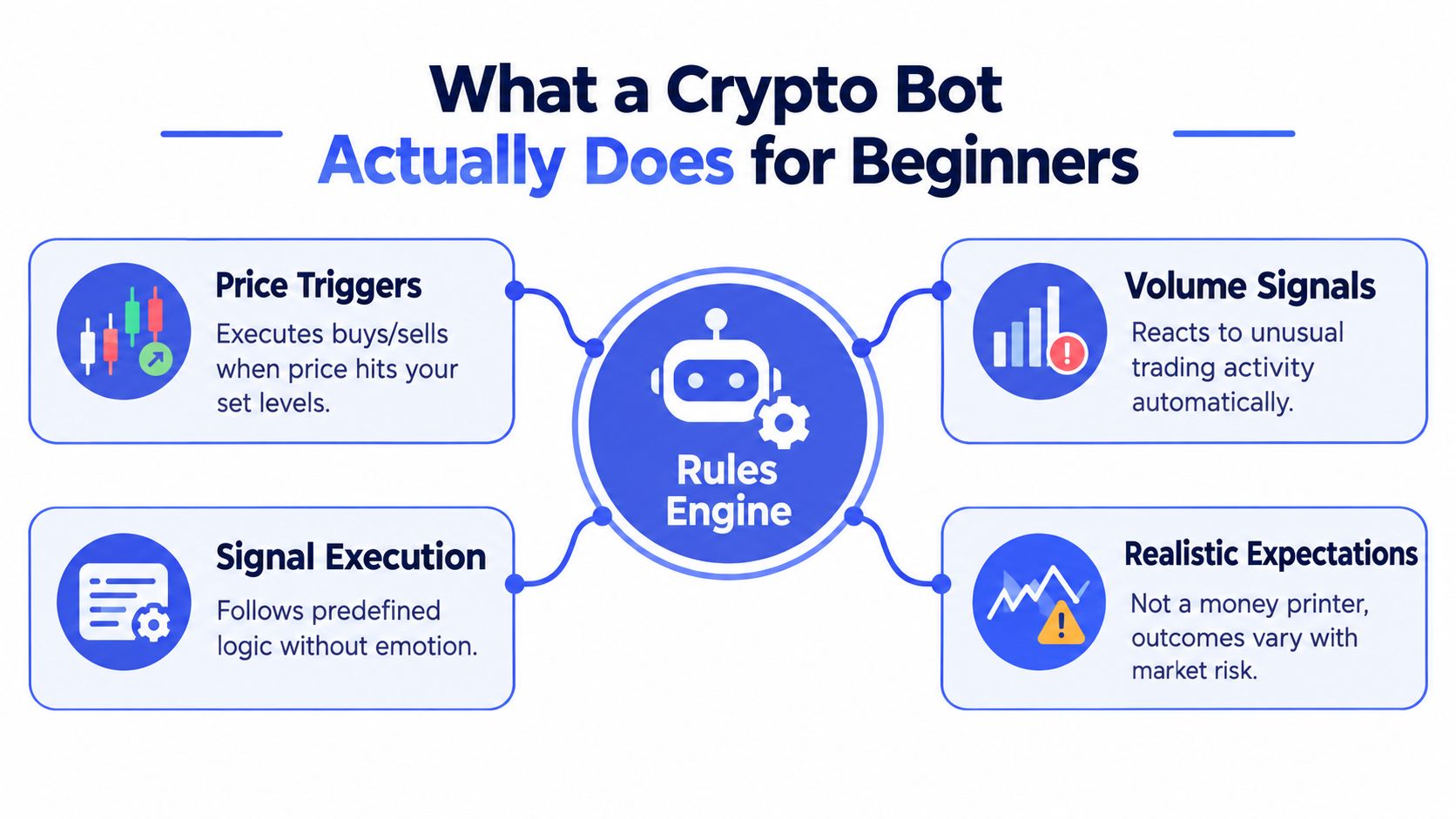
A crypto bot follows rules. It can react to a price level, volume condition, signal, or another trader's transaction. It doesn't understand your financial situation, recognize a broken strategy, or feel discomfort when a position moves against you.
The distinction matters. In a 90-day multi-exchange study covering 100,236 copier outcomes, only 48.48% finished profitably, despite 97.04% of leaders being profitable on their own PnL. The same dataset found only 43.61% of leaders generated positive follower PnL. Those figures are reported in the multi-exchange copy-trading study. A strong source trader doesn't guarantee a strong follower result. Your fill, size, timing, fees, and slippage are different.
Match the bot to the job
Signal bots use predefined market conditions. Execution bots handle orders after a decision has been made. Copy-trading mirrors follow another wallet or trader. These are different tools with different failure points.
A beginner usually makes four mistakes:
- Oversizing: One copied trade consumes too much of the wallet.
- Ignoring costs: Fees, spread, funding, gas, and slippage reduce the result.
- Chasing recent winners: A leaderboard can show a filtered slice of performance.
- Expecting passive income: The bot still needs rules, monitoring, and an exit plan.
The useful setup is a rules engine with a per-trade cap, daily loss limit, pause control, and visible slippage. Start with those controls. Add complexity later, if the simple version survives real execution.
How copyfomo Mirrors Trades Without Taking Custody
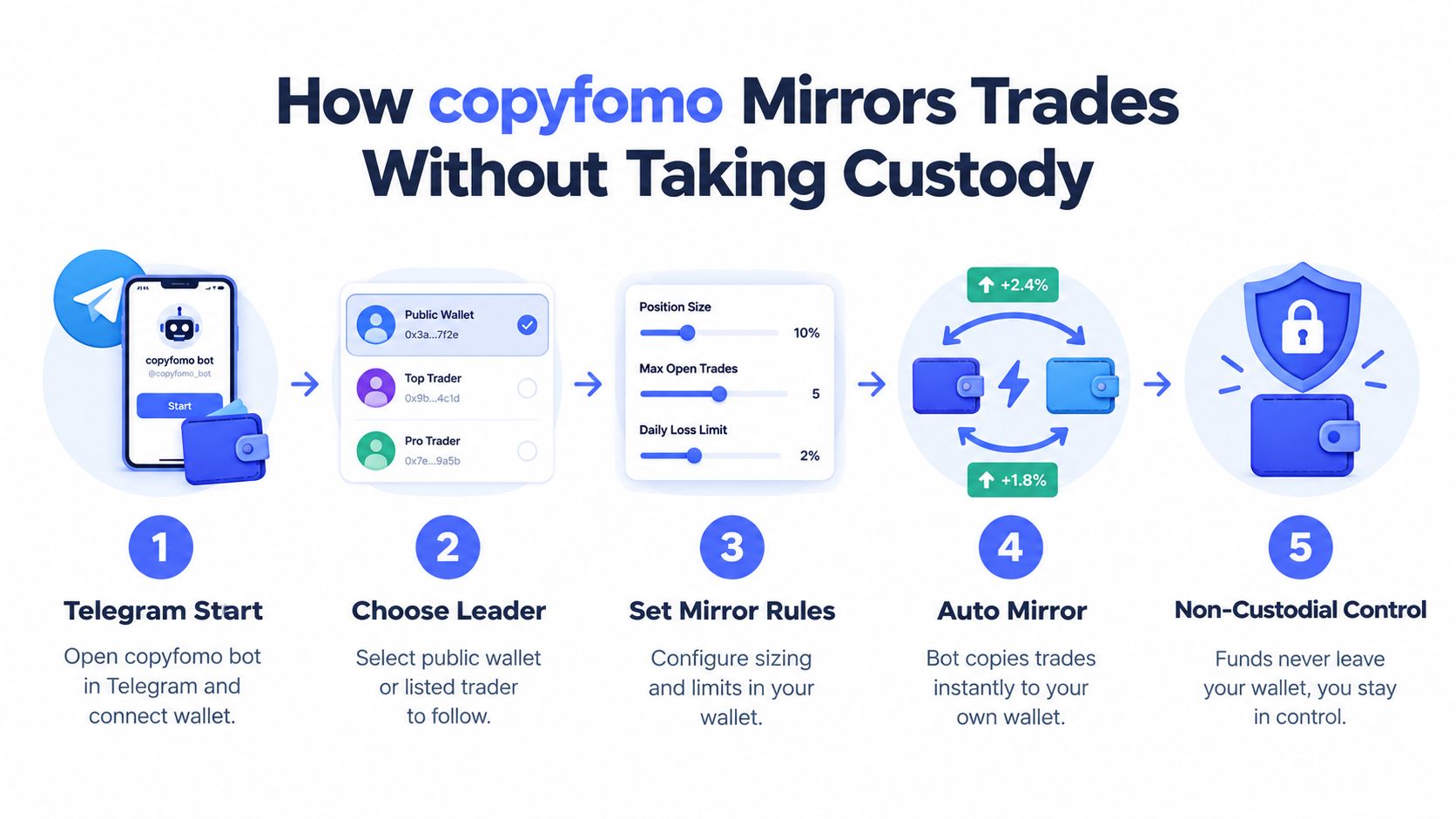
copyfomo is a Telegram bot that lets users automatically copy the trades of top traders on the fomo app. It's designed for traders who already follow the fomo leaderboard and want to mirror filled entries and exits into their own wallet at a configured size.
The custody distinction deserves attention. In a non-custodial or allowance-based setup, your funds remain in your wallet. The bot operates through permissions you grant, and those permissions can be revoked. That's different from a custodial service where you deposit funds into an account controlled by the provider.
The user-visible process is straightforward. Open the bot in Telegram, select a public wallet or listed trader, connect the wallet you control, choose a copy size, and set limits before allowing any trade to run. You're still responsible for reviewing the wallet address, permissions, token risk, and transaction settings.
The important benefit is control, not safety from losses. You can lose money when the copied trader loses, when your execution is worse, or when a token becomes difficult to trade. This guide to the best copy-trading bot is useful for understanding the product flow, but it shouldn't replace your own permission and sizing checks.
The bot can reduce the need to watch every entry manually. It doesn't make the copied trader reliable, and it doesn't turn volatile assets into a predictable strategy.
Setting Up Your Wallet and Bot Permissions Safely
A bot can follow rules, but it cannot judge a wallet prompt for you. Start with a self-custody wallet you control. Create or import it through a trusted wallet application. Store the recovery phrase offline. Never paste it into Telegram, a website, or a support chat. A compromised device can expose the wallet. A leaked recovery phrase gives an attacker direct access to its assets.
Connect through the bot's standard wallet flow. Check the domain and read each wallet prompt before signing. A familiar interface proves nothing. Phishing pages can copy legitimate tools closely.

Permissions come before positions
Use a limited token allowance, not unlimited spending permission, when the wallet and application support that option. Trade-only access is safer than withdrawal access. Check active allowances after use and revoke permissions that no longer serve a purpose.
Set a per-trade cap before choosing a trader. Keep the amount small enough that one failed trade cannot damage the wallet. Fixed sizing is easier to audit than proportional sizing while you are still learning how fills behave.
Before the first mirrored trade, enable the kill switch or daily loss limit. The bot should stop new entries after reaching the threshold. Test the pause and one-tap close controls with a tiny position. Confirm that the position closes as expected and that the allowance remains within the scope you approved.
Security rule: If you can't explain what a permission allows, don't sign it.
Use this compact setup check:
- Wallet control: Recovery phrase stored offline.
- Allowance scope: Limited and trade-only where possible.
- Sizing: Per-trade cap set before activation.
- Emergency controls: Pause and close functions tested.
- Slippage visibility: Expected and actual execution checked.
- Review process: Active permissions checked after use.
For the operating model, read the crypto auto trading overview. copyfomo can execute instructions within the permissions you grant. It cannot protect a wallet whose owner signs every prompt without reading it. Treat the bot as a rules engine and execution system. Set the limits first, then allow it to trade.
Picking a Trader to Copy on the fomo Leaderboard
Treat the fomo leaderboard as raw data. It isn't a list of safe winners. IOSCO warns that imitative trading can expose retail investors to misleading disclosure and filtered performance data, while copy-trading risk guidance highlights survivorship bias. Traders who recently performed well are more visible than traders who failed and disappeared from attention.
Start with realized PnL over the longest period the interface exposes. Then inspect the trade count. A result built around one position tells you less than a record showing repeated entries and exits.
Review average position sizing relative to the trader's portfolio. Heavy margin use or aggressive concentration can make a profile look attractive while creating a risk level you can't tolerate. Study exits too. Short holds with tight targets behave differently from longer positions that wait for a broader move.
A profile showing no losing trades across many fills deserves skepticism. That pattern may reflect incomplete history, simulated activity, or selective display. Don't assume a clean row means a clean process.
| Metric | What to Look For | Red Flag |
|---|---|---|
| Realized PnL | Results across the longest available window | Strong recent result with little history |
| Trade count | Repeated fills across different conditions | One position explains most of the result |
| Position sizing | Exposure that resembles your own risk tolerance | Heavy concentration or leverage |
| Exit behavior | Clear, repeatable exits | No visible exit discipline |
| Losing trades | A record that includes ordinary losses | No losses across many fills |
Shortlist two or three profiles whose sizing and exit behavior you can tolerate. Test with a small allocation before considering any increase. This guide to fomo traders to copy can help you inspect the selection process, but leaderboard rank alone is never a risk assessment.
Running and Monitoring Your Mirrored Trades
A live bot can copy the wrong size, fill at a worse price, or open a duplicate position. The rules engine follows its configuration, not your intent. Monitor the first trades yourself.
Check the slippage display on every fill. Your price can be worse than the source trade in a thin market or during a fast move. That gap matters when the strategy depends on narrow exits or frequent trades. Treat slippage as a cost, not a minor interface detail.
Keep the mirrored feed open during the initial test. Confirm the correct wallet received the fill, the copied size matches your allocation, and the position matches the source trade. If the asset, size, or direction is wrong, pause new copies immediately.
Keep an operating log
Record each fill in a simple log:
- Timestamp: When the mirrored transaction executed.
- Pair or token: What the wallet traded.
- Entry and exit price: The actual prices, not only the leader's display.
- Slippage: The difference shown by the interface.
- Fees: Platform, trading, and network costs.
- Position status: Open, closed, or manually exited.
Review the log weekly. Check for repeated execution gaps, unexpected fees, and changes in the trader's behavior. A trader who shifts from short trades to concentrated positions may no longer fit your original selection.
Set a per-trade cap before copying. Keep a kill switch ready to stop new entries when the feed behaves unexpectedly, the trader changes style, or the market becomes too thin for clean execution. A pause blocks new trades. One-tap close can affect open positions and create additional costs, so inspect those consequences first.
Do not leave a position open because closing it feels like admitting the setup failed. If the copied behavior no longer matches your rules, stop the bot and review the position manually.
Costs, Slippage, and Beginner Risk Guardrails
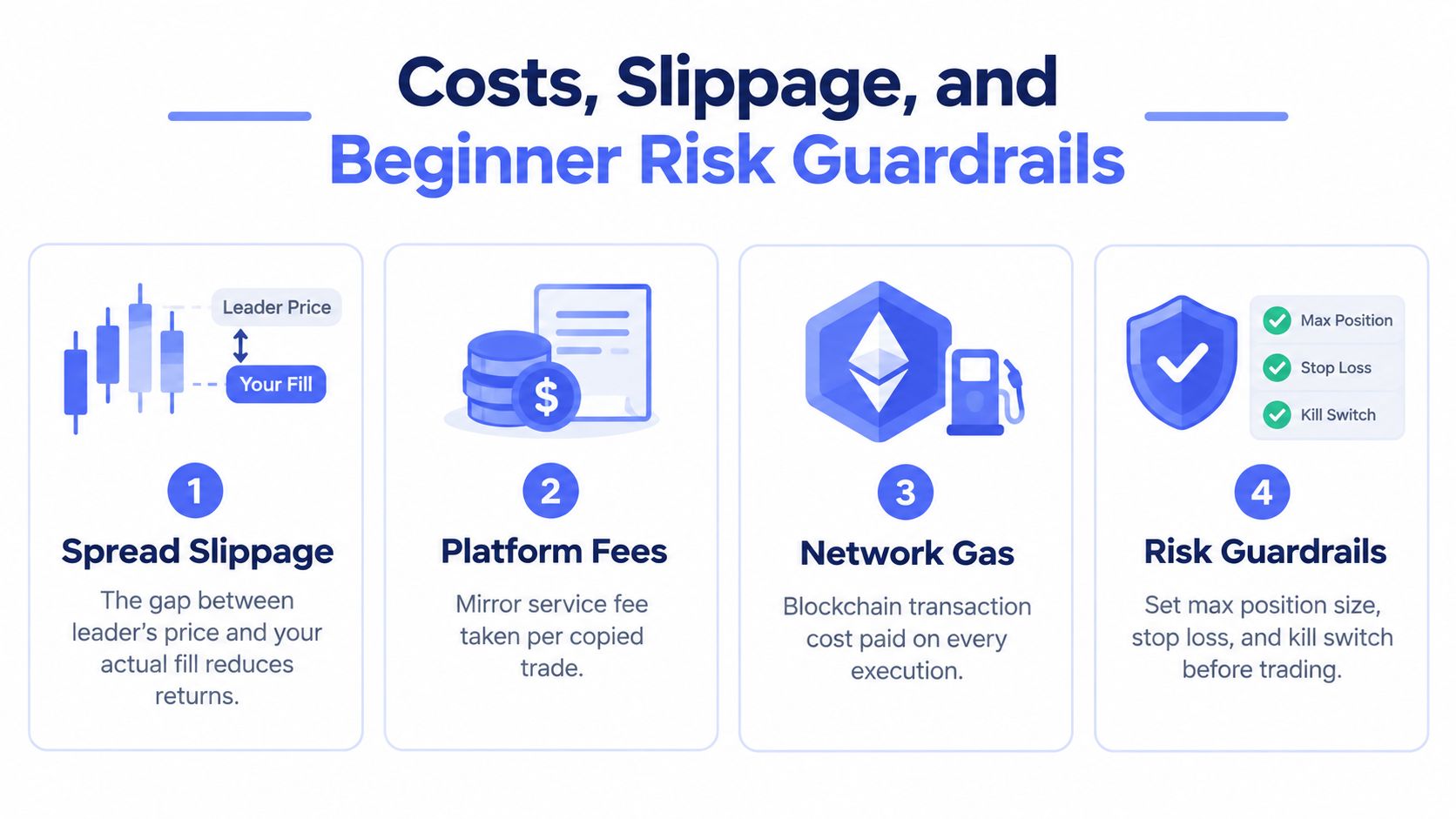
A mirrored trade can look profitable in the source wallet and lose money in yours. The balance alone hides four costs: spread slippage, platform fees, network gas, and latency slippage. Spread slippage separates the leader's price from your fill. Platform fees cover the mirror service or trading process. Gas pays for on-chain execution. Latency slippage appears while the market moves between the source and your transaction.
Beginner guidance recommends paper trading, small starting sizes, and modeling the complete round trip before going live in this beginner bot guide. Apply that rule to copyfomo. The signal is only the start. Your wallet receives an execution after fees and price movement.
Where beginner setups fail
A large allocation to one trader can turn one losing sequence into a wallet-level problem. High-risk profiles and thin-liquidity tokens create another failure point. Gains may look steady until the position must be closed and there is not enough liquidity for a clean exit.
Unlimited allowances add wallet exposure. A compromised contract, or permission left active after use, can create a separate security problem. Keep allowances narrow and revoke access you no longer need. These steps reduce operational exposure, but they do not remove smart-contract or token risk.
Leaderboard history can also distort selection. A short or filtered record may make a trader appear steadier than the full pool. BitMEX's crypto copy-trading guide warns that followers can lose in proportion to the lead trader, with losses amplified by the copied position.
Cost rule: If you have not modeled the complete round trip, you do not know whether the trade has an edge.
Set the controls before activation. Use a fixed per-trade cap so one copy cannot dominate the wallet. Add a daily loss switch that pauses new entries after the limit is reached. Keep allowance hygiene by restricting permissions and revoking unused access. Apply a liquidity filter to trades that may be hard to exit. Set a capital boundary using only funds you can leave untouched for months. Conduct a monthly review of fees, gas conditions, and execution quality because costs change.
The market can stay large while retail activity contracts. Global crypto retail activity reached USD 979 billion in Q1 2026, down 11% from Q1 2025, according to Radex Markets' Q1 2026 market update. The update described that period as part of a two-quarter contraction linked to macroeconomic tightening and reduced retail participation. A bot still needs liquidity beneath each trade. Automation cannot create volume.
Key Takeaways and Where to Start
A crypto bot for beginners should be treated as a rules engine and cost-sensitive execution system. It doesn't create passive income. It follows the settings you provide, and those settings can be wrong.
Use a self-custody wallet you control. Set a per-trade cap before choosing a trader. Enable the kill switch before increasing size. Read the slippage shown on every mirrored fill. Watch the feed instead of walking away after activation.
The fomo leaderboard is a research screen, not a promise. Realized PnL can help you compare behavior, but it doesn't tell you what your fill will be. Past fills don't guarantee future execution, and the source trader's result may not match the follower's result.
A sensible starting process is deliberately boring. Open the copyfomo bot in Telegram, connect a wallet, choose a trader whose sizing and exits you understand, and run a small mirrored position through one complete trade cycle. Review the actual entry, exit, slippage, fees, and wallet balance before changing anything.
You're responsible for position sizing, allowance management, recovery-phrase security, and the decision to continue. Capital can be lost. If you can't accept that outcome, don't activate the bot.
copyfomo gives fomo users a Telegram-based way to mirror selected traders' filled entries and exits into their own wallet with configured sizing and control limits. Visit copyfomo to start the bot on Telegram, then test the setup with a small position and monitor the full execution cycle.
stop reading. start copying.
pick a trader from the fomo leaderboard, set your size, and the entries and the exits land in your own wallet while you sleep.
open copyfomo on telegram →