Follow Crypto Traders: How to Copy Them Safely
learn how to follow crypto traders safely: judge copyability, set sizing limits, check fills, and keep control of your own wallet.
Pick the highest-PnL wallet and copy it. That's the popular advice for anyone who wants to follow crypto traders. It skips the part that matters: whether you can enter, size and exit those trades at prices that leave the strategy intact.
The highest-PnL wallet can be the least copyable. A trader who catches an early move in a thin pool may have a strong result that followers can't reproduce. Judge the trade you can execute, not the result displayed beside someone else's name.
Table of Contents
- What Copying a Trader Actually Transfers to You
- Judge a Trader on Copyability, Not Rank
- Size Each Copy So One Trade Cannot Hurt
- How to Set Up a Follow Step by Step
- Why Copied Fills Differ and How to Check Them
- How Exits and the Kill Switch Work
- Decide Whether to Keep Following Each Trader
What Copying a Trader Actually Transfers to You
A profitable-looking wallet doesn't remove market risk. In its study of retail investors using crypto-exchange apps across 95 countries between 2015 and 2022, the Bank for International Settlements estimated that the median investor had lost approximately $431 by December 2022, nearly half of the roughly $900 invested after downloading an app.
Those estimates aren't a copy-trading success rate. They establish the underlying problem: better access to another trader's decisions doesn't make volatile assets reliably profitable. Automation changes who initiates your trades, not what can happen to the assets.
The distinction between a winning wallet and a follower's exposure matters.
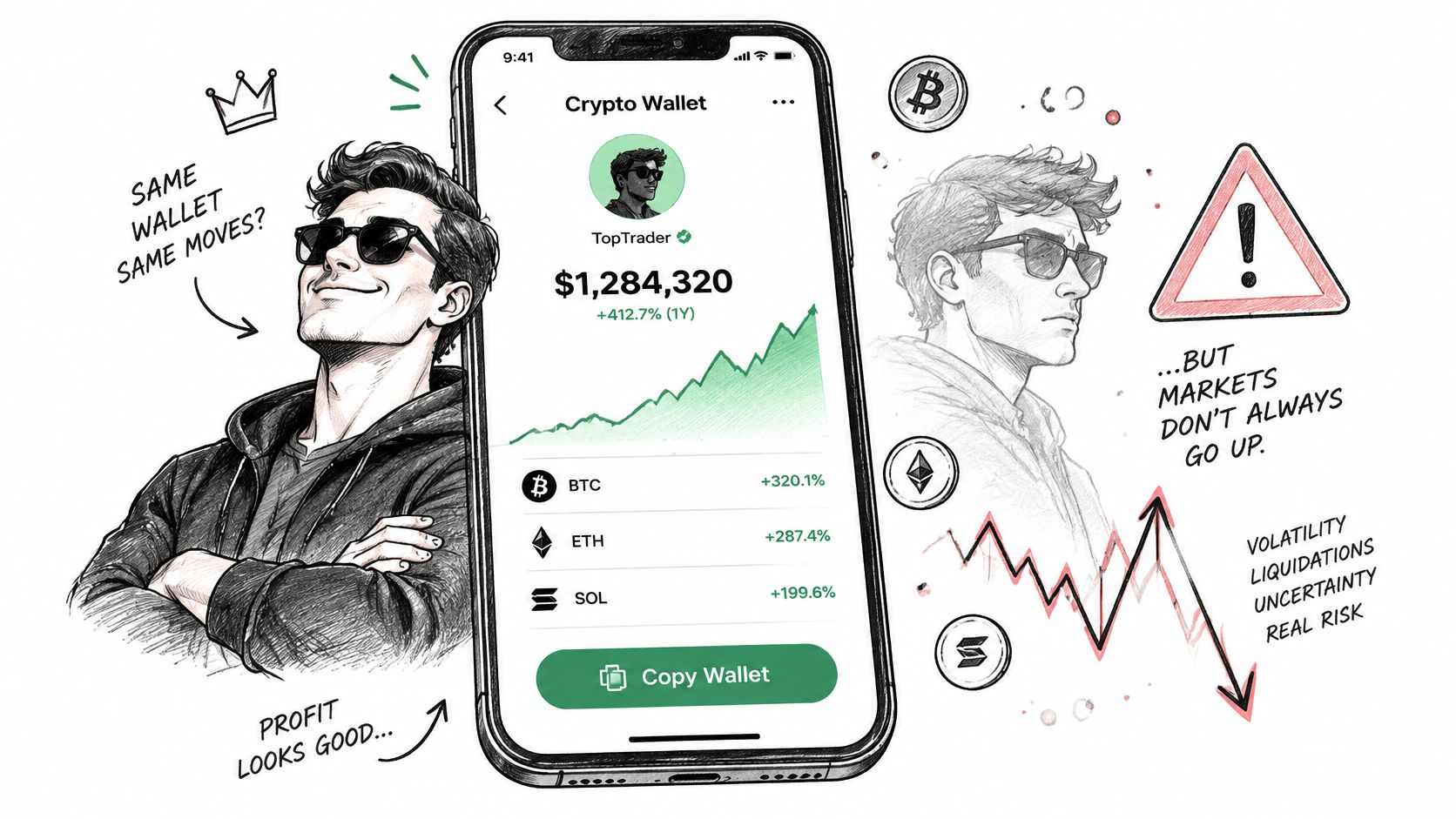
You inherit decisions, not the original result
A follow mirrors a trader's buys and sells into your wallet at your configured size. You take exposure to their timing and decisions. You don't acquire their skill, original entry price or ability to judge when conditions have changed.
Your outcome depends on several separate checks:
- Entry execution. Your fill may arrive after the source price has moved.
- Position size. A sensible source position can become excessive relative to your wallet.
- Available liquidity. A copied order needs buyers and sellers at an acceptable price.
- Exit execution. An entry that looks close enough tells you nothing about the eventual sell.
- Record persistence. Historical results don't establish that the trader's next decisions will work.
Before activation: Write down the result you'll measure, the loss you'll accept and the condition that ends the follow.
Measure your own net outcome, including execution costs and remaining exposure. Don't substitute the leader's displayed PnL for that calculation.
Copy trading carries risk. Past performance does not predict results. A follow transfers exposure to someone else's decisions, with additional execution constraints attached.
Judge a Trader on Copyability, Not Rank
The top of the leaderboard is often the worst place to start without further checks. The fomo leaderboard ranks traders on realized PnL from filled trades. That's a screening signal, not proof of repeatable skill or suitable execution.
An academic analysis of crypto copy-trading platforms found that portfolio popularity was highly correlated with the ranking algorithm and platform interface. Visibility influences whom people copy. A crowded trader card isn't an independent assessment of quality.
Copyability checks for a trader shortlist
| Criterion | What to check | Red flag |
|---|---|---|
| Realized PnL across windows | Result holds over several time windows, not one | A single window carries the whole rank |
| Realized vs unrealized PnL | Profit comes from closed trades | Large open losses sit under a winning rank |
| Drawdown | Losses recover in reasonable size and time | One drawdown erases most of the gains |
| Trade count and holding time | Enough trades to rule out one lucky run | A handful of large bets |
| Win rate and payoff | Average win compared with average loss | High win rate offset by oversized losers |
| Token concentration | Trades spread across several tokens | One token repeated across most trades |
| Liquidity and position size | Trader's size fits the pools you trade | Trades in thin pools where your fill will differ |
| Performance after costs | Result still positive after gas, swap fees and slippage | Only gross PnL is shown |
Start with the measurement windows. A large closed winner can dominate a short record. Compare the same periods for every candidate, including periods when their preferred tokens weren't moving favorably.
Keep realized and unrealized PnL separate. A trader can close winners while retaining losing positions. Read the open exposure before treating the closed-trade total as a complete account of performance.
Read the behavior behind the total
Drawdown tells you what following the trader could require you to tolerate. Inspect both its depth and the time spent recovering. A recovery that required a much larger subsequent bet deserves scrutiny, not automatic credit.
Trade count and holding time help distinguish a repeatable process from a concentrated outcome. Pair win rate with average win and average loss. Frequent small winners don't compensate for occasional losses of unrestricted size.
Token concentration needs interpretation too. Several token names can still represent the same trade if they react to the same catalyst. Conversely, specialization isn't automatically disqualifying, but you need to accept the resulting exposure deliberately.
The final test is executable size after costs. Can the pools accommodate your order, and does the result remain acceptable after gas, swap fees and slippage? The smart money crypto guide provides context for evaluating wallet activity without treating a label as evidence.
Shortlist candidates and compare them on identical criteria. Rank should decide where you look, not whom you trust with execution.
Size Each Copy So One Trade Cannot Hurt
No sizing model makes a trade harmless. The practical objective is narrower: prevent a single copied decision from consuming more of your risk budget than you intended.
A fixed ticket and a proportional ticket fail differently. Choose based on the trader's behavior and the liquidity you'll use, not which setting is easiest to activate.
Sizing models compared
| Sizing model | How it works | Main risk |
|---|---|---|
| Fixed ticket | Same amount on every copied trade | Ignores how large the source trade was |
| Proportional | Scales with the source trade size | An oversized source trade becomes an oversized copy |
| Proportional with per-trade cap | Scales up to a set ceiling | A low ceiling underexposes the trades that matter most |
| Per-token and daily loss limits | Stops new copies after set losses | Can halt copying just before a recovery |
| Liquidity-relative sizing | Sizes against pool depth | Needs a depth check before every fill |
Fixed tickets give the clearest starting exposure. They also flatten the leader's sizing decisions. A tentative entry and a substantial allocation receive the same amount from you.
Proportional sizing preserves relative differences in source trade size. It doesn't establish why the trader used that size. They may be adding to an existing position, reducing another exposure or taking a risk your account shouldn't reproduce.
A per-trade cap constrains that problem. The trade-off is a different allocation from the leader's, especially when their largest positions determine much of their result. Don't expect proportional performance from capped exposure.
Set limits as a package
Per-token limits prevent repeated entries from building an unintended concentration. A daily loss stop limits continued copying during a bad session. Neither identifies when conditions will improve, so either can stop activity before a recovery.
Liquidity-relative sizing addresses a different constraint: your own order can worsen your price. Wallet-based limits alone won't catch that. A ticket can be small relative to your balance and still be too large for the pool.
A cap is a restriction on exposure, not a prediction that the remaining exposure is safe.
Define a base ticket, a per-trade ceiling, a per-token exposure limit and a daily loss stop before activation. Distinguish available bot settings from limits you must monitor yourself. Don't assume every risk rule is automatically enforced.
Small balances need particular care because transaction costs consume part of every ticket. Use the small-account copy-trading guide to assess that trade-off.
Write the amounts into the relevant settings and your review log. Schedule a review after the initial observation period rather than rewriting the rules emotionally after a loss.
How to Set Up a Follow Step by Step
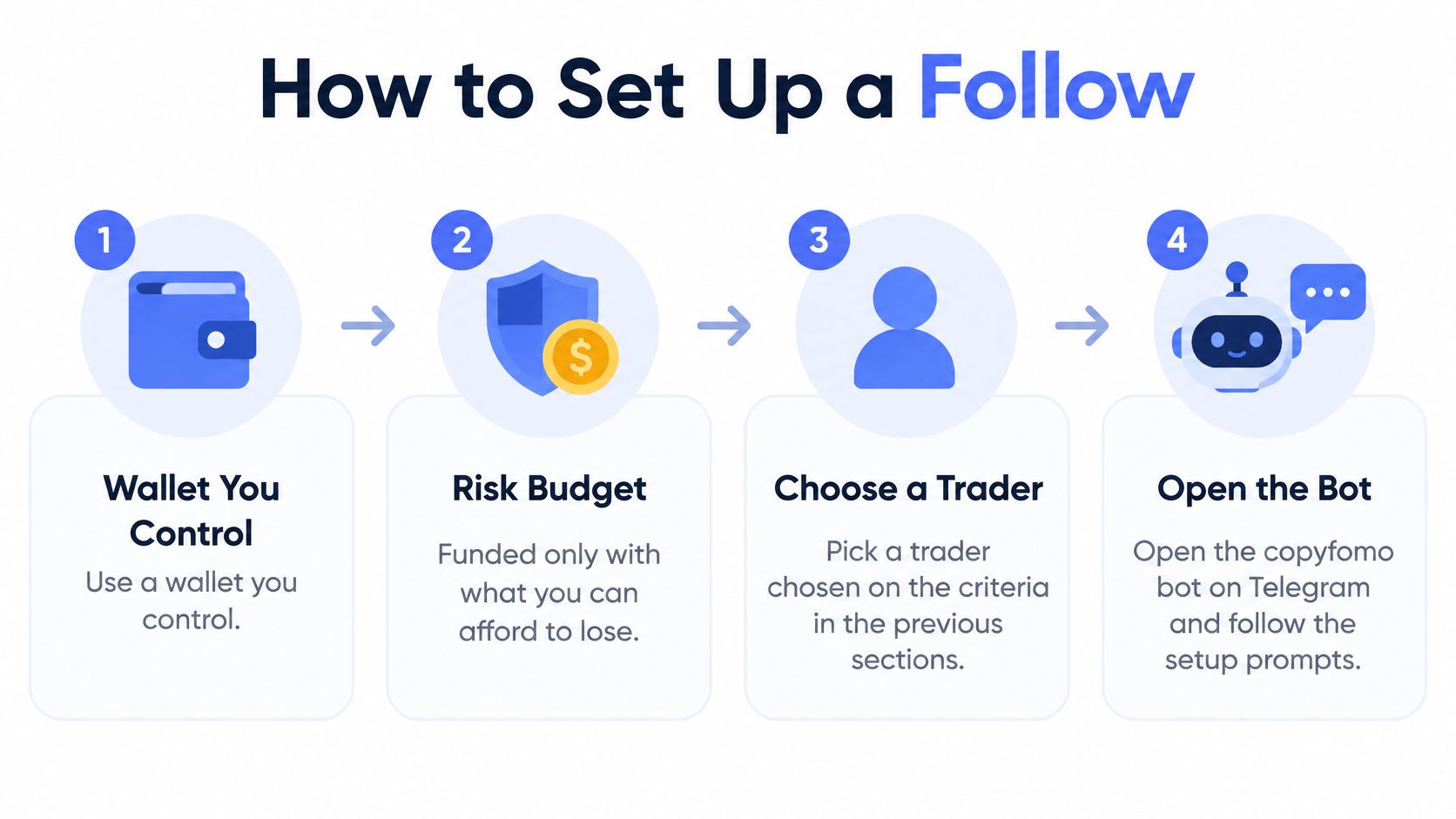
Start with a wallet you control, funded only with money you can afford to lose. Select the trader using a complete record, not a winning screenshot.
copyfomo is a Telegram bot that automatically mirrors the buys and sells of a chosen top fomo trader into your own wallet at your chosen size. Its non-custodial setup keeps assets in your wallet, but permissions still create smart-contract exposure.
Use this setup sequence before allowing unattended execution.
Configure before committing capital
Confirm the trader, chain and wallet. Send
/startto@copyfomo_bot, then select a trader with/leaderboardor/findand enter the copy flow. copyfomo copies trades on Robinhood Chain, Base, BNB and Solana, so don't assume an address or balance on another chain is the relevant one.Set a funding ceiling. Fund your wallet with
/deposit, using only the amount allocated to this activity. Don't transfer your general trading balance just because the deposit step is available.Limit the token allowance. Approve only what execution needs, rather than leaving unlimited spending permission. Ethereum.org's token-access guide warns that unlimited access can let a contract spend all of the approved tokens held by the wallet, and explains that revocation requires an on-chain transaction and network fee.
Save sizing and loss controls before activation. Enter the base size and maximum per trade, then document any additional exposure stops you'll monitor. Funding first and configuring later leaves room for an unintended initial position.
Begin with a small fixed ticket. Use the initial trades to examine execution rather than to validate a profit expectation. Raising size after a favorable price move confuses market direction with fill quality.
Record the revocation route. Know which permission you granted and how to remove it. Keep enough network funds for the revocation transaction instead of allocating the entire balance to trades.
Reconcile the first entries and exits. Compare each mirrored trade with its source, including displayed slippage. A buy message alone doesn't establish that the complete position lifecycle behaves as intended.
If you use an exchange to fund the wallet, assess that exchange separately. NomadCards' guide to European exchange licensing is relevant to that funding decision, not evidence that an on-chain trade or bot permission is safe.
The setup walkthrough provides a visual reference for the bot flow.
A healthy initial review shows corresponding entries and exits, explainable amounts and slippage within your accepted limit. It doesn't require a profitable market move to count as an operational check.
Why Copied Fills Differ and How to Check Them
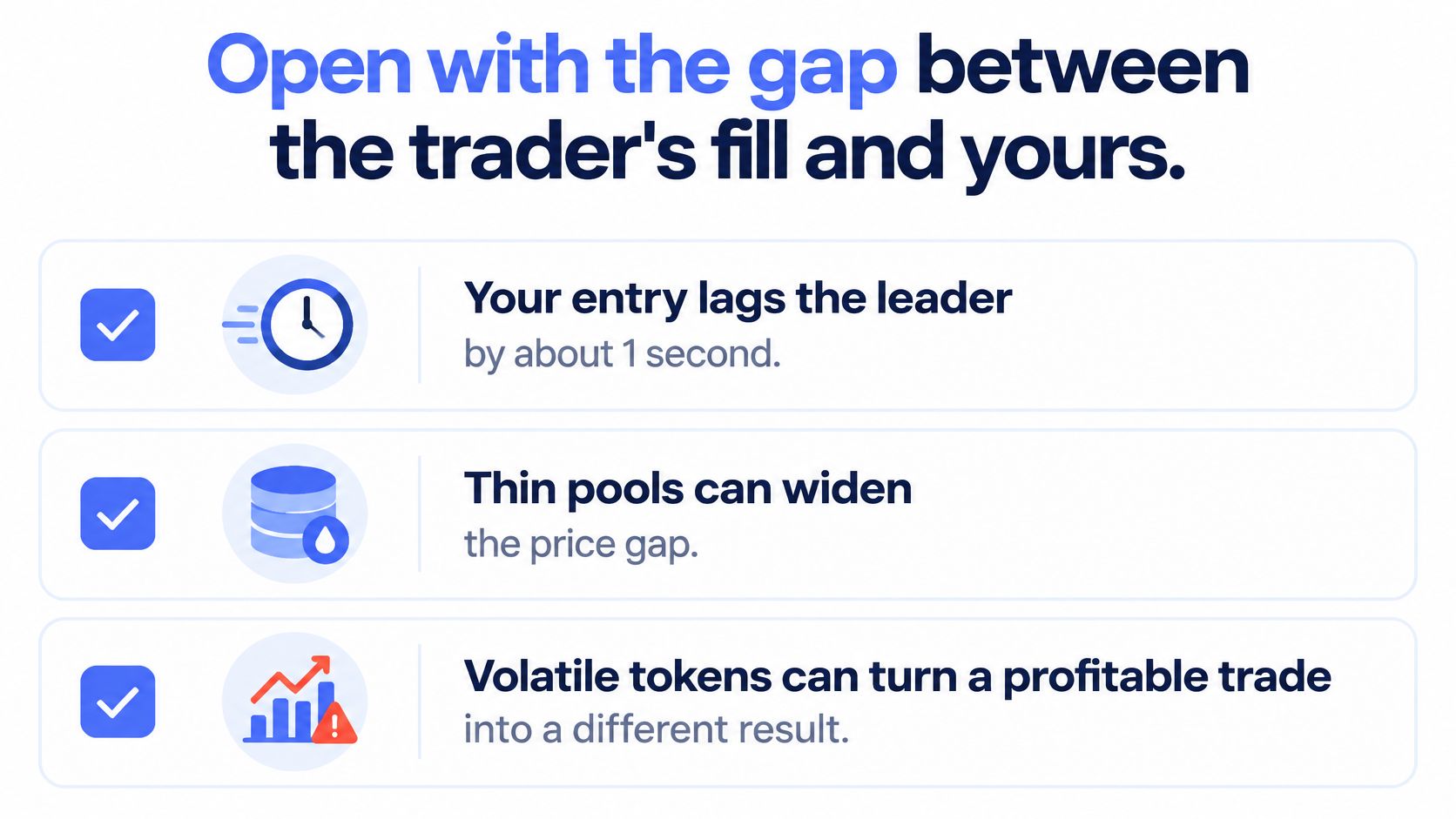
copyfomo mirrors filled entries and exits about one second after the trader's fill. That gap is enough for a different price, particularly when the source order has already moved a thin pool.
The first symptom is usually simple: you receive fewer tokens than the source price suggested. Copying the transaction doesn't copy its price. Block ordering, competing orders and available liquidity affect what remains executable.
Use the execution gap as a checklist, not a reason to widen every limit.
Fill symptoms, causes and checks
| Symptom | Likely cause | Check or fix |
|---|---|---|
| Fill far worse than the source price | Thin pool or large price impact | Cap ticket size by pool depth and reject trades above the impact limit |
| Fill after a sharp move in the token | Latency and block ordering | Set a maximum chase price and an expiry on each order |
| Frequent failed transactions | Slippage bound too tight or gas set too low | Review the bound and gas settings and check the failure log |
| Buys fill above the source, every time | Sandwich or MEV activity on thin tokens | Use smaller tickets on thin tokens and set separate buy and sell limits |
| Exit sells below the source exit | Sell into thin liquidity | Set a sell slippage limit and check pool depth before a large exit |
These are diagnostic hypotheses, not proofs. Repeated worse fills don't establish a sandwich attack without inspecting transaction ordering.
A large empirical study of MEV activity identified about 9.4 million MEV activities among roughly 2 billion transactions, including approximately 3.0 million sandwich attacks. Transaction ordering is an execution risk, not just a technical detail.
Reconcile the actual amounts
copyfomo prints slippage on every copied trade. Read it as an observed execution measure, not a promise that your fill matches the leader's. The slippage-tolerance guide explains the distinction between accepting price movement and controlling it.
For each trade, retain the source reference, timestamps, quoted amount, actual amount, transaction hash and gas paid. Use the bot feed and on-chain transaction record together where necessary. Don't assume a summary message contains every reconciliation field.
Set pool-depth ticket caps, an estimated-impact rejection threshold and separate buy and sell boundaries wherever the execution controls support them. An account-wide maximum chase also needs to suit the traders you follow.
Benchmark net follower results after fees, gas, failed transactions and slippage. A high copied-trade count establishes activity. It says nothing about whether that activity was worth executing.
How Exits and the Kill Switch Work
An entry creates exposure. An exit determines what you receive back. Both buys and sells are mirrored, but a corresponding sell doesn't establish that your position closed completely or at the source trader's price.
Review the source exit and your exit as separate executions. Check the amount sold, remaining token balance and timing difference. A small residual position still belongs in your exposure record.
Understand the re-entry restriction
Once a token has left your wallet through the trader's sell, your take profit or your stop loss, copyfomo won't buy it back for 24 hours. A source trader's re-entry inside that window isn't followed.
That restriction can produce a meaningful difference between your trade sequence and the leader's. If the trader repeatedly exits and re-enters the same token, evaluate whether their style fits the rule before activation. Don't diagnose every missing re-entry as an execution failure.
Take profit, stop loss and maximum-per-trade settings are stored per trader. Minimum trade and maximum chase apply across the account. Check that distinction when following traders with different holding styles.
A personal stop can close your position before the leader sells. A take profit can do the same. Those controls deliberately change the strategy you're following, so compare the resulting sequence rather than expecting identical PnL.
Pause first, then decide what to close
Use the kill switch in a deliberate order:
- Pause new copies. Stop additional exposure while you inspect what triggered the intervention.
- Inspect open mirrored positions. Confirm balances and available exit liquidity before deciding what must close.
- Close with a reason. Optional one-tap closure is an execution action, not a free reset. Selling into a thin pool may impose a substantial price concession.
- Reconcile before restarting. Identify residual holdings, failed sells and tokens subject to the re-entry restriction.
Pausing new copies and closing existing positions are different decisions. Don't combine them by habit.
Test the pause while exposure is small. After each closed position, inspect trade history for the amount committed and the amount received, rather than relying only on the headline result.
A stop loss isn't an assurance of a particular exit price. Mirrored sells and kill-switch controls help manage exposure, but exits don't remove market risk.
Decide Whether to Keep Following Each Trader
Keep, adjust or stop. Make that decision from your own execution record, not from the leader's latest rank.
A Dropstab article on crypto copy trading reports a 90-day sample of 100,236 copy trades in which 48.48% of followers were profitable, compared with 97% of leaders. Those figures describe a specific sample, not a universal market rate. They demonstrate why leader profitability and follower profitability must be evaluated separately.
Use explicit decision rules
| Decision | Evidence to require | Action |
|---|---|---|
| Keep | Your net result is consistent with the source trade sequence after costs, execution stays within limits, and exits reconcile | Maintain the existing configuration |
| Adjust | A specific sizing or execution constraint explains the difference | Change that constraint and record the reason |
| Stop | Persistent divergence, unacceptable exposure or a material change in trading style | Pause new copies and assess remaining positions |
Keep following only when the execution evidence remains acceptable. This doesn't require identical monetary PnL because your sizing differs. It requires an explainable relationship between the trades taken, costs paid and exposure retained.
Adjust when you can identify a bounded operational problem. An oversized ticket in shallow liquidity is a sizing issue. Repeatedly widening slippage to force every trade through isn't a diagnosis.
Stop when the trader changes into a strategy you didn't agree to follow. Much longer holds, repeated additions to losers or a move into thin tokens can change the risk substantially. A familiar handle doesn't mean familiar exposure.
Review without forcing another trade
Use /copies to examine PnL by trader. Trade history lists closed positions with the amount committed, the amount received and entry and exit market caps. Keep open holdings alongside that closed-position record so the review doesn't omit unresolved exposure.
Compare candidate histories across several windows, inspect trader profiles and use the public data page for additional transparency. Read the copy-trading risk posts before changing controls you don't fully understand.
You can also get alerts on any trader card without copying, with no sizing, no fee and no wallet needed. Observation is a valid decision when the record is incomplete. You don't need an active position to keep evaluating a trader.
Copy trading carries risk, and past performance does not predict results. If the checks hold, start small through the Telegram bot available from the copyfomo website. Keep the objective operational: controlled exposure, accountable fills and a clear stopping rule.
copyfomo lets you follow crypto traders from fomo through a Telegram bot that mirrors entries and exits into your own wallet at your configured size. Visit copyfomo to start the bot, select a trader and set your limits before activating a follow.
stop reading. start copying.
pick a trader from the fomo leaderboard, set your size, and the entries and the exits land in your own wallet while you sleep.
open copyfomo on telegram →