Smart Money Crypto: How to Read the Signals
learn smart money crypto signals, how leaderboards mislead, and when a wallet's edge is not copyable.
Smart money crypto means wallets that change balances before price moves, which is observable positioning, not proof of skill or future results.
The useful question isn't which wallet made the most. It's whether another trader could reproduce its entries and exits after delay, fees, and price impact. The wallet with the best realized result can be the worst one to mirror if its advantage disappears before a follower can trade.
Table of Contents
- What Smart Money Crypto Actually Means
- On-Chain Signals That Point to Smart Money
- How to Read Leaderboard Ranks
- Two Prints That Are Not the Same Trade
- When a Wallet Edge Is Worth Copying
- Risks That Copying Does Not Remove
- Tools for Tracking Smart Money
- Start a Copy Only After You Set the Size
What Smart Money Crypto Actually Means
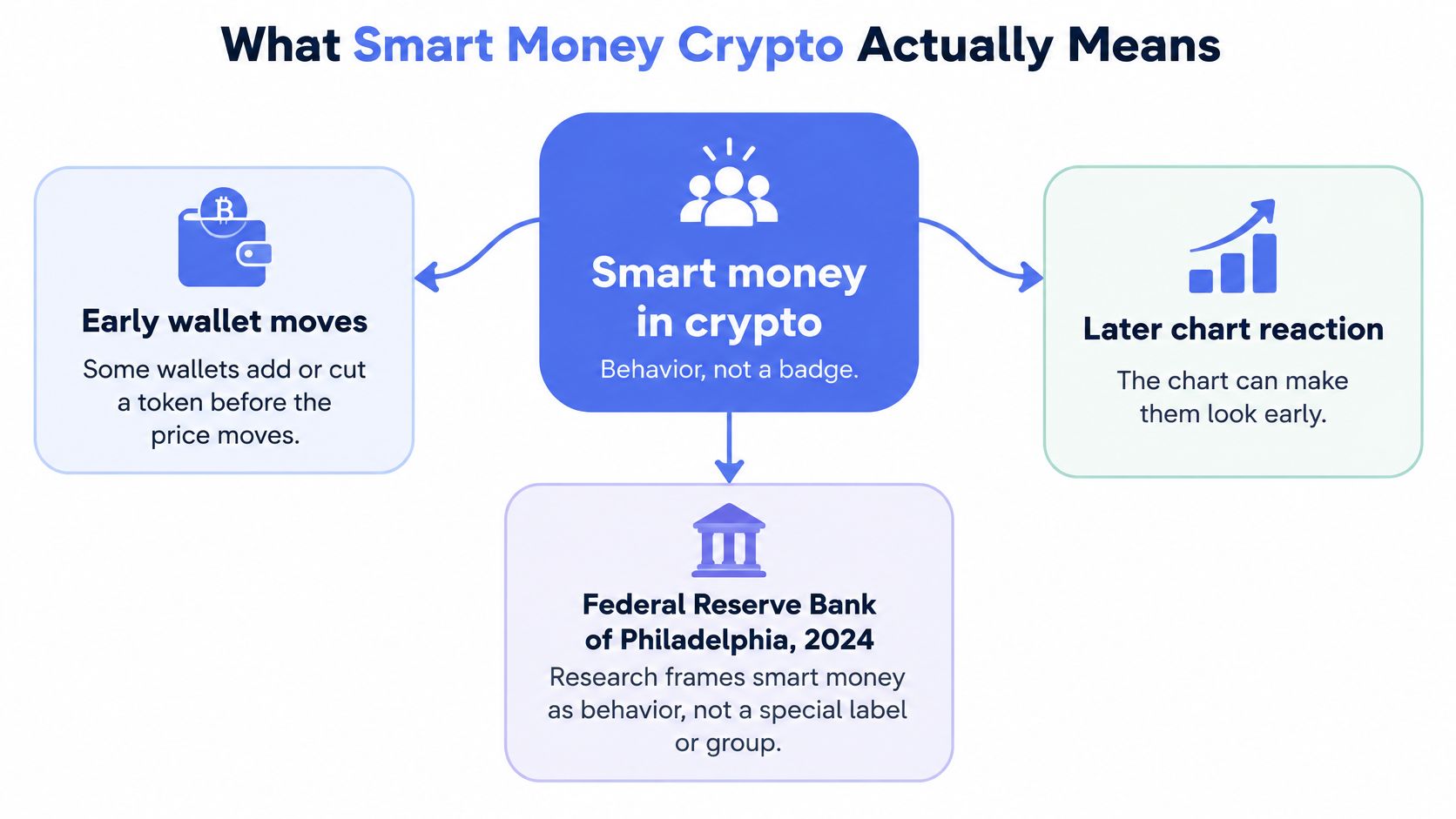
Smart money is a behavior, not a badge. A wallet adds exposure before a price increase or reduces exposure before a decline. The sequence deserves investigation. It doesn't establish who controlled the wallet, what they knew, or whether they could repeat the result.
A 2024 Federal Reserve Bank of Philadelphia working paper, studying Ethereum wallets from 2018 through 2023, found that more than 95% of ETH wallets held less than $1,000, while wallets containing more than $1 million accounted for over 55% of the market. The researchers also found that large holders tended to increase their ETH balances before prices rose, while smaller holders generally reduced their holdings before those increases.
That distinction explains why traders monitor wallets alongside charts. A chart shows the price at which participants traded. Changes in wallet balances can reveal how holders positioned themselves before the wider market repriced an asset.
The distinction is behavioral, not a classification of people.
Size Doesn't Resolve Identity
A large address may represent an exchange, a custodian, an institution, or an individual. Its balance can change because customers deposited assets, a treasury reorganized storage, or a trader bought. Those are different events.
A whale is a large shadow on the water. You still need to establish whether it's one animal or a school.
Working rule: Name the wallet, classify the action, and write down what would invalidate your interpretation.
Use a transaction-level test before assigning intent:
- Identify the action. Separate a swap from an inbound transfer or an internal wallet movement.
- Check the inventory. Establish whether exposure increased or assets merely changed addresses.
- State the alternative. Ask whether custody operations or pooled customer activity could explain the movement.
- Define disconfirming evidence. A matching outbound transfer may undermine an accumulation thesis.
The signal table below is a checklist for interpretation. None of its rows identifies skill by itself. A useful signal must survive an explanation that doesn't involve a well-informed trader.
On-Chain Signals That Point to Smart Money
Smart money signals and false reads
| Signal | What you see | Cautious read | Does not prove |
|---|---|---|---|
| Balance build before a move | Token balance rises over several transactions | Positioning ahead of a repricing | One skilled trader owns the address |
| Exchange or custodian flow | Large moves to or from known venues | Liquidity is shifting | A personal directional bet |
| Realized exit | Sells that close inventory | The holder is cutting risk | You can exit at the same price |
| Fresh funded wallet | New address funded, then buying | Possible informed flow or a bot | Who controls it or why |
| Wallet cluster | Several addresses buy the same token quickly | Coordinated or copied flow | The cluster is profitable |
| Leaderboard realized result | Rank from closed filled trades | A recent score on closed trades | Future results or a copyable fill |
Read these signals as competing explanations, not trading instructions. An inbound transfer supports a much weaker conclusion than a sequence of identifiable purchases. Several addresses acting together may reflect separate traders, shared control, or followers copying the same source.
The practical task is to remove interpretations the transaction record doesn't support. Don't upgrade possible informed flow into known informed flow because the subsequent chart looks convincing.
Read the Whole Inventory Cycle
Say a wallet accumulates through separate swaps, keeps its position through price noise, and later sells into stronger demand. That record is cleaner than a screenshot of a large purchase. You can inspect how the position opened, how long the holder carried it, and how the holder reduced exposure.
Check the funding transaction before treating a fresh address as a new participant. Follow the inventory after the apparent exit, too. A transfer elsewhere isn't necessarily a sale, and a partial sale isn't a completed round trip.
- Trace the entry. Verify that the wallet exchanged assets rather than merely received them.
- Follow the holding period. Check for additional purchases, transfers, and reductions.
- Reconcile the exit. Establish how much inventory remains after the reported realized result.
Ignore screenshots of unrealized gains as evidence of a completed trade. They don't establish whether the holder could sell the position at the displayed valuation. They also omit the route another trader would need to take to close comparable inventory.
Separate Trading Interpretation From Transaction Safety
Address analysis also has a permission boundary. Understanding a wallet's activity doesn't establish that a destination or contract is appropriate to interact with.
For a separate transaction-screening workflow, BroLabel explains how to screen crypto transfers before signing. Use that kind of review to examine a proposed transfer, not to certify a trader's skill or predict a token's price.
A visible transaction proves that an action occurred. It doesn't prove the motive you assign to it.
None of these signals is a buy instruction. Combining them can make a hypothesis more specific, but it can't turn an incomplete address history into certainty. Leaderboard ranks require another test altogether: who qualified for the ranking, who disappeared, and how much closed-trade evidence remains.
How to Read Leaderboard Ranks
A leaderboard answers a narrow question: who scored highest under its rules during its measurement window? It doesn't establish whether the same behavior will hold up in a different market.
Dropstab's coverage of on-chain research described more than 247,000 wallets across six monthly cohorts, reporting 50.0% for a disciplined cohort against negative 7.3% for the average qualified trader and negative 25.3% for Bitcoin, but the study was self-reported, backtested, and not independently audited. Those figures illustrate the distance between a filtered cohort and a broader comparison group. They aren't results a follower should expect.
The selection method matters as much as the displayed score. A ranking can overrepresent wallets that survived while omitting traders who stopped, lost access, or ceased to qualify.
Replace Rank Chasing With Record Checks
Start with the observation window. A trader who looks consistent across rolling periods deserves a different assessment from one whose entire result came from a brief favorable market.
Use the guide to fomo leaderboard timeframes to interpret the window rather than treating every rank as the same measurement.
- Rolling results. Examine overlapping windows and subsequent periods that weren't used to select the wallet.
- Drawdown and loss streaks. Read the path to the final result, not just its peak.
- Closed-trade sample. Set a minimum evidence requirement before examining candidates. Don't lower it to admit a recent winner.
- Inventory accounting. Keep realized PnL separate from unrealized marks and remaining positions.
- Complete records. Verify that the history contains buys and sells, including unsuccessful trades.
- Comparable benchmarks. Compare the wallet with holding Bitcoin over the same window, not a convenient unrelated period.
Test Whether the Behavior Persists
A wallet may look strong when its preferred sector rises and ordinary when that sector stalls. Changing the chain, liquidity tier, or holding period may expose a different risk profile. Don't combine those environments into a single reassuring average.
Selection discipline: Decide what evidence qualifies a wallet before opening the ranking.
Also inspect how inactive wallets are treated. Excluding them can make the remaining population appear more durable than the original group. A leaderboard without that context is a discovery tool, not a complete evaluation.
A lower-ranked wallet with liquid, repeatable round trips may be a more practical candidate for mirroring than the current leader. That isn't a prediction of better performance. It's a distinction between an impressive historical score and a trading process that can be examined under realistic follower conditions.
Two Prints That Are Not the Same Trade
Print A is aggregate ownership. Print B is an individual trading record. Both can appear under the smart money crypto label. They answer different questions.
The concentration picture concerns who holds inventory, not whether a particular trade is reproducible.
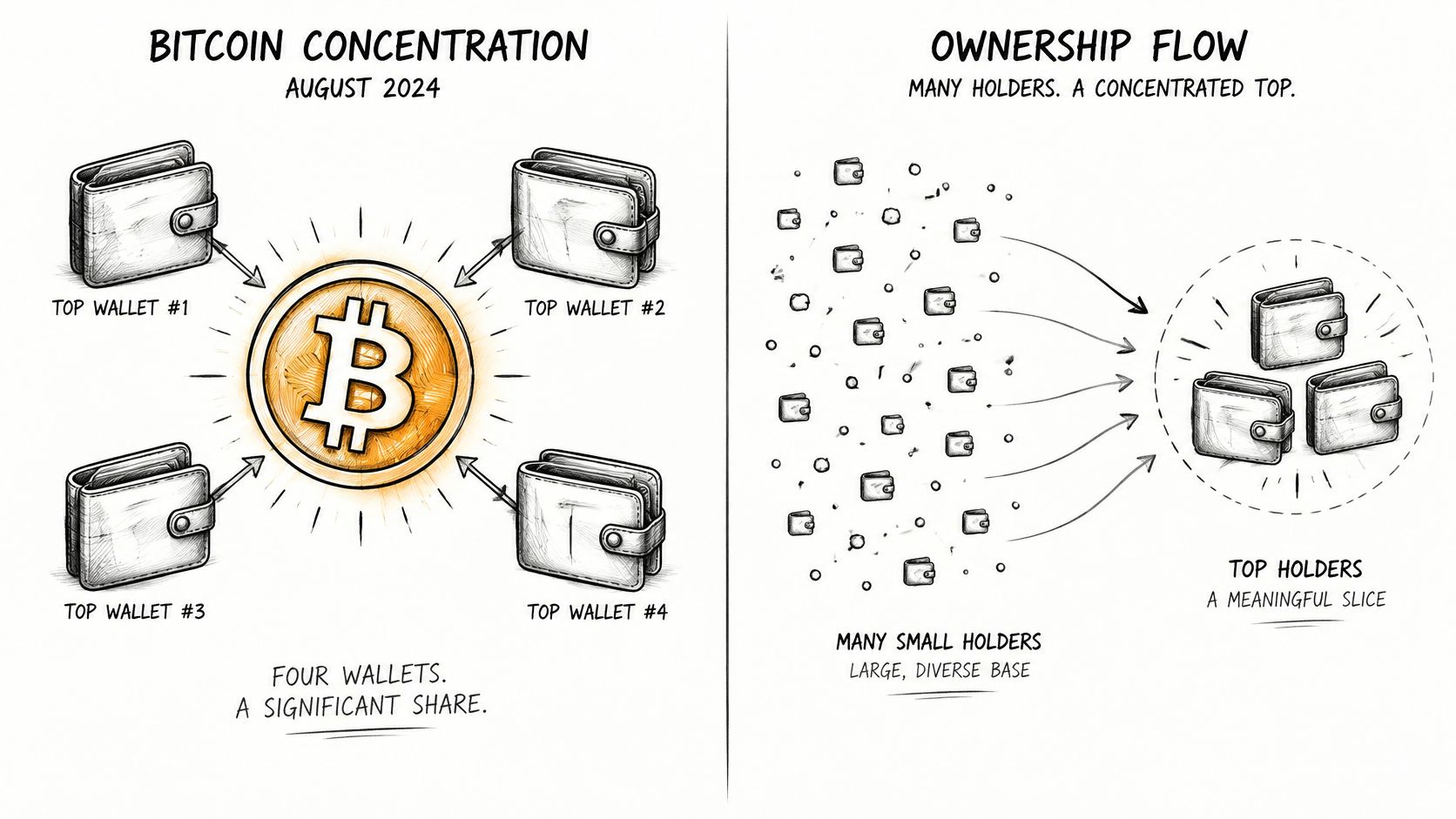
Investopedia, citing BitInfoCharts, reported that in August 2024, four Bitcoin wallets held 3.56% of circulating BTC, while the top 89 wallets held an estimated 15.08%, with those top addresses each containing more than 10,000 BTC. This establishes concentration. It doesn't resolve the owners or identify an executable strategy.
Print A Shows Harbor Traffic
An accumulation category groups addresses by balance. It may include exchange cold wallets, custodians, over-the-counter desks, and fund storage alongside individual holders. Treating the entire category as one trader assigns a shared intention that the classification doesn't establish.
Large movements still matter. They can affect available liquidity and how traders interpret supply. But accumulation alongside rising prices doesn't demonstrate that the accumulation caused the rise.
Label the observation precisely:
- Exchange transfer. Assets moved to or from a venue.
- Cohort accumulation. A balance-defined group increased its aggregate holdings.
- Individual round trip. A particular wallet bought inventory and subsequently sold it.
These aren't interchangeable signals. The first concerns movement. The second concerns group positioning. Only the last provides a direct candidate for examining a mirrored trading sequence.
The accompanying video provides another format for considering the distinction.
Print B Shows One Boat's Log
Say a leaderboard trader has identifiable filled purchases, a measurable holding period, and completed sales in pools with observable depth. You can inspect the order of actions and the inventory between them. That's closer to a boat's log than a count of vessels entering a harbor.
The record still leaves a follower-specific question unanswered. Could another order have entered and exited those pools without materially changing the economics?
A large ownership print can't answer that. Neither can a closed result alone. The candidate must survive an execution test using the follower's intended size and actual fills, rather than the source wallet's historical prices.
When a Wallet Edge Is Worth Copying
The question isn't which wallet looks smart. It's at what size its trading behavior remains copyable.
An empirical study of Uniswap transactions described by Northwestern Kellogg found that small swaps were often dominated by gas costs, large swaps by price impact and slippage, and the probability of adversarial slippage when trading PEPE was approximately 80% higher than for USDC. The distinction matters because a source's transaction and a follower's transaction reach different pool states.
A fast copy can still be an expensive copy. Speed measures elapsed time. Execution quality measures what the follower received.
Execution checks before you mirror a wallet
| Check | What to record | Bad sign |
|---|---|---|
| Delay | Time from the source fill to your fill | You arrive after the pool has already moved |
| Price gap | Your fill versus the source fill | Gap is wider than a normal fee |
| Slippage | Expected price versus price received | Fill is far from the quote in a thin pool |
| Failed or partial copy | Copies that do not land or land much smaller | Failures or cut size keep repeating |
| Exit quality | Whether the source sell is copied | You still hold after the source is out |
| Size versus depth | Your order against pool reserves | The order is a large slice of the pool |
Measure the Follower, Not Just the Source
Record quoted and realized prices, source-to-follower divergence, gas and protocol costs, and any evidence of adverse transaction ordering. Keep failed transactions in the record. Removing unsuccessful copies would make the remaining fills look cleaner than the actual experience.
Coinpaprika's educational guide to copy trading explains that followers trade after the lead trader and can receive worse prices, particularly in volatile or illiquid markets, while MEV can introduce additional execution costs. A displayed source result doesn't include those follower-specific differences.
Don't collapse everything into average slippage. Separate trades by liquidity, size, and holding period. A wallet may be straightforward to follow in deeper pools but impractical in the thin markets responsible for its strongest historical result.
Size Determines Transferability
Use smaller copied orders when a trade would consume a substantial share of reserves. Apply particular caution to memecoins and concentrated-liquidity pools. A fixed slippage limit doesn't make a fill economically sensible when available liquidity is disappearing.
Exit replication belongs in the same assessment. Copying a purchase without reproducing the reduction leaves the follower carrying inventory after the source has changed its exposure.
The best realized result may belong to the least reproducible trading process.
Define execution limits before copying. Pause new orders when measured degradation or repeated failures exceed those limits, and keep a separate decision process for positions already open. Stopping new entries doesn't close existing exposure.
The source may rely on early access, tiny orders, or first-block positioning. If the follower can't match those conditions, the source's apparent edge isn't evidence of a transferable opportunity.
Risks That Copying Does Not Remove
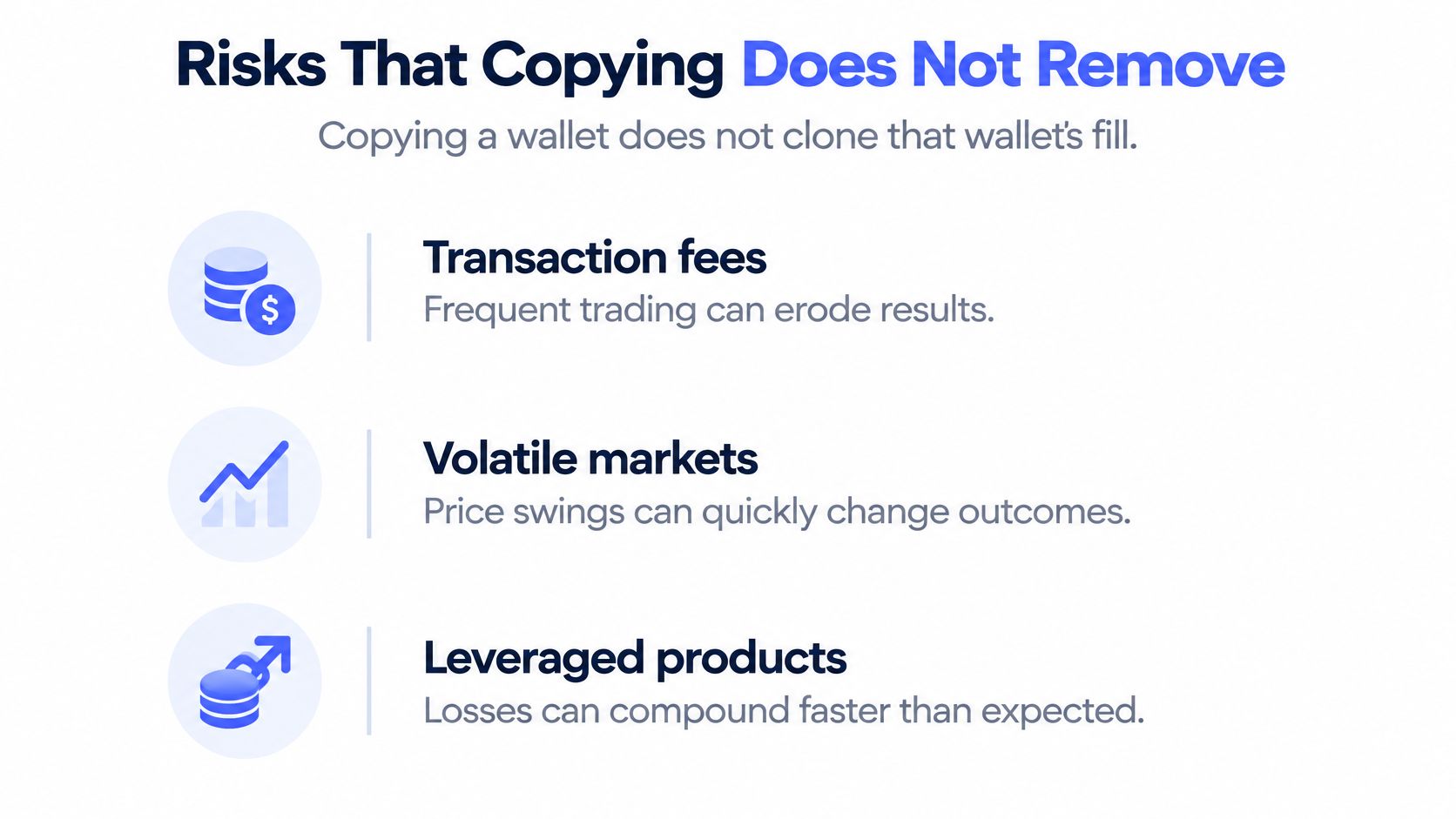
Copy trading carries risk. Past performance does not predict results. Automation changes who submits each order. It doesn't remove market exposure.
The International Organization of Securities Commissions identifies transaction-fee erosion, increased cumulative losses in volatile markets and products that magnify losses, follower-driven price movement, and operational risks including technical failures and cyber incidents. When followers collectively move a market, they may buy higher or sell lower than the lead trader.
Those risks remain even when every copied action matches the intended direction.
Non-Custodial Doesn't Mean Permissionless
copyfomo is non-custodial. You keep your keys and wallet, and grant a trading allowance from your own wallet that you can revoke at any time. Keeping custody and granting spending permission are separate decisions.
Ethereum.org's token-access guide warns that an unlimited allowance can let an approved platform spend all tokens of that asset in a wallet, including tokens returned to the wallet later. It recommends approving only the amount needed and regularly revoking permissions; revocation is an on-chain transaction that requires a network fee.
Inspect what you authorize, not just where the assets sit. A wallet balance doesn't tell you which permissions remain active.
Automation Moves the Monitoring Work
Mirroring a leaderboard trader isn't safer than submitting trades yourself. You replace repeated manual decisions with monitoring of execution, source behavior, and permissions. Unattended operation still requires explicit boundaries.
The copy trading risks guide provides further context for evaluating that responsibility. The important distinction is between reducing screen time and reducing financial risk. They're not the same outcome.
Keep the operating controls narrow enough to enforce:
- Cap each source. Limit the size assigned to a wallet before its next trade.
- Set an execution pause. Stop new copies when measured fills breach your predefined tolerance.
- Revoke unwanted access. Remove the allowance when you no longer want trading permission active.
These controls limit specific exposures. They don't establish that the source trader will make sound decisions or that an open position will remain sellable.
Tools for Tracking Smart Money
Tool selection starts with the question you need answered. An explorer shows on-chain activity. A leaderboard helps identify wallets to examine. Automation mirrors a selected trader's trades into your wallet.
Tool types and their limits
| Tool | What it shows | Use it for | Limit |
|---|---|---|---|
| Block explorer | Wallet balance and transaction history | Checking whether a buy was followed by a sell | Labels are incomplete |
| fomo leaderboard | Wallets ranked by recent realized results | Finding candidate wallets | Survivor bias and short sample sizes |
| copyfomo (Telegram bot) | Mirrors a chosen fomo trader's buys and sells into your wallet at your chosen size | Copying trades while offline | Slippage, fees and source-trader losses still apply |
Match the Tool to the Question
Use a block explorer to check transactions and remaining inventory. Treat wallet labels as clues, not proof of ownership. Use the fomo leaderboard to find candidates, then compare their activity across the available ranking periods.
The crypto whale wallet tracker guide explains how wallet monitoring fits into this process. The leaderboard and a block explorer can help distinguish a repeated pattern from an isolated result, but neither establishes that a wallet's approach will work for you.
copyfomo automates execution, not source selection. Its Telegram bot mirrors a chosen fomo trader's entries and exits into your own wallet at your chosen size. A wallet with the strongest realized result can still be a poor one to copy if its edge depends on speed, thin liquidity, or trade sizes you cannot match.
Start a Copy Only After You Set the Size
A wallet with the best realized result can still be a poor one to mirror. Its edge may depend on fast entries, thin liquidity, or trade sizes you cannot match. Set your allocation before automation begins, and judge the source by whether its trading conditions fit your own.
copyfomo mirrors a chosen fomo trader's buys and sells into your wallet at your selected size. The trader's record does not predict your results. Trading involves risk, and this content is not financial advice.
Establish the Boundaries First
- Send
/startto@copyfomo_bot. - Pick a trader with
/leaderboardor/find, then run the copy flow. Base the choice on the record you examined, not a recent result alone. - Set your trade size and any cap before the first copy. Decide how much exposure the source can create without another manual decision.
- Fund your wallet with
/depositusing crypto, Apple Pay, or Cash App. Depositing funds does not change the limits you set.
Keep Selection Separate From Supervision
Use the fomo leaderboard for trader-level context and the copyfomo documentation for setup details. Keep your own notes on each trader's record, including why you selected them and what would make you reconsider.
Do not change those conditions just because a trader moves up the ranking. A stronger recent score does not show that your allocation or execution conditions still fit.
You choose the trader, set the size, and control whether copying continues. The wallet remains yours, and you can revoke its trading allowance. Automation can mirror entries and exits while you are away, but it cannot make the source's next trade predictable.
If the record and limits make sense to you, visit copyfomo to start the Telegram bot. Keep the source, allocation, and permission to continue under your control.
stop reading. start copying.
pick a trader from the fomo leaderboard, set your size, and the entries and the exits land in your own wallet while you sleep.
open copyfomo on telegram →