Mirror Trading Crypto: What It Is and How It Works
learn how mirror trading crypto works, how it differs from copy trading, and what to expect from execution timing, slippage, and bot setups.

You've got the chart open, the setup looks clean, and the move still goes without you. You were in a meeting, or asleep, or just one tab too late. By the time you come back, the entry is gone and the whole idea feels obvious in hindsight.
That's the basic appeal of mirror trading crypto. It's a way to let a rule, a bot, or a trader's activity trigger execution while you're not at the screen. The point isn't to catch every candle. The point is to remove the human delay that keeps breaking the same setup over and over.
Table of Contents
- The Trader Who Keeps Missing the Move
- Mirror Trading and Copy Trading in Crypto
- How a Mirrored Trade Gets Executed
- Timing, Slippage, and the Real Cost of Copying
- Common Implementations from Bot to Bot on Telegram
- Why Copying the Trade Does Not Copy the Result
- Non-Custodial Setup and Revocable Allowances
- What to Check Before You Turn Mirroring On
The Trader Who Keeps Missing the Move
A spot trader sees a clean breakout on the 1-hour chart. Volume is there. The level is obvious. The plan is simple. Enter on the retest, keep the size small, and let it work.
Then life happens. The trader is in a meeting, or on a train, or asleep because the market moved during another timezone. When they get back, the breakout has already run, the pullback entry is gone, and the chart looks dead. That isn't a strategy problem. It's a timing problem.
Mirror trading crypto exists to close that gap. A rule or signal watches the setup, then places the trade when the conditions match. The user doesn't need to be staring at the screen at the exact second the order prints. The system handles the mechanical part.
Practical rule: if your entry depends on being awake at the right minute, you're not actually trading the setup. You're trading your schedule.
That's the cleanest way to think about it. Mirror trading is not about making the market kinder. It's about reducing the penalty for being late. If the signal is valid, the execution happens. If it isn't, nothing should happen.
The next question is simple. How is that different from the copy trading model that is already widely known?
Mirror Trading and Copy Trading in Crypto
The two terms get mixed together because both automate follow-through. The mechanics are not identical. Mirror trading starts from a strategy rule or a predefined signal path. Copy trading usually starts from a leader, a wallet, or a trader profile.
| Dimension | Mirror Trading | Copy Trading |
|---|---|---|
| Signal source | Rule-based strategy or automated trigger | Named trader, wallet, or leader profile |
| What gets replicated | Defined order logic, including entries and exits | Another trader's positions, usually scaled to your allocation |
| Decision layer | Code plus user settings | Follower allocation plus platform rules |
| Typical focus | Exact fills and exits | Proportional position following |
| Where the user acts | Sets the rules before execution | Chooses who to follow and how much to allocate |
They overlap in one obvious way. Both can read exchange data or on-chain activity and both can create child orders in your account. The difference is in what the system treats as the source of truth. In mirror trading, the logic itself is the product. In copy trading, the trader is the product.
That matters when the market moves fast. A mirrored setup aims to reproduce the entry, the exit, and the conditions around both. A copy setup often behaves more like “follow this person's flow with your own size.” That sounds close until the fills start to drift.
The industry label matters less than the execution path. If the system is following a signal tree, that's one model. If it's following another person's live trades, that's another. The user shouldn't assume they're getting the same result just because the interface looks similar.
How a Mirrored Trade Gets Executed
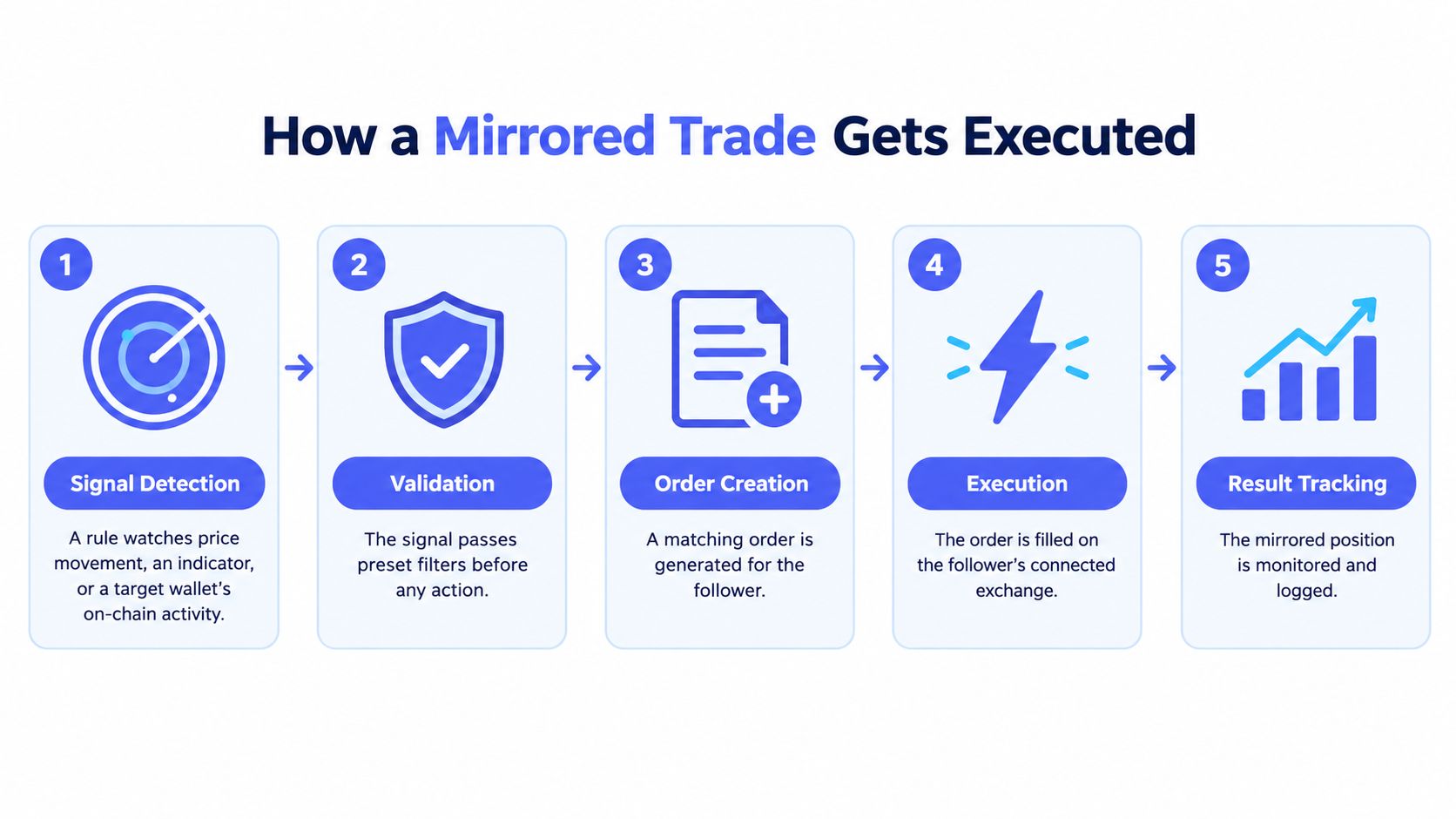
A clean mirrored run follows a chain. If one link is weak, the whole thing drifts.
Signal Detection
The first step is the trigger. That can be a price rule, an indicator condition, or activity tied to a target wallet. The bot is not guessing. It is watching for a prewritten condition.
Validation
Next comes the filter. A setup can look valid on the chart and still be a bad trade if liquidity is thin, gas is ugly, or the market is already too far gone. Validation blocks weak signals before they turn into orders.
Order Creation
If the setup survives validation, the bot builds the order. Side, size, slippage tolerance, and sometimes a limit price all get set here. This is the point where the user's controls matter most.
Routing and Execution
The bot then routes the order to the venue or swap path, checks the expected output, and compares it with the slippage cap. If the route can't respect the limit, the order should fail rather than force a bad fill.
Result Tracking
Once the transaction lands, the fill gets logged. That record matters because the same rule often has to decide when to close. If the entry is tracked badly, the exit logic starts from a bad reference point.
The fill is not the whole story. On-chain copy systems are latency-sensitive because the follower only sees the leader's fill after it's visible on-chain, and that delay can include gas fees, slippage, and confirmation lag, with a one-block miss on Ethereum being roughly a 12-second delay in volatile tokens, according to Arkm's research on crypto copy trading.
A useful way to read the log is to treat it like a desk blotter, not a promise. You want the signal, the filter, the order, the route, and the fill to line up. If one part is late, the trade is no longer the same trade.
Keep the execution chain short. Every extra hop adds another place for price to move away from you.
Timing, Slippage, and the Real Cost of Copying
Execution quality is where mirror trading stops being abstract. The trade can be “right” on paper and still come out wrong because the market moved between detection and fill. That gap is usually small in calm conditions and painful in fast ones.
Where the cost comes from
Latency starts before the order reaches the market. Detection, propagation, bot wake-up, transaction construction, and block inclusion all stack together. A setup that is roughly a second behind the source can still be usable. A setup that's much slower starts to chase.
Slippage is the second hit. The market may not be there when the follower order lands. That gets worse in thinner pairs, during volatile moves, and when the exit is forced into weaker liquidity. Fees add one more drag, especially when the bot or venue charges for each swap or route.
| Component | Typical Range | When It Grows | User Impact |
|---|---|---|---|
| Reaction delay | Seconds, not instant | Busy networks, slow routing, manual confirmation | Later entry or exit |
| Slippage | Depends on pool depth and volatility | Thin liquidity, fast moves, large tickets | Worse average fill |
| Gas or network fee | Variable | Congested chains, rushed inclusion | Higher round-trip cost |
| Bot or platform fee | Depends on provider | Per-trade automation, routing layers | Eats into the edge |
| Exit drag | Often worse than entry drag | Thin unwind liquidity, panic moves | Lower realized result |
On smaller accounts, the fee stack can matter more than the signal. On larger tickets, slippage becomes the problem. Either way, the mirrored fill is the point where theory meets the book.
For a plain breakdown of one of the most common drag points, see this guide on slippage in crypto.
Common Implementations from Bot to Bot on Telegram
Mirror trading shows up in two delivery formats. The first is the standalone bot. The second is the Telegram bot. The trading logic can be similar underneath, but the user experience is not.
Standalone services usually live in a dashboard. You log in, review trader settings, choose size, set limits, and watch fills in a panel. That format is useful when the user wants a broader settings surface and more visible account management.
Telegram-based bots compress the workflow into chat. The commands are inline, the status messages arrive in the thread, and fills are reported where the user already spends time. That's why the interface feels lighter. It's still only an interface. Telegram itself is not the trading engine.
What the user actually touches
- Dashboard model: the user works in a web panel, checks settings there, and often sees more detailed logs.
- Telegram model: the user sends commands in chat, gets updates in the same thread, and reacts from the phone.
- Hosted setup: the platform handles most of the infrastructure.
- Wallet-based setup: the user's wallet and signer still control settlement, even if the bot handles the flow.
The key difference is not “chat versus app.” It's whether the system is asking the user to think in a control room or in a conversation. One is more verbose. The other is faster to operate.
If you want a broader primer on the format, this overview of crypto copy trading bots is the cleanest way to compare the moving parts without mixing up the interface with the strategy.
Telegram is a delivery surface. It doesn't change the market. It only changes how quickly you can tell the bot what to do.
Why Copying the Trade Does Not Copy the Result
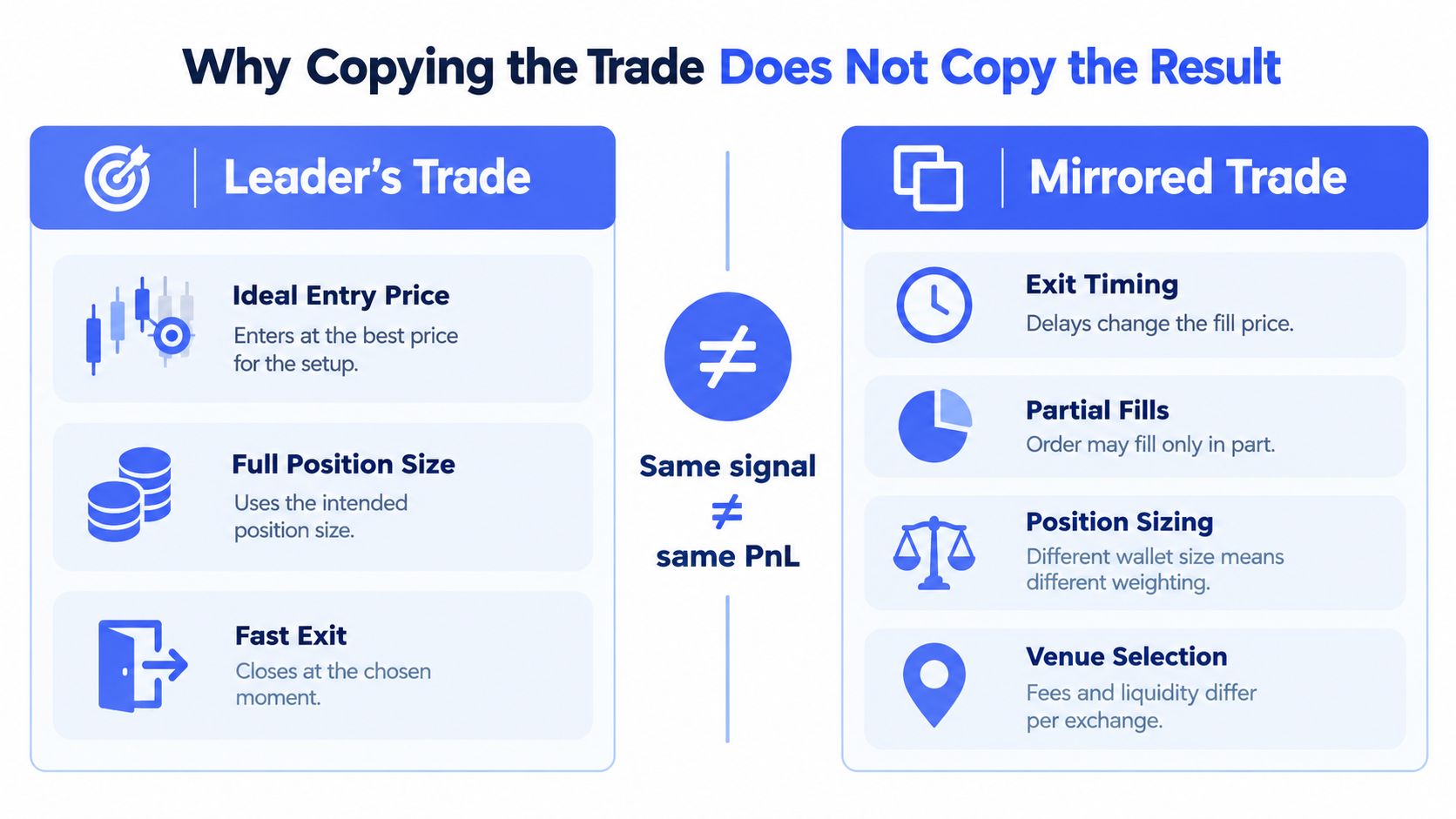
The first mistake is assuming the entry price is the whole trade. It isn't. A mirrored system can match the signal and still miss the outcome because exits, fills, size, and venue all bend the result.
Four things that change the outcome
Exit timing. If the leader exits cleanly and the follower exits late, the realized price changes. That alone can turn the same idea into a different trade.
Partial fills. A bot may only fill part of the order. The rest never happens, or it fills later at a worse price.
Position sizing. A large wallet and a small wallet don't hit the book the same way. A bigger ticket can move the market more, and a tiny ticket can get chewed up by fees.
Venue selection. The leader may trade on one pool or exchange while the follower settles on another. Different liquidity, different costs, different result.
A relevant point from the on-chain side is that leaders and followers do not see the market from the same spot. Copy systems can lag, and faster markets widen that gap. BitMEX notes that fast markets, follower volume, and lower-liquidity contracts can make the follower's result diverge from the source trade.
That is why copying the trade is necessary but never sufficient. You still need the right exit logic, enough liquidity, and a size that fits the venue. Same signal does not mean same PnL.
Non-Custodial Setup and Revocable Allowances
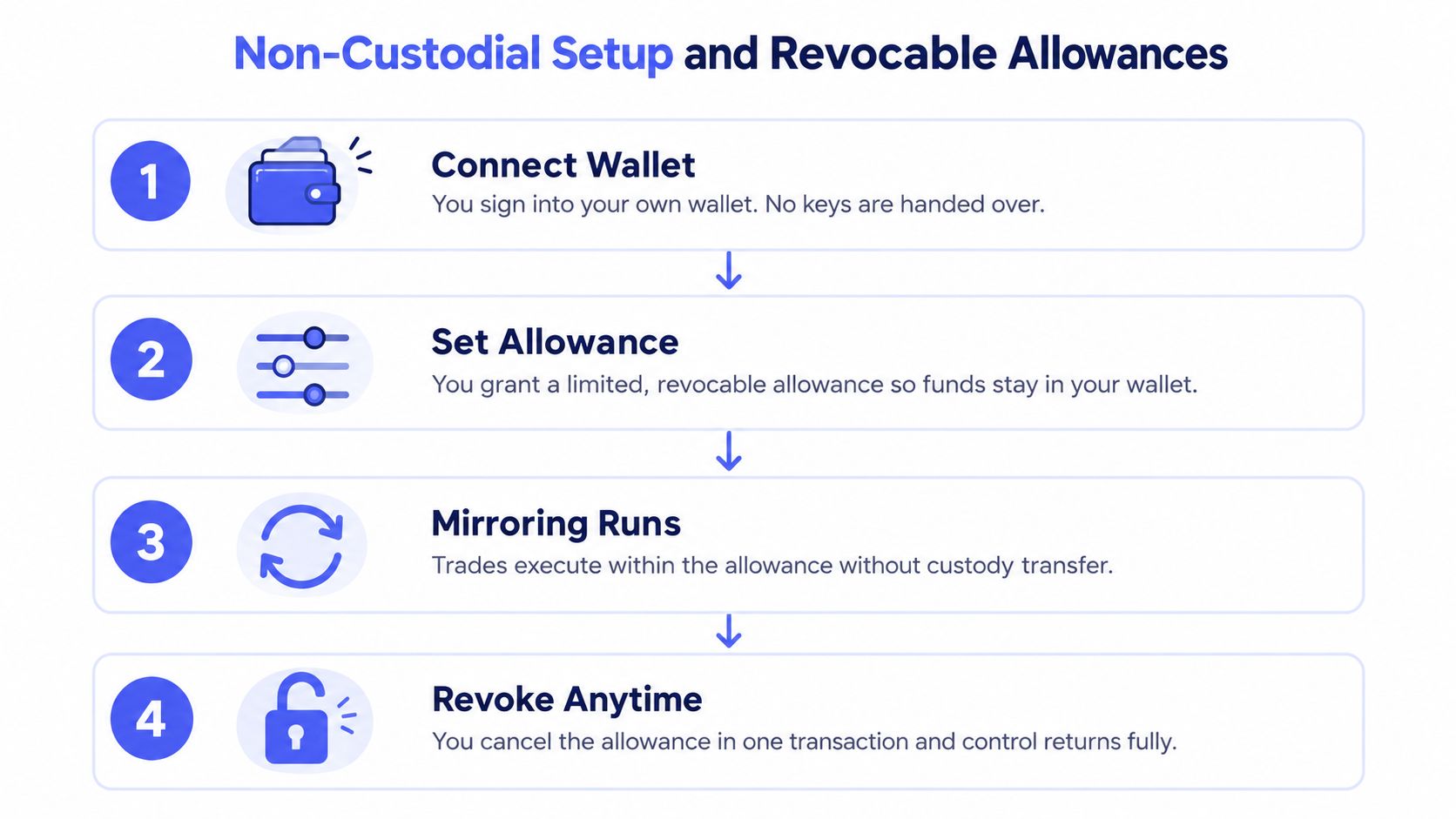
A non-custodial setup keeps the funds in your wallet. The bot gets permission to act within a limit. It doesn't take possession of your keys, and it doesn't need to withdraw your balance to run the strategy.
The plain version
You connect your wallet. Then you approve a spending allowance for a specific token and a specific amount. That allowance is the gate. The bot can trade within it, and only within it.
If you want to stop, you revoke the permission on-chain. The allowance gets written back to zero in a transaction, and the spender can no longer use that approval. That is the core safety control. It's not perfect, but it is clear.
Use the wallet's approval view to check which spender address has access. Compare it with the bot you intended to authorize. If the address doesn't match, revoke it. If the strategy is done, revoke it anyway.
A custodial system holds balances on its own ledger. This model doesn't. That's the whole point. The trade can run while your wallet remains yours.
For a related setup overview, this copy trading app guide is the right reference point for how a wallet-based flow differs from a custodial one.
What to Check Before You Turn Mirroring On
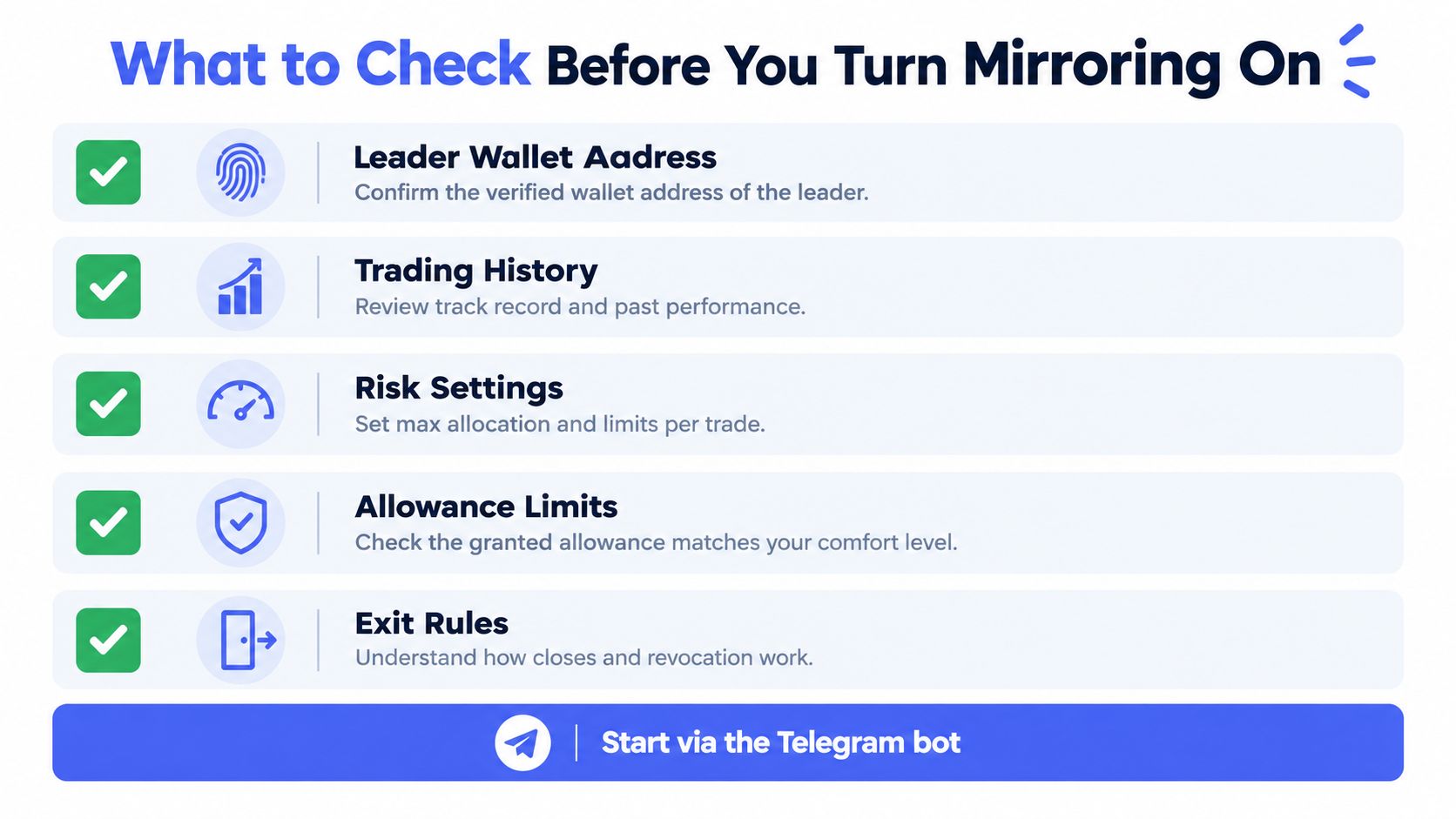
Before enabling mirroring, check the full trade lifecycle. A copied entry can still produce a different exit, fill, or result.
- Can you verify the wallet or strategy address? If the address is unclear, stop before connecting.
- Is the allowance capped at an amount you can accept losing? Lower it if the answer is no.
- Does your wallet have gas and support the trading chain? Without both, an order may fail or arrive late.
- Can you explain the entry, exit, and stop rules? If you cannot describe how the position closes, the setup is not clear enough.
- Does the venue match the leader's venue? A different settlement path can produce different fills.
- What is the slippage setting? A loose limit can accept a poor price. A tight limit can leave the order unfilled.
- Can you reach revocation tools, and are shared devices logged out? Fix those access points first.
These checks should be visible in a Telegram workflow. To start a mirror session in copyfomo, open the bot at copyfomo, use the setup commands, set the allowance, and stop mirroring when finished. Start with a size that can withstand a bad fill. Timing controls the result, not the copied signal alone.
copyfomo provides a non-custodial way to mirror entries and exits from traders on the fomo leaderboard into your wallet at a configured size. It suits users focused on execution, timing, and control, while leaving the outcome dependent on their own fills.
stop reading. start copying.
pick a trader from the fomo leaderboard, set your size, and the entries and the exits land in your own wallet while you sleep.
open copyfomo on telegram →