Position Sizing Crypto: Methods and Worked Examples
learn position sizing crypto methods: fixed ticket, percent of portfolio and volatility-based sizing, with worked examples and risk rules.

You're watching the fomo leaderboard, a trader you've been following just bought again, and you have to decide on a size in the next minute. Copy the trade too large and a normal pullback becomes a real dent in your wallet. Copy it too small and fees, gas and slippage eat most of the move. Most traders settle this by picking a round number that feels comfortable. That comfort lasts until the token moves 10% in an hour, several copies stack up at once, or your fill lands well away from the trader's price. Position sizing in crypto is how you decide the size before any of that happens. It starts with how much you can lose, not how much you can buy.
Table of Contents
- Three Sizing Methods Compared at a Glance
- Calculate Trade Size From Your Risk Budget
- Fixed Ticket or Percent of the Trader's Size
- Slippage, Stacked Copies and Exposure Limits
- Set Your Sizing Rules Before the Next Copy
Three Sizing Methods Compared at a Glance
Volatility based sizing is the most defensible method for crypto. Fixed ticket is the simplest to run. Percent of portfolio sits between them. None removes risk. Each one controls a different thing and fails in a different way.
A fixed ticket means the same dollar amount on every trade. A $50 ticket costs $50 whether the token moves 2% or 20%. You always know the cash going out. You don't know the loss you're accepting, because that depends on where the exit sits.
Percent of portfolio means a fixed share of equity per trade. Say you put 2% of a $10,000 wallet into each trade. That's a $200 position. A 5% stop on $200 risks $10, or 0.1% of equity. The size grows and shrinks with your account, which fixed ticket doesn't do, but it still says nothing about the distance to your stop.
Position Sizing Methods Side by Side
| Method | How the size is set | What it controls well | Where it breaks |
|---|---|---|---|
| Fixed ticket | Same dollar amount every trade | Cost per trade and simple budgeting | Ignores volatility and account growth |
| Percent of portfolio | Fixed share of equity, such as 2% | Scales with account size | Does not account for how far the stop sits |
| Volatility-adjusted | Risk budget divided by stop distance | Loss per trade stays constant across tokens | Needs a defined stop and a volatility estimate |
Volatility adjusted sizing divides a fixed risk budget by the stop distance. A wider stop on a volatile token gives a smaller position. A tighter stop on a quieter token gives a larger one. The dollars at risk stay roughly constant, and that's the point.
The trade off is work. You need a stop before you enter, and you need a volatility estimate to place it sensibly. Fixed ticket needs neither, which is why traders keep using it, and it's also why a $50 ticket on three different tokens can mean three very different losses.
Pick the method whose weakness you can live with, write it down, and use it for every trade until you have a reason to change it.
Changing method after a loss is where sizing stops being a system. Write the choice down before the first trade, not after the third one goes wrong.
Calculate Trade Size From Your Risk Budget
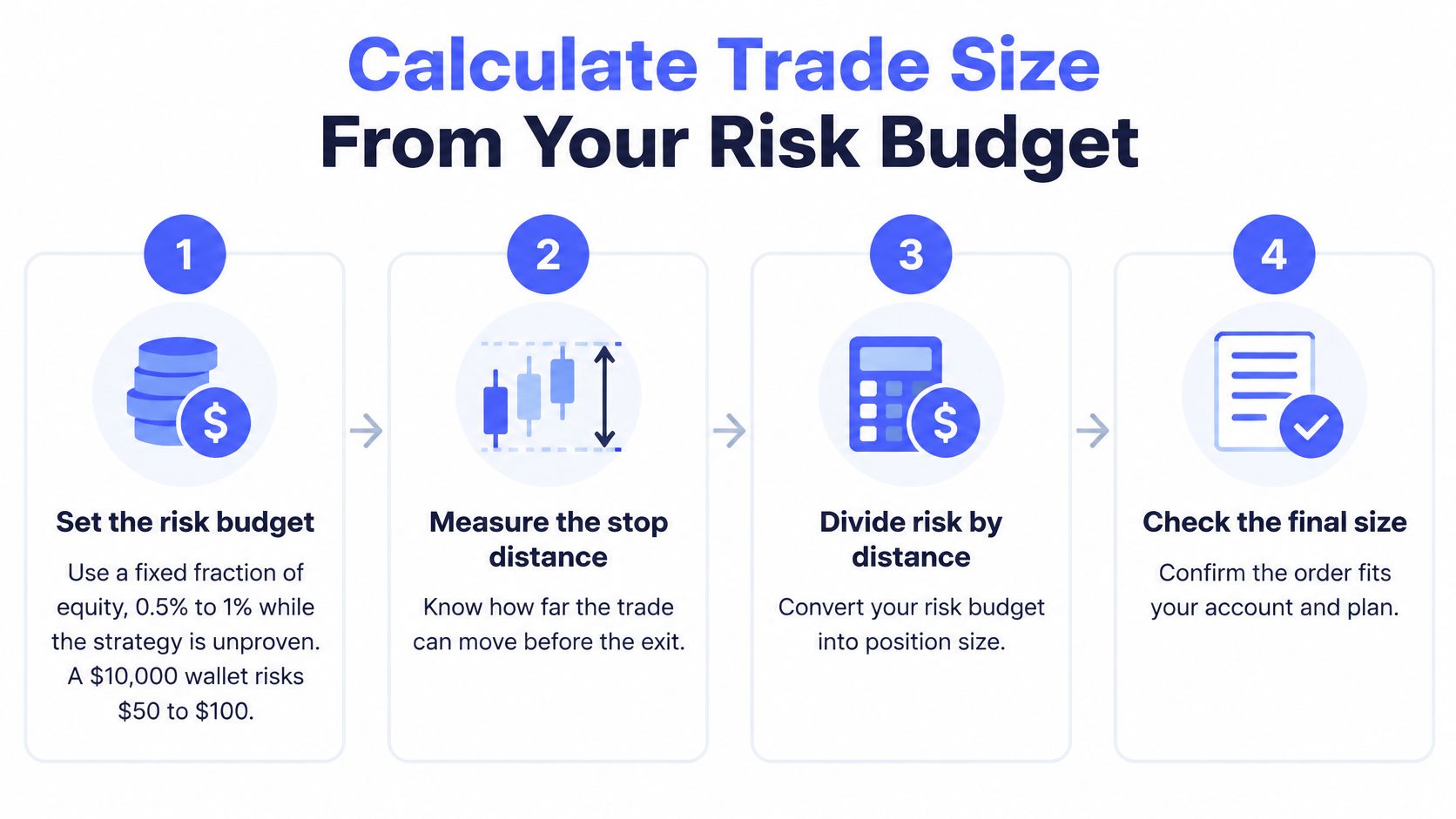
Start with the loss, then work back to the size. The four steps below follow the workflow in the MarketPro guide to risk management for crypto positions, which sets the maximum acceptable loss per trade at 0.5% to 1% of equity while a strategy is unproven and calculates notional as risk budget divided by stop distance. The stop is the input. The size is the output.
The sequence matters more than the arithmetic. Watch it run once before you work through the numbers.
The Four Steps
Set the risk budget. Fix the most you'll lose on one trade as a share of equity. On a $10,000 wallet, 0.5% is $50 and 1% is $100. Stay at the low end while the strategy is unproven, because you don't yet know its losing streaks, its slippage, or how often your fill diverges from the source. A proven record on a leaderboard says nothing about your own fills.
Place the stop where the idea is wrong. Use volatility, not an arbitrary percentage. The same guide cites 1.5 to 2.5 times the 14 period ATR as a common proxy, which for daily Bitcoin has often meant roughly 4% to 7% of price. A stop inside normal noise gets hit before the idea has a chance to work. Copied trades never show you the trader's stop, if they use one at all, so set your own.
Divide the risk budget by the stop distance. $50 divided by a 5% stop gives $1,000 notional. That's the whole calculation. Widen the stop and the position shrinks. Tighten it and the position grows. The loss at the stop stays at $50 either way.
Cut the result for slippage, fees and overlapping exposure. The stop price is not the fill price. You pay a spread on the way in, fees on both sides, and you may exit through a thin book. Shave the notional before you place the trade, and shave it again if two open positions sit in the same sector, because they will usually fall together. Price the copies you'll stack on top as well. Three copies into the same token are one position wearing three tickets.
Common slip: sizing from the entry price and ignoring the stop distance. Entry price sets nothing. Distance to exit sets everything.
The four steps, laid out as a single pass you can repeat before each trade:
Notional Size for a $10,000 Wallet by Stop Distance
| Stop distance | Notional at 0.5% risk ($50) | Notional at 1% risk ($100) |
|---|---|---|
| 3% | $1,667 | $3,333 |
| 5% | $1,000 | $2,000 |
| 7% | $714 | $1,429 |
| 10% | $500 | $1,000 |
Every cell is the risk budget divided by the stop distance, rounded to the nearest dollar, before fees or slippage. Read down a column and the pattern is plain. A 10% stop halves the size of a 5% stop while the dollars at risk stay flat. Volatility gets a smaller ticket, not a bigger budget.
The 3% row needs a second look. It sits below the 4% to 7% range that daily Bitcoin volatility has often implied, so it's likely inside normal noise for that asset. It also produces a $1,667 position, which is 16.7% of a $10,000 wallet in one token. Tight stops make big positions. That is what the cap check is for.
Run the Cap Check Last
Compare the calculated size with your per trade cap before you submit anything. If the result exceeds the cap, trade the cap and accept that the position risks less than the budget. Never stretch the risk budget to justify a size the cap was built to block. The cap exists for the trades where your inputs are wrong, and you won't know which ones those are in advance.
The habit of pricing the downside before committing a stake is not specific to crypto. It is the same discipline applied when bettors calculate expected value on sports bets, where the stake only makes sense once the cost of being wrong is on paper.
One pass, end to end. Equity $10,000, risk budget 0.5%, stop 7%. Notional is $714. You trim it for expected slippage and fees, then check it against your cap. If your cap is $500, you trade $500 and risk roughly $35 at the stop. A smaller trade than planned, and one you can repeat.
Losses are priced into this plan. At 0.5% risk, ten straight losers cost about 5% of equity. At 5% risk, the same streak leaves you down roughly 40%. The budget is what keeps a bad week from ending the account.
Fixed Ticket or Percent of the Trader's Size
Say a trader spends $40,000 on a token and you're set to copy 1% of their size. Your copy is $400. On a $5,000 wallet, that's 8% of your equity in one token, committed before you've placed a stop or checked the liquidity. The percentage looked small. The position isn't.
Fixed ticket avoids that. Every copy uses the same dollar amount, so total exposure is easy to add up and easy to cap. The trader's own sizing stops having any effect on your risk. The cost is real, though. A trader who doubles their size because they like a setup more still gets your standard ticket, and a trader who takes a small exploratory position gets the same ticket too. You copy the direction, not the conviction.
Percent of the trader's size keeps the conviction signal. Your copy scales with theirs, so their big trades become your big trades. That's only useful if their sizing is deliberate and you can see enough of it to judge. Plenty of large buys are wallet management, hedging, or moving inventory between accounts, and none of that tells you anything about conviction.
The Ceiling Does the Work
If you size by percent, set a per trade ceiling and treat it as the control. The percentage sets the intention. The ceiling sets the limit. When the trader's size spikes, the ceiling is the only thing that holds, and traders do size up suddenly on exactly the trades that draw the most followers.
Recalculate when your balance changes. The same percentage of a smaller wallet produces a smaller ticket, which is fine, but only if you notice. Traders who set a percentage once and never revisit it end up with sizes that no longer match their account. Our notes on copy trading with a small account cover how quickly fees and minimums distort percentage sizing at lower balances.
Check what the ranking is measuring before you copy anyone. The Bitquery investigation reported by CryptoSlate looked at 3,170 large memecoin wallet token positions and found that only 26% of reported gains passed checks for conventional market trading. A wallet can sit at the top of a realized PnL table on the strength of transfers and allocations you'd never be able to buy into. Rank is a filter for attention, not evidence of copyable performance.
Decision rule: use fixed ticket when you can't judge the trader's account size. Use percent with a hard ceiling when you can see enough of their sizing to trust it.
Slippage, Stacked Copies and Exposure Limits
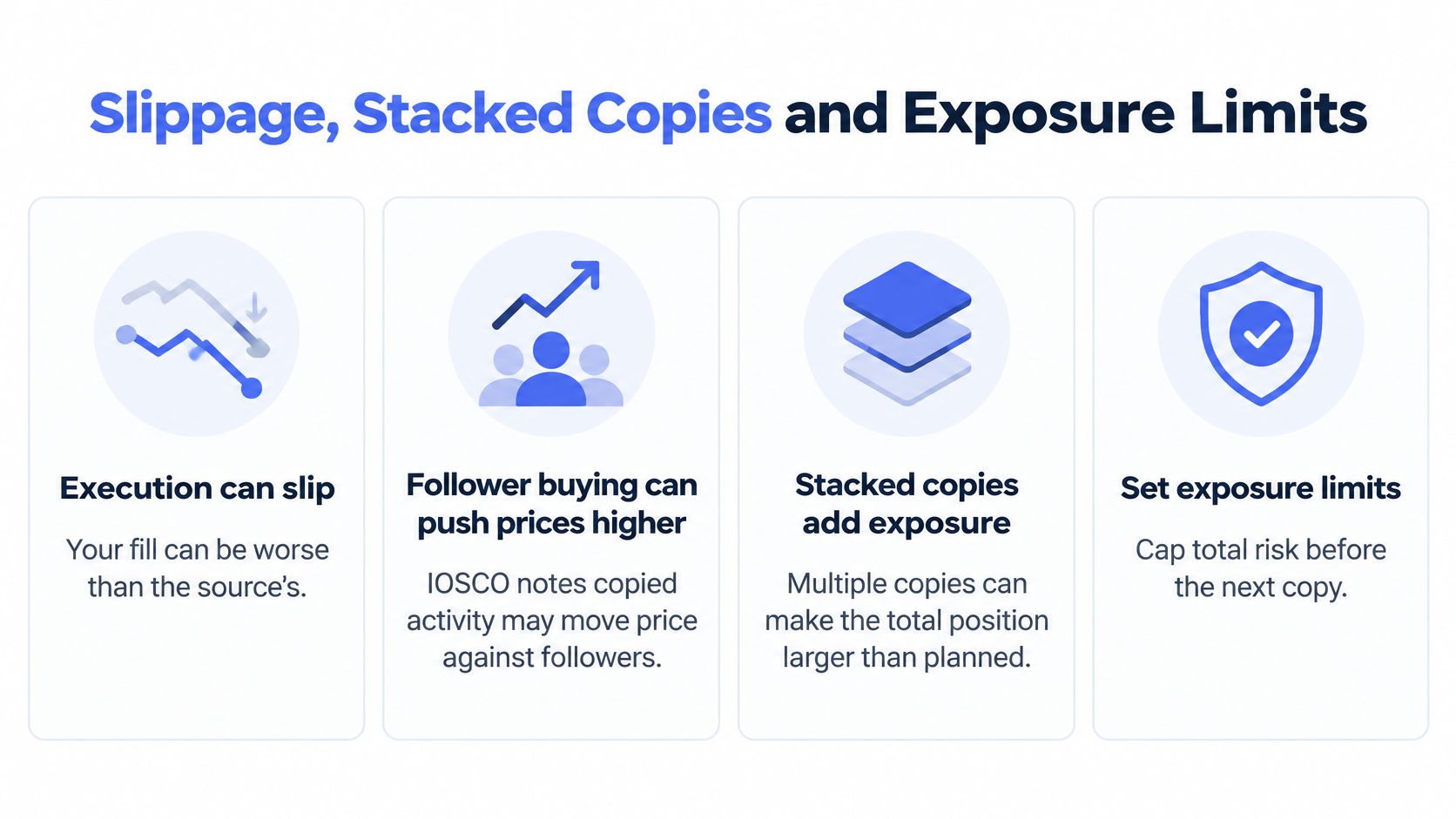
Eight copies of $100 into one sector is $800 of exposure, even though every individual ticket looked small. Nobody decided to put $800 into that sector. It accumulated one reasonable looking trade at a time, which is how most oversized positions happen.
Execution comes first. Your fill can be worse than the source's, and on thin tokens it often is. The IOSCO report on online copy trading identifies timing and pricing as core risks, noting that follower activity can push prices higher when buying and lower when selling, leaving later copiers with worse execution. It also flags transaction fees from frequent trading as a source of return erosion. Treat each copy as a separate trade. The leaderboard price is the source's fill, not yours.
Slippage belongs in the size calculation, priced before the trade rather than reviewed after it. A token that costs more to enter and exit than planned behaves like a bigger position than the one you set. It needs a wider stop to avoid getting shaken out, and a wider stop at the same risk budget means a smaller ticket.
The main pressure points:
Set the Limits Before You Need Them
- Total open exposure ceiling: cap everything open at once as a share of equity. 20% of a $5,000 wallet is $1,000 across all open copies, however many trades that turns out to be.
- Sector and token check: add up positions that will move together. Five different memecoins on one chain behave closer to one position than five.
- Borrowed-size ceiling: borrowed size counts toward exposure at its full notional value, not the margin you posted. The higher the multiplier, the less distance sits between your fill and a forced close, and volatile periods shorten that distance further. Keep the ceiling conservative, or skip borrowed funds on copied trades entirely.
- Cost discipline: fees on frequent small copies add up, and the general principles behind ways to reduce transaction costs apply here too. Fewer, deliberate trades usually cost less than mirroring everything.
Review on a fixed schedule; weekly is enough. Compare your planned price with your filled price on each copy. copyfomo prints the slippage on every copied trade, so the number is there to read rather than estimate. Cut the ticket on any token where slippage repeatedly exceeds your buffer, and stop copying it if the pattern holds. Our guide to slippage tolerance settings covers how to set that buffer.
Pausing new copies stops the stacking. It doesn't close anything already open, and closing open positions is a separate decision you should make on its own merits. Confusing the two is how traders end up frozen in positions they wanted out of, or dumping everything in a panic because they hit one button.
Copy trading carries risk, and past performance does not predict results.
Set Your Sizing Rules Before the Next Copy
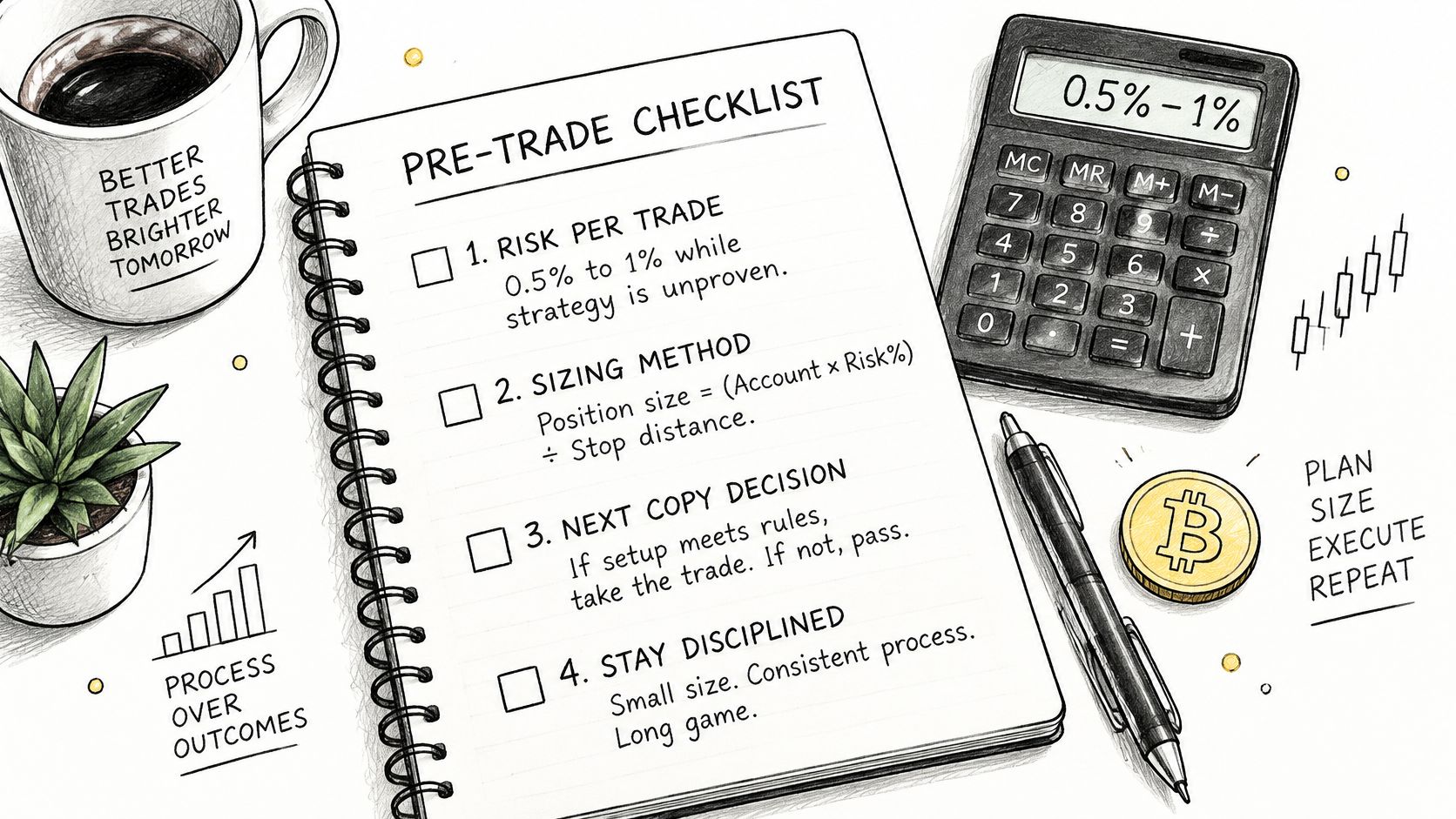
A sizing rule decided mid-drawdown is a guess. Write yours before the next copy fills, as four plain numbers in a note you'll look at. If you can't fill in all four, you're not ready to size the trade.
- Risk per trade: 0.5% to 1% of equity while the strategy is unproven, with a date when you'll reassess.
- Sizing method: fixed ticket or percent of the trader's size, picked in advance and applied consistently.
- Per trade ceiling and a cap on open positions: both written as numbers, not intentions.
- Slippage review date: a fixed day when you compare planned and filled prices and adjust tickets.
Two of the four items on that note are bot settings, and two stay yours to enforce. copyfomo stores sizing and caps per trader: fixed tickets of $20, $50 or $100, or a custom amount from $3, defaulting to $50, or percent sizing at 1%, 3%, 5% or 10%, or a custom share from 1 to 100 of what the trader spent. On percent sizing you can add a per trade maximum of $50, $100 or $250, or a custom ceiling, defaulting to $250. A maximum positions cap of 3, 5 or 10 limits how many tokens you hold at once, and it is off by default; topping up a token you already hold still goes through. Risk per trade and the review date are yours alone. The bot won't check them for you.
The checklist, in the order you'd fill it in:
I would start at the smallest ticket that still clears fees, run it for a fixed number of trades, and raise it only after comparing your fills with the source's. Raising size because the first few copies worked is the most common way a workable system turns into a drawdown. The copyfomo settings walkthrough shows where each of these controls sits.
Before you pick who to copy, compare traders on the /traders/ pages and check the public metrics on /data. Look for a run of verifiable entries and exits at sizes you could realistically follow. A trader whose edge depends on size or speed you don't have isn't one you can copy, whatever the ranking says.
Write the four numbers, enter the ones the bot stores, then start it on Telegram at copyfomo.com. Copy trading carries risk, and past performance does not predict results.
With sizing and caps set per trader, copyfomo mirrors the entries and exits of the fomo trader you pick at your chosen size, with slippage printed on every copied trade. Your funds stay in your own wallet and you can pause new copies at any time. Start the bot on Telegram and run your first copies at the smallest ticket that clears fees.
stop reading. start copying.
pick a trader from the fomo leaderboard, set your size, and the entries and the exits land in your own wallet while you sleep.
open copyfomo on telegram →