How to Track Crypto Wallets Without Getting Burned
learn how to track crypto wallets with explorers, alerts, and on-chain feeds. covers practical steps, privacy pitfalls, and copy trading safety.
You've got a wallet address, a screenshot from a trader's profile, and a feed full of green transactions. Then the wallet buys, you react late, and the price has already moved against you. The address may be misidentified. The apparent edge may come from one lucky trade. Your copy may also face worse liquidity than the original.
That's the reality of tracking crypto wallets. Visibility is useful, but visibility without verification, timing, and risk controls turns into expensive noise. A serious setup combines explorers, alerts, and on-chain feeds, then filters every signal before you act.
Table of Contents
- Why Tracking Wallets Became a Trader Workflow
- The Three Data Sources Every Tracker Relies On
- Finding a Wallet From a Handle or Screenshot
- Signals That Separate Real Edge From Noise
- The Legal and Security Traps Most Guides Skip
- A Practical Daily and Weekly Monitoring Routine
- What Tracking Can and Cannot Do for You
Why Tracking Wallets Became a Trader Workflow
Wallet tracking used to mean checking a few public whale addresses and watching for large transfers. That approach no longer survives in a market where traders, research teams, and automated systems monitor the same public ledgers continuously.
The underlying reason is simple. Every fill, transfer, contract interaction, and exit leaves a public record. A wallet tracker can turn one address into a readable portfolio view containing balances, transaction history, token holdings, NFT holdings, and DeFi positions, as described in this guide to crypto wallet trackers.
The scale is bigger than most retail traders assume. Chainalysis has clustered more than 1 billion wallet addresses into 107,000 named entities, according to the same source. That doesn't mean every address has been identified. It means modern analytics increasingly tries to connect fragmented addresses to exchanges, protocols, companies, and other economic actors.
The workflow has three jobs
Source the wallet. Find an address that can be verified, not merely repeated by a social account.
Score the behavior. Measure realized PnL, activity, concentration, counterparties, and drawdowns. A large balance proves nothing about trading skill.
Time the response. A wallet can buy early and still be useless to follow if your alert arrives after the move. Copy trading carries direct execution risk because the lead trader is filled first, while followers receive later fills. Volatility and low liquidity can worsen both entry and exit prices for followers, as Arkham's copy-trading research explains.
Practical rule: Treat a tracked wallet like a research subject, not a signal provider. You're studying behavior before deciding whether any action is justified.
The professional analogy is equity research. You gather a source, test the record, compare the behavior with a benchmark, and stop following when the thesis breaks. Wallet tracking isn't a passive feed. It's a system with inputs, filters, latency, and failure conditions.
The Three Data Sources Every Tracker Relies On
A reliable setup uses three layers. Each solves a different problem. Explorers provide proof, alerts provide speed, and feeds provide structure for automation.
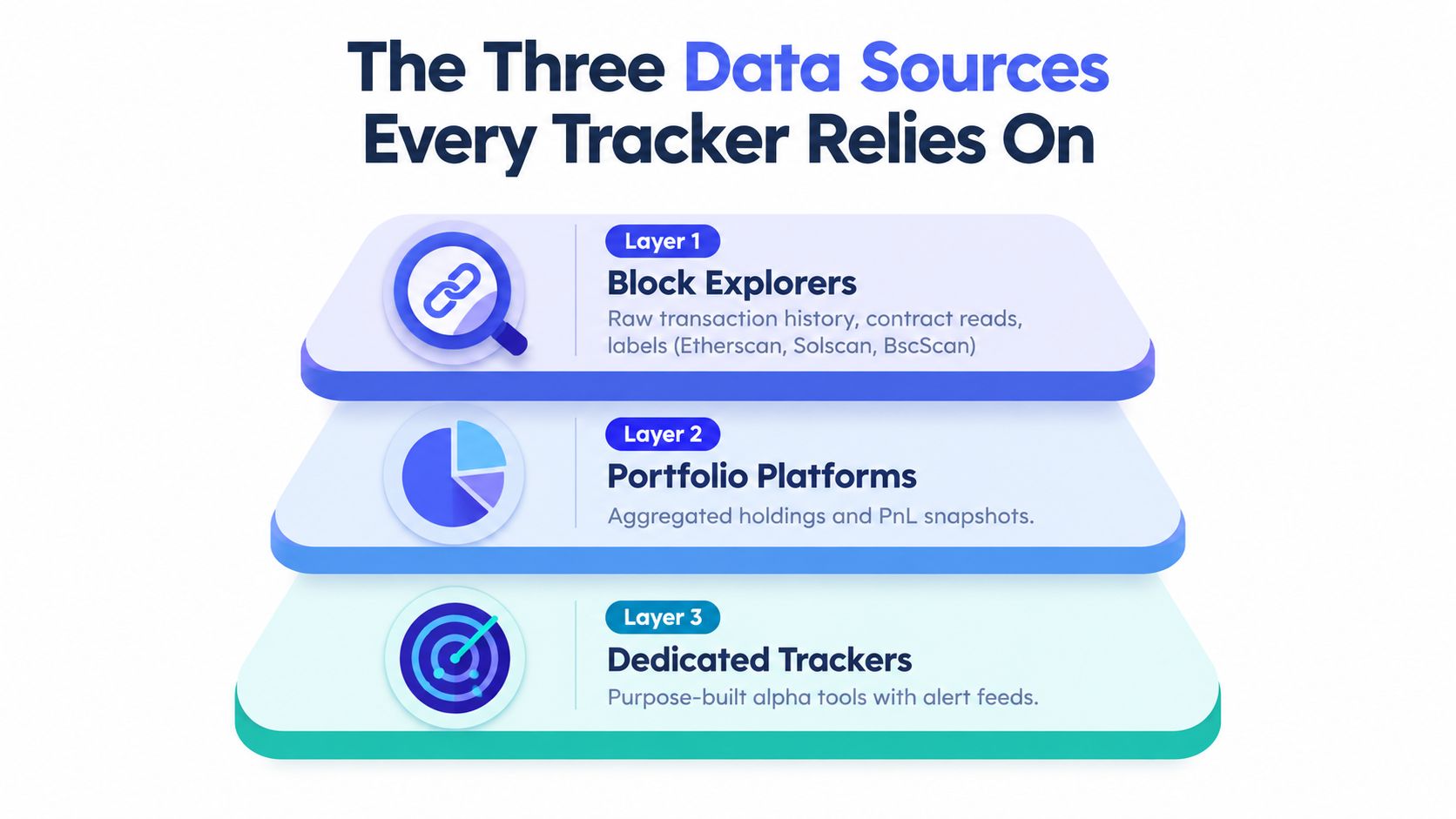
Layer one uses block explorers for verification
Etherscan, Solscan, and BscScan are where you confirm what happened. Check the transaction hash, token contract, amount, timestamp, gas activity, and destination. Read the contract interaction instead of trusting a portfolio label.
Explorers are slow for active monitoring. They also force you to interpret raw events manually. That's their weakness, but it's also their value. When an alert says that a wallet bought a token, the explorer lets you check whether the event was a real swap, an internal transfer, a test transaction, or a misleading balance change.
Use explorers to verify:
- Transaction history: Confirm the wallet's entries and exits rather than relying on a screenshot.
- Contract reads: Check what the wallet interacted with and whether the call matches the claimed trade.
- Labels: Look for exchange, protocol, bridge, and known-service labels, while treating labels as context rather than proof of ownership.
Layer two turns activity into alerts
Alert platforms such as Arkham, Nansen, and custom Tenderly bots reduce the delay between a wallet action and your awareness of it. Configure alerts around watched addresses, token interactions, tagged counterparties, or transactions that meet your chosen conditions.
This layer is where monitoring becomes usable during a trading session. You shouldn't keep refreshing an explorer. You should receive a notification, open the transaction, and decide whether the activity is relevant.
Portfolio views can also help with holdings and PnL snapshots. They're useful for ranking candidates, but a snapshot can hide the route, timing, and liquidity behind a result.
Layer three supplies machine-readable data
Alchemy, QuickNode, and Bitquery can feed wallet activity into dashboards, backtests, and execution systems. APIs are useful when you need consistent ingestion across many addresses or chains. They also make it possible to record alert latency, classify transactions, and compare a wallet's behavior over time.
Feeds alone aren't enough. Raw events lack the human context that an explorer and labels provide. Explorers alone aren't enough either, because manual checking is too slow for fast-moving markets.
Use the stack in order. Feed finds the event, alert surfaces it, explorer verifies it.
For traders who already understand fomo and want to connect monitoring with execution, copy-trading tools can be evaluated only after the underlying wallet and transaction data have been verified. The tool should come after the research process, not replace it.
Finding a Wallet From a Handle or Screenshot
A handle isn't an address. A PnL screenshot isn't ownership proof. Start with that distinction and you'll avoid a large class of copy-trading mistakes.
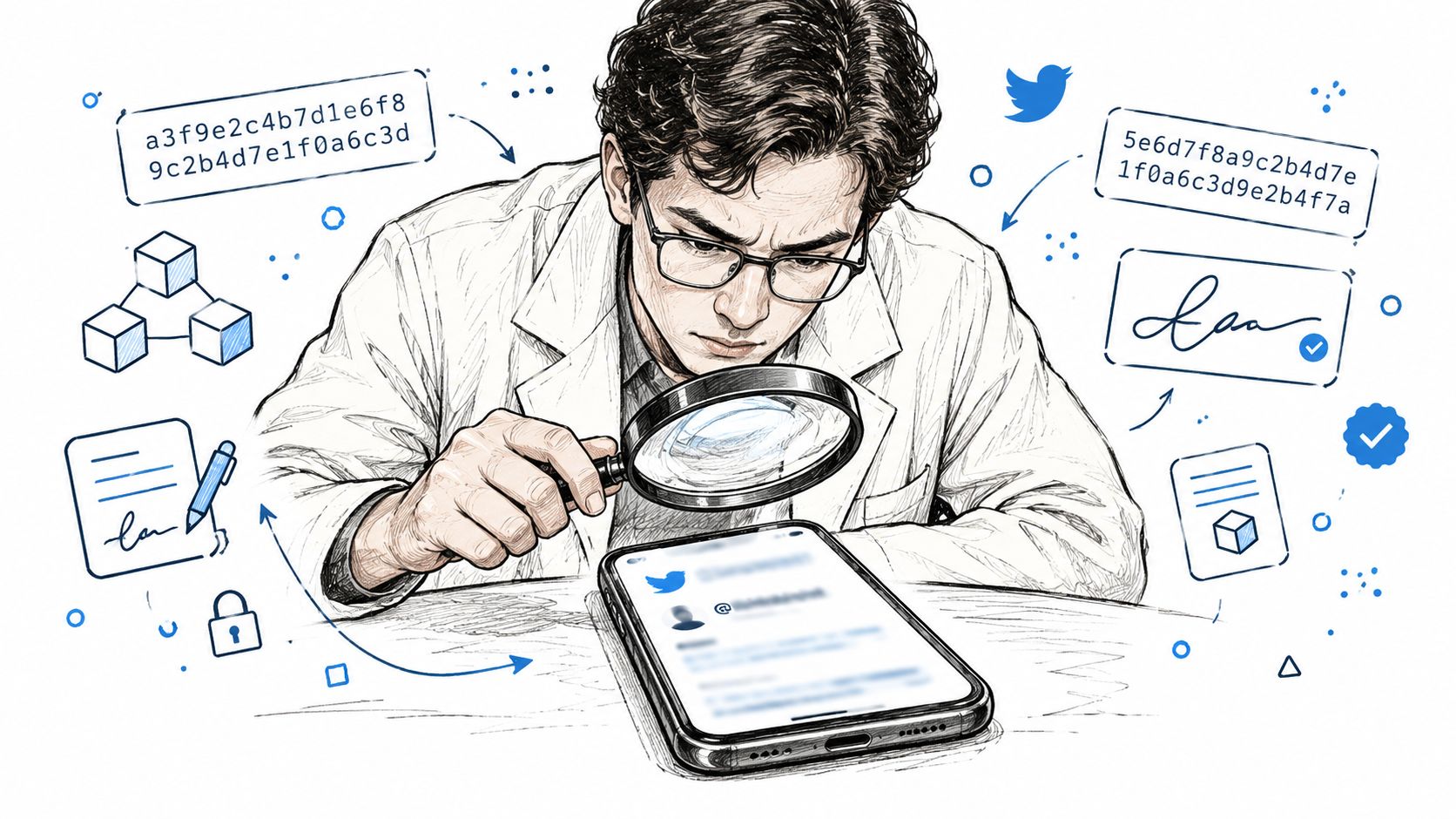
Suppose a trader posts a profitable table on Twitter or shares a Telegram alias. First, ask how the claimed wallet is tied to the identity. The cleanest proof is a signed message from the wallet. A recent on-chain post that links the handle to the address can also help, but it deserves independent checking.
Search broadly, then test the claim
Search the handle across explorers, NFT marketplaces, and ENS or SNS records. Look for addresses publicly tied to the account. Don't assume the first result is the trading wallet. Many traders use separate addresses for holding, trading, testing, and interacting with applications.
Next, compare the candidate wallet with the claimed record:
- Check the first funding source. Did the wallet receive its initial funds from an exchange, another known wallet, or an unrelated address?
- Map recurring counterparties. Repeated interactions can show whether the wallet belongs to a trader, a service, a team, or a routing system.
- Compare drawdowns. A wallet that claims a smooth record but shows large historical losses needs more investigation.
- Review the full timeline. A screenshot may show a selected period, not the wallet's complete trading history.
Forensic attribution works best when on-chain behavior is combined with off-chain evidence. Analysts commonly use transaction graphs, co-spend and behavioral heuristics, OSINT, KYC-derived disclosures, or seizure data. Chainalysis notes that attribution is strongest when multiple independent signals agree, while mixers and other obfuscation methods reduce confidence, as explained in its wallet attribution glossary.
The privacy boundary matters. Never publish personal information, pressure a person to reveal an address, or treat a suspected address as confirmed because it appeared in a group chat. Never DM an unsolicited address and assume the sender is the owner.
A practical starting point is wallet discovery from a fomo handle or screenshot, but discovery is only the first step. Verification is the bottleneck. Most avoidable copy-trading losses begin with an unverified handle, a stale screenshot, or an address copied from a poisoned message.
For a visual walkthrough of address investigation, use the following video after reviewing the evidence in the explorer.
Signals That Separate Real Edge From Noise
A wallet can look brilliant because it bought one token early. That isn't enough. Before you mirror a trade, test whether the result survives different windows, repeated activity, and independent comparison.
Start with realized PnL, not current holdings. Review rolling 30-day, 90-day, and 180-day windows. Unrealized gains can disappear. A wallet that still holds a large position may look successful while having no realized discipline.
Then classify the wallet's trading style. An accumulator, sniper, and market maker shouldn't be judged by the same activity pattern. A sniper firing hundreds of swaps in a short period may be profitable, but the strategy may be impossible to follow manually and difficult to replicate after fees, slippage, and latency.
Use filters before narratives
Counterparty concentration is another fast test. If most of a wallet's PnL comes from one token, one protocol, or one insider-adjacent route, you're looking at a concentrated bet, not necessarily repeatable skill. A wallet can be right once and still be a poor monitoring candidate.
The decay check is harsher. Ask whether the wallet's apparent advantage disappeared after public trackers and copy tools began watching it. Search for late entries, worse exits, and shrinking position sizes. If the edge depends on being first, your alert may be an obituary rather than an opportunity.
Compare the wallet with a passive ETH buy-and-hold benchmark over the same windows. My recommendation is to require at least 2x the benchmark's performance before spending serious monitoring time. That's a personal screening rule, not a promise of future results. Past performance doesn't predict results.
| Signal | What to Measure | Pass Threshold | Why It Matters |
|---|---|---|---|
| Realized PnL | Results across rolling 30, 90, and 180-day windows | Positive across more than one window | Reduces dependence on a single lucky period |
| Recent activity | Current trades adjusted for the wallet's strategy | Enough recent activity to evaluate behavior | Dormant wallets create hindsight bias |
| Concentration | Share of PnL from one token, protocol, or route | No single exposure dominates the record | Tests whether the edge is diversified |
| Benchmark comparison | Wallet performance versus passive ETH over matching windows | At least 2x as a monitoring hurdle | Justifies the time and execution risk |
| Execution quality | Entry delay, exit delay, liquidity, and slippage | Acceptable for your actual trade size | A visible trade may be unfillable for you |
A useful tracker also records what the wallet didn't do. Did it cut a losing position? Did it reduce size after volatility increased? Did it exit before liquidity vanished? Those details tell you more than a green PnL tile.
Discard wallets whose apparent alpha is mostly memecoin timing unless the full record survives independent verification. Fast markets punish simplistic “follow smart money” thinking. The signal is not the wallet's best trade. The signal is the repeatable behavior around many trades.
The Legal and Security Traps Most Guides Skip
Public visibility doesn't make every use of wallet data safe. Monitoring a public address for research is different from linking it to a person, publishing personal details, harassing the holder, or using the information to manipulate a regulated market.
The legal position varies by jurisdiction and use case. Public on-chain activity is visible, but systematic identity linkage, sanctions exposure, AML screening, data retention, and real-time copying can create obligations that a casual wallet lookup doesn't. The on-chain copy-trading compliance guide highlights this practical gap between technical possibility and safe operational use.
Don't turn attribution into doxxing
Wallet attribution should remain evidence-based and proportionate. A public handle, address cluster, or exchange label isn't the same as a verified real-world identity. Mapping an address to a named individual through KYC data you don't own is especially risky. Scraping verification endpoints can also breach platform rules.
Use separate labels for research and personal activity. Keep your watchlist free of unnecessary personal details. Treat a direct message from a wallet you monitor as hostile until independently verified.
Security failures are less theoretical than most guides admit:
- Address poisoning: An attacker sends dust from a look-alike address, hoping you copy the wrong string from your transaction history.
- Fake tracker pages: A phishing site clones a familiar interface and asks you to connect a wallet or approve a transaction.
- Rogue extensions: A browser extension can expose wallet labels, browsing activity, or sensitive account context.
- Overbroad permissions: A bot may operate through allowances, but a permission you no longer need should be revoked explicitly.
Non-custodial bots can use revocable on-chain permissions instead of moving assets out of your wallet. Disconnecting a site doesn't revoke a token allowance, so revocation must be performed separately, as explained in this crypto bot security guide.
Tracking creates no protection if the source wallet fails. It also doesn't protect you from sanctions exposure, malicious contracts, or a copied trade that executes at a materially worse price. Use a dedicated research account, minimize permissions, and document why each wallet remains on your list.
A Practical Daily and Weekly Monitoring Routine
A monitoring system should fit inside a schedule. If you react to every alert, you aren't researching. You're letting notifications dictate your trades.
The daily pass
Set aside a short daily review. Start with new buys from your Tier 1 wallets, which should be the small group that passed your PnL, activity, concentration, and benchmark filters. Then compare realized and unrealized results from the prior day's exits. Finally, open an explorer for any unlabeled address that interacted with a token on your watchlist.
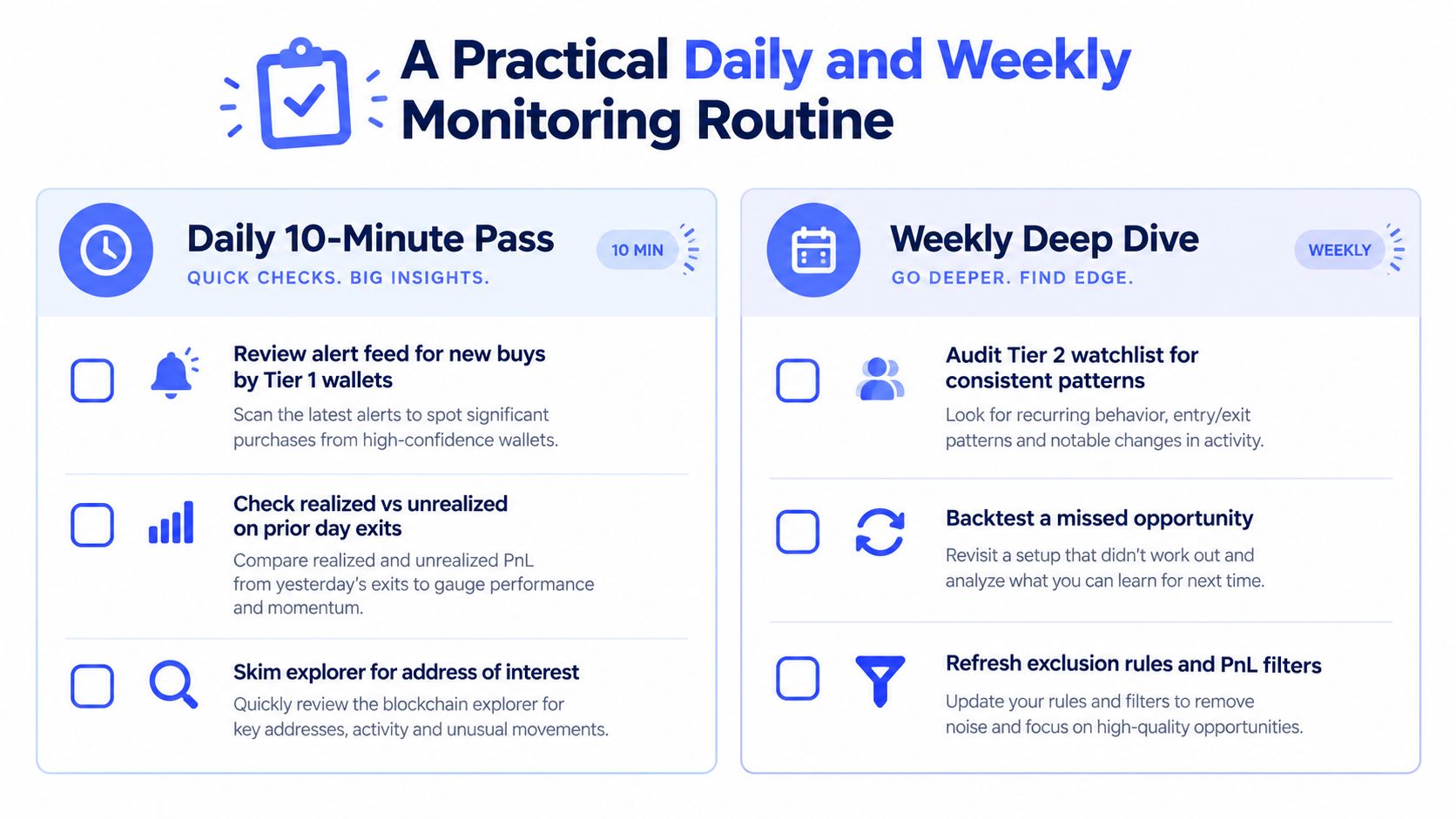
The daily pass should take about 10 minutes. If it takes longer, reduce the number of alerts or tighten the wallet filters. A feed full of low-quality addresses creates the illusion of diligence while making important events harder to see.
The weekly review
Use a deeper weekly review to re-rank the watchlist by rolling 30-day realized PnL. Remove wallets that fell below your ETH benchmark. Audit new followers for address poisoning and compare your labels with a second explorer to catch silent re-tagging or mistaken classifications.
The weekly review should answer three questions:
- Did the wallet behave as expected? Check strategy, sizing, exits, and counterparties.
- Did your alerts arrive in time? Record whether a notification was actionable or already stale.
- Did your assumptions survive? Remove any wallet whose edge depended on one token, one event, or one unexplained transfer.
The monthly reset
Once a month, export the watchlist and archive closed positions. Retest alert latency with a dust transaction through a test address, not a live trading wallet. Verify that API keys still use least-privilege scopes and revoke anything no longer required.
This reset is where operational risk gets exposed. A tracker with stale labels, excessive permissions, and untested alerts isn't an advantage. It's an unattended failure point.
Routine beats intensity: Daily checks find events. Weekly reviews test the thesis. Monthly resets remove accumulated risk.
Anything outside this cadence is usually reactive trading dressed up as research. Your tracker should narrow decisions, not multiply them.
What Tracking Can and Cannot Do for You
A crypto wallet tracker delivers visibility, not profit. It can confirm that a wallet bought early, exited on time, interacted with a known service, or routed funds through a suspicious counterparty. It can also shorten the gap between an on-chain move and your screen.
It can't predict the next narrative. It can't guarantee that you'll enter before the crowd. It can't create liquidity for a trade your wallet size can't fill. Copy-trading tools can mirror buys and sells, display per-trade slippage, and operate approximately one second behind a source trader, but that delay can still change the result when prices move quickly, as noted in this copy-trading bot overview.
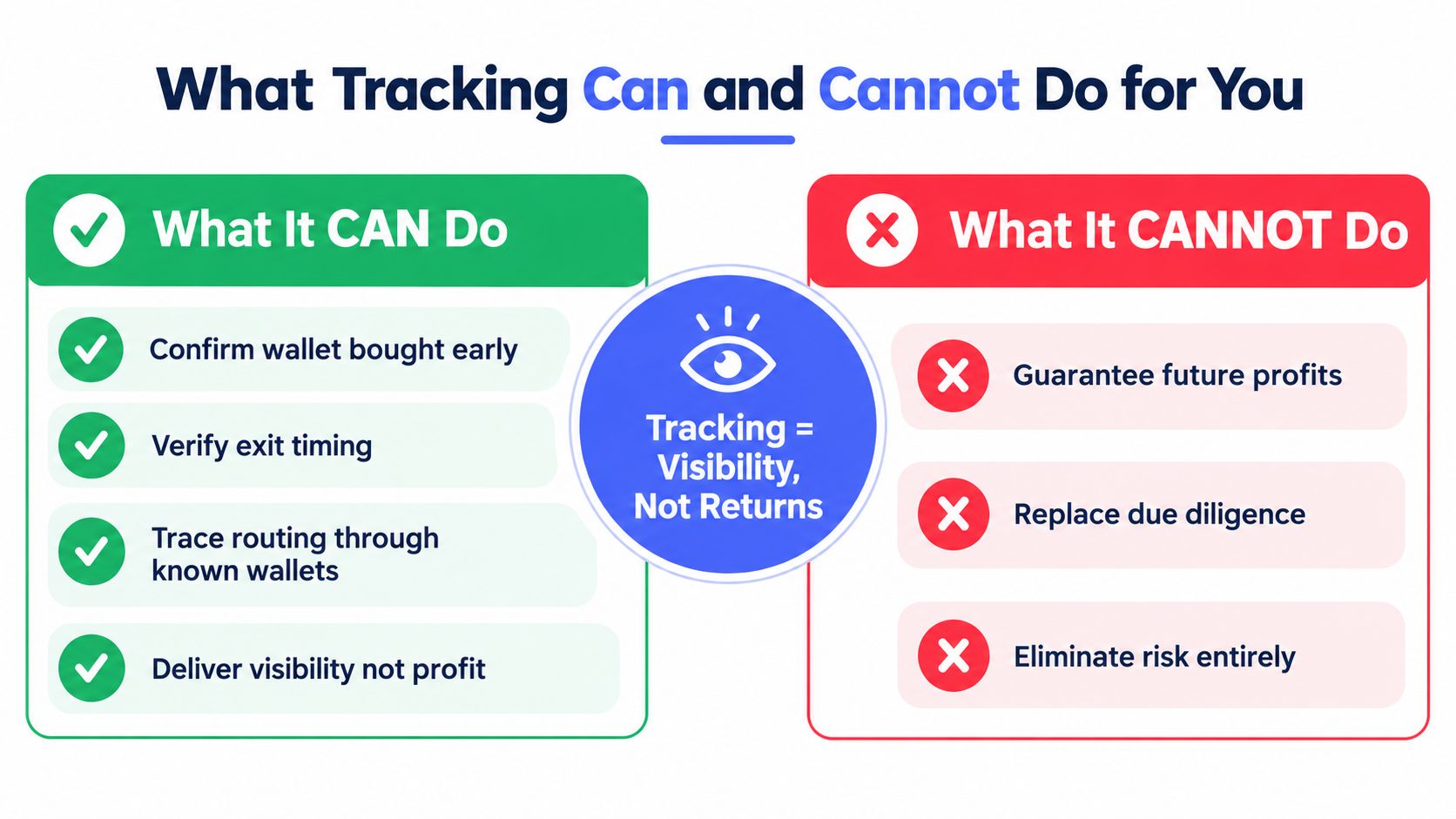
Use explorers to verify. Use alerts to reduce delay. Use feeds to organize the data. Use PnL, activity, concentration, benchmark, and execution filters to decide which wallets deserve attention. Then stop following when the evidence changes.
The action for today is simple: verify one address, record its recent realized behavior, and set one alert. Don't copy the first trade you see.
copyfomo lets fomo users mirror the filled buys and sells of selected leaderboard traders into their own wallet through a Telegram bot, with configurable sizing and displayed slippage. If you want to turn verified wallet monitoring into a controlled execution workflow, visit copyfomo and start the bot on Telegram.
stop reading. start copying.
pick a trader from the fomo leaderboard, set your size, and the entries and the exits land in your own wallet while you sleep.
open copyfomo on telegram →