Copy Trader Guide: How to Judge a Leader Before You Copy
learn what a copy trader does, how leaders and followers differ, and how to check realized pnl, execution quality and wallet permissions before you copy.

Copy the wallet at the top of the leaderboard. That's the advice you'll hear most, and it's the advice I'd put down first.
Rank is one number, and it's the number every follower checks. That makes it the cheapest thing for a wallet to optimise for and the weakest thing for you to trust. Two separate risks sit between the leaderboard and your money: what the leader's record contains, and what your copy fills at. They fail in different ways, and checking one tells you nothing about the other.
A leaderboard lists filled trades from the past. It isn't a forecast, and no amount of rank changes that. Copy trading carries real risk, and past performance does not predict results.
Table of Contents
- What a Copy Trader Does and Who Plays Each Role
- Judge a Leader Step by Step
- Execution Quality, Slippage and Fill Price
- What Copying Costs Beyond the Trade Price
- How Copy Tools Use Your Wallet and Permissions
- How Sizing and Exits Play Out in a Losing Stretch
- Set Your Limits Before You Copy Anyone
What a Copy Trader Does and Who Plays Each Role
A copy trader is a trader whose filled buys and sells another person can mirror automatically into their own wallet. That's the mechanic in one line. Everything else is detail about who controls what.
Two roles carry the model. The leader, also called the signal provider, makes the trades others follow. The follower, or copier, picks that leader and sets how much of each trade gets replicated. The split matters more than the labels do.
Here is the model as a signal path from one wallet to another.
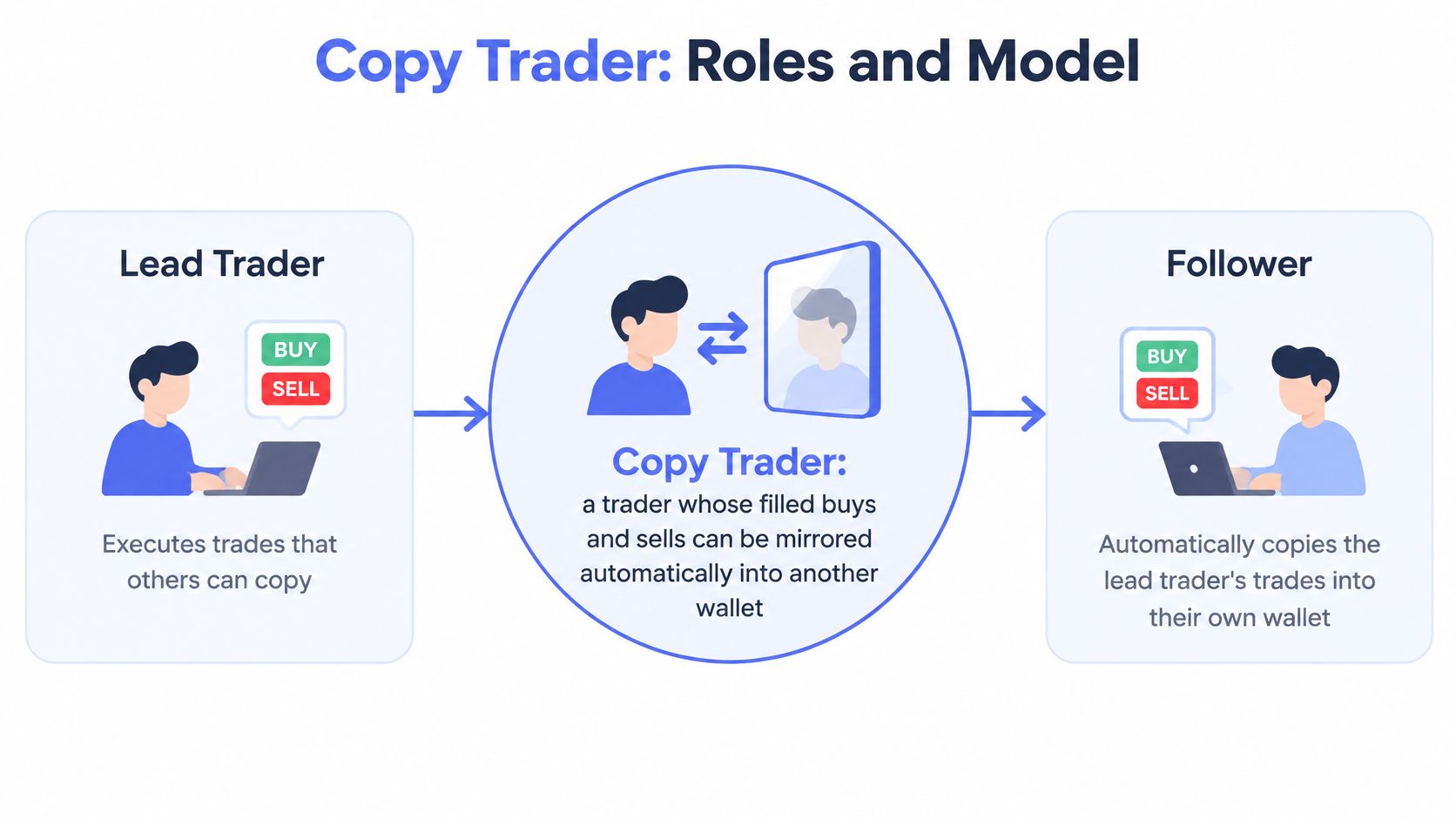
Control and risk divide in a specific way, and it's worth seeing it side by side.
| Role | What They Decide | What Can Go Wrong | What to Check |
|---|---|---|---|
| Leader (signal provider) | Strategy, timing and position size | Concentrated bets, short-lived streaks | Full filled-trade history and drawdown |
| Follower (copier) | Which leader, copy size, caps and when to stop | Copying a lucky run, oversized tickets | Own limits set before the first copy |
| Platform tool | Execution of copies on the follower's wallet | Delay and slippage on thin tokens | Printed slippage on each copied trade |
On-chain, the split gets literal. The leader's fills are visible to anyone watching the address, and the follower's copies execute from the follower's own wallet, so the funds never sit with a platform.
A leaderboard entry records what a wallet already did. Those ranking interfaces aren't neutral either. Peer-reviewed research on copy-trading behaviour found that showing retail participants other investors' success significantly increased their risk-taking, and the effect grew larger when direct copying was available. The list you read shapes the size you take.
Judge a Leader Step by Step
The usual method is a sort by PnL, a glance at the top name, and a copy. It survives because it's fast, not because it works. Realized PnL counts closed positions only. A wallet can post a clean green number while carrying open positions that are underwater, and a handful of outlier trades can carry the whole total.
The Record Is Not the Rank
Rank tells you where a wallet sits against other wallets. It doesn't tell you whether the profit came from a process that repeats or from one token that ran for six hours. Each check below answers a different question, and a leader who fails one of them badly isn't rescued by passing the others.
| Metric | What It Shows | Red Flag |
|---|---|---|
| Realized vs unrealized PnL | Profit locked in against paper gains | Large open losses under a strong closed record |
| Maximum drawdown | Deepest fall from a peak balance | Drawdown larger than the reader can tolerate |
| Win rate and win/loss size | Whether wins are frequent or only large | Many small wins offset by a few large losses |
| Trade frequency | How often the wallet trades | Bursts of activity followed by long silence |
| Holding time | How long positions stay open | Holds that shrink into the same few tokens |
| Liquidity of traded tokens | Whether exits are realistic at the size copied | Positions concentrated in thin tokens |
| Position concentration | Share of the book in one token | One token drives most of the result |
Run the Checks in This Order
- Pull the full filled-trade history. Not the summary card.
- Separate realized from unrealized results and list every open position with its entry.
- Measure maximum drawdown, the worst stretch inside it, and how long that stretch lasted.
- Check trade frequency and holding time for sudden shifts, because a change in behaviour usually shows up before a change in results.
- Check each token's liquidity against the size you intend to copy, not against the leader's size.
- Count the tokens behind most of the result. Two or three is a warning, not a portfolio.
- Compare behaviour before and after the wallet became visible on the fomo leaderboard.
- Set ticket size, per-trade cap and the drawdown level at which you stop.
What Happens After the Wallet Becomes Visible
The last check isn't paranoia. A 2024 peer-reviewed study of two major cryptocurrency copy-trading platforms found that leaderboard rankings were often poorly correlated with future returns. Copier performance commonly weakened after a trader became highly visible, with copiers able to profit for roughly one week before their PnL declined and sometimes turned negative. Portfolios in the bottom 25% of the Gold tier lost more than USD 15,000 within ten days of promotion.
The event data points the same way. An event study of 500 certified social-trading providers and 167 popularity surges found approximately +2% abnormal returns during the ten trading days before a visibility jump, then no performance persistence afterward. Traders kept attracting copiers without a demonstrated post-event advantage.
That's why a lower-PnL wallet is a candidate worth examining rather than a worse choice. Consistent sizing, clear exits and a shallow drawdown can produce a more durable follower outcome than a spectacular total built on illiquid tokens and rare windfalls. The most profitable wallet isn't automatically the safest signal.
Practical rule: if you can't explain in one sentence where the leader's profit came from, the check isn't finished.
Public activity can also be inflated by wash trading, so verify wallet history directly instead of trusting aggregate volume. The smart money wallet checks walk through the on-chain verification side. A pass is a filter, not a forecast.
Execution Quality, Slippage and Fill Price
A copy doesn't fill at the same moment as the source trade. A copied buy lands within seconds of the trader's buy, and seconds are enough for the price to move, especially on a token with shallow liquidity.
Two terms get mixed up constantly, and the mix-up hides real losses. Tolerance is the maximum deviation you allow before a swap is refused. Realized slippage is the actual gap between the expected price and the price you filled at. A research note on copy-trading execution quality draws that line plainly and adds the reason it matters: a copied swap submitted about a second after the source can meet changed reserves, competing transactions and a different marginal price. copyfomo prints the slippage on every copied trade, so the gap shows up per position instead of being averaged into nothing.
Settings That Carry the Load
| Control | What It Limits | Setting to Consider |
|---|---|---|
| Fixed ticket | Size of each copy regardless of the leader's size | Smaller amount for low-liquidity tokens |
| Proportional sizing with cap | Copy size scaling with the leader | Hard maximum per trade |
| Slippage tolerance | Worst accepted fill price | Lower on thin markets |
| Transaction deadline | Fills submitted after the price has moved | Short window |
| Price impact threshold | Trades into shallow liquidity | Reject above the reader's limit |
| Route check | Poor execution path | Confirm before sending the swap |
Tighten in thin markets and whenever your ticket is large relative to the pool. Don't loosen a setting because a leader's record looks strong. That record describes their entries, not your fills. If you haven't worked with tolerance before, start with the slippage tolerance settings guide and change one variable at a time.
Build one habit early. Read printed slippage across several copies of the same token, and if a token repeatedly shows a wide gap, cut the ticket or stop copying that leader on that token. Before copying a buy, copyfomo checks that the trader paid for it, and a buy that can't be confirmed is not copied.
What Copying Costs Beyond the Trade Price
Costs arrive in the order you pay them, and the first two land before any trade happens.
Gas on the approval. Granting the allowance that lets a contract move your tokens is a network transaction with a fee. Gas on revocation. Removing that allowance is another transaction with another fee, and it happens even though no trade takes place. Neither is avoidable in an allowance-based model. Both are small next to a badly sized position, and both are worth knowing before you start.
Slippage appears as the gap between expected and filled price, printed on each copied trade. It isn't a fee you agree to. It's a cost you discover afterwards, per trade.
| Cost | Where It Appears | What to Check |
|---|---|---|
| Gas on approval | Granting the allowance | Network fee at setup |
| Gas on revocation | Removing the allowance | Network fee even though no trade happens |
| Slippage | Gap between expected and filled price | Printed on each copied trade |
| Bot fees on copied trades | Any fee charged by copyfomo | Current fee schedule in the bot before funding |
| Fee drag | Frequent small trades adding up | Count trades per month |
Fee drag is the one that accumulates. A fee and a slippage hit on every copy means frequent small trades cost more than a few larger ones, even at an identical hit rate. IOSCO's 2025 report warns that imitative trading, which centers on short-term volatile products such as crypto-assets, may expose retail users to excessive risk, cumulative losses and fee drag.
Costs are certain. The outcome they attach to isn't.
Nothing in that list implies a return. Costs reduce whatever result you get, so subtract them from the leader's filled history before deciding the record is worth copying at all.
How Copy Tools Use Your Wallet and Permissions
A copy tool can trade from your wallet only through the permissions you grant. With copyfomo, funds remain in your own wallet, and a revocable allowance lets it execute copied trades. The allowance is the security boundary to inspect.
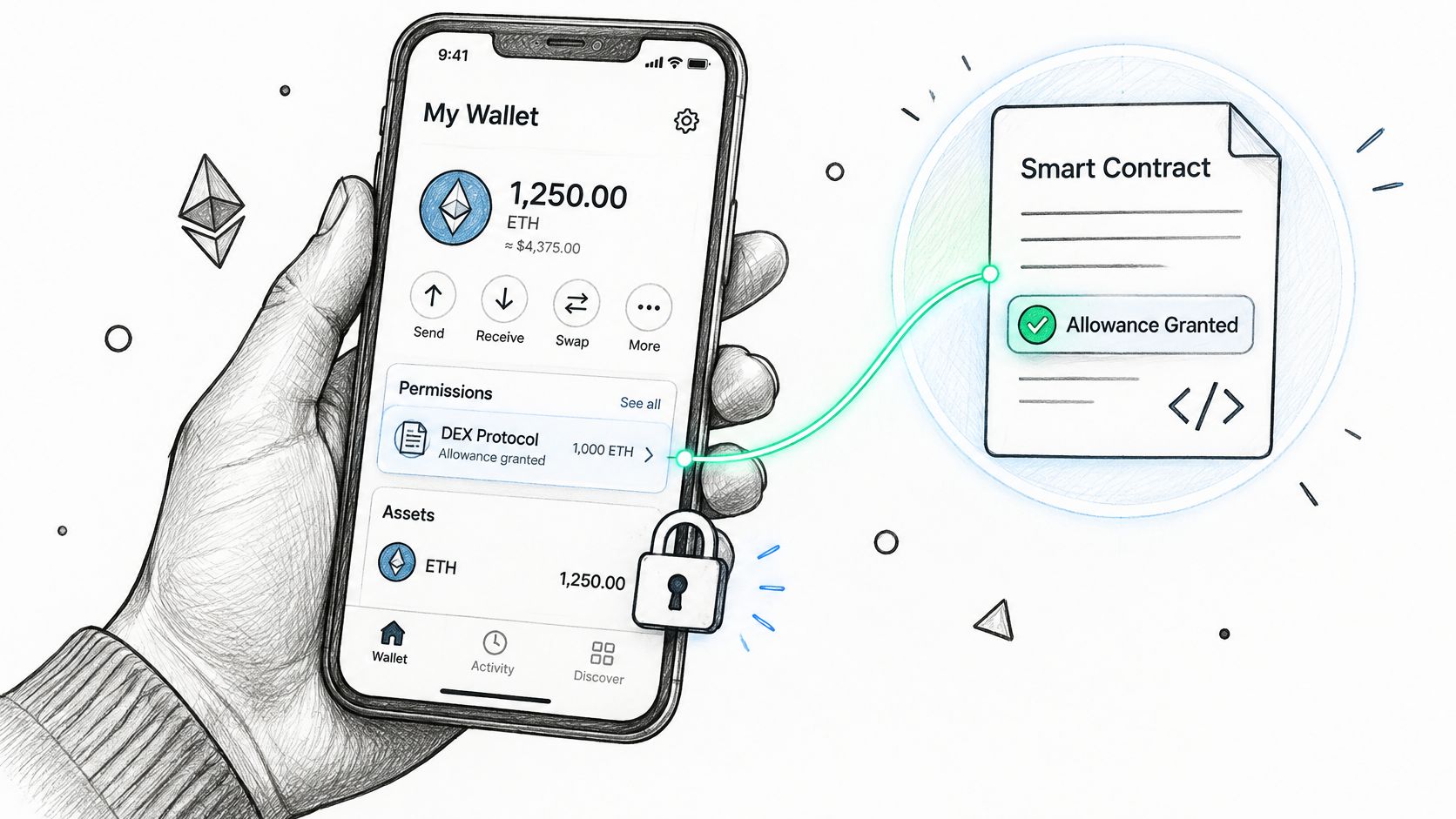
Before signing an allowance, check the token, amount, spender contract and chain. Ethereum.org's guide to revoking token access explains how to review and remove token permissions. Revocation requires an on-chain transaction and stops future use of that allowance. It cannot recover assets already transferred.
The allowance model is easier to follow visually.
copyfomo's copying switch pauses all mirroring. Paused positions remain open and can still be sold by hand from /portfolio. A stop loss set inside a trader's copy flow applies only to that trader, while one set from /settings applies to every trader you copy. Take profit and stop loss use the levels you set, not the trader's levels, and apply to copied positions. The non-custodial wallet model explains how wallet control and permissions work.
Non-custodial control means the funds stay in your wallet, and you can revoke access. It does not remove trading risk, smart-contract risk, token risk or losses caused by an unfavorable fill.
How Sizing and Exits Play Out in a Losing Stretch
Take a hypothetical follower with a fixed ticket and a per-trade cap, both set before the first copy. The leader buys a token. Your copy opens at your ticket, not at the leader's size, which means a leader taking a position ten times your size never drags you into a ticket you didn't choose.
A Partial Exit, Mirrored
The leader sells 60 percent of the position. Your copy sells at the same fraction, so you keep 40 percent of your own exposure, and you can multiply that out with your own numbers. Unless you set exits to sell all at once, the exit follows the leader's fraction rather than closing you out.
Now the leader opens a second position and it goes against them. Stop placement decides what happens next. A stop set inside that trader's copy flow applies only to that trader. A stop set from /settings applies to every trader you copy. Minimum trade size and max chase are account-wide either way.
Set the exit before the entry: the drawdown level where you stop copying is a decision you make while calm, not during the slide.
Say you'd rather stop copying this leader halfway through. Nothing is sold when you do. The position keeps its pnl, and your own take profit and stop loss keep protecting it. One rule to remember on top of that: once a token has left your wallet through a trader's sell, your take profit or your stop loss, copyfomo does not buy it back for 24 hours.
Before the next copy, answer four questions out loud. What's the ticket. What's the cap. Which stop covers this trader. What happens to my position when the leader sells.
Set Your Limits Before You Copy Anyone
Set the limits before funding. Check the leader, choose your execution settings, and decide which stop applies. Know how to pause copying and revoke the wallet allowance.
- Open the bot and send /start to @copyfomo_bot.
- Pick a trader with /leaderboard or /find, using the checks above rather than the default order.
- Run the copy flow and set your size.
- Fund the wallet with /deposit.
- Wait for trade messages. Copied trades need no confirmation or tap.
For each copied trade, choose a flat ticket amount or a share of the trader's size, plus a cap. Proportional sizing can increase your exposure when the trader adds to a position. The cap limits the amount you copy.
Keep comparing leaders after you start. The blog covers individual checks in more depth. Review the slippage printed on each copied trade over several copies before raising your ticket.
Copy trading carries risk. Past performance does not predict results. A leader who passes your checks can still lose money on the next trade. When you're ready, start the copyfomo bot on Telegram.
copyfomo mirrors the filled buys and sells of a fomo trader you choose into your own wallet, at the size you set, and prints the slippage on every copied trade. Judge the leader and the execution separately. Open copyfomo to learn more.
stop reading. start copying.
pick a trader from the fomo leaderboard, set your size, and the entries and the exits land in your own wallet while you sleep.
open copyfomo on telegram →