Copy Trading Crypto: How It Works, Risks, and Better Setups
learn how copy trading crypto works, how to evaluate custodial vs non-custodial setups, and what to monitor for safer, data-driven trade mirroring.

Picking the trader with the highest PnL is the most popular advice about copy trading crypto. It's also incomplete. You don't receive that trader's entry price, position size, or exit liquidity just because a bot follows their trades.
The useful question isn't only who to copy. It's whether their trades are reproducible in your wallet. For traders who already use fomo, that means looking beyond the leaderboard and checking the mirror itself: filled orders, execution delay, sizing, slippage, and completed exits.
Table of Contents
- What Copy Trading Crypto Actually Is
- How Copy Trading Works Step by Step
- Custodial Versus Non-Custodial Copy Trading
- Why Follower Returns Diverge From Leader Returns
- Sizing Strategies for Copied Trades
- Picking Traders to Copy on a Real Leaderboard
- Safer Copytrading Habits and Risk Controls
- Putting It All Together Before You Start Copying
What Copy Trading Crypto Actually Is
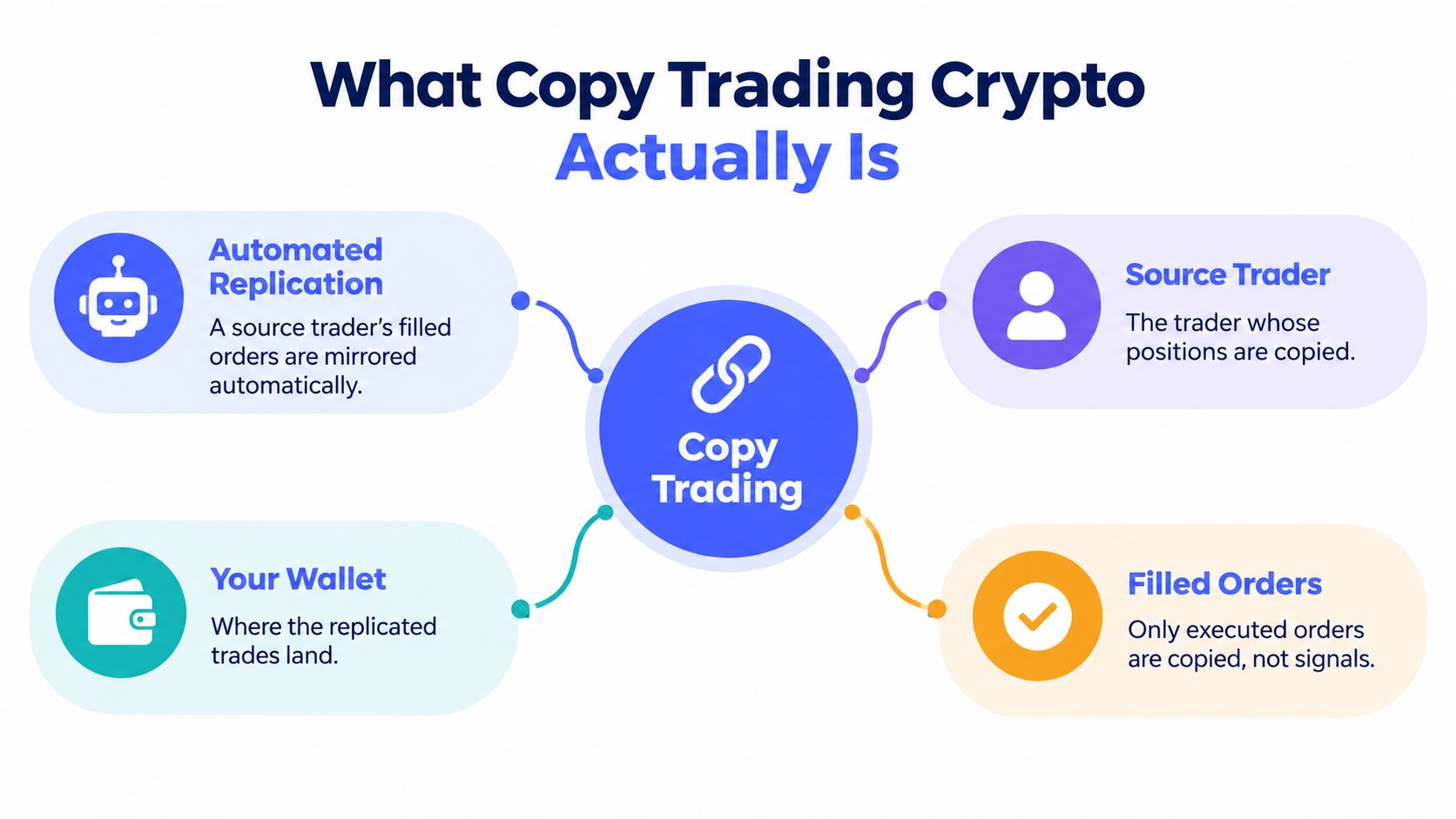
Crypto copy trading is automated replication of a source trader's filled orders into your own account or wallet. The source executes a trade. Your system attempts a corresponding trade under the rules you've configured. Your transaction remains separate from theirs.
That distinction matters. A signal group gives you an idea to act on. An alert tells you something happened. A copy-trading system attempts execution without waiting for you to read a notification and place the order manually.
The diagram separates the source trader from the wallet receiving the copy.
Replication is older than crypto
Copy trading developed from social-trading and automated signal-following systems, not from crypto. A historical study covering June 2010 through October 2012 examined more than 28.5 million trades from 81,300 real-money traders, classifying 67.6% as mirror trades, 31.8% as independently initiated trades, and 0.6% as individual copy trades, as summarized in this history of copy-trading execution.
Those categories aren't interchangeable. The useful historical point is that mechanical replication was already a substantial activity before crypto exchanges adapted it to digital assets.
Two wallets, two outcomes
Leader PnL describes the source trader's outcome. Follower PnL describes yours after your own executions and costs. Treating those as the same number is the basic error behind most unrealistic expectations.
A copied order is an attempt to reproduce exposure. It isn't a transfer of the leader's trading result.
A useful trading record therefore needs more than a leaderboard screenshot. Keep source fills, copied fills, fees, and position changes together. Otherwise, you can't tell whether a disappointing outcome came from the strategy or its replication.
Those records also give an accountant something concrete to review. For jurisdiction-specific help interpreting crypto transaction records, you can browse crypto tax solutions from Nanak Accountants and Associates rather than assume a bot's PnL display answers your tax questions.
The practical value of automation is reduced manual execution. Whether the mirror is acceptable requires a separate assessment.
How Copy Trading Works Step by Step
A reasonable copying system should make the path from source fill to follower fill understandable. You don't need its proprietary implementation details. You need evidence of what happened to your order.
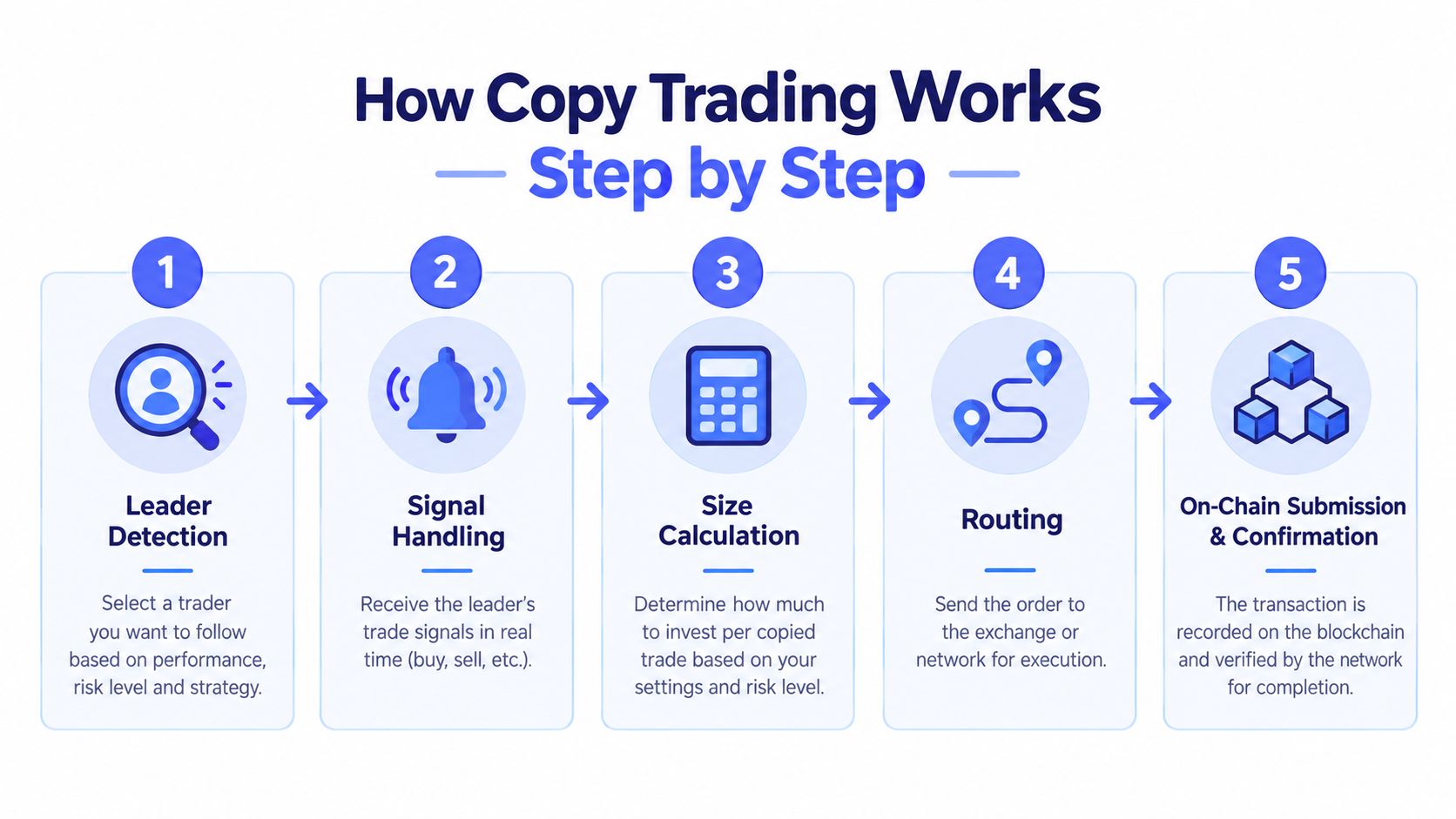
The process diagram shows the main stages between choosing a trader and receiving a confirmed transaction.
From source activity to your transaction
- Select the source. Choose the trader whose executed activity you want to follow. A profile is a selection aid, not an execution receipt.
- Handle the trade event. The system needs to distinguish an actual filled entry or exit from an idea, notification, or unfilled order.
- Calculate your size. Your configured sizing rule determines the attempted amount. An order that breaches your limits shouldn't silently become an exception.
- Route and submit. The system obtains an execution route and submits your transaction under the applicable constraints.
- Confirm the outcome. A submitted transaction isn't a completed copy. The final record should show whether it filled, failed, or remained unresolved.
Delay deserves its own inspection. Research across Bybit and Binance associated execution discrepancies with volatility, exchange latency, and order-book liquidity; the supplied execution analysis also explains why a roughly one-second delay can matter economically in fast markets, rather than representing an acceptable universal threshold (latency and execution-discrepancy research).
Following a trader is like trailing a car through traffic. You can take the same turn without reaching the junction under the same conditions. The gap matters most when conditions change between arrivals.
Exits belong in the same pipeline
Copying buys without copying sells leaves the follower running a different strategy. Exit replication should cover the source's sell activity, while making the follower's actual outcome visible.
Check what happens after a missed entry, a partial exit, or a manual change to your position. Don't assume the system can sell a matching position when your wallet no longer matches the source's history.
The embedded walkthrough provides another way to follow the copying workflow.
A useful execution log records source time, submission time, confirmation time, quoted amount, minimum received, and actual fill. That's how you inspect a mirror instead of trusting a speed claim.
Custodial Versus Non-Custodial Copy Trading
Custodial and non-custodial describe who controls the assets used for execution. They don't describe whether the selected trader is competent or whether the copied trade will fill well.
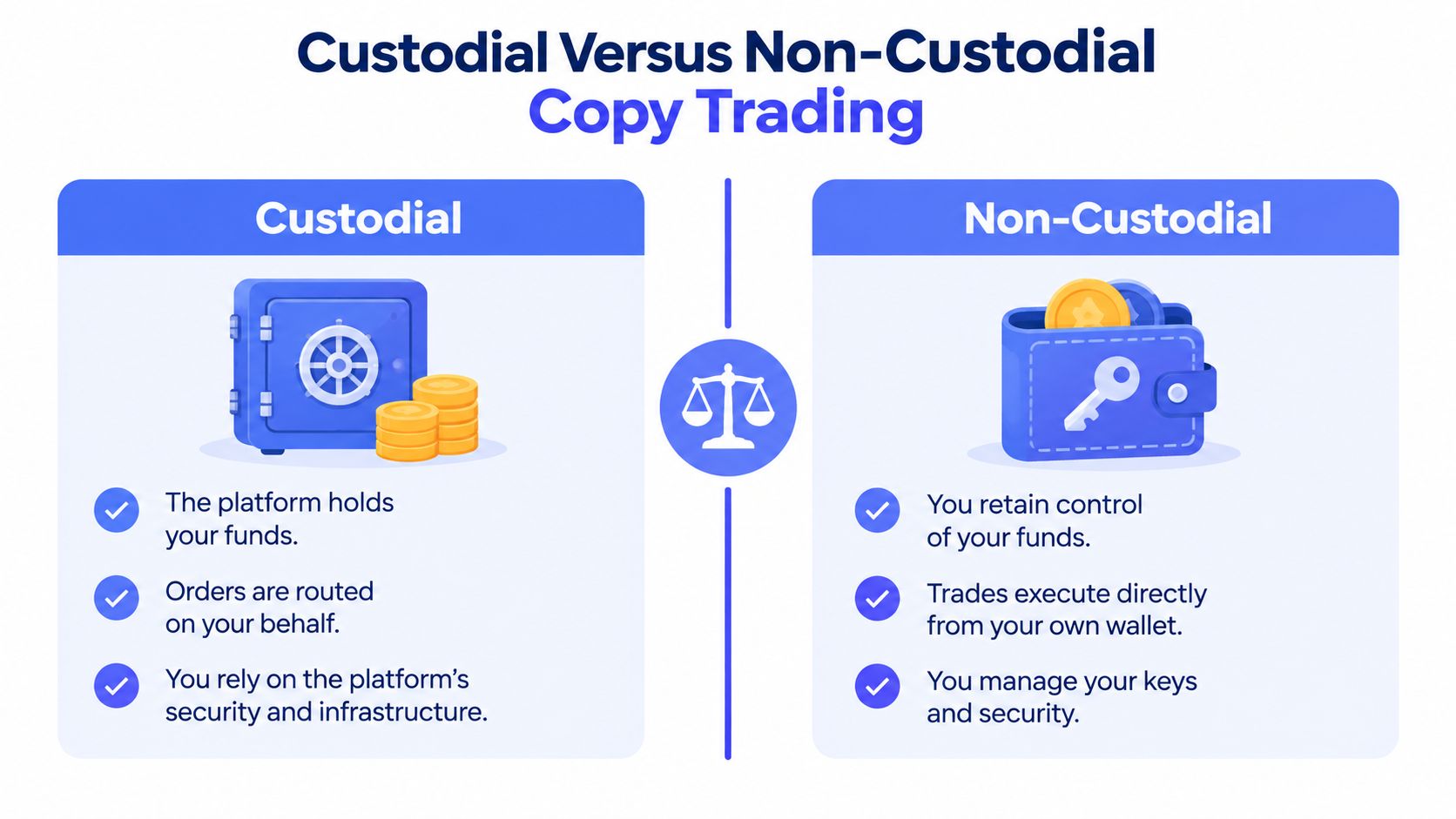
In a custodial arrangement, the platform holds the funds and routes orders on the user's behalf. In an allowance-based non-custodial arrangement, the user retains the wallet and grants a specified spender permission to use approved tokens.
The comparison below separates asset custody from trading authorization.
Custodial vs Non-Custodial Copy Trading
| Dimension | Custodial | Non-Custodial |
|---|---|---|
| Custody | Platform holds the trading funds | User retains control of the wallet |
| Authorization | Platform account permissions govern trading | Approved spending permissions govern token use |
| Revocability | Depends on account controls and platform processes | User can revoke the relevant allowance |
| Execution route | Platform routes orders on the user's behalf | Authorized swaps execute from the user's wallet |
| Failure modes | Platform access, custody, and execution failures | Approval, smart-contract, and execution failures |
What an allowance actually permits
An allowance gives a named spender permission to use approved tokens. Revocation normally means setting that allowance to zero, typically through the token contract's approval function, as described in this wallet allowance and revocation guide.
That's different from depositing assets into a third party's custody. It's also different from granting no access at all. While an approval remains active, the authorized spender has the permission you granted.
Permission check: Retaining your wallet keys doesn't make every approval safe.
Before authorizing execution, inspect the spender, token, and approved amount. Understand which permission you must remove if you stop trusting the service. A pause button and allowance revocation solve different problems: stopping new copies isn't the same action as removing spending access.
Non-custodial execution doesn't remove smart-contract risk or prevent a poorly priced swap. Custodial execution doesn't remove those trading questions either, although it puts more operational responsibility inside the platform.
Use this copy-trading platform guide to evaluate the model and controls rather than treating the custody label as a complete safety assessment. The relevant choice is which responsibilities you retain and which dependencies you accept.
Why Follower Returns Diverge From Leader Returns
A green leader can produce a red follower without making a different trading decision. The follower can pay more to enter, receive less when exiting, and spend more executing the round trip.
On-chain research found that gas dominates small swaps, while price impact and slippage become the largest cost components for larger swaps; it also recorded approximately 80% higher adversarial-slippage probability for PEPE than USDC, and mean combined slippage and price impact of 22.5 basis points for WETH-USDC during a stressed episode versus 3.8 basis points during a low-cost period (Uniswap transaction-cost research).
Those observations aren't forecasts for your next copy. They show why asset type, trade size, and market conditions belong in execution analysis.
Execution Cost Components in a Copied On-Chain Swap
| Component | What It Captures | When It Dominates |
|---|---|---|
| Pool fee | Charge for trading through the pool | Material when other execution costs are relatively low |
| Gas | Network cost of submitting and executing the transaction | Small swaps, relative to their notional |
| Price impact | Price change caused by your own order | Larger orders relative to available pool liquidity |
| Adverse slippage | Unfavorable movement between quote and execution | Rapid price changes or transaction-ordering effects |
| Sandwich-related slippage | Execution deterioration associated with adversarial ordering | Vulnerable swaps where ordering can be exploited |
Pool depth matters more than the token label
A source wallet might enter a pool before other buyers arrive. A follower enters after that demand has changed the available quote. If additional followers also buy, the original fill becomes an increasingly poor reference for the next transaction.
Price impact isn't a fixed surcharge. Increasing the order size against limited liquidity can change the execution price disproportionately. The right comparison is your proposed order against available liquidity, not your wallet balance against the leader's wallet balance.
This explanation of slippage in crypto helps distinguish quote-to-fill deterioration from the impact of the order itself.
Exits deserve the same scrutiny. A leader's completed sale doesn't establish that equivalent liquidity remains for followers. An attempted exit that fails is especially important because the wallet retains exposure after the source has reduced it.
Inspect entry cost, exit cost, and unsuccessful copies together. Faster copying alone isn't enough. A faster transaction with an unacceptable fill is still an unacceptable transaction.
Sizing Strategies for Copied Trades
Your sizing rule determines which version of the source strategy you run. Copying the same tokens isn't enough if your capital allocation behaves differently.
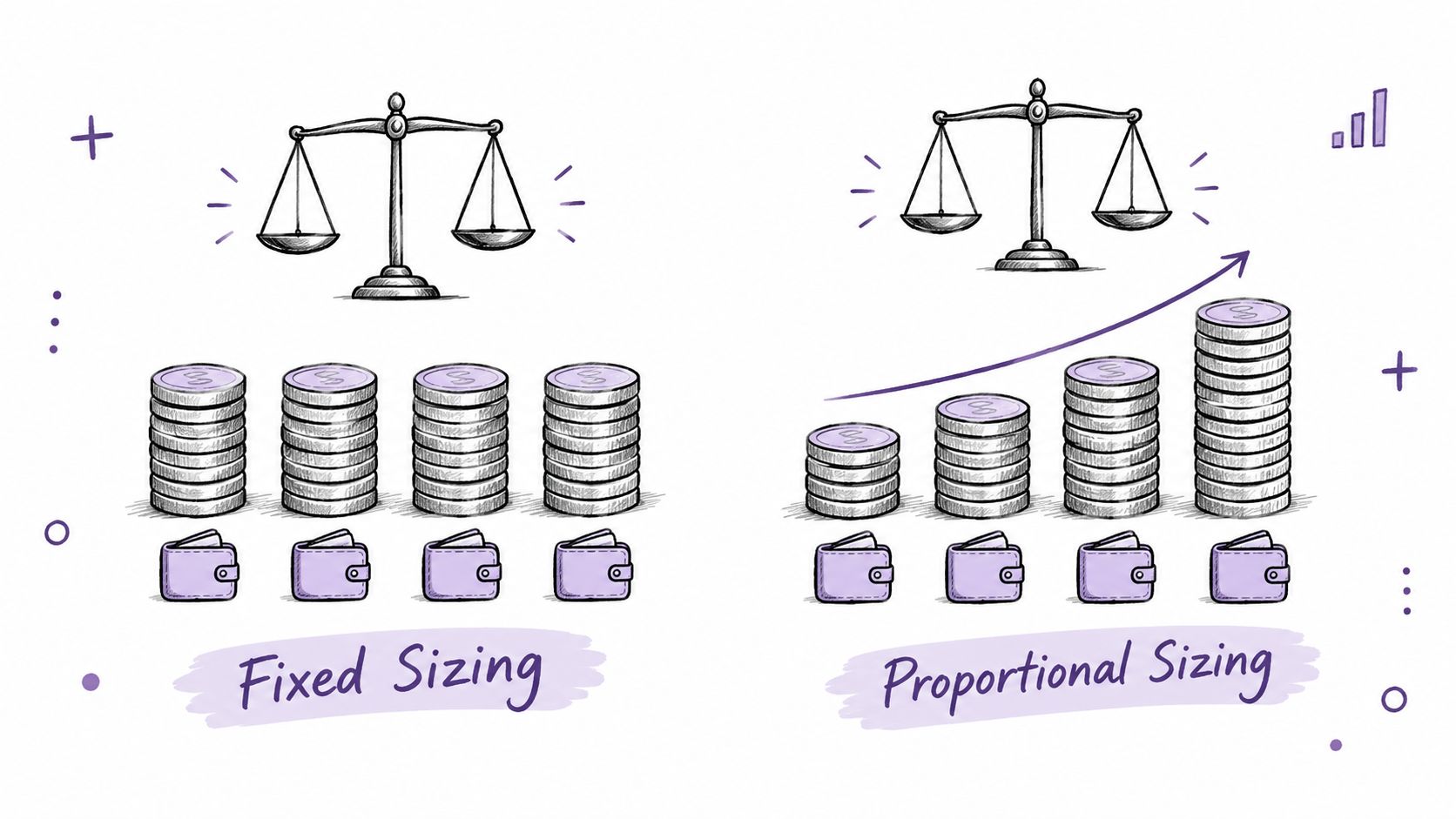
Fixed ticket sizing uses a configured amount for each copied trade. Proportional sizing scales the follower's amount relative to the source. Neither rule should bypass a liquidity check or a per-trade cap.
The sizing diagram shows the distinction between equal-sized copies and copies that scale with the source.
Fixed tickets for budget clarity
Fixed tickets make the attempted amount predictable. They're useful when the operational priority is knowing how much each new copy can commit.
The trade-off is loss of the leader's relative sizing. A source trader's small exploratory entry and larger conviction trade can become equal-sized positions in your wallet. That changes the strategy's weighting even if both copies execute correctly.
Repeated entries need attention too. A per-trade limit doesn't necessarily limit your total exposure to the same token.
Proportional sizing for relative exposure
Proportional sizing preserves more of the relationship between the source's trade amounts. It only reproduces their broader risk allocation if the relevant capital base and existing positions are understood.
Don't confuse proportional with affordable. A source's unusually large order can still exceed your budget, and an amount that fits your budget can still be too large for the pool.
- Set the cap separately. Treat the per-trade maximum as a hard boundary, not a suggestion overridden by the leader.
- Define out-of-budget behavior. Know whether the system scales down or skips the copy. Those choices create different positions.
- Check accumulated exposure. Include repeated buys and overlapping selections, not just the newest ticket.
- Respect execution limits. A smaller copy or skipped trade can be preferable to loosening constraints merely to force a fill.
Sizing rule: Your budget decides what you can authorize. Pool liquidity decides what size can execute acceptably.
Write the rule down before enabling automation. Changing it after every winning or losing trade makes the follower's strategy difficult to evaluate.
Picking Traders to Copy on a Real Leaderboard
A leaderboard ranks recorded outcomes. It doesn't rank how easily your wallet can reproduce them.
A filled-trade PnL ranking, such as the fomo leaderboard, is a more concrete starting point than a theoretical valuation of unsold holdings. It shows executed activity rather than assuming every displayed position could be liquidated at its marked price. But the source's completed fills still aren't follower fills.
IOSCO identifies cumulative losses, frequent-trading fees, volatility, and operational failures among the risks of online imitative trading, which supports evaluating more than a headline performance figure (IOSCO report on online imitative trading).
Inspect the trading behavior behind the rank
| Question | What to inspect |
|---|---|
| Is the history informative? | Activity across different conditions, including losing periods |
| How often does the trader rotate? | Token changes and the operational burden of repeated copying |
| Are the orders reproducible? | Source trade amounts relative to pool liquidity |
| Does the trader close positions? | Executed sells, remaining holdings, and partial exits |
| What happens after losses? | Position additions, changes in size, and abandoned exposure |
| Does your mirror keep up? | Missed trades, rejected copies, and completed follower exits |
A trader who frequently switches thin-liquidity tokens may be difficult to copy even with an attractive realized PnL. A trader whose fills leave more time and liquidity for followers may be easier to inspect. That's an execution judgment, not a prediction of future performance.
Look at the bags, not just the sales
Realized PnL needs context from remaining positions. If a trader sells selected winners but retains difficult-to-exit holdings, the realized figure alone won't describe the whole exposure you may inherit.
Inspect sell behavior directly. Does the trader exit fully, trim gradually, or leave residual positions? Check whether your own copied position would still be manageable after the source has sold.
The guide to evaluating fomo traders to copy is a starting point for that inspection, not a reason to outsource judgment to a ranking.
Selection should produce a testable explanation: this trader's order sizes, turnover, and exit behavior fit the mirror's constraints. If the explanation is only that their PnL is high, the evaluation isn't finished.
Safer Copytrading Habits and Risk Controls
Copy trading carries risk. Past performance does not predict results. Automation changes who submits the order. It doesn't remove the possibility of losing capital.
ESMA reported that national regulators found 74% to 89% of retail CFD accounts typically lost money, with average losses ranging from approximately €1,600 to €29,000 per investor (ESMA's retail leveraged-trading findings).
CFDs aren't spot crypto swaps, and those figures aren't a crypto copy-trading loss rate. Their relevance is narrower: copying high-risk behavior doesn't supply the source trader's capital, experience, or controls.
Before enabling copies
- Review authorization. Inspect active allowances and remove permissions you no longer need or trust.
- Define exposure boundaries. Set the sizing rule, per-trade cap, and acceptable accumulated exposure.
- Set a slippage ceiling. Decide what execution deterioration you'll permit before an order should be rejected.
- Locate the stop controls. Understand how to pause new copies and whether closing existing positions requires a separate action.
Don't learn the kill switch during a bad fill. Check the available controls before leaving the system unattended.
During operation
Watch for execution behavior that violates your assumptions: repeated rejected orders, unexpectedly poor fills, or source exits without corresponding follower sales. During fast-moving news or deteriorating liquidity, pausing can be more appropriate than widening settings to keep every trade flowing.
A closure control is an attempt to transact, not protection from unavailable liquidity. Keep that distinction clear when planning an emergency response.
After execution
Compare actual received amounts with quotes and minimum-received settings. Review both winning and losing copies, and account for failed transactions rather than removing them from the record.
Then compare follower PnL with source PnL. Ask whether the difference came from timing, sizing, costs, or missed activity. If the answer isn't visible, request better records before expanding automation.
A bot that runs unattended still needs an operator who reviews what it did.
Keep a short journal of setting changes and why you made them. Otherwise, you can't distinguish a deteriorating mirror from a strategy you kept altering yourself.
Putting It All Together Before You Start Copying
The setup decision is a chain of dependencies. Trader selection matters only after custody, permissions, sizing, and execution limits are understood.
For an allowance-based wallet setup, confirm that you retain custody and can revoke the relevant permissions. Then check whether the available controls match the way you intend to operate. Don't assume every tool described as non-custodial offers the same pause or position-management behavior.
A before-you-copy checklist
- Confirm the model. Identify where assets remain and what the service is authorized to spend.
- Choose the sizing rule. Decide between fixed tickets and proportional sizing, then apply a separate per-trade cap.
- Bound execution. Set a slippage ceiling and understand what happens when a copy can't meet it.
- Check exit handling. Verify that sells are included and that missed or incomplete exits remain visible.
- Evaluate replicability. Use source trade size, turnover, liquidity, and completed exits alongside realized PnL.
- Schedule review. Compare follower and leader outcomes weekly, including unsuccessful copies and changed settings.
Judge the mirror, not the story
A useful setup makes deviations observable. You should be able to explain why your wallet differed from the source without relying on a promotional claim or a leaderboard position.
Keep selection decisions separate from execution diagnosis. Changing traders won't necessarily fix poor routing or unsuitable sizing. Changing slippage settings won't fix a source strategy you don't understand.
For bot access, use the official Telegram start page rather than an unsolicited account offering setup help. Review permissions and controls before authorizing trades.
Copy trading carries risk, and past performance does not predict results. The objective is a bounded, inspectable execution process, not an assumption that another wallet's history becomes yours.
copyfomo is a Telegram bot that automatically mirrors top fomo traders' filled entries and exits into your own wallet with configurable sizing and revocable allowances. It provides timestamps and displayed slippage so you can inspect the execution gap rather than rely only on leader PnL. Visit the site to start the bot on Telegram and review its controls before enabling copies.
stop reading. start copying.
pick a trader from the fomo leaderboard, set your size, and the entries and the exits land in your own wallet while you sleep.
open copyfomo on telegram →