Copy Trading Platform Guide: Key Features & How to Choose
learn how to choose a copy trading platform that fits your goals. explore key features, architecture, and selection tips for 2026.

You know the setup. A leaderboard screenshot is making the rounds. One wallet is up hard for the month. You watched the entries print in real time, did nothing, then saw the move extend without you. That's where many meet a copy trading platform. Not in theory. In regret.
My view is simple. A copy trading platform isn't mainly a discovery tool. It's an execution system glued to wallet permissions. The trader you follow matters. But the bigger question is whether the software can mirror the same filled trade into your wallet, at a size you chose, without taking custody and without wrecking the price on the way in or out.
That matters because copy trading is no side feature anymore. In a large social trading sample covering 28.5 million trades from 81,300 real-money traders, 67.6% of activity was mirror trades, versus 31.8% independent trading and 0.6% direct copy trades, showing how automated mirroring became the dominant mode in that venue. Earlier work on social signal-following preserved chat logs from 2000 to 2003, covering nearly 9,000 trades and 676 traders, and found that once a buy or sell signal appeared, later orders were 40.7% more likely to move in the same direction. That arc matters. Copy trading moved from social influence to automated market infrastructure with measurable impact across eras and venues, as summarized in this social trading research overview.
Table of Contents
- What a Copy Trading Platform Actually Does
- Custodial vs Non-Custodial Architecture
- How Execution, Latency, and Slippage Work
- Features That Change Real Outcomes
- Why Custody and Exit Mirroring Matter Most
- Choosing a Platform by Trader Profile
- Checklist Before You Turn the Bot On
What a Copy Trading Platform Actually Does
A copy trading platform replaces manual stalking, screenshots, and late entries with software. In crypto, the basic definition is straightforward. It's an automated setup where a follower's account mirrors a chosen lead trader's positions, and the copied order size is usually scaled to the follower's allocated capital rather than matched one-for-one, as described in TheStreet's crypto copy trading definition.
The three moving parts
First, there's the leader signal. That's the trade you want to mirror.
Second, there's the relay layer. It detects the leader's activity and routes that signal into the follower workflow.
Third, there's the follower execution engine. That's where your sizing rule gets applied and your order gets sent.
If any one of those breaks, the copy isn't the same trade anymore. It becomes a rough imitation. That's a problem when the asset is moving fast and the edge depends on timing.
What users usually get wrong
Many assume the product is “follow a good trader.” That's only half the job. The harder half is operational. Can the platform verify the wallet you intend to follow. Can it mirror both buys and sells. Can it show you what was filled, what was skipped, and how much slippage you ate.
Practical rule: If the platform can't show the exact copied trade path into your own account or wallet, you're trusting a black box.
The risk is plain. Copy trading doesn't remove market risk. It adds execution risk, software risk, and often custody risk. You're handing critical decisions to infrastructure you didn't build and probably didn't audit. That doesn't mean don't use it. It means stop pretending the leaderboard is the product. The mechanics are the product.
Custodial vs Non-Custodial Architecture
This split decides what happens when things go wrong. Not the slogan on the landing page. Not the logo. The architecture.
A custodial copy trading platform usually wants your deposit inside its system. Orders can route fast because the platform controls the account environment. Setup is easy. That's why people like it. But if the platform freezes withdrawals, has an outage, or gets hit, you don't have an independent path to move funds or sign around the problem.
A non-custodial setup is different in practice. Your funds stay in your wallet. The platform gets limited permission to act within the scope you approved. If you don't like the setup anymore, you revoke access. The software may stop mirroring, but your wallet still exists and your assets don't sit inside someone else's pooled account.
What failure feels like
In custodial systems, outages tend to trap the whole workflow. Entries stop. Exits stop. Your only option is support or waiting.
In non-custodial systems, the mirror channel can fail while your wallet keeps working. That doesn't remove market risk. It changes who controls the last move.
Public safety guidance on crypto copy trading keeps coming back to the same issues, platform risk, borrowed exposure, over-allocation, strategy drift, and the fact that custody changes who controls access to assets, as laid out in Trust Wallet's guide to copy trading safety and self-custody.
| Dimension | Custodial | Non-Custodial |
|---|---|---|
| Who holds funds | Platform or exchange account | Your wallet |
| Who controls keys or signing | Platform controls execution environment | You grant limited permissions |
| Can you revoke access | Usually not in a wallet-native way | Yes, typically by revoking permissions |
| What happens in a platform outage | Entries and exits can both stall inside the platform | Mirroring can stall, but your wallet remains independent |
| Onboarding friction | Lower | Higher |
| Operational cost | Often hidden in platform structure | You may bear wallet and on-chain execution costs |
My recommendation
If you care about control, start from custody and work outward. Don't start from the leaderboard and work backward. A non-custodial model won't save a bad strategy, but it does reduce one class of avoidable failure.
If you want a product-level example of that distinction in the app category, this breakdown of a copy trading app is the right place to compare what users experience.
How Execution, Latency, and Slippage Work
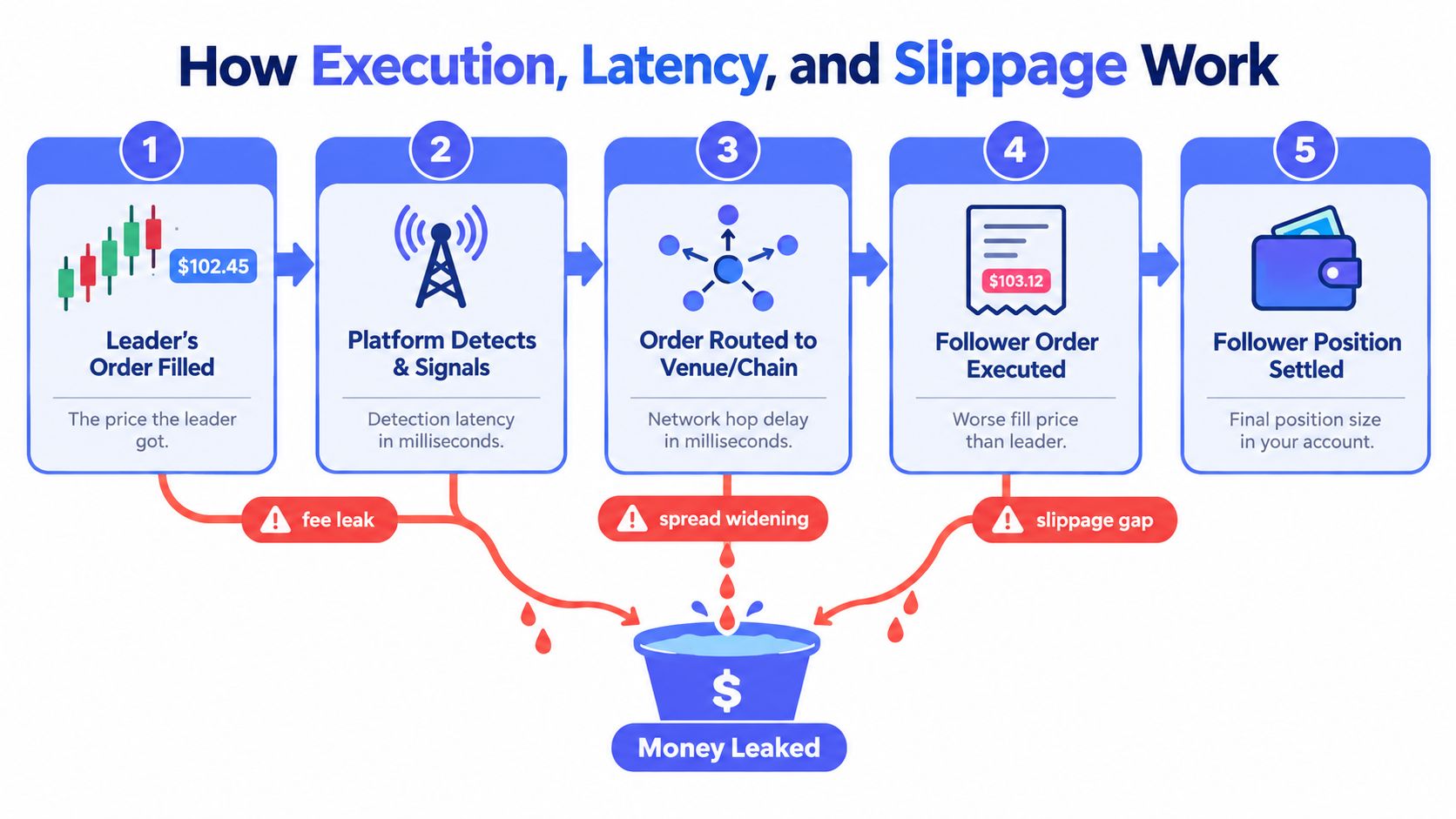
The leak starts after the leader is already filled. That's the part many users ignore.
Execution isn't simultaneous with the source trader. The follower's order is placed after the lead trader's order, so slippage and available liquidity can change the entry price and the eventual fill, as explained in BitMEX's overview of how copy trading works.
Where the delay comes from
The leader fills first.
Then the platform has to detect the trade. Then it has to apply your sizing rule. Then it routes the follower order. Then the venue or chain has to execute it. Every step adds delay. In optimized setups, a typical follower can be filled roughly 50 to 200 milliseconds after the signal, while slower relays can stretch into hundreds of milliseconds or seconds. In volatile crypto, even a few seconds can mean about 28 basis points of entry slippage on one trade, and the same problem can hit again on exit if exits aren't mirrored too, according to independent analysis of why copy traders lose money.
A fast-looking bot that reports only entries can still leave you with a very slow exit.
Here's the visual version of the pipeline. Watch where the cost leaks out.
Why exit mirroring matters more than people think
A copied entry is only half a trade. If the leader closes and your system doesn't, the leader has realized PnL and you have exposure. Those aren't the same thing.
Public exchange and education material also note that copy trading platforms commonly support both openings and closings, not just entries, with follower accounts replicating position openings and exits when the lead trader changes or closes a trade, as described in KuCoin's copy trading guide.
Sizing also changes the outcome. Proportional balance sizing tracks your capital allocation. Fixed ticket sizing keeps each copy the same size. Multiplier logic amplifies exposure and makes mistakes larger. None is automatically right. The correct choice depends on how much variance you can handle and whether the leader trades liquid majors or thinner pairs.
If you want the short version of the mechanics, study latency budget, slippage reporting, and exit fidelity before you study headline returns. And if you want a deeper breakdown of the cost leak itself, read this guide on what slippage in crypto actually does to copied trades.
Features That Change Real Outcomes
Most copy trading product pages sell convenience. That's not the same as safety or execution quality. The useful features are the ones that change what lands in your wallet and what happens when the market turns.
Start with trader selection data
A trader list is worthless if it hides the ugly parts. You need enough context to tell whether the track record is broad or just one good stretch. Independent and exchange-published guidance keeps the warning simple. A follower keeps gains and losses in their own account, while fees, slippage, performance-chasing risk, and the fact that past results don't ensure future results remain part of the setup, as summarized in CryptoSlate's guide to copy trading risk and cost.
What I want to see:
Trade history that's about fills, not screenshots
Realized activity matters more than claims.Risk information beside performance
If the product makes it easy to chase heat and hard to inspect risk, that's a design choice.Trade frequency and style visibility
A high-frequency trader and a swing trader create very different copy conditions.
Then inspect the controls
The next layer is pure mechanics. Good and bad platforms separate here.
| Feature | What to Check | Impact on Outcome |
|---|---|---|
| Sizing mode | Fixed ticket, proportional, or copy-by-trade | Changes drawdown shape and concentration |
| Per-trade cap | Whether one oversized leader trade can exceed your comfort | Limits single-trade damage |
| Kill switch | Whether you can pause new entries, and what happens to open copied positions | Determines how fast you can stop exposure |
| Address verification | Whether the followed wallet is clearly identified and not ambiguous | Reduces copy-the-wrong-wallet errors |
| Fill transparency | Whether each copied trade shows fill price, timing, and slippage | Lets you measure implementation, not marketing |
| Skipped trade handling | Whether the platform logs missed or partial copies | Stops silent failure from hiding in the background |
| Liquidity path | Whether orders route independently or through shared internal logic | Affects fill quality and conflict risk |
What I'd reject immediately: any platform that can't tell you which trades were skipped, which were partially filled, and how exits are handled.
One factual example in this category is copyfomo. It's a Telegram bot for users of the fomo app that mirrors selected traders' filled entries and exits into the user's own wallet, supports configurable sizing and per-trade caps, and displays slippage on mirrored swaps. That's the right direction because it focuses on verified trades, wallet control, and execution transparency rather than vague social features.
Why Custody and Exit Mirroring Matter Most
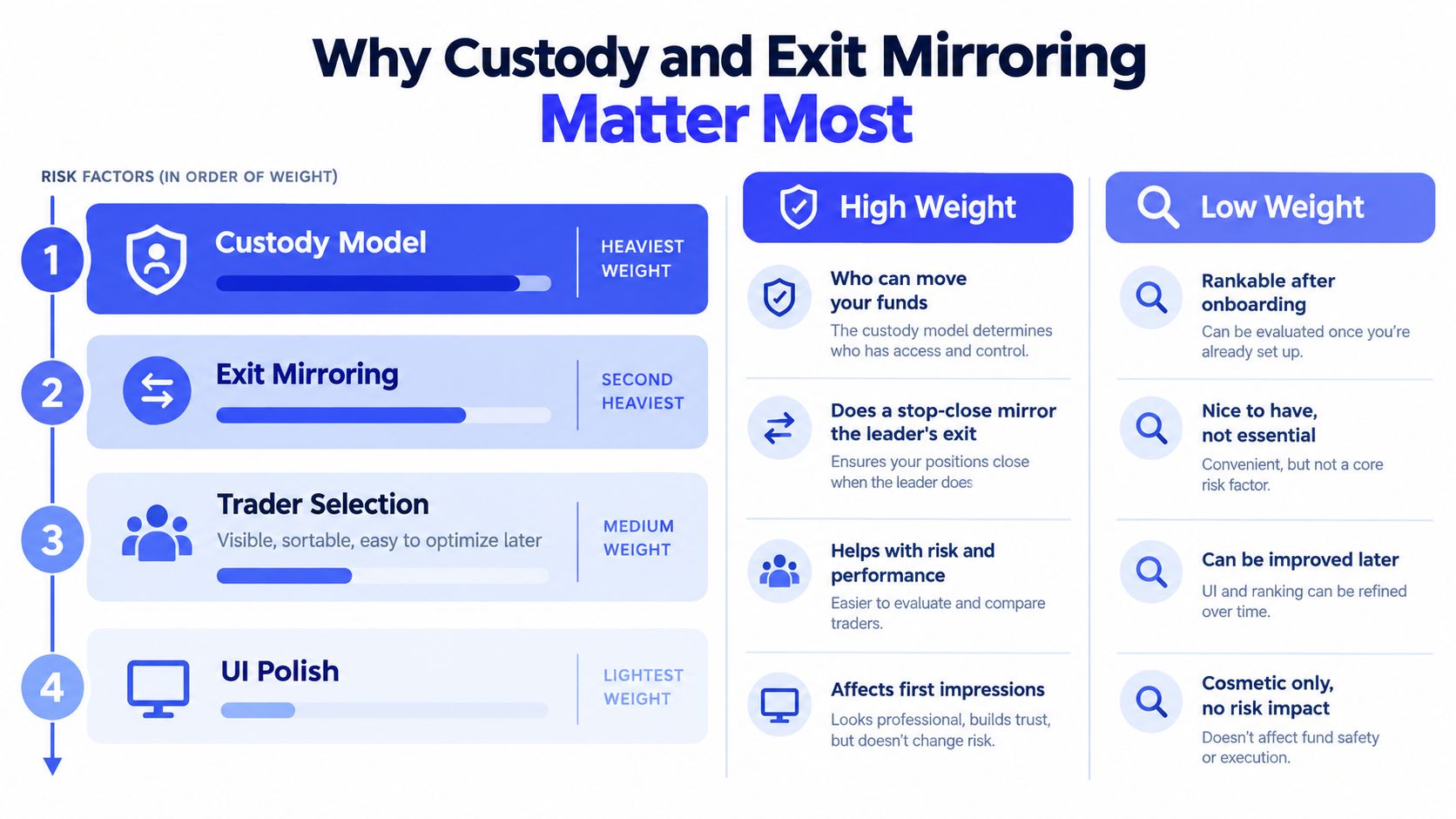
I care less about polished dashboards than most people do. You can improve trader selection later. You can learn a rough interface in a day. But you can't patch over the wrong custody model after funds are locked in, and you can't claim a copied win if your exit never happened.
Why these two decisions sit above the rest
Custody determines who can move, freeze, or lose assets. That's not a feature checkbox. That's the base layer of trust.
Exit mirroring determines whether copied exposure can be closed in line with the source. If it fails, you're not really following the same trade lifecycle.
That's why I rank risk in this order:
- Custody model
- Exit mirroring
- Trader selection
- UI polish
The market has already matured past the novelty stage
This isn't a fringe habit anymore. Neutral industry summaries estimate the copy trading market at about $2.6 billion today with projections to $4.9 billion by 2034, while other reporting puts social trading at roughly $3.2 billion in 2024 and about $6.7 billion by 2034, implying around 9% annual growth over the decade. Active participation is estimated at 10 to 20 million people across centralized and decentralized platforms. Platform growth tells the same story. eToro reported roughly 500,000 users at the end of 2019, 2 million by the end of 2021, and 2.8 million the following year. In crypto-specific copy trading, Bitget's 2023 H1 report said more than 109,000 followers had profitable returns, total profitable copy trades exceeded 16 million, cumulative gains passed 74 million USDT, and futures copy trading represented 91% of copy transactions versus 9% for spot, according to Spark's market overview of copy trading scale and adoption.
That scale makes one point obvious. A copy trading platform is now infrastructure. When infrastructure fails, it fails at size.
Choosing a Platform by Trader Profile
There isn't one right platform for everyone. There is a wrong one for your workflow. Match the product to the way you trade, not the other way around.
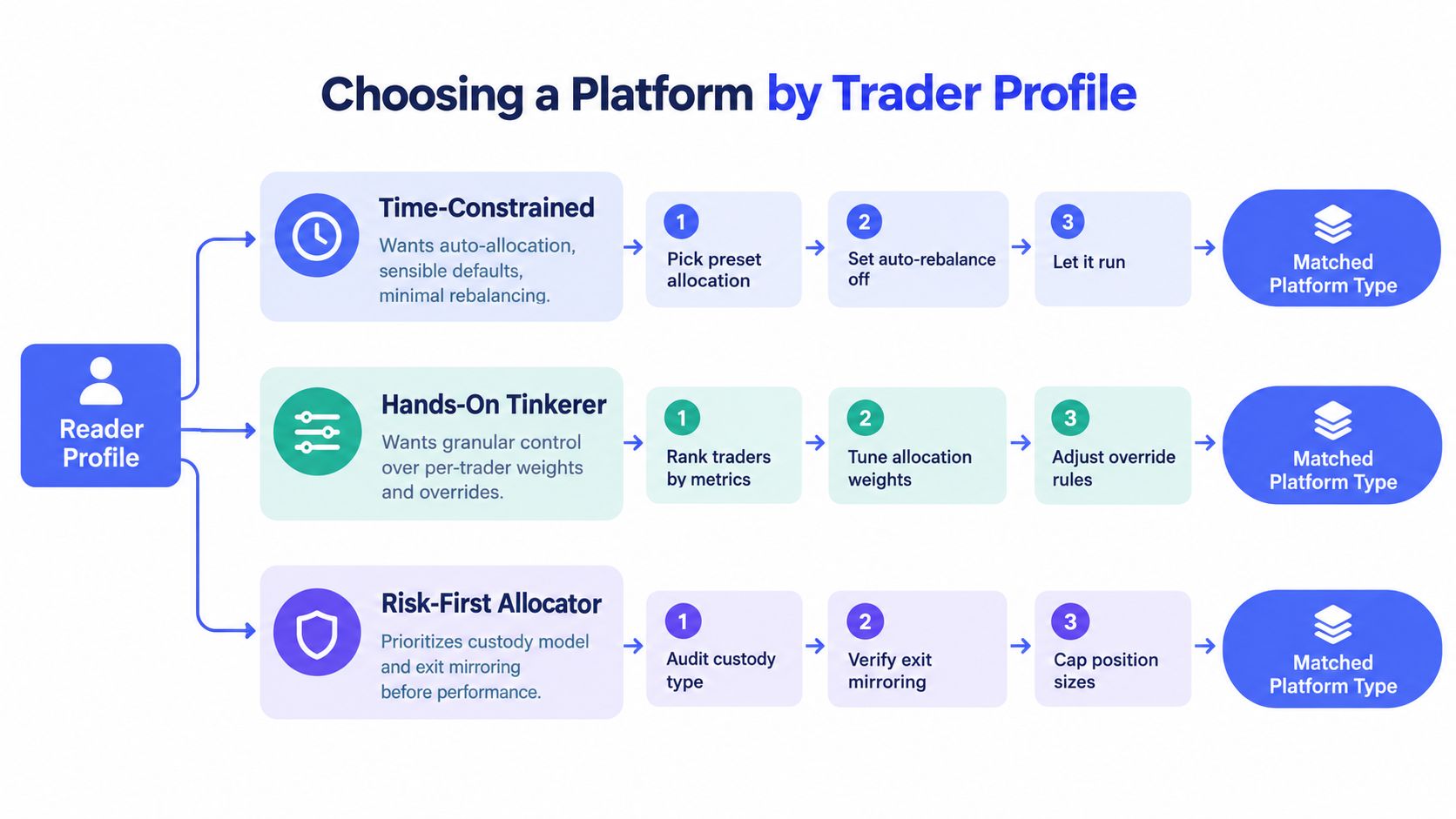
The time-constrained trader
This user doesn't want to babysit a feed. They want clear defaults, straightforward allocation, and background execution.
For that profile, simplicity matters. Clean onboarding is useful. So are preset sizing rules and a visible pause button. But don't confuse easy setup with low risk. If the product hides the wallet, the trade log, or how exits are copied, you're paying for convenience with uncertainty.
Ask these two questions before connecting capital:
- Can I see exactly which trader wallet I'm following
- Can I stop new copies fast without losing control of existing funds
The custody-cautious trader
This person will tolerate more setup friction to keep keys local. Good. That instinct is usually right.
What they should verify is practical, not philosophical. Are permissions revocable. Does the setup rely on wallet allowances or delegated actions rather than deposits. If the mirror channel breaks, can the user still operate the wallet independently. Those are the questions that matter under stress.
The unresolved angle in a lot of copy trading content is that follower risk changes materially with custody, exit behavior, over-allocation, and the ability to revoke permissions. Recent attention in Europe also suggests copy trading is being scrutinized more like an investment service than a convenience widget, which raises the relevance of custody and control questions, as discussed in Trust Wallet's analysis of safety, custody, and follower risk.
The data-driven trader
This user wants logs, exports, and enough detail to measure whether the copy engine is actually worth using. They care more about implementation than branding.
For them, I'd prioritize:
Raw trade visibility
Every copied fill should be inspectable.Slippage history
Without it, you can't separate leader skill from follower execution drag.Sizing control
Fixed, proportional, and capped modes should be explicit.
If you can't audit the copy, you can't judge the strategy.
If you're choosing between styles of product in this category, this roundup of top copy trading approaches is useful as a framework. Don't read it for brand worship. Read it to decide which operating model fits your habits.
Checklist Before You Turn the Bot On
Most losses in copy trading don't start with a bad market call. They start with sloppy setup. Wrong permissions. Wrong wallet. Wrong sizing. No tested exit path. You can fix that before any trade goes live.
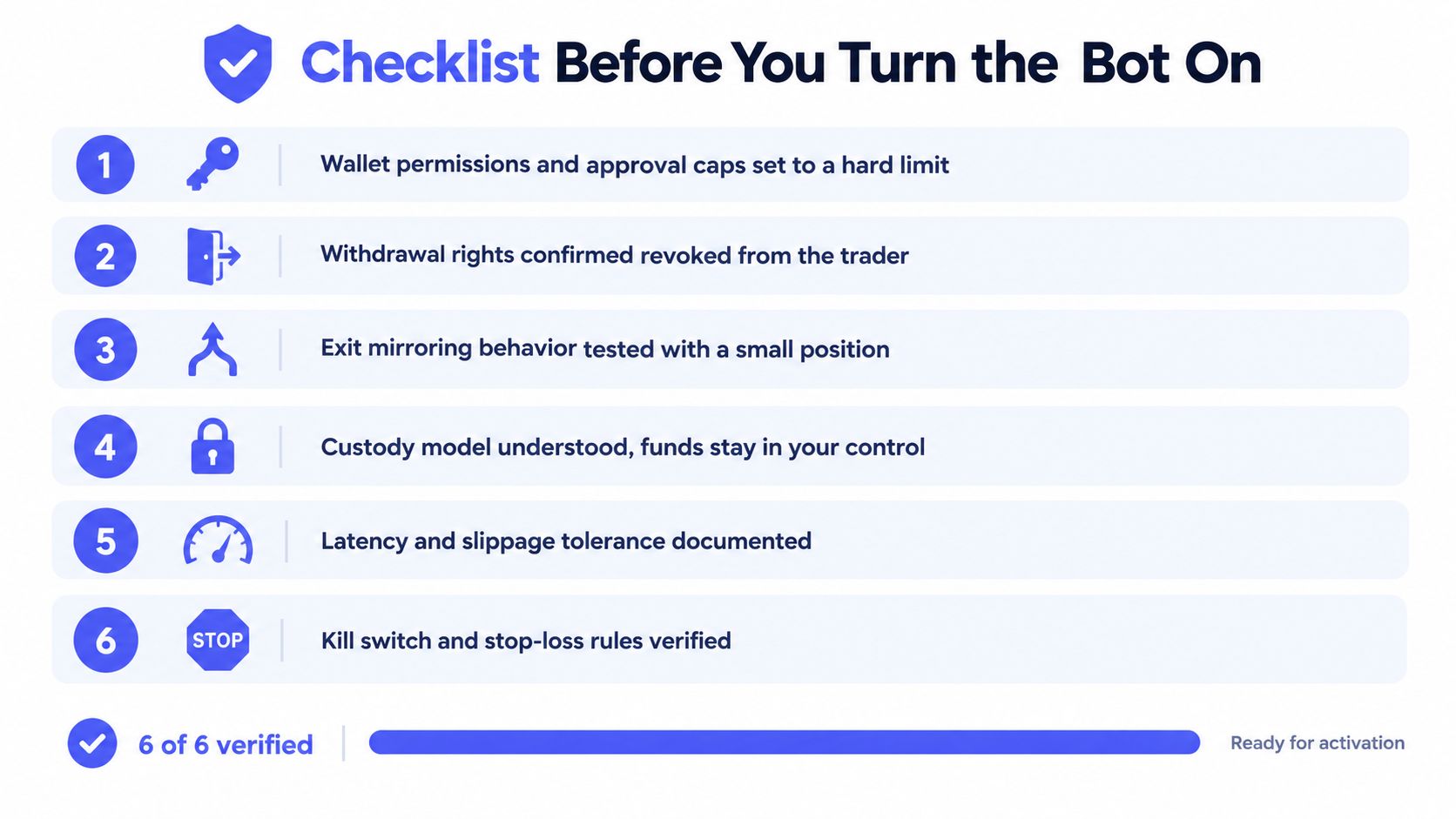
Run this list in order
Confirm wallet permissions
Know exactly what the bot or platform can do. Keep approvals scoped and revocable.Verify withdrawal rights
If the system can move assets beyond the copied trade flow, stop there.Check the source wallet
Don't follow a handle unless the mapped wallet is clearly verified.Set sizing rules before first use
Pick fixed or proportional logic deliberately. Add a hard cap per trade if the platform supports it.Test exit mirroring small
A tiny live test tells you more than a polished dashboard ever will.Review slippage logging
If the platform doesn't show you copied slippage, you won't know where performance went.
Then test your stop conditions
You also need a kill switch. Not just in theory. In practice.
Can you pause new entries immediately. Can you close open mirrored positions if needed. Does the platform tell you what it skipped. These aren't edge cases. They're the basic checks that decide whether automation remains a tool or becomes a liability.
Current risk guidance around copy trading keeps pointing to the same operational failure points, slippage, latency, liquidity depth, hidden borrowing costs, over-allocation, and fast-moving market conditions where even immediate triggers can still produce materially different fills. That problem looks even sharper in short-horizon crypto trading and on thinner tokens, as highlighted in BingX's overview of copy trading risks and execution hazards.
Don't turn on automation until you know how you'll turn it off.
If you already trade around the fomo workflow, run this checklist before you connect anything. The point isn't paranoia. The point is keeping control while you automate execution.
If you want a non-custodial way to mirror filled buys and sells from fomo traders into your own wallet, copyfomo does that through a Telegram bot with configurable sizing, exit mirroring, and revocable permissions. It's built for the exact wallet-control and execution questions covered here, not for leaderboard tourism. Start the setup at copyfomo.
stop reading. start copying.
pick a trader from the fomo leaderboard, set your size, and the entries and the exits land in your own wallet while you sleep.
open copyfomo on telegram →