Crypto Sniper Bot Explained and What Traders Should Know
crypto sniper bot explained: how they front-run on-chain swaps, the real costs, the scam exposure, and what retail users should know before running one.
You spot a new token on fomo, open the chart, and see that the first candles have already moved. Someone bought before your screen refreshed. You submit a market order anyway. It lands later, at a worse price, or fails because the pool has changed.
That is the setting for a crypto sniper bot. It watches for a launch or pending swap, evaluates the transaction, and competes for inclusion before slower participants can react. The important point is not that software clicks faster than a person. The important point is that every participant is competing for a position in an ordered execution system, while fees, slippage, malicious token design, and failed transactions consume the edge.
A 2023 academic study found 161 sniper-bot addresses on Ethereum and 819 on BSC, alongside 14,029 sniping operations on Ethereum and 1,395,042 on BSC. The estimated capital deployed was $10,144,808 on Ethereum and $18,720,447 on BSC. The activity was already a multi-chain market, not a small technical curiosity. (academic study of sniper-bot activity)
Table of Contents
- What Happens in the First Second of a New Token
- How Sniper Bots See and React to Pending Swaps
- The Latency Stack and Why a Second Is an Eternity
- The Real Edge Is Not Speed, It Is the Math After Fees
- Custody, Allowances, and What You Are Actually Granting
- A Pre-Launch Checklist for Anyone Considering Automation
- Questions Retail Users Ask Before They Turn a Bot On
What Happens in the First Second of a New Token
A deployer adds liquidity to a new decentralized exchange pool. The pool now has a tradable price, even if almost nobody has seen the token yet. A searcher's transaction is already waiting. It buys against the shallow opening liquidity, and the pool's formula quotes the next buyer at a higher price.
A human trader may still be looking at a launch page. The first bot has already submitted. A second bot sees the new state and sends another buy. A third wave arrives after that. Each purchase changes the reserves, so the next order pays more or receives fewer tokens. On a thin pool, a modest order can move the quoted price sharply.
The launch is a queue inside a block
The sequence looks simple:
- Liquidity appears. The deployer creates or funds the first tradable pool.
- The first buy executes. The pool calculates a new price from its updated reserves.
- Competing buys arrive. Searchers pay for transaction priority and try to land before later orders.
- Retail interfaces refresh. By then, several state changes may already be final.
- The next trade inherits the new price. The buyer may be entering after the early move rather than before it.
The race isn't only between a bot and a person. Bots compete with other bots, market makers, deployers, and block-building systems. The transaction that arrives first at a node isn't automatically the transaction that executes first. Validators and builders order transactions according to incentives that include fees, routing, and block construction rules. The Ethereum documentation on MEV describes this environment as one where searchers monitor pending transactions and compete to have profitable transactions included.
Practical rule: A first fill is an execution event, not proof that the token is safe or that the entry is good.
The actors have different roles. The deployer creates the token and supplies or controls the initial market. The searcher looks for an advantage and submits a competing transaction. The block builder selects and orders transactions for a block. The retail user clicks confirm, often after the first price changes have already happened.
That last participant usually sees a clean chart and a buy button. The chain sees an ordered set of state transitions. A sniper bot operates in the gap between those two views.
How Sniper Bots See and React to Pending Swaps
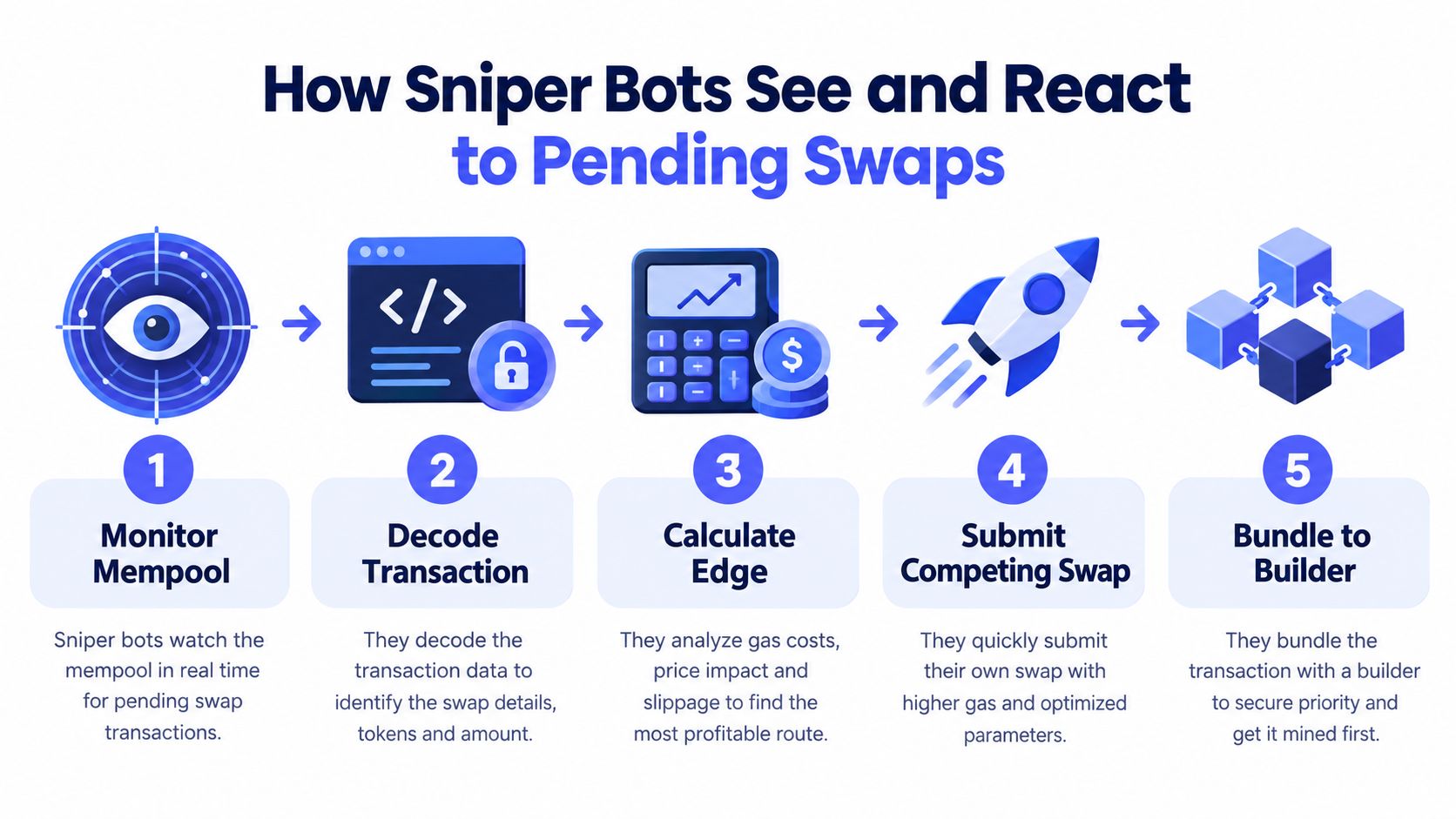
On EVM chains, a bot can watch the public mempool, which is the holding area for transactions that have been broadcast but not yet included in a block. It doesn't need to understand a trader's sentence or intention. It reads transaction data, identifies the contract being called, decodes the function and parameters, and checks the likely result against current pool state.
A pending swap might reveal a token address, a router call, an input amount, a minimum output, and a deadline. The bot can simulate the transaction, estimate the price impact, and decide whether the visible order creates an opportunity. If it proceeds, it submits its own transaction with a higher priority fee or sends a private bundle through a relay or builder route.
A paid bypass at the club door
Think of a crowded club queue. Everyone has a place in line, but some people can pay for a faster entrance. The payment doesn't guarantee entry if the venue is full or the ticket is invalid. It only improves the chance of being processed earlier.
Priority fees play a similar role. A public transaction spreads through the peer-to-peer network. Nodes share it with peers, builders receive it, and the transaction competes with other transactions for block space. A private relay or private mempool can keep the order away from the public queue, then offer it directly to a builder. That can reduce exposure to other searchers, but it doesn't remove execution risk.
A sniping bot usually has a narrower trigger than a general front-running system. It may target a new liquidity event, an initial pool interaction, or a specific launch condition. A general searcher can scan many pending transactions and pursue several forms of MEV. Both use similar low-latency components.
Landing in the same block matters more than a faster clock reading. If the target trade changes the pool price and the bot lands in the next block, its quoted entry may no longer exist. The full pipeline includes mempool visibility, decoding, state simulation, transaction signing, propagation, fee selection, and inclusion. A delay at any stage can change the result. (MEV execution mechanics)
The bot isn't reading human-readable intent. It filters function selectors, token addresses, contract calls, and emitted event logs. It sees structured data. The trader sees a button.
The same logic explains why pending swaps are an attack surface. Public order flow gives competing actors information before final inclusion. A bot can react to that information, but the reaction itself enters another contest.
The Latency Stack and Why a Second Is an Eternity
A crypto sniper bot doesn't experience one delay. It experiences a chain of delays. The node receives data, the strategy evaluates it, the wallet signs a transaction, the fee decision is made, the transaction propagates, and a builder or validator includes it.
Industry explanations of copy trading place typical end-to-end lag at roughly 2 to 12+ seconds, depending on the chain and the system. The stack can include leader signing, propagation, indexing, copier wake-up, transaction construction, broadcasting, and inclusion. (copy-trading latency explanation)
Sniping systems aim for a different class of timing, but the principle is the same. The delay budget is consumed across several stages.
Where the time goes
| Stage | Retail node | Co-located setup | Profitability budget |
|---|---|---|---|
| RPC read and state refresh | Variable and exposed to shared-load queues | Direct, dedicated access | Fresh enough to model the current pool |
| Transaction construction | Wallet and application dependent | Prebuilt paths and local signing | Shorter than the price move |
| Signing overhead | Device or hosted-wallet dependent | Local hot-wallet signing | Small relative to propagation |
| Fee bidding | Reactive and often late | Automated and continuously updated | Enough to compete without erasing the edge |
| Propagation to validators | Public peer-to-peer path | Direct relay or builder route | Must reach the relevant block producer in time |
| Block inclusion | Depends on ordering and congestion | Better routing, not certainty | Same-block inclusion may matter |
A home connection adds application delay, network variation, and dependency on a shared RPC endpoint. A co-located setup can shorten the path to nodes, relays, and builders. It still can't force a builder to include a transaction or make a bad trade profitable.
The hidden bottleneck
Raw milliseconds get most of the attention. The larger failure often happens after detection. The bot bids too little, arrives after a competing bundle has been sequenced, simulates against stale state, or enters with a fee that consumes the expected edge.
That is why the relevant measurement isn't just “how fast is the bot?” Track the time from event detection to submission, the fee paid, the block position, the executed price, and the outcome after selling. Without those records, a fast system can look successful while steadily losing money through failed attempts and poor fills.
The Ethereum MEV overview is useful for the basic incentive model. Validators and builders order transactions. Searchers compete for inclusion. Speed helps only when the rest of the transaction pipeline is also sound.
The Real Edge Is Not Speed, It Is the Math After Fees
Being first doesn't guarantee a positive result. A snipe starts with a cost stack before the token has moved in your favor.
The bot may pay a priority fee to compete for inclusion. Network congestion can raise that fee. The decentralized exchange charges its own swap fee. A shallow pool creates slippage between the quoted amount and the executed amount. Then the bot faces the same costs again when it tries to sell.
Thin liquidity also creates a trap. The buy can push the price upward, making the position appear valuable on paper. Selling into the same pool can push the price down and return much less than the displayed mark.
A launch-by-launch break-even test
| Layer | What it costs or risks | Typical impact on net return |
|---|---|---|
| Priority gas | Payment for transaction ordering | Reduces the amount available after entry |
| Base-fee volatility | Higher network cost during congestion | Makes the same strategy less viable in busy blocks |
| DEX fee | Charge on the swap | Applies at entry and exit |
| Slippage | Price movement caused by the order and competing trades | Reduces received tokens or sale proceeds |
| Failed transaction | Fee paid even when the intended trade doesn't settle | Accumulates across repeated attempts |
| Honeypot design | Buy succeeds while selling reverts or is blocked | Can make the position unexitable |
| Dynamic tax | Transfer or sell tax changes after entry | Can remove most of the exit value |
| Mint or ownership control | Deployer changes supply or trading conditions | Dilutes the position or invalidates the entry |
| Same-block competition | Faster or higher-paying searchers land first | Leaves the bot buying after the initial move |
The simple industry example is enough to challenge the speed narrative. One explainer estimates roughly 2% round-trip cost through a 1% bot before slippage, which means a trade needs to overcome that drag before it produces a net result. (sniper-bot cost and retail-risk discussion)
A strategy that loses two of every three attempts can still be unprofitable even if the wins cover the losses before fees. The correct question is not whether the bot occasionally catches a launch. It is whether the distribution of outcomes remains positive after priority gas, failed transactions, buy and sell fees, slippage, taxes, and scam exposure.
For a practical explanation of the price difference between a quote and the actual fill, see what slippage means in crypto. Record the quoted amount and executed amount separately. Don't calculate performance from a chart price.
Break-even checklist: Log the entry quote, entry fill, gas, swap fee, price impact, sell quote, sell fill, exit gas, and any tax or failed transaction. If one field is missing, the result is incomplete.
Honeypots deserve special attention. A token can permit buys while blocking sells, charging an adjustable tax, blacklisting wallets, or changing transfer behavior after liquidity arrives. Technical speed doesn't test those conditions by itself. A pre-trade simulation of the sell path is more useful than a fast buy that can't be closed.
Custody, Allowances, and What You Are Actually Granting
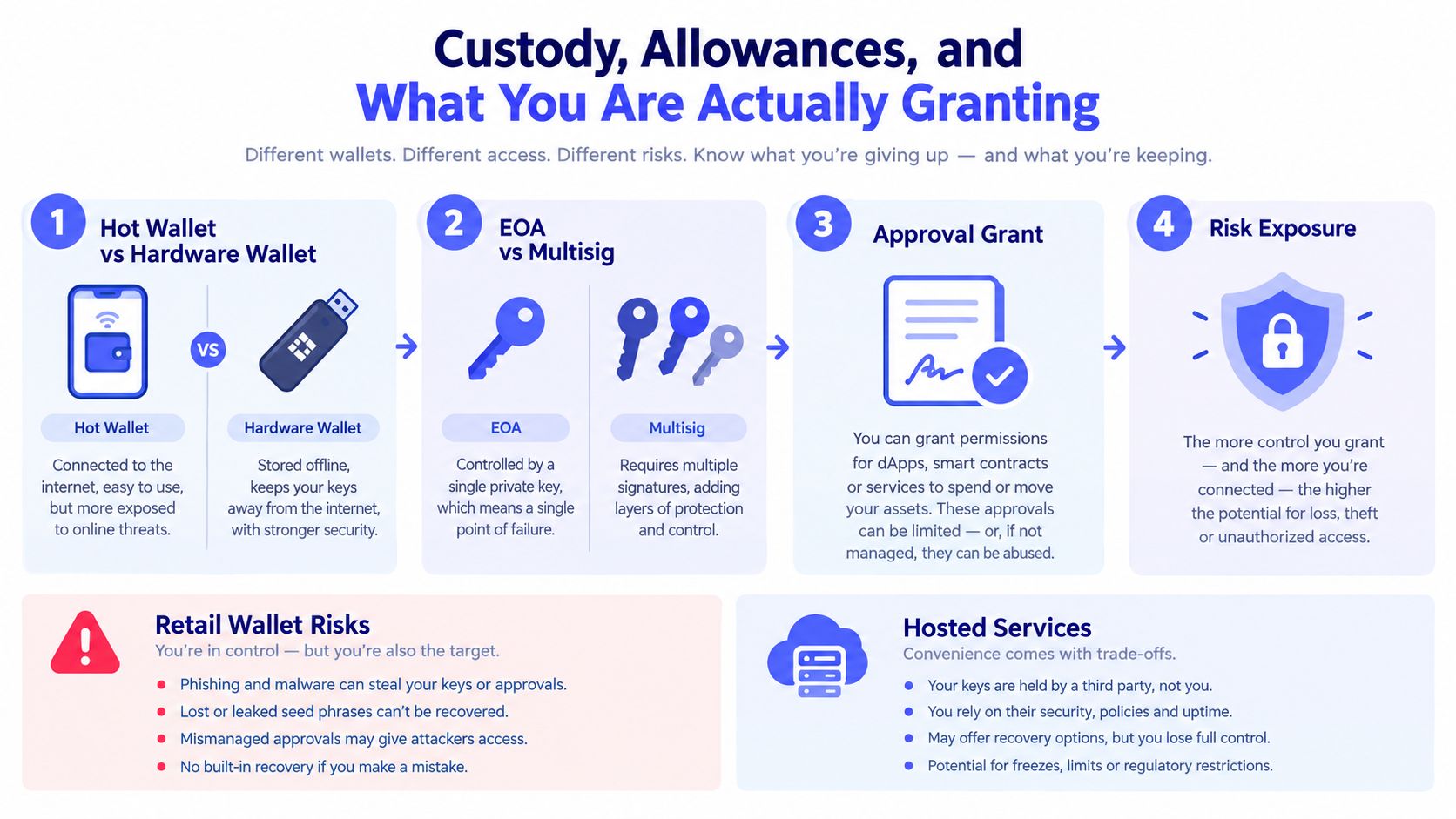
A retail wallet usually falls into one of two practical categories. A hot wallet keeps its signing key on a connected device or service and is convenient for automation. A hardware wallet isolates the key and is better suited to assets that don't need constant automated signing.
An externally owned account, or EOA, is controlled by one private key. A multisig requires approvals from multiple signers. Most automated systems need an EOA because the bot has to sign without waiting for a manual confirmation. That convenience is why a fresh EOA funded only with the amount you intend to risk is safer operationally than connecting automation to a wallet holding long-term assets.
An allowance is a standing permission
With an ERC-20 token, an approval transaction gives a router or contract permission to move that token from your wallet up to a defined allowance. The permission doesn't necessarily transfer the token immediately. It creates authority that another contract can use later, within the approved scope.
Unlimited approvals are common because they avoid repeated approval transactions. They also create standing exposure. If the approved contract is compromised, malicious, or not the contract you thought you were approving, the approved token balance can be at risk. The wallet still holds the funds, but the permission can let the contract move them.
That distinction matters for non-custodial systems. The service doesn't own the assets. The smart contract or spender address receives the authority you granted. The contract can perform only the actions allowed by its code and the permission it has, but that can include draining approved tokens if the code or integration permits it.
Baanx's delegation documentation explains that users can revoke spending authority by setting an allowance to zero or changing the spender address. OWASP's smart-contract guidance also treats active grants as permissions that should be visible, limited, and revocable.
Use a separate wallet for automation. Review the spender address before signing. Prefer a defined cap over an unlimited approval where the workflow allows it. After a session, revoke stale permissions and check the allowance on-chain.
A broader overview of permission-based copy execution is available in this guide to copy-trading apps. The same custody question applies to any automated wallet workflow. Ask what can sign, what can spend, and how quickly you can stop it.
Permission hygiene: A revocable allowance limits counterparty access, but it doesn't make a bad transaction safe. Review both the spender and the token contract.
A Pre-Launch Checklist for Anyone Considering Automation
Automation should begin with a failure plan, not a launch target. Decide what loss you can absorb per trade, keep the bot wallet separate from long-term holdings, and fund it only with capital whose loss wouldn't affect essential obligations.
The wallet should be small enough that a worst-case drain is survivable. Pre-revoke old allowances before funding the wallet. Keep a written record of the spender contracts, token approvals, and the conditions that will pause the system.
Before the transaction
Use this screening list before enabling a strategy:
- Set a fixed loss limit: Define the maximum amount the strategy can lose per launch. Don't widen it after a failed fill.
- Separate holdings: Keep savings and long-term positions outside the automation wallet.
- Inspect the contract: Check source visibility, ownership controls, mint functions, blacklist functions, pause controls, and transfer-tax logic.
- Test the sell path: Simulate both the buy and the sell. A successful buy alone proves little.
- Verify liquidity: Check that the pool has real two-sided liquidity rather than a token deposit that creates a misleading price.
- Review permissions: Remove stale allowances and confirm the exact spender before signing.
The contract review won't identify every malicious behavior. It does force the trader to look for the controls that can change after entry. A token with mutable supply or owner-controlled transfers has a different risk profile from an immutable contract.
This beginner's guide to crypto bots can help organize the operational questions, but no guide replaces transaction-level checks.
While the strategy runs
Log every transaction hash, including failed submissions. Compare realized PnL with quoted PnL, because the quote doesn't include every fee, failed attempt, or exit difference. Track the actual sell result rather than treating an unrealized chart value as cash.
Use a kill switch. Pause new entries when the RPC becomes unstable, the sell simulation fails, liquidity changes sharply, or the strategy hits its predefined loss boundary. Exit the strategy after a defined run of losses instead of increasing size to recover them.
Jurisdiction and tax reporting belong in the same checklist. Automated swaps create records that may need to be reported, so keep transaction hashes, timestamps, cost basis, and realized outcomes for your local tax professional.
Questions Retail Users Ask Before They Turn a Bot On
Are sniper bots legal where I live?
The answer depends on your jurisdiction, the chain, the venue, and the conduct involved. Regulators haven't drawn clean lines around every form of automated retail front-running. Automation itself isn't a guarantee of lawful conduct, and private relays or priority bidding don't remove local market rules. Review the rules that apply where you live before using the system.
Can an exchange or wallet ban me?
A wallet provider and a centralized exchange can apply their own terms. Centralized venues may close positions or restrict accounts when activity violates those terms. On-chain execution doesn't override a platform's policy. Read the applicable terms and keep records of what the bot is submitting.
Can I rent a bot instead of running one?
You can use a hosted service, but the economics still need review. Monthly rent, transaction fees, priority fees, slippage, and performance limits all reduce the room available to the strategy. A hosted system may also expose you to a different custody and permission model. Understand what you control before funding it.
Are the results taxable?
In many regions, swaps, disposals, and other realized events can create reporting obligations. Tax frameworks for automated strategies aren't uniform, and they may not describe every copy or bot workflow clearly. Keep complete records and ask a qualified local adviser how your transactions should be reported.
IOSCO warns that imitative trading can expose retail investors to significant losses, including losses from using borrowed funds and returns eroded by frequent trading fees. Binance also notes that slippage, partial fills, failed orders, and proportional losses can make a follower's result differ from the lead trader's result. (IOSCO report on imitative trading) (Binance explanation of copy-trading execution)
Before turning on any automated workflow, run the pre-launch checklist above. Past performance doesn't predict results, and copy trading carries market, execution, custody, and operational risk.
copyfomo mirrors filled entries and exits from selected traders on the fomo leaderboard into your own wallet at a configured trade size, with permissions controlled through a revocable allowance. If that execution model fits your workflow, visit copyfomo to start the bot on Telegram.
stop reading. start copying.
pick a trader from the fomo leaderboard, set your size, and the entries and the exits land in your own wallet while you sleep.
open copyfomo on telegram →