Crypto Trading Bot: A Practical Copytrading Explainer
explore how a crypto trading bot works for automated copytrading. understand functionality, architecture, risk controls, and performance evaluation

You're watching a trader buy a token on the fomo leaderboard. You open the profile, copy the address, paste it into your swap screen, adjust the amount, and confirm. By the time the transaction reaches the market, the price has moved and the fill no longer resembles the source trade.
That delay is only part of the problem. Time zones, sleep, weak mobile connections, and emotional hesitation all create inconsistent execution. A crypto trading bot can remove some of that manual friction, but it can't remove market risk. Copytrading is an execution model, not a profit guarantee.
Table of Contents
- Why Traders Automate Replication
- How a Copytrading Bot Works
- Architecture and Custody Models
- Entry-Only versus Full Exit Mirroring
- Risk Controls and Position Sizing
- Execution Latency and Slippage Behavior
- How to Evaluate Automation Performance
Why Traders Automate Replication
Manual replication breaks at the exact point where traders need consistency. A source trader enters a position during a fast move. You may see the alert immediately, but you still need to identify the trade, prepare the transaction, approve it, and wait for the fill. In a thin market, those steps can change the entry materially.
The same problem appears at the other end. A trader exits while you're asleep or working. You wake up to an open position that no longer matches the source wallet. The missed exit matters more than the missed notification. An entry without a corresponding exit is incomplete replication.
Automation solves an attention problem
Copytrading exists because one person can't monitor every wallet and every market continuously. A bot can follow defined instructions while the trader is offline. It can also apply the same sizing rule repeatedly, instead of changing the amount based on mood or the last trade.
That doesn't make the underlying strategy safer. It only changes how the instructions reach the market. The source trader's timing, liquidity, token selection, and exit decisions still determine what the follower is trying to replicate.
Practical rule: Treat automation as a way to control execution and attention, not as evidence that a trader's results will transfer to your wallet.
The wider market has already moved toward automated execution. One industry estimate places the crypto trading bot market at $47.43 billion in 2025, with a projection of $54.08 billion in 2026 and $200.14 billion by 2035, implying a 14% CAGR over that period. The same summary says about 42% of traders prefer bots, while North America is cited at 41% share and Asia-Pacific at 37% adoption. These are market estimates, not proof that any individual bot or strategy works. (crypto trading bot market estimates)
The useful question isn't whether a bot sounds fast. Ask whether it shows what happened, when it happened, how much slippage occurred, and what permission it has over your wallet. Transparency is more useful than a promise of effortless trading.
How a Copytrading Bot Works
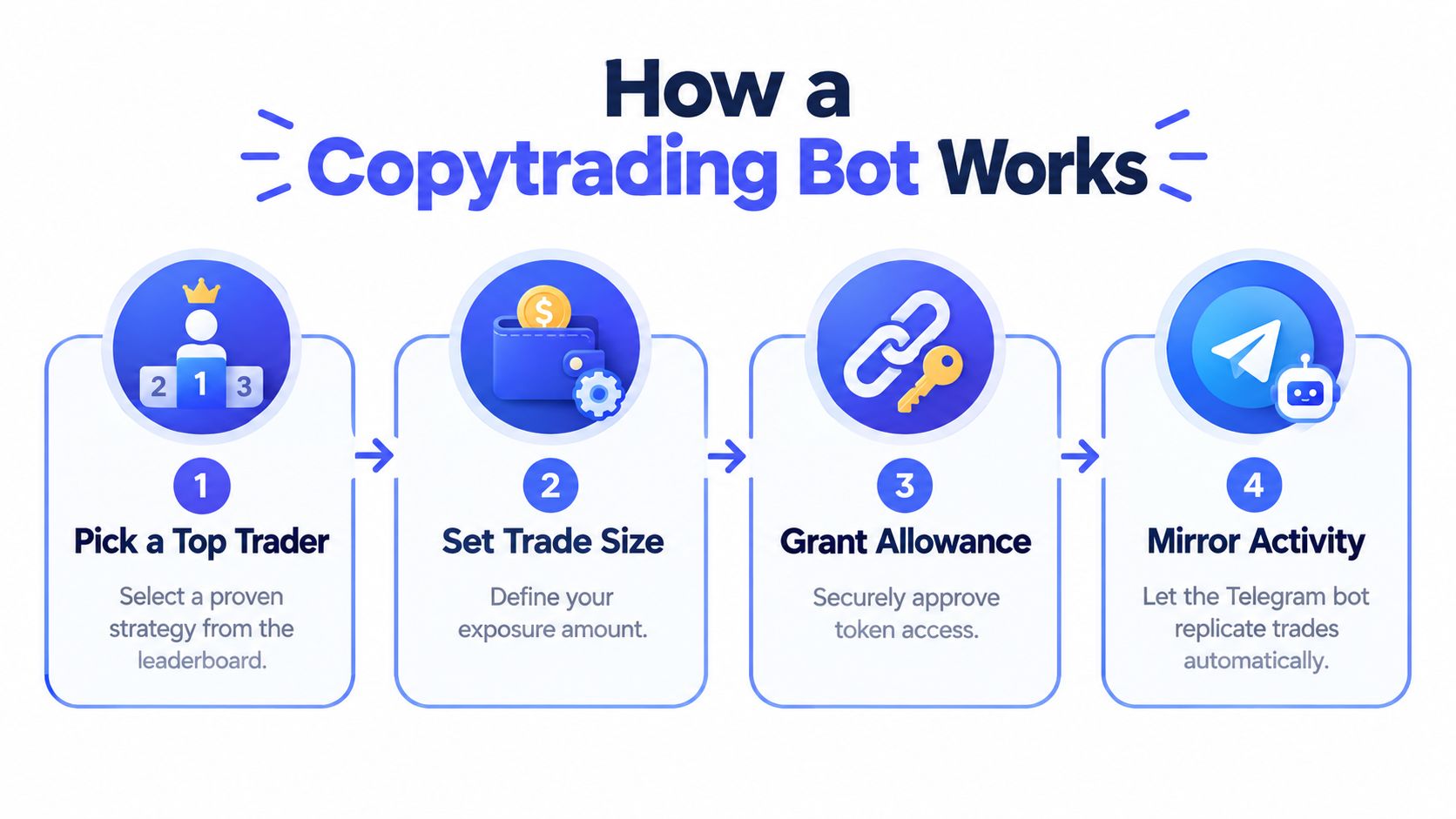
A copytrading setup has four practical decisions. You choose the source trader, define your exposure, approve a limited permission, and let the Telegram bot mirror eligible activity. The user experience should make each decision visible rather than hiding it behind a single activation button.
Start with the trader, not the button
A public leaderboard gives you a starting point for evaluating a trader's filled activity. Look at the actual record, the assets traded, the frequency of entries and exits, and whether the strategy appears concentrated in one market condition. A strong leaderboard position doesn't tell you how that trader fits your risk limits.
Next, set the trade size. A fixed ticket gives every copied trade the same nominal exposure. Proportional sizing follows the source trade according to a chosen ratio. A per-trade cap can stop a large source position from becoming an outsized position in your wallet.
The third step is permission. In a non-custodial model, the platform receives a limited allowance to act within approved boundaries. Your assets remain in your wallet, and the allowance can be revoked. That is different from sending assets to a platform and allowing it to hold them.
Finally, the Telegram bot mirrors the source activity through on-chain swaps. A useful live feed should show the copied trade, its timestamp, and the slippage recorded for the fill. Those details let you compare the source signal with your actual execution instead of treating every copy as identical.
The mental model is simple: selection creates the rule, sizing defines exposure, permission enables action, and the live feed records the result. The bot doesn't turn a source trade into your exact trade. It attempts to reproduce the activity under your settings and the market conditions available at the time.
The Telegram format also matters for control. Independent coverage describes bots that execute on-chain swaps through chat commands and let users set trade-size and tolerance rules rather than copying every trade without limits. (Telegram crypto trading bot features)
Architecture and Custody Models
The main custody question is simple. Where are the funds while the bot is operating?
A custodial system holds assets on behalf of the user. The platform controls the account or wallet, and the user depends on its security, availability, withdrawal process, and internal controls. A non-custodial system leaves the assets in the user's wallet. The service receives a limited permission to perform approved actions, but it doesn't become the wallet owner.
That distinction changes the risk profile. It doesn't make a trade safe, and it doesn't protect a position from a falling token price. It does reduce the specific risk created when a third party holds the assets directly.
What a revocable allowance changes
An allowance is permission, not ownership. The user can set the permitted scope and later reset the allowance to zero. Resetting it removes the platform's ability to act through that permission, while the assets stay where they were.
This guide to DeFi trading bots is useful background for separating automated execution from custody. The distinction matters because traders often describe every automated setup as if it carried the same counterparty risk. It doesn't.
| Model | Fund location | Access control | Permission reset |
|---|---|---|---|
| Custodial | Platform-controlled account or wallet | Platform holds the assets and manages account access | Depends on the platform's withdrawal and account controls |
| Non-custodial | User's own wallet | User grants limited permission for approved actions | User can revoke the allowance, typically by resetting it to zero |
A non-custodial design still demands discipline. Check the allowance before activation. Review the wallet after use. Revoke permission when you pause the setup or no longer trust the operating environment. Wallet ownership doesn't excuse careless approvals.
The practical benefit is control over the boundary between your wallet and the automation. You decide whether the permission remains active. You also decide how much capital sits in the wallet being used for mirrored swaps. The architecture can limit counterparty exposure, but it can't replace sizing rules or transaction review.
Entry-Only versus Full Exit Mirroring
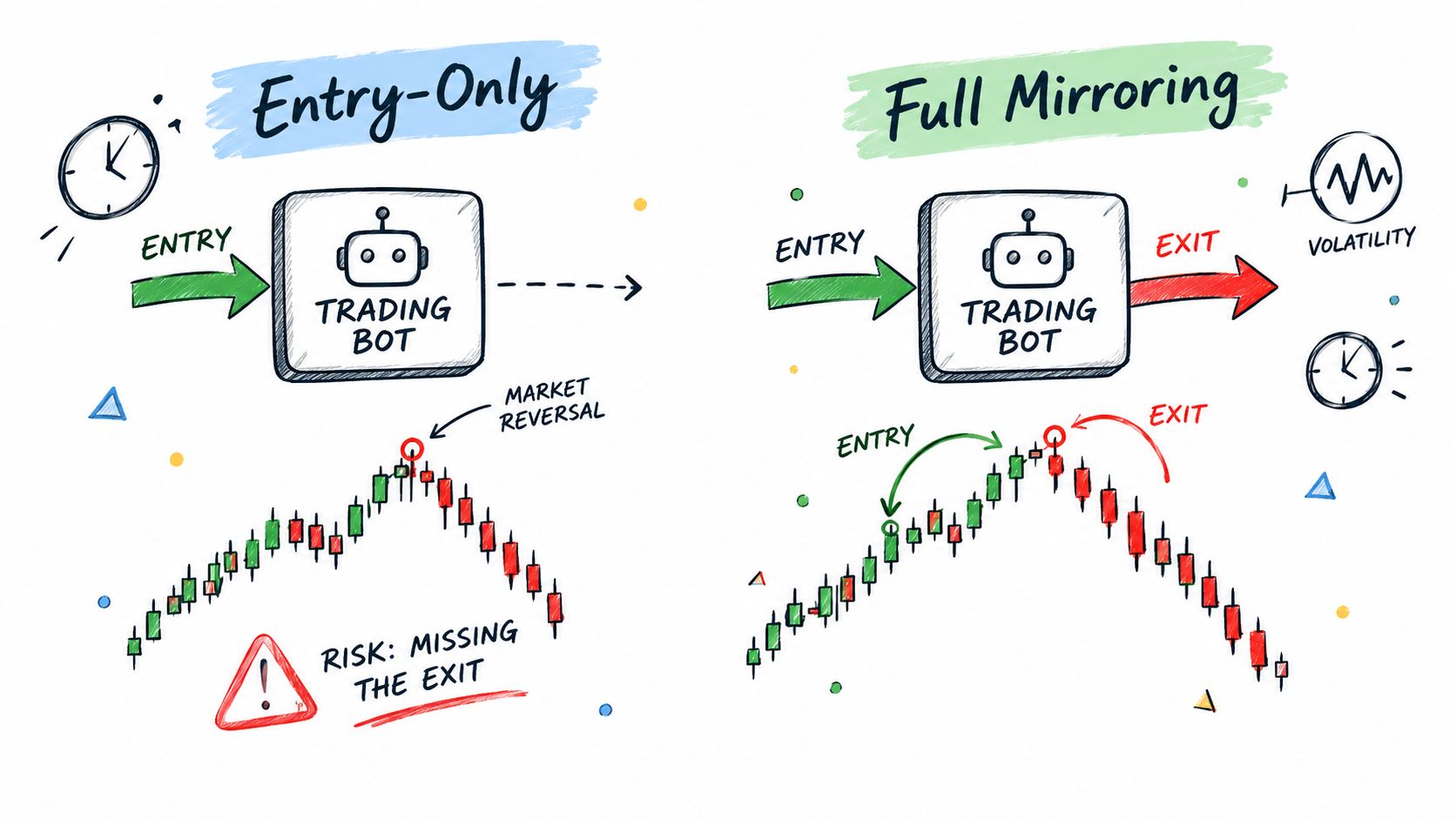
An entry-only bot copies the easy part. It sees a source trader buy and opens a position in the follower's wallet. The difficult part comes later, when the source trader sells and the follower must close or reduce the position under different market conditions.
Suppose the source wallet buys a token and the price rises. Your copied position shows an unrealized gain. The source trader then sells into available liquidity, but your tool only copied entries. You still hold the token. If the market reverses, the earlier gain can disappear, and you may be left deciding whether to sell manually into a worse market.
Replication needs both sides
Full exit mirroring attempts to copy buys and sells. That doesn't guarantee the same result because the follower may receive a different price, face thinner liquidity, or use a different size. It does preserve the source trader's basic position lifecycle.
The difference is especially important during volatile chop. A trader might open and close several positions as conditions change. Entry-only automation accumulates decisions without receiving the corresponding risk reduction. Full mirroring at least gives the follower a defined response when the source exits.
| Workflow | What it copies | Main weakness |
|---|---|---|
| Entry-only | Source purchases or openings | Positions can remain open after the source has sold |
| Full mirroring | Source entries and exits | Fills can still differ because timing, liquidity, and size differ |
Copy trading coverage identifies several reasons why a follower's result can diverge from the source, including timing, liquidity, slippage, spreads, account size, margin exposure, minimum order requirements, copy ratios, and failed orders. Past performance isn't indicative of future results, and copied trades can differ materially from the original. (copy trading execution differences)
Exit replication should therefore be a first filter, not a bonus feature. A fast entry that leaves the position unmanaged is less useful than a slower workflow that makes the full sequence visible and controllable.
Risk Controls and Position Sizing
Position sizing is where automation becomes a risk-management tool instead of a faster way to repeat mistakes. The source trader's size isn't automatically suitable for your wallet. Your copy size should reflect the capital you want exposed to one trade, one token, and one strategy.
Start with a fixed ticket if you want predictable nominal exposure. Every copied trade receives the same configured amount, subject to the available balance and transaction rules. This is easy to audit, but it can make small trades too large and large trades too small relative to the source.
Proportional sizing follows the source trader's activity. It may reflect the source wallet more closely, but it can also transfer oversized decisions into your account. Add a per-trade cap so the proportional rule has a hard ceiling.
Use controls that stop repetition
A basic setup should answer these questions before it starts:
- What is the fixed ticket? Set the amount you can tolerate on one mirrored trade.
- Is proportional sizing capped? Use a maximum so one source transaction can't dominate the wallet.
- Can new copies be paused? A pause control matters when liquidity changes, the source strategy shifts, or the bot behaves unexpectedly.
- Can open positions be closed? A one-tap closure gives you an emergency response without waiting for another source exit.
- Can the allowance be revoked? Reset the permission when the setup is inactive or under review.
- What happens after a failed order? Check whether the system reports the failure clearly and whether it retries or leaves the position unmatched.
Avoid sizing from the source trader's confidence. A trader may hold a diversified wallet, use a different entry price, or accept drawdowns you can't accept. Your copy ratio should be a control variable, not a vote of confidence.
Sizing rule: Cap the amount you can lose from one mirrored decision before you worry about copying more decisions.
Structural failures are more dangerous than a single bad entry. Guidance on crypto bot risk highlights illiquid pairs, over-allocation, correlated strategies, missing exits, and borrowed exposure placed inside normal price noise as recurring failure points. It also warns that backtests often break when real slippage, fees, and latency enter the calculation. (crypto bot risk checklist)
Copy trading carries risk. Past performance does not predict results. A bot can repeat a source trader's process and still produce a different outcome in your wallet. Size for that difference.
Execution Latency and Slippage Behavior
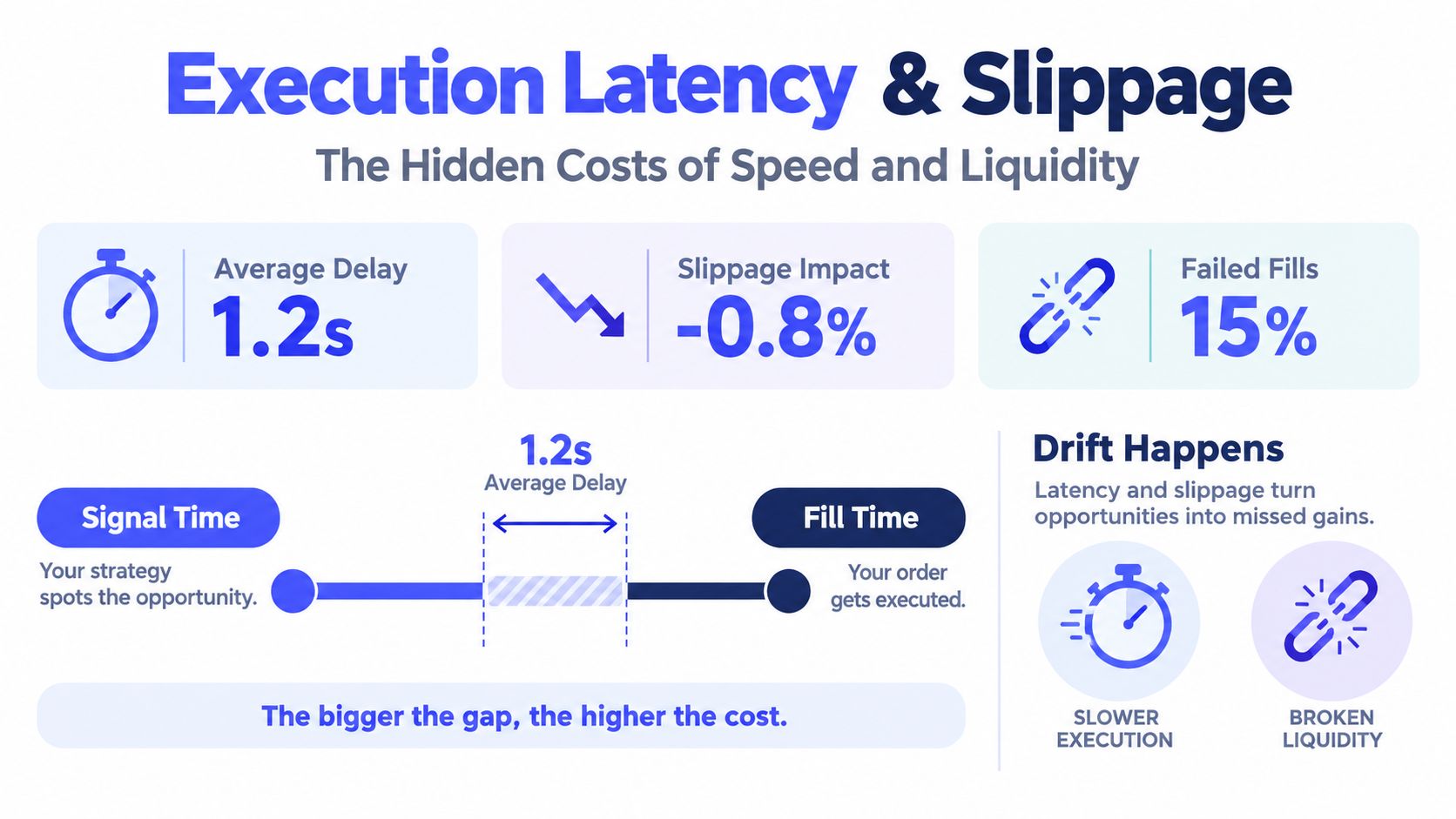
A copied signal is not a copied fill. The source trade happens first. Your bot must process the activity, submit the swap, and find liquidity after the market has reacted. That delay creates a structural gap between the source wallet and your wallet.
Market-taker orders face the greatest exposure. Research on crypto API latency and execution notes that an extra 100 to 200 milliseconds between signal generation and exchange reception can worsen execution. During volatility, slower orders face more adverse selection. Backtests that ignore this delay can overstate a strategy's edge.
Model the bad fills
A realistic backtest should include 100 to 200 milliseconds of execution delay, two times historical spreads, and an additional 0.2% to 0.5% slippage buffer, according to backtesting and paper-trading guidance. In volatile conditions, slippage can exceed 1.5% per order.
These are stress inputs, not universal settings. Use them to test whether the strategy remains viable after poor fills. Do not treat them as a forecast for every trade.
Liquidity depth matters as much as speed. A large order may move the price modestly in a deep market, while the same order can consume several levels in a thin token. The source trader may exit before your transaction arrives, and your position size may create more price impact than the source experienced. See this guide to what slippage means in crypto for the execution difference in practical terms.
Review the live feed as an execution record. Check the source timestamp, your fill timestamp, quoted price, final price, and displayed slippage. Repeatedly worsening fills can show that the copied wallet's assets or trade sizes do not transfer cleanly to your account.
Telegram copytrading execution risk shows the same timing problem. A source wallet can exit while the bot is processing. A copied trade may arrive within milliseconds yet still fill at a different price and moment.
The useful benchmark is execution fidelity, not perfect equality. Keep a record of how and why each fill differed from the source.
How to Evaluate Automation Performance
Before relying on a crypto trading bot, inspect the operating rules rather than the marketing page. You need to know what the bot can do, what it can't do, and how quickly you can stop it.
Check the permission boundary
Open the wallet approval and confirm the allowance. Verify that the funds remain in your wallet and that you can revoke access. Test the pause control before you need it. A control you haven't used is only a claim.
Review the trade record
A public trader profile is only the starting point. Review the filled entries and exits, the asset mix, and the source trader's turnover. Then compare that activity with your own wallet's live feed.
Look for:
- Timestamp visibility: You should see when the source activity occurred and when your copy filled.
- Slippage reporting: Each copied swap should show the execution difference, not just a success message.
- Exit completeness: Confirm that sells are handled as part of the workflow.
- Sizing controls: Check fixed tickets, proportional sizing, and per-trade caps.
- Failure handling: Find out how failed, delayed, or undersized orders appear in the record.
- Public data: Use available trader pages, metrics, and documentation to verify what the system claims to show.
The guide to copy trading signals can help frame the difference between a signal and an executed trade. A signal tells you what another wallet did. Your result depends on timing, liquidity, permission, sizing, and the actual fill.
Start with observation, then small exposure
Don't judge a setup from an idealized backtest alone. Watch the live feed. Compare source actions with copied entries and exits. Review slippage after each trade. If the execution pattern doesn't make sense at a small size, increasing the size won't repair it.
Also check the market regime. A strategy that relies on rapid entries and exits may behave differently in a thin, fast market than in a liquid one. A concentrated source wallet may expose you to a risk you didn't intend to copy. Pause when the assumptions change.
A practical evaluation has one final question: Can you explain every permission, every size rule, every exit, and every material difference between the source fill and your fill? If you can't, the setup isn't ready for unattended use.
copyfomo offers Telegram-based mirroring of selected fomo trader activity, with configured sizing, copied entries and exits, and non-custodial wallet permissions. Visit copyfomo to start the bot on Telegram and review the controls before you enable copying.
stop reading. start copying.
pick a trader from the fomo leaderboard, set your size, and the entries and the exits land in your own wallet while you sleep.
open copyfomo on telegram →