DeFi Trading Bot Explained: How On-Chain Automation Works
learn how a defi trading bot interacts with smart contracts and dexs, common strategies, allowance security, and wallet-based tooling for retail crypto traders.
You wake up and see that a wallet you follow bought a token while you were asleep. The entry is already filled. Your own position is still empty. By the time you open the app, the move may be underway, and the decision is no longer whether you like the trade. It's whether you can execute it without paying a much worse price.
That's the practical reason traders use a DeFi trading bot. It automates transaction execution on decentralized markets. But “automation” covers very different systems. A strategy bot follows coded rules. A copytrading bot follows a wallet. Neither one turns a risky market into a predictable one. Past performance doesn't predict results, and copy trading carries execution risk.
Table of Contents
- What a DeFi Trading Bot Actually Does
- How a Bot Talks to Smart Contracts and DEXs
- Strategy Bots vs Copytrading Bots
- Allowance Security and Non-Custodial Execution
- Slippage, Latency, and Why Exits Matter
- Setting Up a Bot With Your Own Wallet
- Key Takeaways and Where to Start
What a DeFi Trading Bot Actually Does
A retail trader can wake up to several mirrored swaps, each opened at a configured size while their wallet was offline. That doesn't mean the bot discovered a guaranteed opportunity. It means software observed a trigger, built a transaction, and executed according to permissions and settings that the trader had already chosen.
A DeFi trading bot is software that signs or submits on-chain transactions on behalf of a user to follow a defined process. The process might be a token swap when a price condition is met, an arbitrage route between pools, a liquidation, or a mirror of another wallet's filled trade. In copytrading, the trigger comes from a selected trader rather than from a technical indicator or a fixed price rule.
The distinction matters because a bot isn't a trader with judgment. It doesn't understand why a wallet entered a position unless that information is explicitly available. It follows data and permissions. If the input is late, incomplete, or wrong, the bot can execute the wrong action with perfect consistency.
What it is not
A bot isn't the same as a person clicking buttons on a DEX interface. It can monitor events and prepare transactions without waiting for manual input. It also isn't just a centralized exchange API. A DEX transaction still interacts with public smart contracts, routers, liquidity pools, gas markets, and wallet permissions.
It's different from an airdrop-farming script as well. Farming scripts may repeatedly claim, stake, or interact with protocols. A trading bot focuses on execution logic, whether that logic comes from a strategy or a copied wallet.
Practical rule: Treat the bot as an execution tool, not a profit engine.
The bot may construct calldata, simulate a transaction, estimate the expected output, and submit the transaction through a wallet or an approved executor. The custody model depends on how that wallet infrastructure works. In an allowance-based model, the user keeps the assets in their own wallet and gives a contract permission to spend a defined token balance.
That places the bot inside several layers at once. Smart contracts define what can happen. DEX routers direct swaps through liquidity pools. The mempool exposes pending transactions to observers and competing searchers. Wallet infrastructure controls signatures, allowances, and the address where settlement occurs.
The market is already built around this kind of automation. One 2026 industry summary reported that bots execute over 50% of DEX volume, while another estimate put automation and agent activity at about 19% of all on-chain activity. The same reporting cited more than 17,000 agents launched since 2025, over $4 billion in agent trading volume, and bots generating over 76% of stablecoin transfer volume. These figures are reported in the DeFi automation market summary, but they don't make any individual bot safe or profitable.
How a Bot Talks to Smart Contracts and DEXs
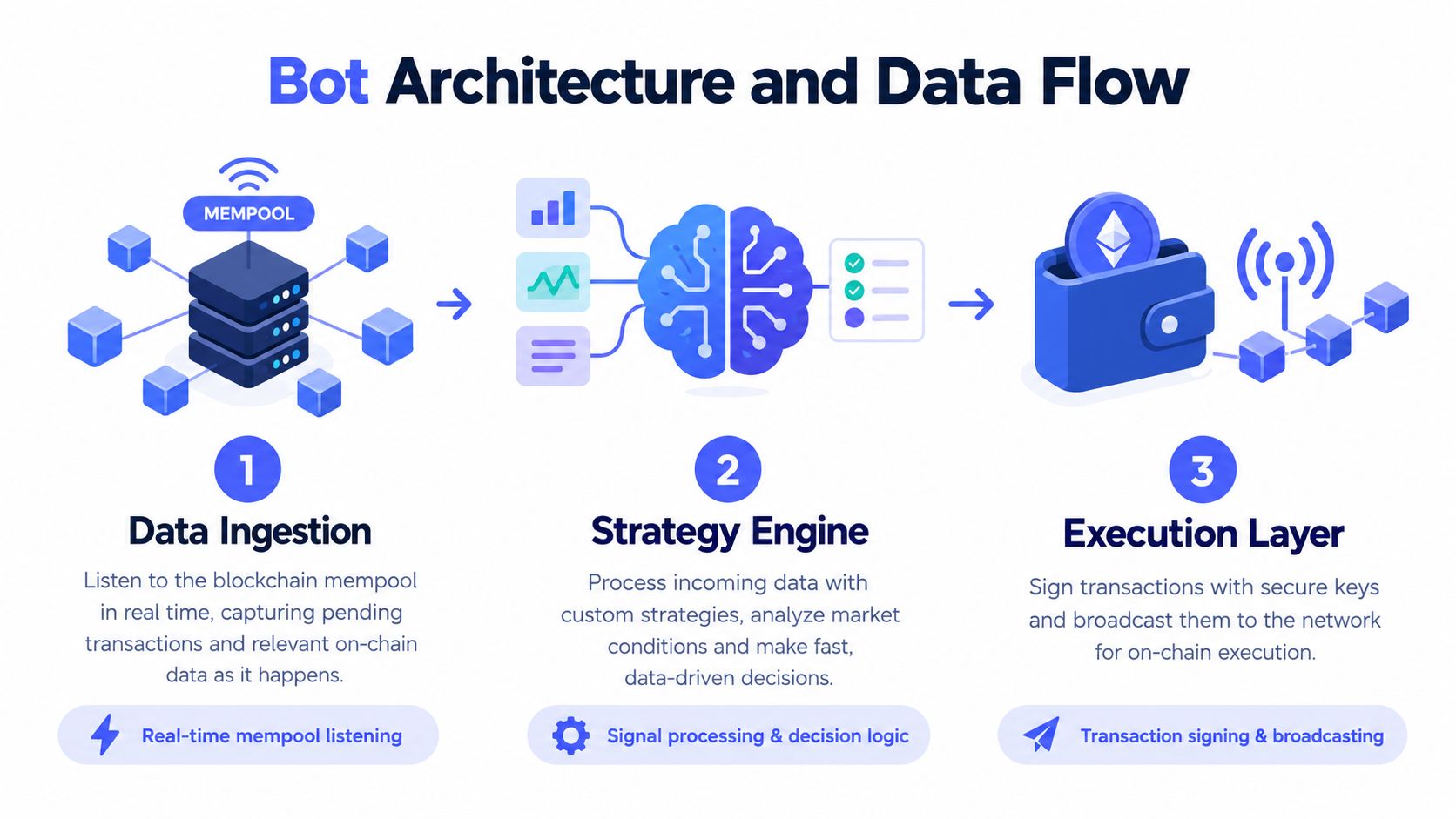
A swap gives the clearest view of the process. The bot first receives a trigger. That could be a price signal, a pending transaction, a completed trade from a followed wallet, or an event emitted by a smart contract.
From signal to calldata
The bot then looks for an executable route. It may compare pools on DEXs such as Uniswap or Sushi, use a private liquidity source, or split the order across more than one route. The route determines which contracts receive the transaction and which token path the swap follows.
Next, the bot encodes that route into calldata for a router contract. The calldata contains the function call, token path, amount, recipient, deadline, and other parameters. Before submission, a production system can simulate the call to check whether the route is likely to succeed and estimate the output.
The important protection is the minimum-out amount. If a trader sells one token for another, the transaction can specify the least acceptable amount of the output token. If the pool moves too far before execution, the contract should revert rather than fill below that threshold. Slippage is therefore a setting with a real on-chain consequence, not a cosmetic preference. One published swap API documents a user-controlled slippage range from 0 to 100 for EVM networks, with Solana allowing 0 to less than 100, as described in the DEX swap API documentation.
From wallet approval to block inclusion
The transaction can enter a public mempool, where validators and other searchers can observe it before inclusion. Under EIP-1559, the bot can set fee parameters that affect priority, but paying more doesn't guarantee the intended fill. A public transaction can still be reordered, copied, or targeted by another participant.
A private relay or protected order flow changes who sees the transaction before execution. It can reduce exposure to front-running and sandwiching, although it introduces reliance on the relay and doesn't remove liquidity, contract, or strategy risk. Public mempool exposure lets bots infer a pending swap's direction and size, then submit a higher-fee transaction to trade ahead of it or sandwich it. This risk is described in Cow's explanation of running trading bots in DeFi.
The user usually signs the approval or transaction that authorizes the action. In an allowance model, later execution can pull tokens within that permission without exposing the private key to the operator. The resulting swap still settles against the user's address and the underlying DEX contracts.
Latency affects every stage. Monitoring should include p50, p95, and p99 latency, along with success rate, timeout rate, and quote-to-outcome time. As Alchemy's analysis of latency in on-chain trading explains, tail latency matters more than the average. On fast chains, a delay of a few hundred milliseconds can move execution into the next block and change the realized price.
The same flow supports lending liquidations, limit orders, and copytrading mirrors. Only the trigger changes. The router, calldata, simulation, fee decision, and inclusion problem remain.
Strategy Bots vs Copytrading Bots
A strategy bot starts with a rule. It may look for an arbitrage gap between pools, place a grid of orders across a price range, or quote both sides of a market. Its behavior comes from code and market inputs.
A copytrading bot starts with a wallet. It watches a selected leader's filled transactions and reproduces the output at a configured size. The key distinction is simple:
A strategy bot decides what to trade from inputs. A copytrading bot decides who to copy and reproduces that trader's output.
That difference changes the main risk. With a strategy bot, you're trusting the logic, data, routing, and safeguards. With a copytrading bot, you're trusting the leader's historical behavior, the timing of the feed, the sizing model, and the system's ability to mirror both entries and exits.
| Dimension | Strategy Bot | Copytrading Bot |
|---|---|---|
| Decision source | Coded rules and market data | Selected wallet or leader |
| Typical trigger | Price, spread, indicator, or protocol event | Filled on-chain transaction |
| Position sizing | Defined by strategy parameters | Fixed ticket, proportional size, or cap |
| Main dependency | Code quality and market assumptions | Leader behavior and execution timing |
| Follower fill | Based on the bot's route and conditions | Usually later than the leader's fill |
| Core trust | Strategy logic and infrastructure | Leader track record and mirror process |
Followers don't receive the leader's exact entry. They receive a scaled version of the trade, subject to timing, liquidity, gas settings, and slippage. The leader may buy into a pool before the follower's transaction arrives. The follower may then receive fewer tokens, a different average price, or a failed transaction if the minimum-out condition is too strict.
Sizing also changes the result. A fixed ticket keeps each copied trade predictable in nominal terms. Proportional sizing follows the source wallet more closely but can amplify exposure when the leader takes a larger position. A per-trade cap limits that effect.
Copy trading itself is a distinct behavior class. A follower mirrors one or more lead traders, but the mirror is never a perfect copy. This guide to mirror trading in crypto describes the basic issue clearly: the leader fills first, while followers can receive different entry and exit prices because timing and liquidity differ.
The practical comparison isn't “which bot wins.” It's which uncertainty you prefer. Strategy automation puts more weight on code and assumptions. Copytrading puts more weight on a person's decisions and the mechanics of reproducing them.
Allowance Security and Non-Custodial Execution
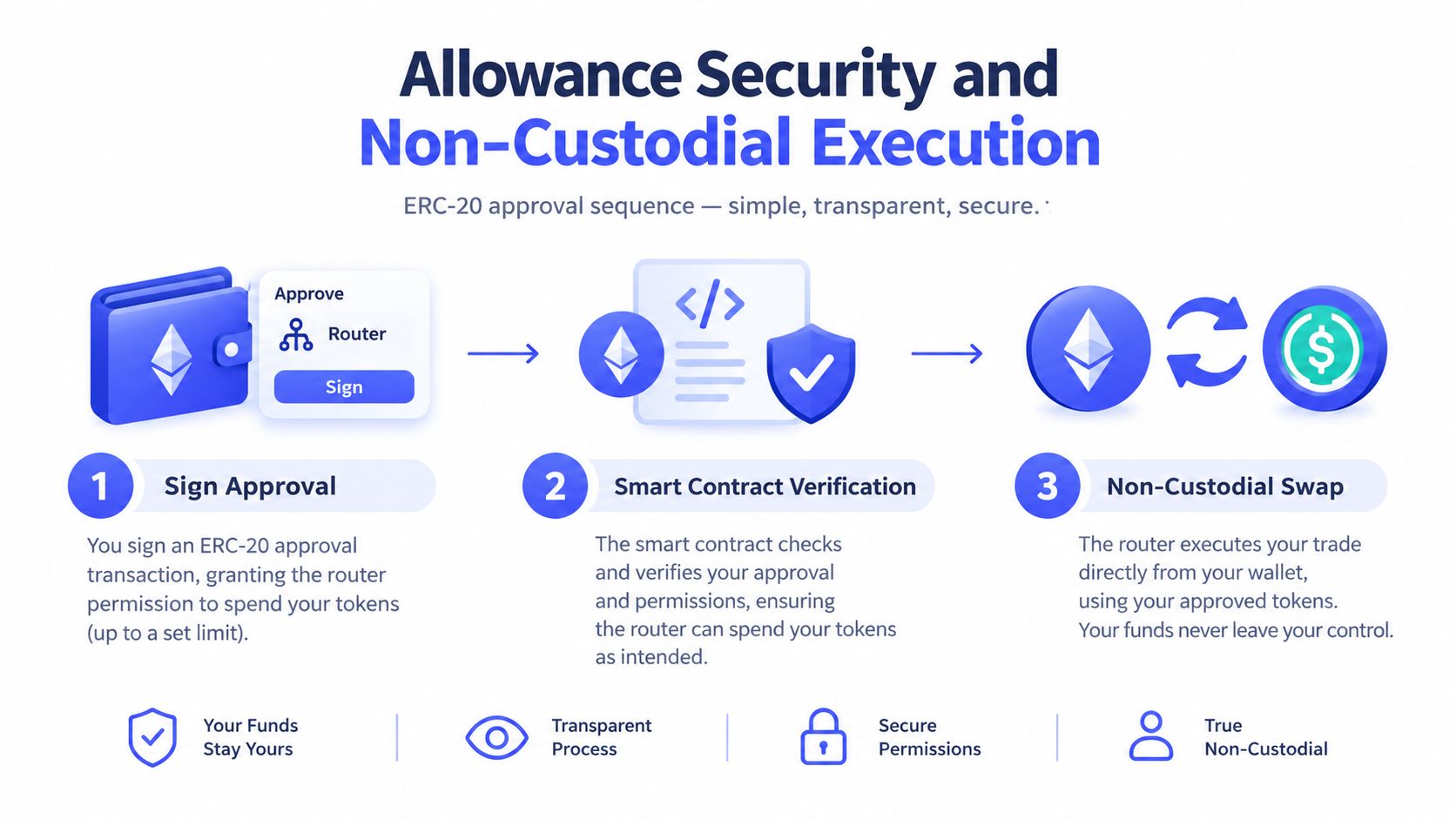
An ERC-20 allowance is a spending permission recorded by the token contract. It doesn't transfer ownership of the wallet. It authorizes a specified spender, often a router or executor contract, to move a specified token up to a specified amount.
What the approval grants
The sequence is straightforward:
- The user signs an approve transaction that names the spender contract and the token allowance.
- The token contract stores that permission on-chain.
- A later swap calls the approved executor, which pulls the required tokens within the allowance and sends the swap output to the user's wallet.
An allowance doesn't let the contract move unrelated assets. An approval for one token doesn't automatically authorize another token. It also doesn't reveal the user's private key or give the operator unrestricted signing access to the wallet.
The danger is that the allowance can be too broad, or the spender can be unsafe. An unlimited allowance is convenient because the user doesn't need to approve each later trade. It also gives a compromised, malicious, or upgradeable contract more room to move the approved token. If the contract has a flaw, the approved balance can be exposed even though the private key remains secure.
Security check: Approve the smallest practical amount, then review and revoke permissions you no longer need.
Tools such as Revoke.cash and Etherscan's approval checks can show active permissions and help users revoke them on-chain. Revocation is a transaction, so it still requires the user to interact with the network and pay its transaction cost. It's not a substitute for checking the spender before signing the first approval.
What non-custodial means in practice
A non-custodial bot acts as a relayer or execution layer. It doesn't hold the user's trading balance as a platform deposit. In the allowance-based copyfomo model, follower funds remain in the follower's own wallet until a mirrored trade executes within the approved permission.
That structure reduces one class of risk, but it doesn't remove all risk. A user can approve the wrong contract, set a cap that's too high, follow a poor wallet, accept excessive slippage, or interact with a vulnerable DEX. The user also needs to verify the chain, token, spender address, and transaction details before signing.
Security incidents often begin outside the smart contract itself. A recent IOSCO report on crypto and digital asset risks noted that off-chain attacks, including phishing and compromised accounts, represented 55.6% of incidents and 80.5% of stolen funds in 2025. Non-custody protects against handing over a private key, but it doesn't protect a user who signs a malicious approval or loses control of the wallet.
Slippage, Latency, and Why Exits Matter
Copying a wallet that made a good trade doesn't mean copying its result. The leader and follower interact with different pool states at different times. Net performance can deteriorate through slippage, latency, gas, failed transactions, and fees before the follower even considers the token's price movement.
Three sources of execution decay
Slippage comes first. A leader's swap changes the pool state. When the follower's order arrives, the available liquidity may be worse. Thin pools are especially sensitive because a relatively small order can move the price. A follower may receive a different entry and exit even when the bot mirrors the same token pair.
Latency adds another gap. The system needs to observe the source transaction, decode it, build a new transaction, choose a fee, and get the transaction included. Public mempool competition can add more delay. Research on bot exploitation and automated DeFi attacks highlights how front-running, oracle manipulation, and liquidation cascades can turn a nominal edge into a poor realized outcome.
Exit replication is the part many simple tools underweight. A leader can sell manually, reduce risk after seeing a chart, or close a position through a transaction that isn't obvious from the original entry. A follower who copies only buys can end up holding an unmanaged position. Copying both entries and exits is operationally different from copying signals.
| Factor | What it does to follower PnL | Typical impact on thin pairs |
|---|---|---|
| Entry slippage | Raises the follower's effective purchase price | The follower receives fewer tokens for the same trade size |
| Latency | Moves the follower into a later pool state | The price can shift before inclusion |
| Exit delay | Keeps the follower exposed after the leader closes | The follower may sell into weaker liquidity |
| Gas and failed calls | Adds cost or leaves the intended position incomplete | A reverted or delayed transaction can miss the route |
| MEV exposure | Allows other searchers to react to visible flow | The follower can face reordering or adverse price impact |
The relevant comparison isn't the leader's screenshot. It's the follower's net result after execution costs and the quality of the exit.
A leaderboard based on realized PnL can help identify wallets worth investigating, but it doesn't show what every follower will receive. It may not capture the follower's position size, approval settings, route quality, or failed transactions. It also can't guarantee that a leader's future decisions will resemble past decisions.
The realistic question is not whether a bot can copy a trade. It can. The question is whether the follower can copy the entire lifecycle closely enough, at a size and liquidity level that remains acceptable after costs. That requires visible timestamps, displayed slippage, transaction logs, and a working stop mechanism. This explanation of slippage in crypto is useful for separating quoted prices from actual execution.
Setting Up a Bot With Your Own Wallet
Setup should start with risk boundaries, not with a leaderboard. The wallet, allowance, trade size, and stop conditions determine how much damage a bad signal or compromised contract can cause.
Use a separate operating wallet
A fresh hot wallet dedicated to bot activity keeps long-term holdings away from routine approvals and trading permissions. Fund it with an amount you're prepared to expose to on-chain execution. Don't connect a cold-storage wallet holding long-term assets to an unfamiliar bot just because it's convenient.
The wallet needs enough native gas token for the intended network and enough balance for the configured trades. Keep the operating wallet separate from the account used for savings, collectibles, or unrelated protocol activity. This isn't a guarantee against loss. It limits the blast radius of an error.
Set the permission before the position
The approval should match the planned activity. A tight allowance can cover the intended per-trade amount or a defined batch of trades. An unlimited allowance is easier to use, but it creates a larger exposure if the spender contract is later compromised.
For a copytrading workflow, decide these values before following a wallet:
- Fixed ticket: The same nominal size for each mirrored trade.
- Proportional size: A scaled relationship to the source wallet's trade.
- Per-trade cap: A hard limit that overrides a larger source position.
- Open-position limit: A ceiling on simultaneous mirrored positions.
- Daily loss threshold: A condition that pauses new copies.
The copyfomo Telegram bot provides a practical sequence for this model. A user connects an EVM wallet, sets a deposit cap, chooses fomo leaderboard wallets to follow, and confirms the initial approval transaction before mirroring starts. The important part is not the interface. It's deciding what the wallet is allowed to do before the first copied swap.
Keep a kill switch
A usable kill switch should pause new copies without requiring the user to hunt through several menus. The wallet should also have a clear contract-revocation path. If open positions need manual closure, the user should know whether the bot can mirror exits, close positions, or only stop new entries.
Every mirrored transaction should be logged with its timestamp, token pair, size, route or transaction reference, and displayed slippage where available. That record lets the user compare the source trade with the follower fill instead of relying on a notification.
This beginner's guide to crypto bots covers the basic operating decisions without treating automation as a replacement for monitoring. Even an unattended bot needs periodic review. Check approvals, failed transactions, position count, and whether the selected wallets still match the behavior you intended to follow.
Key Takeaways and Where to Start
A DeFi trading bot is useful when the task is clear and the limits are explicit. It can remove the need to watch a feed constantly. It can also execute a flawed instruction faster than a human would. The decision is less about finding a magic bot and more about controlling the parts that remain under your control.
Check the bot type
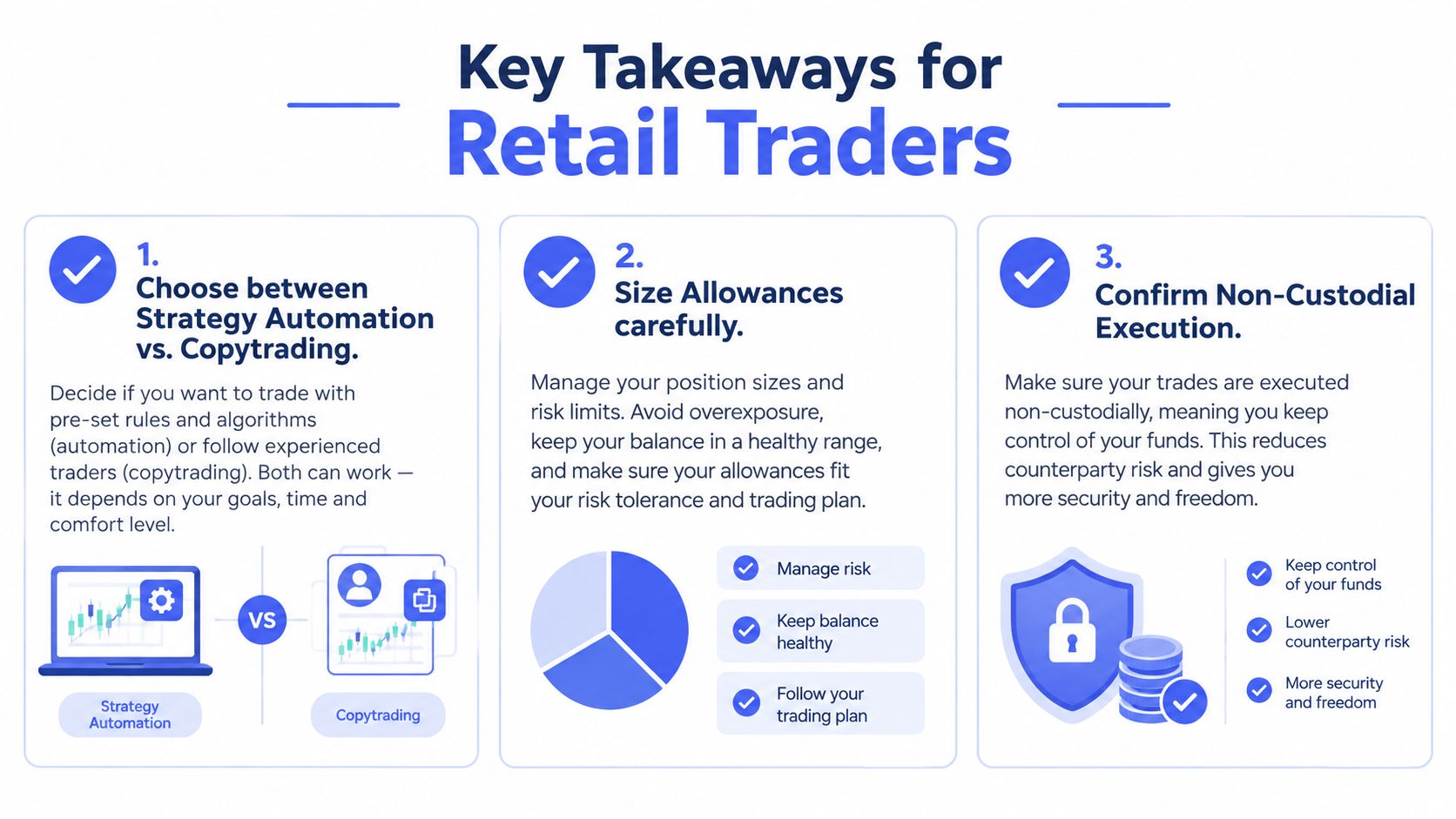
Choose strategy automation if you want code to react to market conditions such as spreads, ranges, or price rules. Choose copytrading automation if you want to follow the filled activity of a selected wallet. Don't treat a copied wallet as a strategy you fully understand. You're following decisions, timing, and execution that may change.
Check the allowance
Confirm the spender contract before signing. Use a limited token allowance where practical. Know how to revoke it. An allowance-based design keeps funds in the user's wallet, but it still makes the approved token available to the designated contract within the permission.
Check the follower-level result
Review entry timing, displayed slippage, gas cost, and exit behavior. The leader's fill is only the starting reference. A follower receives a separate transaction with a separate price and separate pool conditions.
Check the stop path
Find the pause control before you need it. Confirm whether it stops new copies, closes open mirrored positions, or requires a separate wallet transaction. Save the contract-revocation route as well. A kill switch that only exists in theory isn't useful during a fast market move.
For traders who already follow the fomo leaderboard, copyfomo provides a Telegram-based route for mirroring selected wallets from a non-custodial wallet. The setup flow is direct: connect the wallet, browse the leaderboard, choose a leader, set a position cap, and approve the allowance. Execution settles through the user's own address on the underlying DEX, rather than through a platform-held trading balance.
That makes the service a routing and execution layer, not a custodian. It doesn't change the core trade-off. You still need to evaluate the leader, size the exposure, monitor slippage, and accept that past performance doesn't predict future results.
copyfomo mirrors filled entries and exits from selected fomo leaderboard traders into your own wallet at a configured size. If you want to review the setup and start the Telegram bot, visit copyfomo.
stop reading. start copying.
pick a trader from the fomo leaderboard, set your size, and the entries and the exits land in your own wallet while you sleep.
open copyfomo on telegram →