DeFi Copy Trading Explained: Mechanics, Risks, and Metrics
learn how defi copy trading works, why follower results diverge from leader pnl, and what to evaluate before mirroring on-chain wallets.

Copying a profitable wallet is the easy part. The hard part is getting the same trade, at the same time, into your own wallet, under your own execution conditions, without the source trader's edge getting stripped away by latency, slippage, fees, or a bad exit.
That is the part most leaderboard talk skips. A strong realized PnL number tells you what happened to the leader, not what will happen to the follower. In DeFi copy trading, that difference is the whole trade.
Table of Contents
- Why Copying a Profitable Wallet Is Not the Same as Profiting
- How DeFi Copy Trading Actually Executes
- Non-Custodial Execution and the Allowance Boundary
- Exit Replication and Why Sells Matter as Much as Buys
- Slippage, Sandwich Risk, and Execution Controls
- Reading Trader Metrics Beyond Realized PnL
- A Pre-Flight Checklist Before Turning the Bot On
Why Copying a Profitable Wallet Is Not the Same as Profiting
A profitable wallet is not a profitable copier. That sounds obvious until people start scanning leaderboards and treating realized PnL like a transferable asset. It isn't. The follower still has to enter later, clear fees, absorb slippage, and decide whether to mirror the exit, too.
Leader performance and follower performance diverge
The best baseline is blunt. In a 90-day study of 100,236 copy-trading outcomes, only 48.48% of follower outcomes were profitable, while 97.04% of lead traders were personally profitable, and only 43.61% of leaders produced positive returns for the followers copying them, according to the study summarized in Bit's knowledge hub (study summary). That gap is the point. A leaderboard ranks visible performance. A copier lives with execution.
Practical rule: if you can't measure follower-level PnL, you're not evaluating copy trading. You're evaluating a marketing screen.
What actually matters to the follower
The source trader's PnL is only one input. Your result depends on the source-versus-follower price, fees, slippage, latency, and whether the exit was mirrored cleanly. In thin tokens, the copied trade can move the pool before it settles. In fast markets, the trade can land after the move is gone.
That is why a serious reading of defi copy trading starts with execution, not selection. The key question is not, “Who made money?” It's, “How much of that edge survives when a separate wallet submits a separate transaction under worse conditions?”
A useful frame is simple. Selection tells you which wallet looks strong. Execution tells you whether the follower can still capture anything close to the same trade. Without that second step, the leaderboard can mislead you into copying noise, not edge.
How DeFi Copy Trading Actually Executes
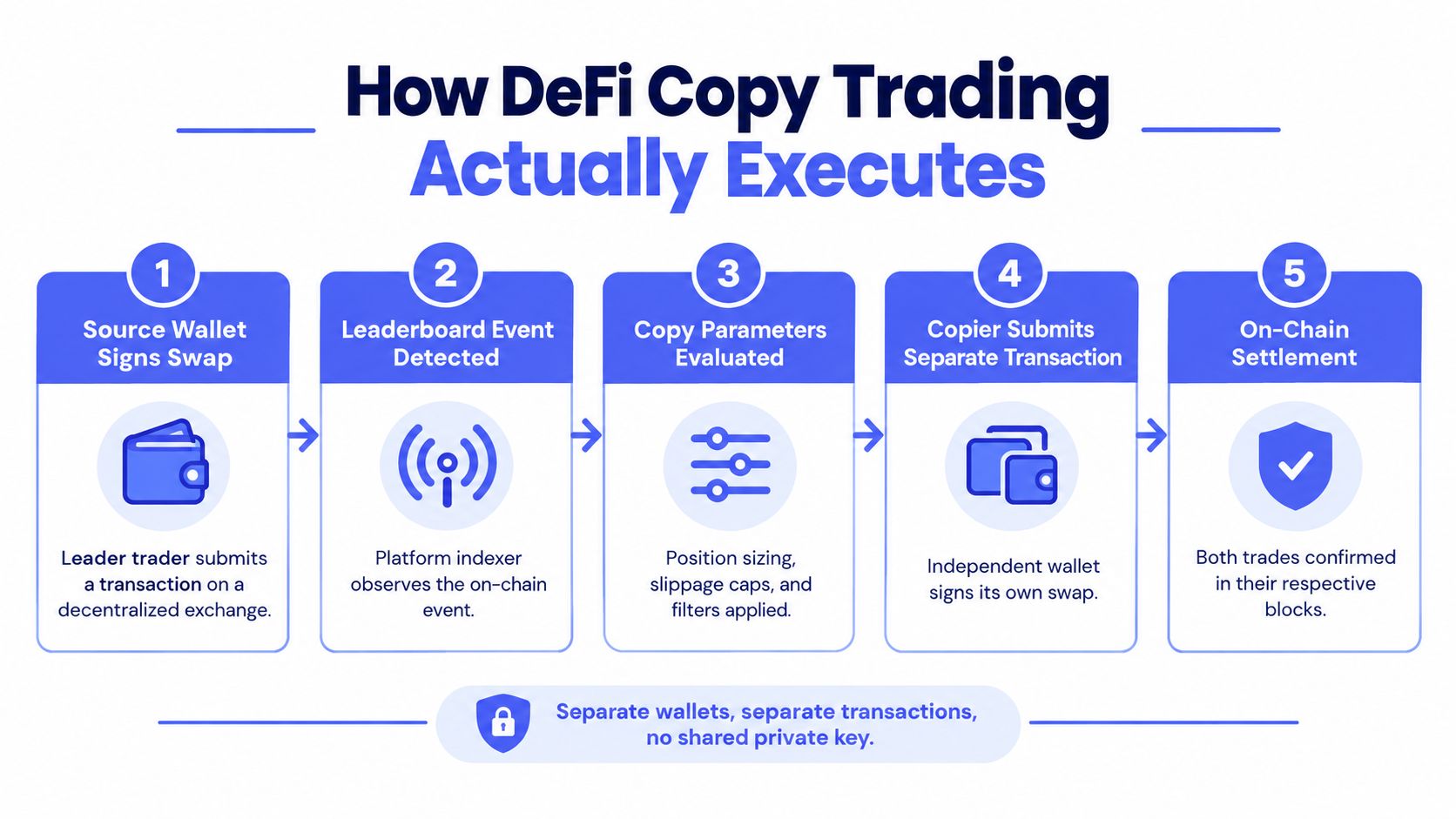
A mirrored trade does not teleport from leader to follower. The source wallet signs a swap on a decentralized exchange. A platform detects that on-chain event. The copier then submits its own swap, with its own timing, its own gas, and its own placement in the block queue.
That separation matters. The copier does not inherit the leader's fill. It submits a new transaction into a public market where pool reserves, block timing, and competing order flow all change the result. This is why the same signal can produce a different outcome for the follower even when the market move looks identical on a chart.
The sequence from signal to fill
The practical order is straightforward. First, the source wallet sends a transaction. Second, the event is observed. Third, the copy settings are applied, including size and slippage limits. Fourth, the copier signs and sends a distinct transaction. Fifth, both swaps settle in their own blocks, if they settle at all.
That last step is where the gap shows up. A copy that lands about a second after the source is still a separate market action, not a replay. It competes for block inclusion. It can be repriced by reserve changes. It can be pushed around by gas priority and adversarial ordering.
For traders used to thinking in fills, this is the key mental shift. The platform is not cloning the source order. It is reproducing intent under worse information and different timing. That means the follower's execution quality becomes the binding constraint.
You can see the same logic in any serious mirrored flow, including the one described at copyfomo's bot documentation. The headline is not “copy the wallet.” The headline is “recreate the trade without pretending the fill is shared.”
Why public blockchain data makes this possible
DeFi made the pipeline visible. Public transaction data exposes wallet addresses, timing, token routes, trade sizes, and exits. That is what turns copy trading from a social feature into an execution problem. The infrastructure is open, but the fill is still local to the copier's transaction.
So the right unit of analysis is not the source wallet alone. It's the source wallet plus the follower's block placement, pool state, and execution costs. That's the actual trade.
Non-Custodial Execution and the Allowance Boundary
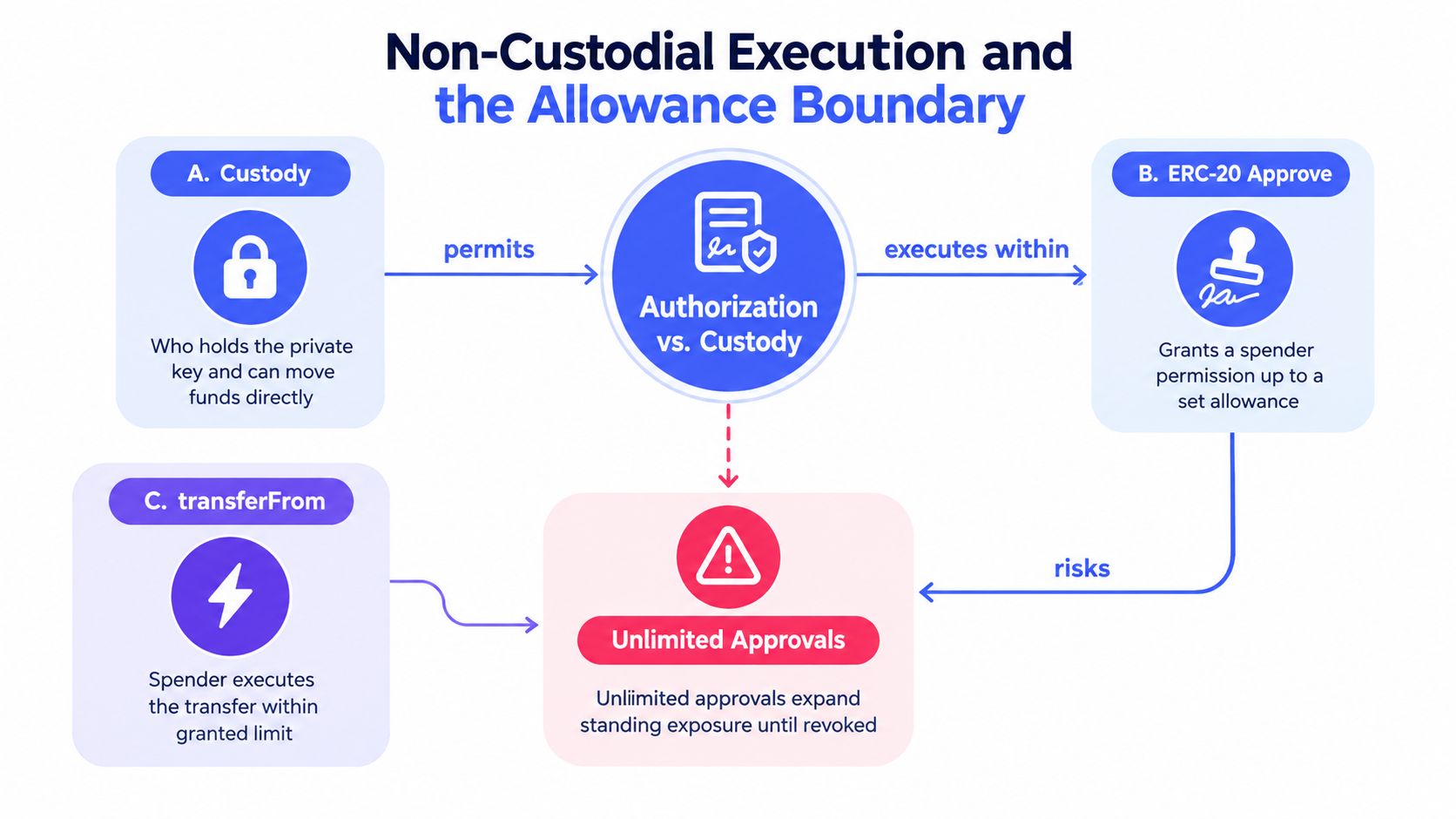
Non-custodial does not mean harmless. It means the service doesn't hold your private key. It does not mean the service can't move tokens within the permission you gave it. That boundary is the actual security line in allowance-based copy trading.
The ERC-20 model separates approve() from transferFrom(). An owner grants a spender permission up to a defined allowance, and the spender can move tokens within that limit without possessing the wallet key, as described in the ERC-20 standard (EIP-20). That structure is why the funds can stay in the user's wallet while a copier still has execution power.
What the allowance actually changes
A token allowance is a spending permission, not custody. It narrows the permission surface compared with handing over a wallet, but it also creates an authorization boundary that has to be watched. Unlimited approvals widen that boundary until the user revokes them.
There's also a documented race condition when changing an existing nonzero allowance directly to another nonzero value. A spender can front-run the update and consume the old allowance before the new one takes effect, which can grant more transfer authority than intended, according to the UDC security note (ERC-20 allowance risks).
Operational rule: treat the spender contract like a security boundary, not a convenience layer.
The practical controls that follow
The safer pattern is narrow and boring. Request an exact or tightly capped allowance. Set the allowance to zero before replacing it. Revoke when you're done. Restrict the spender contract and the token set. Show allowance state in the bot. Disable copying after abnormal transfer attempts.
Those controls matter because “funds remain in the user's wallet” only describes custody. It doesn't solve authorization risk, smart-contract risk, or bad spender configuration. The wallet can still be exposed within the scope of the approval.
A tool such as copyfomo's copy trading app fits that non-custodial model by keeping execution permission bounded rather than turning control over to a custodian. The technical lesson is the same either way. The allowance is part of the risk surface, not outside it.
Exit Replication and Why Sells Matter as Much as Buys
The most common copy-trading mistake is copying the entry and ignoring the exit. That creates a stale position problem. The leader is flat. The follower is still long. From there, the mirrored trade becomes a lagging inventory problem instead of a synchronized replication.
Exits keep the follower aligned
Mirroring only buys is not copy trading. It is partial shadowing. If the source trader closes, the follower needs that sell side to close too, or the follower keeps wearing the risk after the source has moved on. The result can be a position that looks fine on entry and wrong on exit.
That is where sizing control matters. Fixed ticket sizing keeps the follower's exposure predictable. Proportional sizing tracks the source more closely, but it still needs caps. The copied exit matters just as much, because it's the exit that resolves the mismatch between the source wallet and the follower wallet.
A clean design also needs a kill switch. If copied positions are open and the source has already left, the follower needs a way to flatten quickly. Without that, the system can preserve the worst part of automation, the part where a stale trade lingers because nobody closed it.
Why partial sells are a real failure mode
A mirrored sell can fail, partially fill, or get blocked by slippage and liquidity. If that happens, the follower's book diverges from the source. The source is out. The follower is stuck managing residual exposure. In a fast market, that gap is enough to turn a short-lived trade into a longer, less controlled position.
The cleanest evaluation question is simple. Does the tool copy both sides, or only entries? If it only copies entries, the follower is carrying hidden operational risk every time the leader exits.
A copied entry without a copied exit is not synchronization. It's delayed inventory.
That distinction matters more in volatile tokens than in slower markets. A leader can rotate out quickly. The copier can be left with an open bag because the sell side wasn't mirrored, wasn't sized correctly, or failed under execution pressure. Once that happens, the follower's PnL stops being a reflection of the source and starts being a separate trade.
Slippage, Sandwich Risk, and Execution Controls
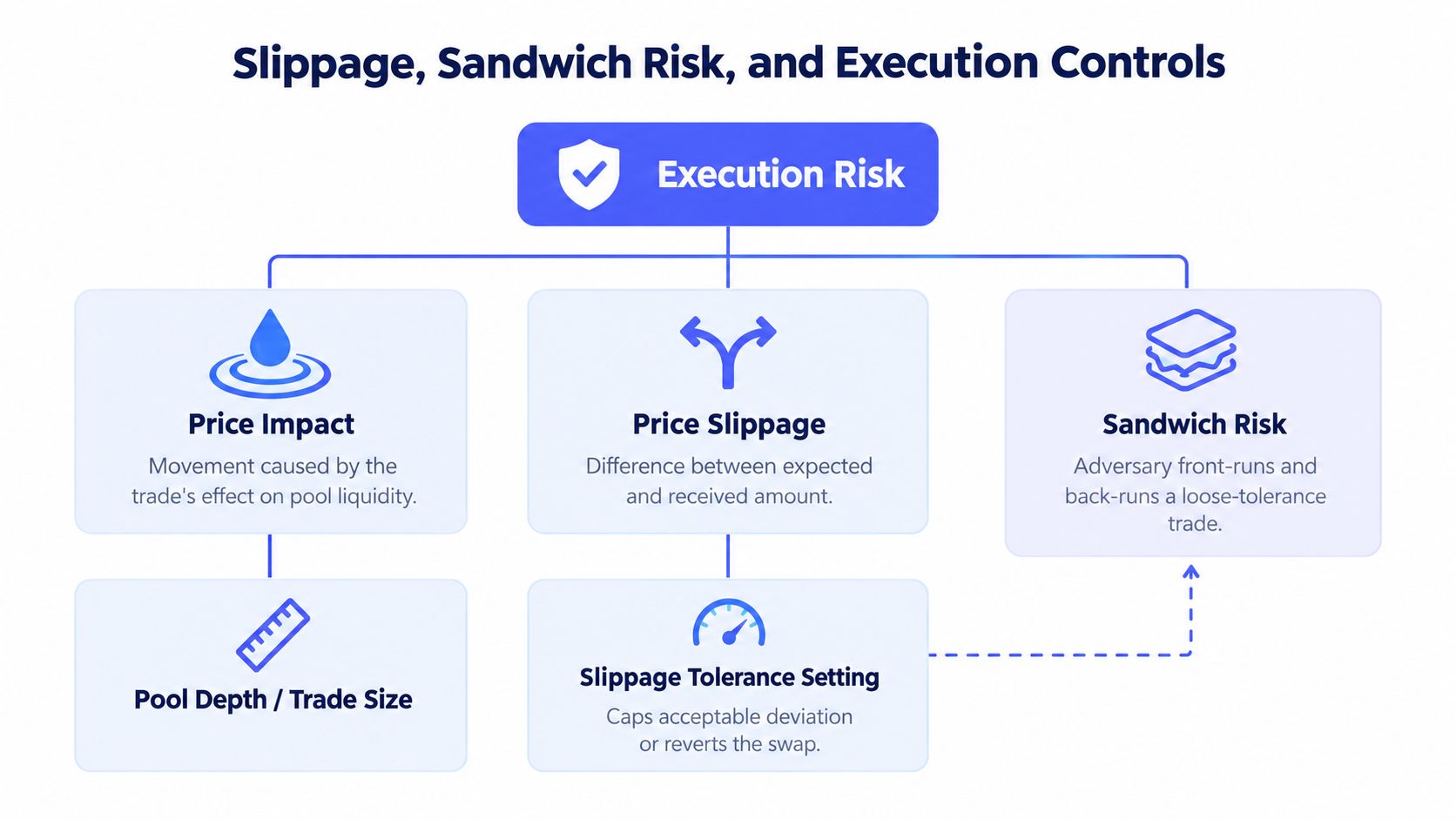
Uniswap separates price impact from price slippage. Price impact is the change caused by the trade's effect on pool liquidity. Price slippage is the difference between the expected amount and the amount received after execution. A slippage tolerance sets the limit. If the trade moves outside that range, it fails instead of executing (Uniswap swaps docs).
That distinction matters in copy trading. A source trade can move the pool, and the follower can still receive a different fill even if the market looked quiet when the signal arrived. The copy is a new order, not a replay.
What the chain research shows about ordering risk
On Ethereum, a large-scale study covering 2,367,980 blocks found at least 480,276 sandwich attacks and about 64,217 ETH in aggregate attacker profit. The researchers estimated that splitting large trades into smaller orders could have avoided roughly 70.67% of observed attacks and saved around 30,525 ETH (Ethereum sandwich attack study). That is the ordering risk in plain numbers.
If a copier submits about a second after the source, latency alone doesn't solve it. The transaction can still land against a different pool state, worse gas priority, or hostile positioning. Faster is not the same as safe.
The controls that actually matter
The mirror settings should reflect that reality.
- Per-trade slippage ceilings: cap how far the execution can drift before the swap reverts.
- Liquidity-based size limits: reduce notional size when the pool is thin.
- Fixed-ticket sizing for large leader trades: avoid letting a huge source order create oversized market impact for the follower.
- Source-versus-copy price logging: record what the leader got and what the follower received.
- Dollar caps: keep a copied trade from growing past what the pool can absorb cleanly.
If you want a more detailed primer on the mechanics, the guide to slippage for yield seekers is useful because it separates expectation from execution instead of treating the two as the same thing.
For copy settings, the internal benchmark should be simple. If the source got a trade off and the follower couldn't execute within tolerance, that's not a signal problem. It's an execution constraint doing its job.
A platform that surfaces what slippage means in crypto gives the user a chance to tune that constraint before the swap hits the pool. That is the right order. Measure first. Submit second.
Reading Trader Metrics Beyond Realized PnL
A leaderboard PnL number is useful, but it is not enough. It tells you who looked strong. It does not tell you whether the follower can replicate the result. The follower-side metrics are the screen that matters.
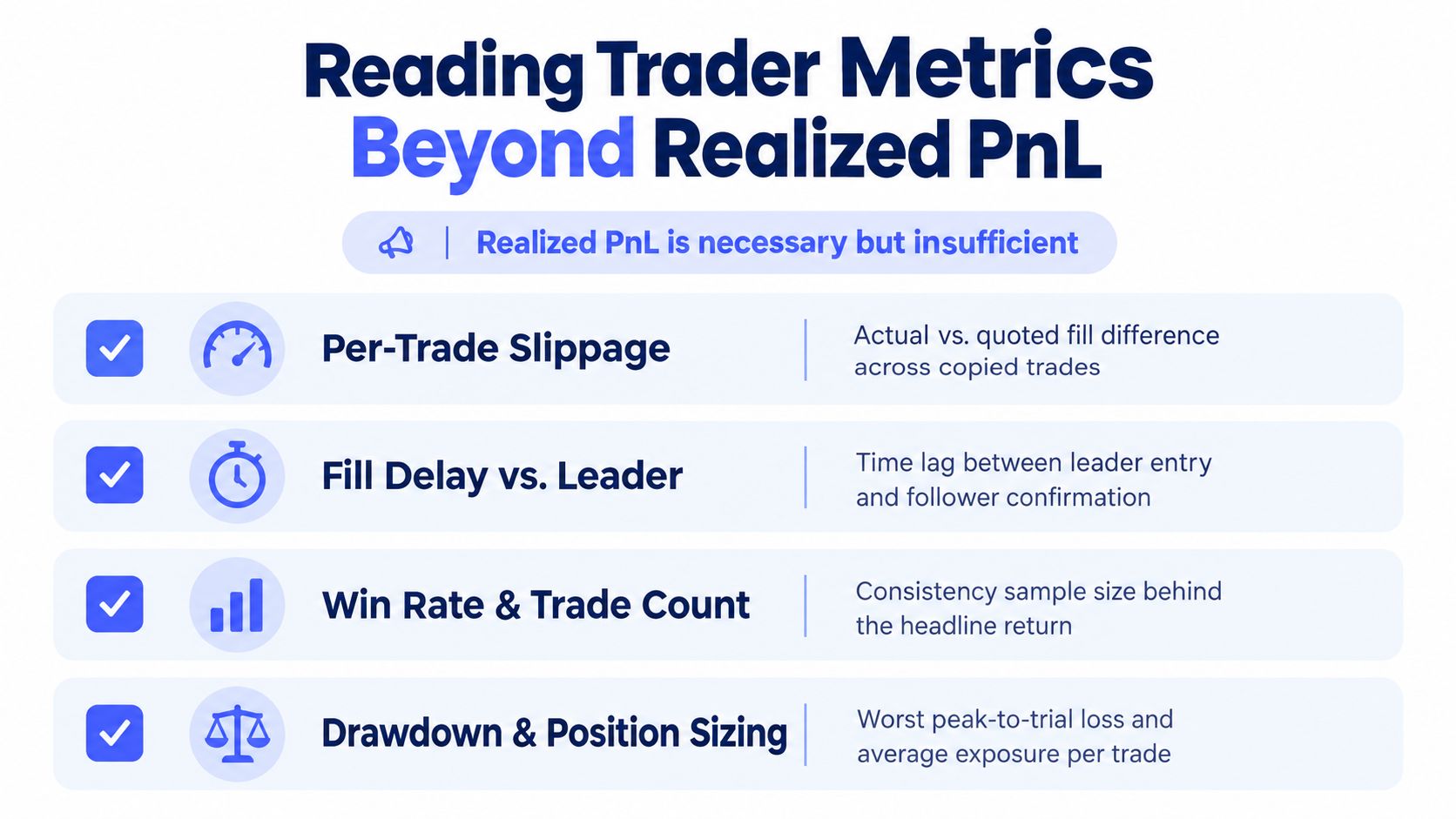
The metrics that belong on the screen
Look for the execution signals that tell you whether the source wallet is copyable in practice.
| Metric | Why it matters |
|---|---|
| Per-trade slippage | Shows the gap between the quoted and actual fill across copied trades. |
| Fill delay vs. leader | Shows how late the follower confirmed the trade relative to the source. |
| Copied-exit rate | Shows whether sells are being mirrored, not just entries. |
| Failed-copy rate | Shows how often the mirrored trade doesn't land. |
| Drawdown and position sizing | Shows how much pain the follower takes and how much exposure the tool is taking per trade. |
Those are the numbers that belong on /traders and /data, not just source wallet PnL. Leaderboard rankings can still help with discovery, but they shouldn't close the decision. The follower result is the decision.
How to read the data without fooling yourself
A trader with strong realized PnL can still be a poor copy candidate if the fills are thin, the exits are messy, or the trade size is too large for the liquidity available to the follower. A trader with less impressive headline PnL can sometimes be more practical if the edge survives after execution costs.
That is the uncomfortable part. The highest-PnL wallet isn't always the best wallet to mirror. The better question is whether the edge survives after latency, fees, slippage, and copied exits.
Bottom line: evaluate the wallet as a source of executable trades, not as a trophy case.
Past performance doesn't predict future results, and automated mirroring can fail or amplify losses. Copy trading is an automation mechanism, not a return strategy. That's the right level of caution.
A Pre-Flight Checklist Before Turning the Bot On
Start with size. Set a fixed ticket or proportional sizing rule, then cap it. If the copied trade is too large for the pool, the rest of the system gets noisy fast.
Set the slippage ceiling next. Keep it tight enough that a bad fill fails instead of drifting without notice. Then check the allowance. It should be bounded, revocable, and easy to reduce.
The order to use before activation
- Define the trade size: choose fixed or proportional sizing, then add a cap.
- Set slippage limits: keep each mirrored swap inside a pre-set ceiling.
- Bound the allowance: avoid open-ended approval where possible.
- Confirm the revoke path: know how to cut permission fast.
- Verify exit replication: make sure sells are mirrored, not only entries.
- Check the kill switch: confirm the bot can stop new copies and close open ones if needed.
- Review trader data: use
/tradersand/datato inspect follower-level outcomes, not just leader PnL.
A bot that mirrors trades into your own wallet can save time, but it doesn't remove risk. It can still land different fills. It can still miss exits. It can still amplify losses if you size it badly or leave permissions too broad.
That is the right way to think about defi copy trading. Treat it as a follower-side execution system with an authorization boundary, not as a shortcut to easy returns.
copyfomo puts that framework into a Telegram bot that mirrors filled entries and exits into your own wallet at a configured size. If you want to test the mechanics with the same execution questions in mind, visit copyfomo and start the bot on Telegram.
stop reading. start copying.
pick a trader from the fomo leaderboard, set your size, and the entries and the exits land in your own wallet while you sleep.
open copyfomo on telegram →