Dex Trading Bot Comparison: Types, Features and Risks
compare dex trading bot types, latency, slippage and allowance controls, and learn what to check before running one. copy trading carries risk.

The popular advice is simple. Pick the fastest DEX trading bot, follow the name at the top of a leaderboard, and leave it running. That advice fails the moment your fill is not the source fill.
A copied swap arrives later, pays its own gas, and can shove a thin pool by itself. I judge a bot on net execution quality: delay, realized slippage, failed attempts, and the token permission left on the contract. A quicker bot that accepts a loose price can do worse than a slower one that refuses the trade.
Copy trading carries risk. Past performance does not predict results. Nothing here is a reason to buy a specific token.
Table of Contents
- Dex Trading Bot Types Side by Side
- Feature Checklist for Choosing a Dex Trading Bot
- Allowances, Permissions and Revocation Limits
- Latency and Slippage Decide Your Copied Fill
- Exit Mirroring and Where Copying Breaks Down
- Matching a Dex Trading Bot to Your Trading Situation
- Confirm Your Settings Before You Run the Bot
Dex Trading Bot Types Side by Side
A DEX trading bot submits swaps from a wallet on a decentralized exchange without manual clicks. The strategy decides what it needs. The interface does not.
Three types cover almost every pitch you will see.
| Bot type | How it acts | Trigger | Execution sensitivity | Main risk |
|---|---|---|---|---|
| On-chain swap mirroring | Copies the buys and sells of a chosen wallet at a set size | The source trader's fill | High, delay and slippage change the price paid | Copying late or at a worse price than the source |
| Arbitrage bot | Trades price gaps between pools or venues | Price mismatch above the cost of gas and fees | Very high, competes with other searchers | Failed transactions and MEV competition |
| Market-making bot | Posts quotes on both sides of a pair and earns the spread | Inventory and volatility bands | Medium, quote updates must keep pace with the market | Adverse selection and inventory losses |
On-chain swap mirroring waits for one wallet. Your size is fixed or scaled. You are not hunting a price gap. You are trying to land near someone else's fill, then get out when they get out. Delay and slippage are the whole game.
Arbitrage bots only fire when the gap covers gas and fees. That race is crowded. In Ethereum concentrated-liquidity pools studied across 125 weeks, the median share of arbitrage transactions was about 7, 8% of volume and count, while the mean was about 15, 16%, and Polygon ran higher, according to a UConn working paper on bot trading. You are bidding against specialist searchers, not against a chart you check at lunch.
Market-making bots post both sides and live on the spread. Quote updates have to keep up, but the painful losses come from inventory and from traders who only hit your stale side.
What the table is for
Treat the table as the first filter. If the goal is copying a trader, latency and exit handling matter most. If the goal is arbitrage or market making, you need deeper infrastructure than a phone bot. A vendor feature list is not that infrastructure. The independent review of Autotrader is useful as a sheet of claims to test against your own logs, not as a reason to change tools. For the wallet-side workflow behind automated swaps, see our note on a DeFi trading bot.
The bot type is set by the strategy, not by the interface.
Feature Checklist for Choosing a Dex Trading Bot
Run these seven checks before you connect a wallet. A missing row is a reason to stop, not a setting to "fix later."
| Criterion | What to check | Red flag |
|---|---|---|
| Custody model | Funds stay in your wallet and access is granted by allowance | Bot asks for a private key or unlimited access |
| Execution latency | Time from source trade to fill, reported per trade | Only a headline speed claim with no trade-level data |
| Exit mirroring | Sell transactions are copied as well as buys | Only entries are copied |
| Slippage control | User-set maximum slippage and minimum output | No user-set limit on price movement |
| Fill reporting | Timestamp, price and displayed slippage for each copied trade | No trade log or delayed reporting |
| Kill switch | Pauses new copies, and closes open mirrored positions on request | No way to stop the bot without withdrawing funds |
| Sizing controls | Fixed or proportional size with per-trade caps | One fixed size with no cap |
Custody fails if the bot wants a private key, or an unlimited allowance on day one. Searchers already run bots to reorder profitable flow, and users caught in a sandwich get worse execution, as Ethereum's MEV documentation describes. You do not need to hand a contract a blank check to participate.
Latency fails when the only number is a slogan. You want the clock from the source fill to your fill, on that trade.
Exits fail when the bot copies buys and leaves sells to you. That is manual trading with extra steps.
Slippage fails with no user-set maximum and no minimum output. Reporting fails with no timestamp, price, and displayed slippage. The kill switch fails if pause is missing, or if pause cannot be separated from closing what is already open. Sizing fails on one fixed ticket with no cap.
Georgia Tech researchers have warned that open approvals can let a compromised contract drain a wallet, and a 2025 security study found 32,582 potentially vulnerable contracts on Ethereum, 410 of them confirmed exploitable at evaluation, as covered by Georgia Tech Research News. Unlimited access ends the evaluation.
How to weigh the rows
Custody and the kill switch are pass or fail. Latency and slippage are graded by how much of the source trader's edge is still there after gas, price impact, and bad fills. A clean log does not make the strategy safe. Copy trading carries risk, and past performance does not predict results.
Allowances, Permissions and Revocation Limits
Non-custodial means the assets stay in your wallet. It does not mean the contract cannot spend them.
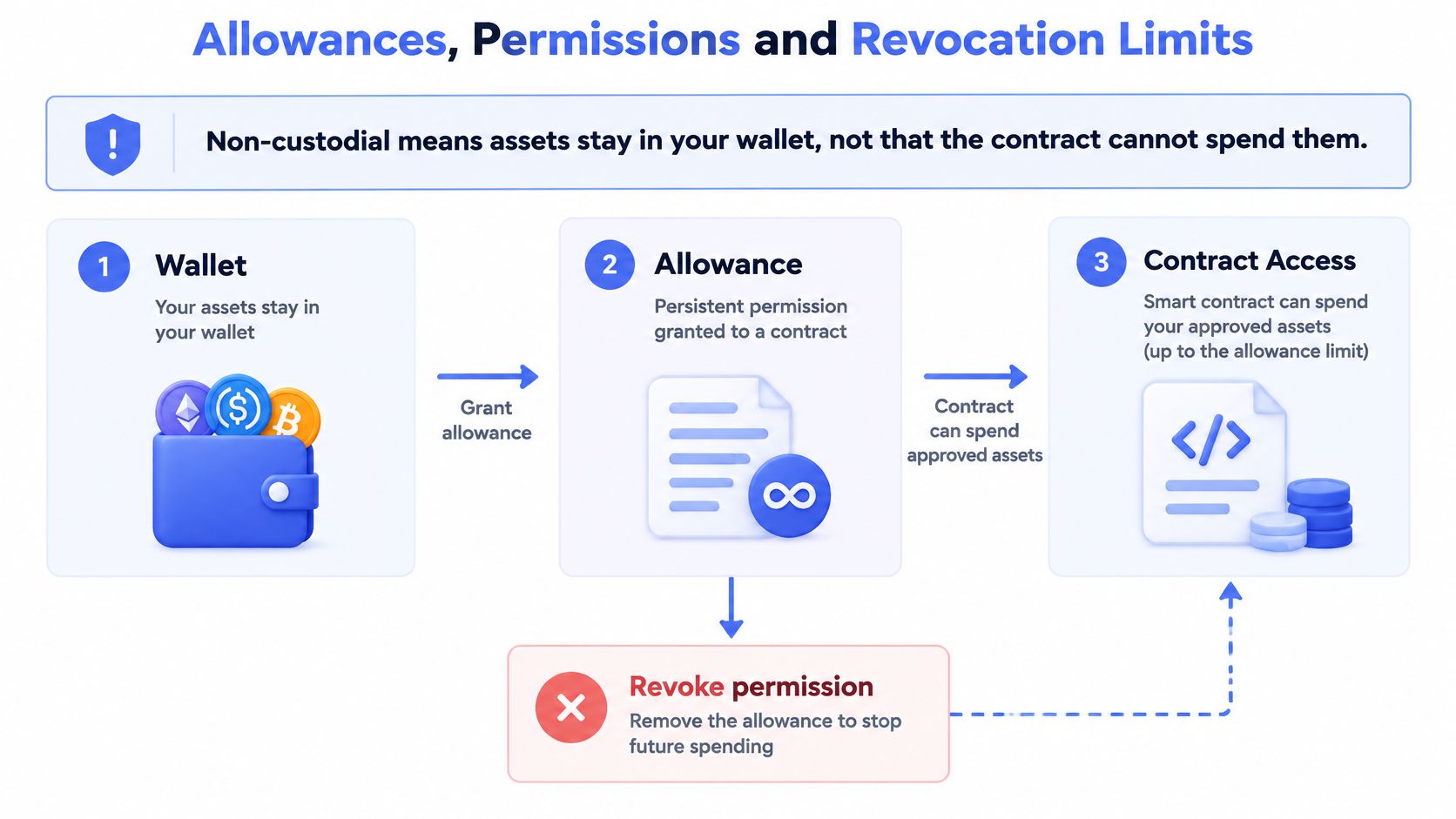
An allowance is a persistent permission, not a one-time click. Ethereum.org's guide to revoking token access states that once a platform has unlimited access to a token, it can spend those tokens even while they remain in your wallet. The documented protections are plain: approve only the amount you need, avoid untested applications, and revoke access when you no longer need it. Revocation does not bring back tokens already taken. Cancelling the permission is its own on-chain transaction, and that transaction has a fee.
| Control | What it limits | Check before use |
|---|---|---|
| Unlimited approval | Any amount of the token the contract can move | Replace with a capped allowance |
| Capped allowance | Spend limited to a set amount | Confirm the cap covers planned trades only |
| Expiry or revocation path | How long access lasts | Know the on-chain revoke step and its fee |
| Separate trading wallet | Keeps copy funds apart from main holdings | Fund only the amount you plan to copy with |
| Pause behavior | Whether pause stops new copies, open positions, or both | Test the pause before leaving the bot unattended |
What to verify before you sign
Unlimited approval lets the spender move any balance of that token, including tokens you add later. Replace it.
A capped allowance stops at a number you chose. Confirm the cap matches the trades you plan, not your whole balance.
Expiry and revocation answer "for how long." If you cannot point to the revoke transaction, you do not have an off switch. Budget the fee. A revoke you cannot afford to send is not a control.
A separate trading wallet keeps copy funds away from long-term holdings. Fund only what you intend to put at risk.
Pause behavior is the control people skip. Pausing new copies does not close open positions. One control stops new entries. Another closes what is already open. Test both while the size is small. Our token approval checker walkthrough is the place to confirm spender, amount, and revoke path before you leave a bot unattended.
Before you grant anything: which token, what amount, which contract, for how long, and how do you revoke it?
If you cannot answer those five, do not sign.
Latency and Slippage Decide Your Copied Fill
A one-second copy delay is a claim to test. It is not a fill at the source price.
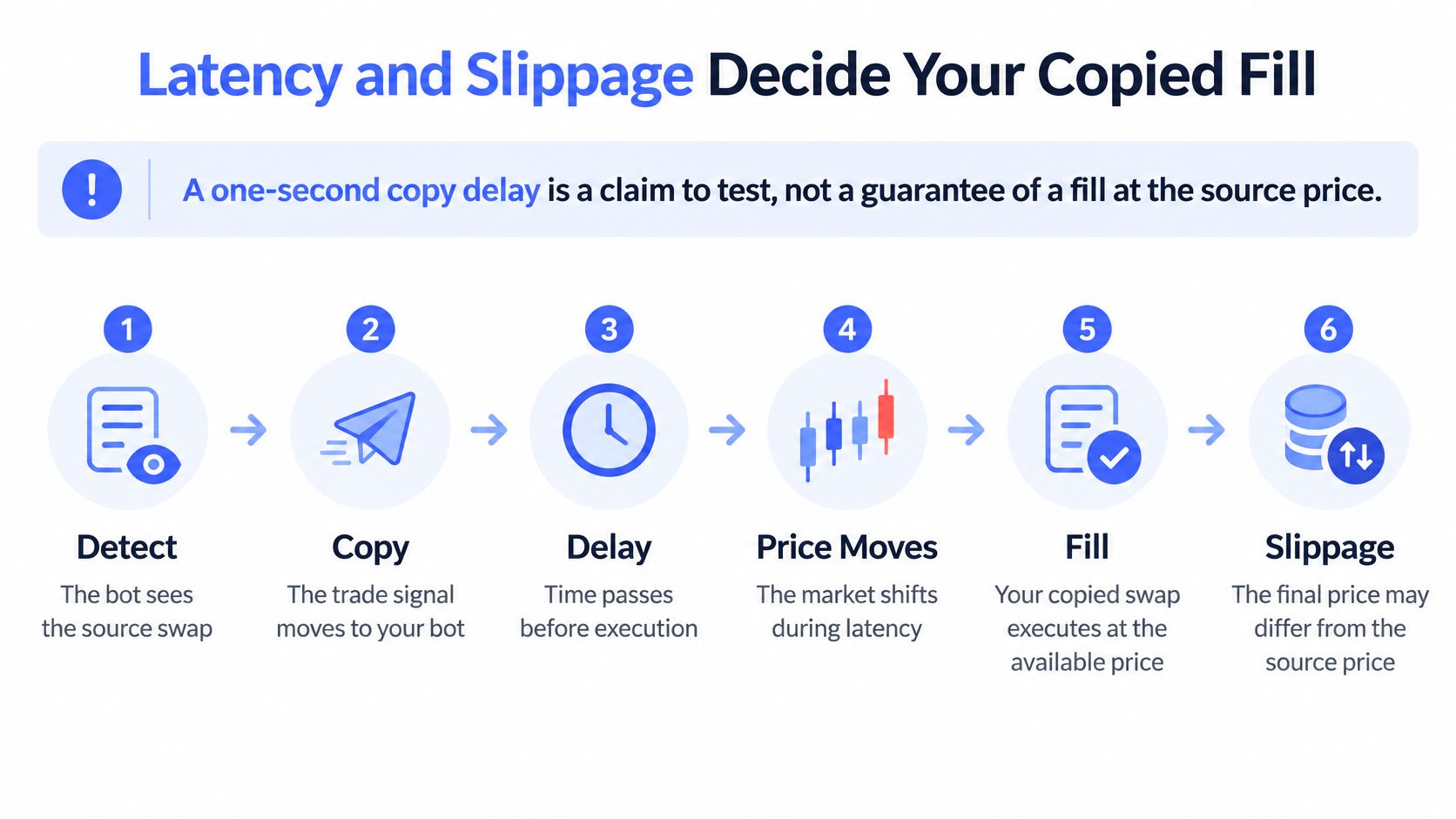
Where the copy loses time
- Detect the source trade. Delay here is indexing and notification lag. Log it separately from everything else.
- Build the transaction. Precomputed calldata helps. A fresh quote that ignores your size does not.
- Propagate it through RPC endpoints. Spread endpoints geographically. A single distant node is a silent tax.
- Wait for validator or sequencer inclusion. Dynamic fees and bounded retries with a replacement transaction are the levers. Endless resubmits just burn gas.
- Confirm the swap and record the fill. Store realized price, not the quote you liked.
A late copy is not the same thing as a missed copy. Once the source has moved, the same route can fill worse. Before submission, enforce a maximum age, a price-deviation limit, and a minimum-output check.
Say a trader buys a thin memecoin and your transaction lands after that buy has already repriced the pool. Your timestamp shows the gap. Displayed slippage shows distance from your quote, not a promise that you matched their entry. If price has already run past their entry by more than your max chase, skip the copy. Chasing is how a fast bot donates the edge.
DEX Guru's swap troubleshooting recommends raising slippage to 2% to 5% when a swap fails because the quoted conditions cannot be met. That range is an operational setting for a stuck transaction, not a performance target. A live feed of timestamps and realized slippage lets you inspect the gap. It does not remove price movement, reverts, or the difference between source and follower.
What actually dominates the cost
| Trade profile | What dominates the cost | Practical effect |
|---|---|---|
| Small swap | Gas dominates total cost | Fixed fees weigh most on small tickets |
| Large swap | Price impact and slippage dominate | Copy size moves the fill |
| Memecoin | Adverse slippage roughly 80% more likely than mature assets | Thin liquidity widens the gap to the source fill |
A 2025 study of Uniswap trading found that gas dominates small swaps, while price impact and slippage dominate larger ones, and that memecoin trades had roughly 80% higher adversarial-slippage probability than mature assets. Compare copied size with that full stack before you call a fill "close enough." Front-running and sandwiching aim at swaps with loose slippage. Keep the maximum tight, keep minimum output on, and log a revert as a real outcome.
copyfomo mirrors entries and exits, in both directions, about one second after the trader's fill, and the message carries the timestamp and displayed slippage. One second is a target reaction time, not a guarantee. For how to set the guard itself, see slippage tolerance.
Track three numbers in week one: p50 detection latency, inclusion latency, and source-to-copy price difference in basis points. Add fill rate and revert rate once those three are stable.
Exit Mirroring and Where Copying Breaks Down
Entries are easy to copy. Exits decide the result.
Exit mirroring copies the sell as well as the buy, so the position closes when the source closes, not when you next open a chart. If your bot only mirrors entries, you are not copy trading. You are late to every entry and alone on every exit.
What a useful message contains
We send a filled buy with what the trader spent and the market cap at the fill. A filled sell carries the PnL of the whole position and how much is still open. You also hear when a take profit or stop loss fires, when a sell does not go through, when a copy is skipped by a setting, when there is not enough USDC, and when a token can no longer be sold. Silence on a trade that is still in flight is intentional. A failed sell is not.
Where the copy fails
- Thin liquidity: your copied size moves the price the source trader did not pay. Faster routing does not fix a pool that cannot absorb you.
- A late landing: the source has already run, and your buy is a different trade.
- Memecoins: adverse slippage shows up more often, and a failed sell leaves you holding what you meant to exit.
- No buyers: the sell reverts or the token cannot be sold. That is an open position, not a rounding error.
A faster bot can still erase the source trader's edge if it keeps crossing thin books. Leaderboard rank will not save that.
Across Binance, Bybit, and MEXC, a 2025 study of 100,236 follower outcomes, cited by Coin98, found that 97% of lead traders had positive personal returns while only 43.61% produced positive follower returns. Only about 12% of top-ranked traders kept that ranking for more than six months. Those are centralized venues, and the warning still fits a mirrored wallet: the leader's past result is not your result. Copy trading carries risk.
Set exit handling before you set entries. If you cannot see a failed sell, do not automate the buy.
Matching a Dex Trading Bot to Your Trading Situation
The right bot is the one whose failure mode you can live with. Judge it by the copied fill after delay and slippage, and by the permissions you grant, rather than by speed claims. Four situations cover many who already use fomo.
Part-time, or stuck in the wrong time zone. You need unattended mirroring, a per-trade cap, and a pause you can hit from a phone. Screen time is the problem, not signal quality. copyfomo is a Telegram bot that mirrors the buys and sells of a top fomo trader you pick from the fomo leaderboard into a wallet that belongs to you, at your chosen size, about a second behind the trader's fill. That is the fit when the requirement is a Telegram control surface and fills that do not wait for you to wake up. Arbitrage and market-making rigs are a different job.
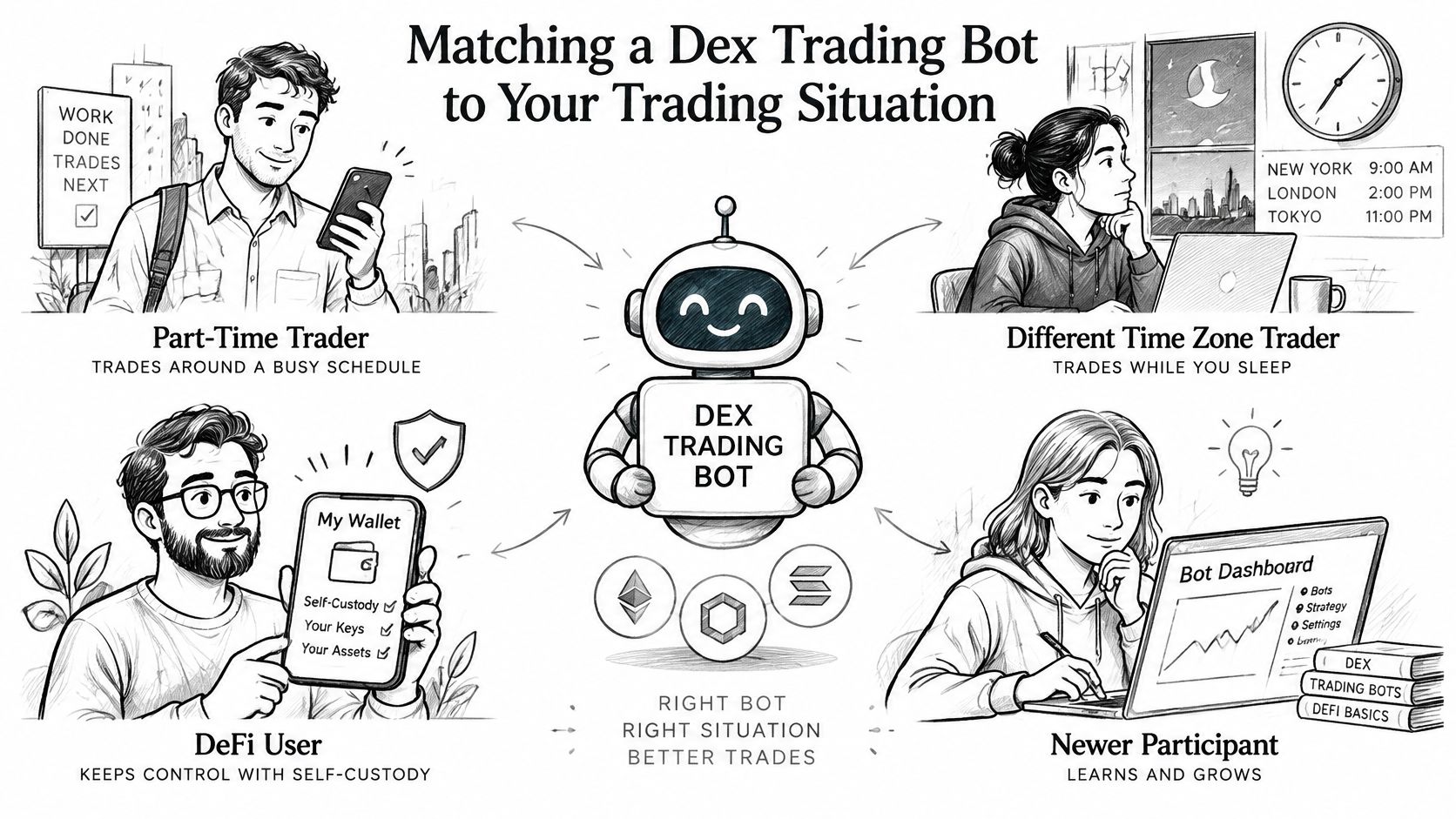
DeFi users who want non-custodial execution. Keep a capped allowance and a separate trading wallet. Funds stay in your wallet under a revocable permission, and the bot cannot withdraw them. If the setup needs your main key, it does not match this profile, however clean the leaderboard looks.
Newer participants following experienced traders. Start with a small fixed ticket and the minimum trade filter on. The filter ignores trader buys under the amount you set, with a default of $20, so you do not mirror dust. Watch how the mirrored sells behave before you trust the buys. Exits are where a copy earns or loses its keep.
Data-driven traders. The fomo leaderboard is ranked on realised PnL from filled trades. Review a trader's record before you bind a wallet to a name, and treat any single ranking position as a sort order rather than a forecast. Wallet discovery from a handle or profile screenshot reaches addresses beyond the leaderboard's top segment, so the pool is wider than the first page suggests.
If your actual plan is to post quotes or to race other searchers, a mirroring bot is the wrong instrument. Stop at the type table and build that stack separately.
Confirm Your Settings Before You Run the Bot
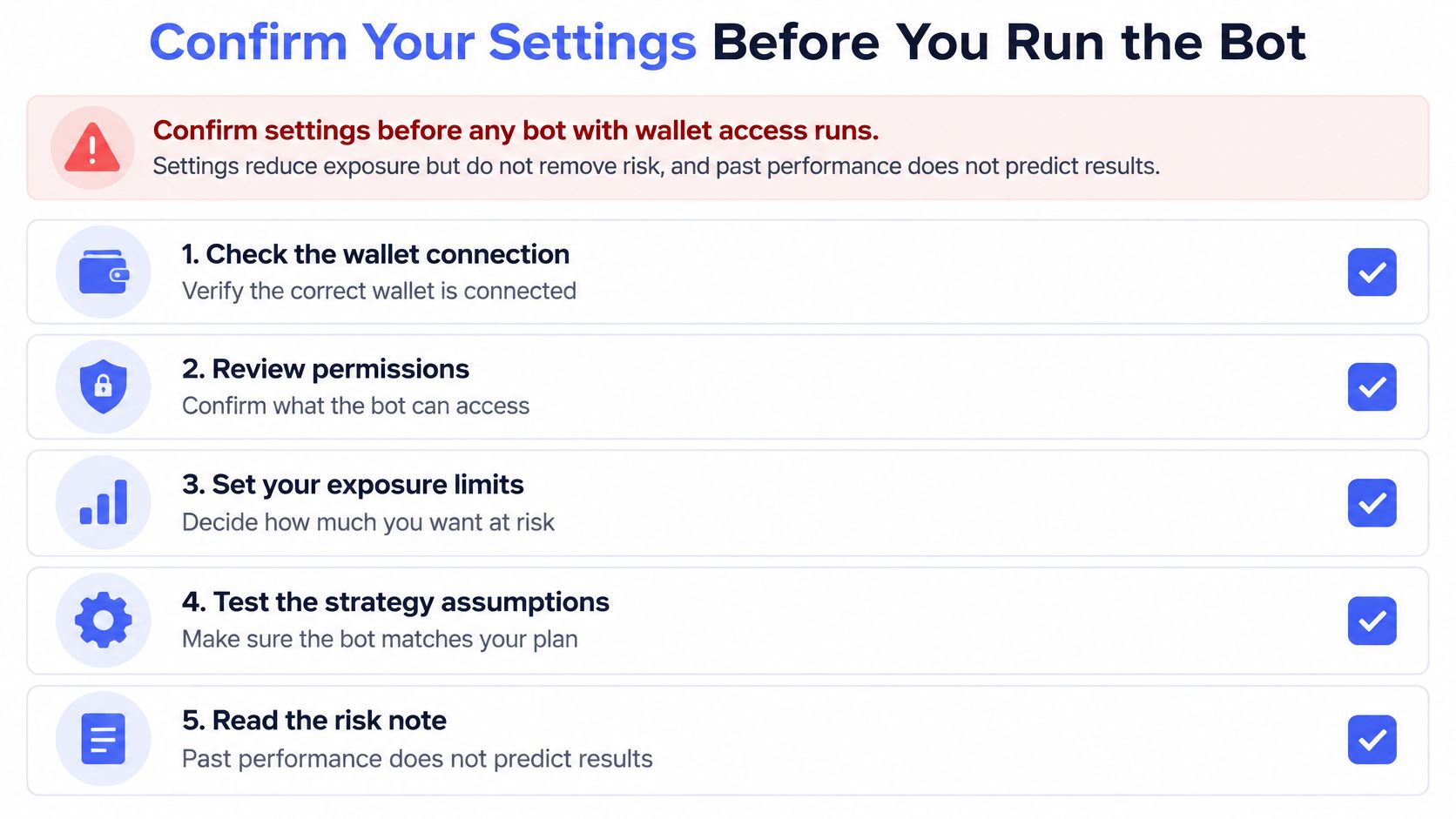
A bot with wallet access fails in two places: the permission you signed and the fill you accepted. Check both before real size goes in. Settings reduce exposure; they do not remove risk, and past performance does not predict results.
- Check the allowance. It should be capped, and the spender should be the bot contract you expect. Verify both against the setup details before you sign, and know how to revoke the permission.
- Pick the trader. /find resolves a handle or profile screenshot to an address, so the choice runs wider than the leaderboard's top segment.
- Set the ticket. Start with a fixed size and a per-trade cap. Sizing, market cap band, take profit and stop loss sit per trader; minimum trade and max chase apply to the whole account. Take profit and stop loss default to off, so decide them now.
- Run a small test. Fund only the test amount, let the first mirrored fills arrive, and compare their timestamps and displayed slippage with the source trades. Copies land about a second behind each fill, so the delay you measure is the delay you keep.
- Rehearse the exit. Pause new copies, then close one test position. The feed reports a sell that did not go through; an exit missing from the log did not happen.
- Scale up only after the test matches what you expected. Late fills, wide slippage, or a failed sell mean no added size.
Setup itself is short: send /start to @copyfomo_bot, pick a trader, run the copy flow, and fund the wallet with /deposit.
copyfomo mirrors filled buys and sells from a fomo trader you select into your own wallet, at your size, with timestamps and displayed slippage on each copy. Delay, slippage and permissions are the audit, and a small ticket is the cheapest way to run it. Copy trading carries risk, and past results do not predict yours. Run the checks above, then open copyfomo and start the bot on Telegram.
stop reading. start copying.
pick a trader from the fomo leaderboard, set your size, and the entries and the exits land in your own wallet while you sleep.
open copyfomo on telegram →