Rug Pull Checker How It Screens Risky Tokens
what is a rug pull checker and how to read its results. learn contract flags, liquidity checks, limits and safe habits.
A token looks hot. The chat is moving fast. The chart is green. You're about to click buy, and the sell button is the part you worry about. That's the moment a rug pull checker earns its keep. It doesn't make a token safe. It gives you evidence before you size in.
Table of Contents
- Why Fast Tokens Need A Quick Risk Filter
- What A Rug Pull Checker Tests
- Contract And Liquidity Signals That Matter Most
- How To Read Checker Results Without Guessing
- Why Low Risk Results Can Still Be Wrong
- A Practical Verification Routine Before You Trade
- Stay In Control While You Screen And Copy
Why Fast Tokens Need A Quick Risk Filter
A fast token can go from exciting to useless in one move. Buyers pile in. Liquidity looks fine. Then sells freeze or the pool thins out and the exit closes. That's why a rug pull checker matters before the trade, not after.
Rug pulls became a major DeFi scam category in 2021. Chainalysis estimated that victims lost more than $2.8 billion in cryptocurrency through rug pulls that year, making them responsible for approximately 37% of all cryptocurrency scam revenue, compared with only 1% in 2020. Their write-up also noted that more than $2 billion went through decentralized-finance projects where perpetrators removed liquidity or abandoned the project after attracting buyers. Chainalysis on 2021 crypto scam revenues
For a trader who already uses fomo, the point is simple. Speed is useful, but speed without screening is how people end up holding a token they can't exit. A checker gives you a pre-trade view of contract risk, liquidity control, and crowd behavior. It does not promise the token is clean. It tells you whether the setup deserves more work or an immediate stop.
Practical rule: if the token can change rules after launch, and you can't see who controls the exit, treat the trade as exposed.
The big mistake is using a checker like a green light. That's too soft. Use it like a gate. If it flags danger, you pause. If it doesn't, you still verify the details and keep size under control.
What A Rug Pull Checker Tests
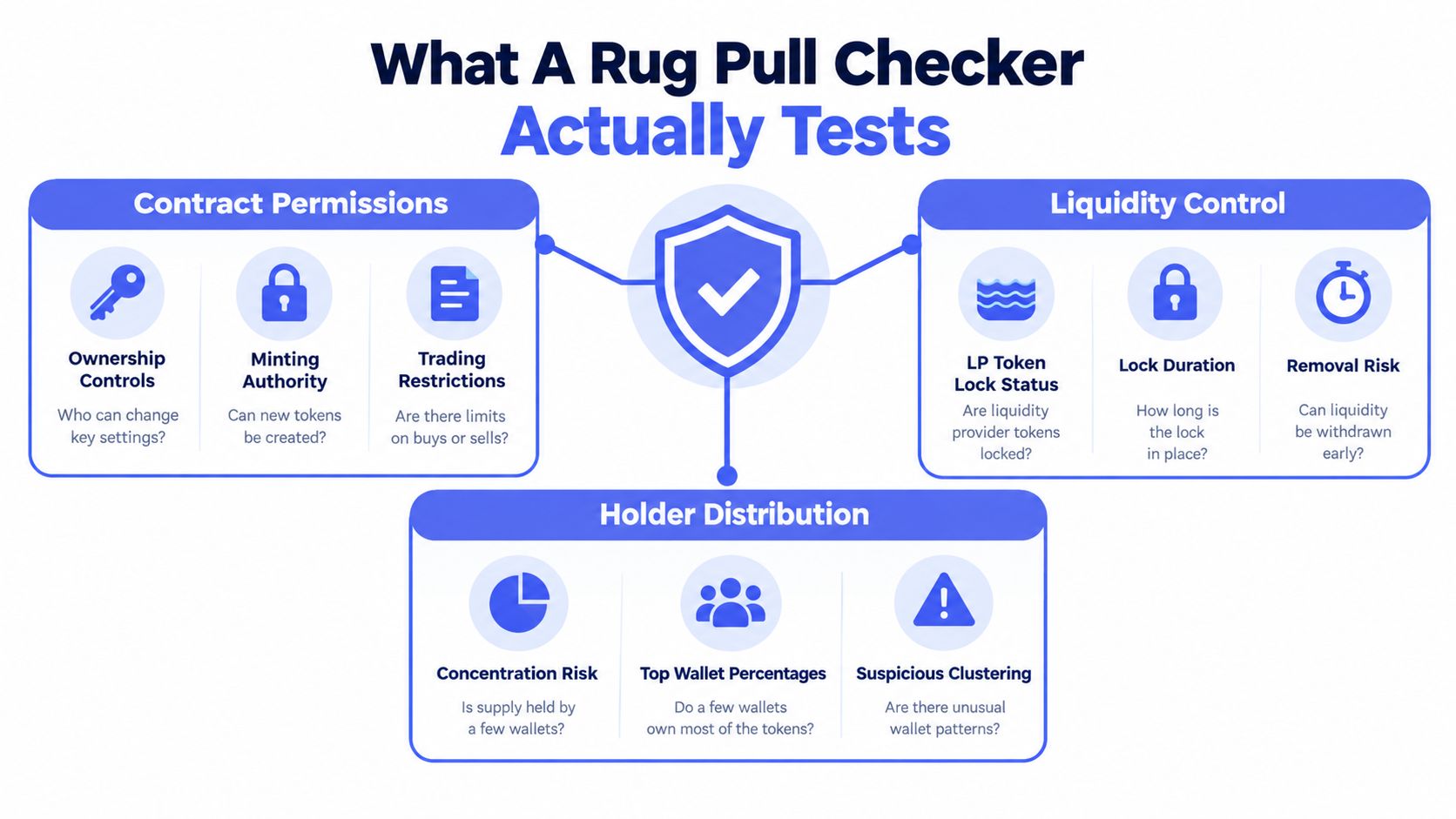
A decent checker is not reading vibes. It is reading three layers of evidence. First, it inspects the contract. Then it checks liquidity control. Then it looks at how supply and trading activity are spread across wallets.
A trader who moves fast still needs a filter. A checker works like a gate at the door. It helps you decide whether the setup deserves more work or an immediate stop.
Contract permissions
The first layer is the code that governs the token. A checker looks for owner privileges, minting control, blacklist or whitelist logic, transfer limits, tax settings, pausability, and upgradeability. A contract can be live and still leave the deployer with a lot of room to change the rules.
Liquidity control
The second layer is who controls the pool. A buyer wants to know whether liquidity-provider tokens are locked, who holds them, how long the lock lasts, and whether the lock is real. If the exit stays under the team's control, the token can look active right up to the moment liquidity disappears.
Holder spread and trading behavior
The third layer is the crowd. A checker should look at concentration, wallet clustering, and trading patterns. A small number of wallets holding a large share of supply is a clear warning. So is activity that looks busy but comes from linked wallets or artificial volume.
If a checker only shows a score and no evidence, it is not doing enough.
Good output gives you warnings, proof links, and enough context to judge the trade for yourself. It should feel like a screening report, not a verdict. That matters because the goal is not to prove a token is good. The goal is to spot when the setup is bad enough to skip.
Contract And Liquidity Signals That Matter Most
A fast trade needs a pre-trade filter, not a promise that the token is safe. The strongest warning signs sit in the contract and the pool. A checker should read both, because one can hide what the other reveals.
Beyond the basic contract checks, the flags that end a trade are usually the ones tied to exit risk. A token can look active and still trap you if the sell path is blocked or changed after launch. Research on slow liquidity-drain scams also points to honeypot-style behavior, where buys go through but sells fail or become too costly through contract-controlled fees. ArXiv research on slow liquidity-drain scams
| High Severity Flags And What To Do | |
|---|---|
| Flag | What It Means, Reader Action |
| Owner can mint more tokens | Supply can be diluted. Treat it as a blocker until you understand who controls issuance. |
| Blacklist or pause functions exist | Trading can be stopped or selective wallets can be blocked. Do not size in blindly. |
| Buy or sell taxes can change | Selling can become expensive or impossible. Check the current settings and who can edit them. |
| Proxy upgradeability is present | The rules can change after launch. Recheck after any upgrade event. |
| Honeypot-style sell failure appears | You may be able to buy but not exit. Stop the trade. |
| Liquidity control is unclear | The exit may sit under insider control. Verify LP ownership and lock terms before entry. |
A small test trade helps, but only if you test both directions. Buy first. Then try to sell. Compare the sell output with the quote you expected. If the simulation fails, or if a fee change could make the exit worse, that is a blocker.
Read the table like a severity ladder. One hard stop can be enough to pass on the trade. Two or more moderate flags make the setup weaker fast. The checker should help you sort the evidence, but your job is to notice the problems that break the trade, not to count green marks and hope for the best.
How To Read Checker Results Without Guessing
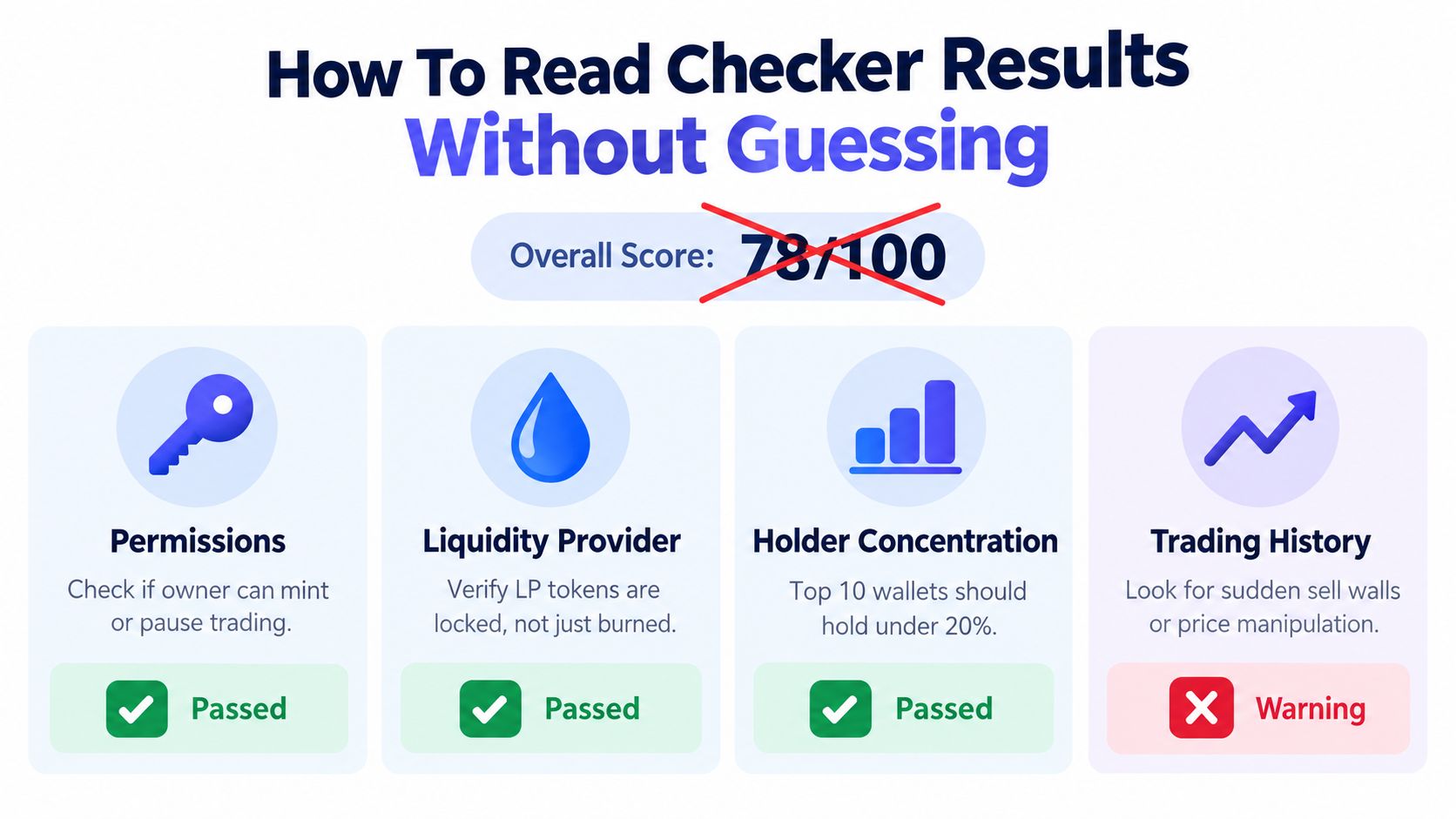
A result page can look tidy and still hide risk. The score at the top is the least useful part at first. Start with the evidence rows. Look at permissions, liquidity provider control, holder concentration, deployer funding links, and recent trading behavior. That tells you what the score is built from.
A systematic study of 14 detection tools found that they collectively covered 25 of 34 identified rug-pull root causes, leaving 26.5% undetected. Individual tools also performed unevenly, with some root causes detected by one tool and missed by others. That's why “no issue found” is only a point-in-time result, not proof of safety. Chainalysis on blockchain security
The right habit is simple. Read the evidence first. Then decide whether the setup deserves a test trade. If the report says green, that means the checker didn't find a problem at that block. It does not mean the token can't fail later.
For workflow, think in change events. Alerts should fire when ownership transfers, fees change, LP gets withdrawn, or the deployer starts selling into the pool. Those are the moments that matter. A clean result from an hour ago is weaker than a fresh warning on-chain.
If you already keep notes on wallet screens, a false alarm review process helps here too. This write-up on false positive analysis for MSSPs is useful because the logic is the same. Separate the signal from the noise, preserve the evidence, and don't confuse “alert” with “confirmed scam.”
One more habit helps. Keep the block height or timestamp with the report. If the token later moves, you want to know what the checker saw and when. That keeps the review honest and makes it easier to compare later scans.
Use the result like a trader, not a gambler. If the checker gives you one bad line, slow down. If it gives you several, stop. If it gives you a clean result, still respect the size of the trade.
Why Low Risk Results Can Still Be Wrong
A low-risk result can still miss the thing that hurts you. Contract scanners are good at visible code paths. They are not good at distributed team wallets, off-chain multisig control, social engineering, compromised social accounts, or a founder slowly leaving the project. Those problems don't always show up in a token scan.
Liquidity locks can be misleading too. A lock can cover only part of the pool. It can expire soon. It can depend on a weak locking service. None of that means the token is instantly bad, but it does mean the word “locked” needs context.
Chainalysis identified 90,408 Ethereum ERC-20 tokens launched in 2023 that met its possible pump-and-dump criteria. Those tokens represented 24.4% of all tokens launched on Ethereum and 53.6% of tokens listed on decentralized exchanges during the study period. The pattern mattered because it showed how often repeated trading, concentrated liquidity removal, and a tiny remaining pool can sit behind what looks like normal activity. Chainalysis on possible pump-and-dump tokens
The practical lesson is plain. A checker can tell you that the token looks technically acceptable at the moment you checked it. It cannot tell you the team won't abandon the project, the socials won't get compromised, or the market won't turn on you. That's why a clean scan is not a promise.
Trader rule: low risk on a scanner means “reviewed and not flagged right now,” not “safe to buy.”
Copy trading makes that gap more important. A bot can mirror an entry before the slow part of the rug becomes obvious. So use checker results with position caps, sellability tests, and allowance controls. Past performance doesn't predict results, and a low-risk badge doesn't change that.
A Practical Verification Routine Before You Trade
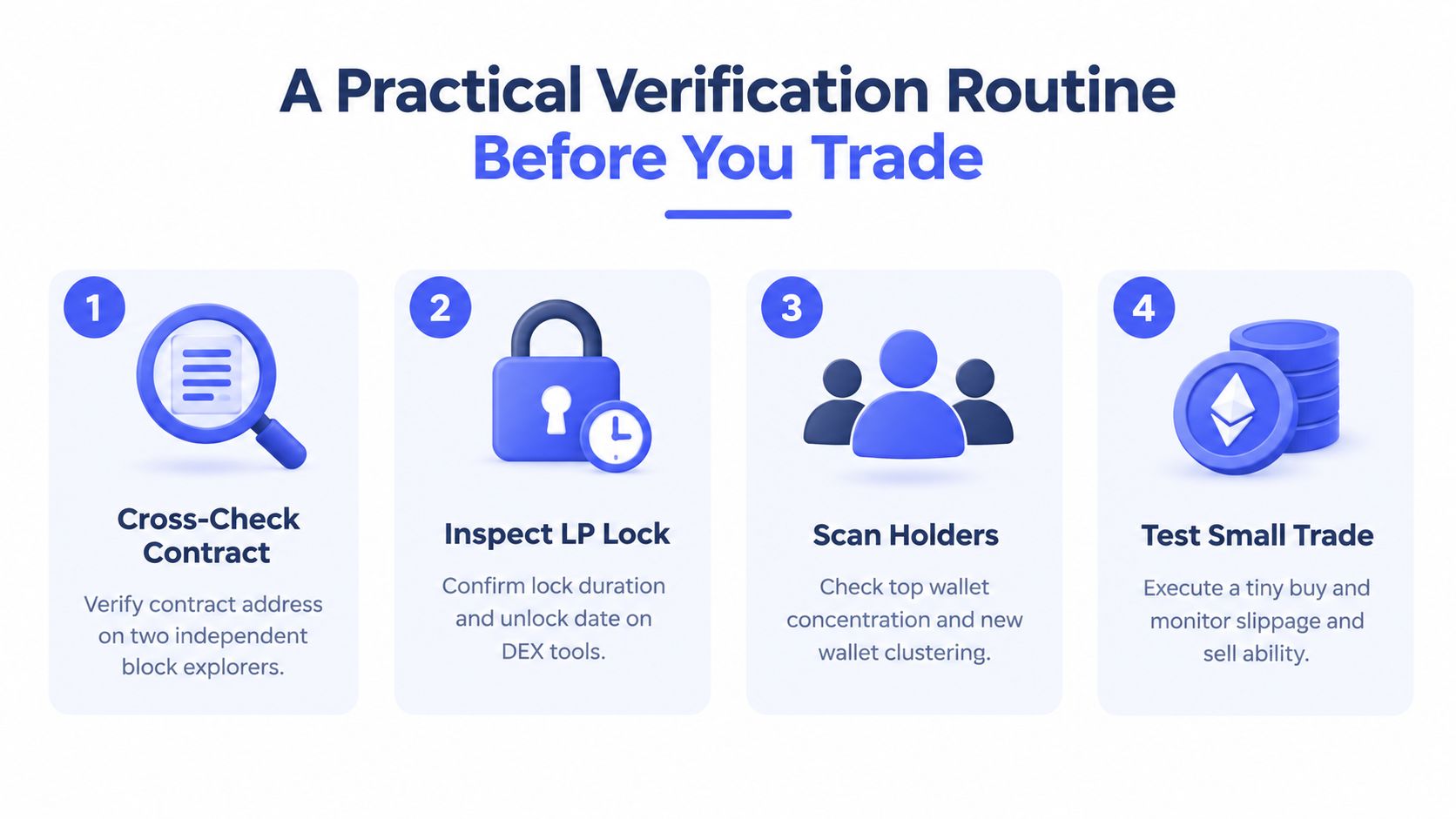
A checker works best as a pre-trade filter. It helps you sort a fast token into “worth a closer look” or “leave it alone” before money leaves your wallet. That is useful for active traders and for anyone who copies wallet activity, because speed makes bad reads expensive.
Cross-check the contract. Open the token address in two independent explorers. Make sure the contract you are reviewing is the one being traded. If the address does not match, stop there.
Inspect the LP lock. Check the lock length and the release date in DEX tools. See who controls the LP tokens, and confirm that the lock covers the pool, not just a small slice of it.
Scan holders. Look for concentration, clustering, and fresh wallets that appear linked. One wallet can sit in the list while the pattern around it says something else.
Test a tiny trade. Buy a small amount, then check whether you can sell. Watch slippage and output closely. If the sell path behaves oddly, do not push ahead.
Wallet-level clustering is one reason this routine matters. In the Chainalysis analysis covered by CoinDesk, a single wallet was linked to 81 possible pump-and-dump schemes and about $830,000 in profit. That kind of pattern is easy to miss if you only look at the token in isolation. CoinDesk on the Chainalysis market-manipulation analysis
For traders who move fast, keep the flow simple. Check the contract, verify the pool, scan the wallets, test the exit. If one step fails, skip the trade. If all four look clean, still size small and keep a cap in place. A clean scan is a read on the setup, not a promise about what happens next.
If you screen meme tokens often, this guide to trade meme coins fits this routine well. If you track addresses across trades, trade crypto wallets helps you keep that review organized without turning it into a full-time job.
Stay In Control While You Screen And Copy
The job is not finding a perfect token. It's keeping control when the setup changes. Fraud losses are large, recovery is hard, and transfers move fast. That makes prevention a process problem, not a hope problem.
Ethereum's official guidance says that an unlimited token allowance lets a smart contract spend all approved tokens, even tokens still in your wallet after you've withdrawn funds from a platform. It also says revoking access is a separate blockchain transaction that costs a network fee. So check the spender, the token, and the current limit before you approve anything. Then revoke unused access when you no longer need it. Ethereum on revoking token access
If you want a broader view of automation risk, this guide from SupportGPT on purchase bots is a practical side read. The same caution applies. Automation helps with speed, but it doesn't remove the need to inspect permissions and keep a hard stop ready.
That's where copyfomo fits for traders who already live on fomo. It mirrors filled entries and exits from traders on the fomo leaderboard into your own wallet at a configured trade size. It's built for non-custodial execution, revocable access, and controls like pause and close. Pairing that with a rug pull checker keeps you from copying blind. For a broader view of tooling, see copy trading tools.
What matters most is discipline. Approve only what you need. Keep your allowance visible. Use a checker before entry, not after regret. Copy trading carries risk, and past performance does not predict results.
If you want faster trade mirroring with clearer control, start with copyfomo on Telegram. It helps you mirror fomo traders without handing over custody, so you can keep using a rug pull checker as your first filter. Visit copyfomo and set up the bot before your next trade.
stop reading. start copying.
pick a trader from the fomo leaderboard, set your size, and the entries and the exits land in your own wallet while you sleep.
open copyfomo on telegram →