Scalping vs Day Trading: Which Strategy Fits Your Schedule
scalping vs day trading compared by edge, capital, and risk. see which strategy fits your time, account size, and risk tolerance.
Scalping and day trading are both intraday strategies, but scalping usually holds for seconds or minutes and may take dozens of trades in one session, while day trading generally holds for minutes to hours and closes everything before the session ends. The core issue isn't speed, it's whether your edge can survive per-trade friction.
| Criterion | Scalping | Day Trading |
|---|---|---|
| Holding time | Seconds to minutes | Minutes to hours |
| Trade count | High turnover, many entries and exits | Fewer positions, more selective |
| Main pressure | Execution quality and costs | Patience and session management |
| Best fit | Fast decisions, tight spreads, low friction | Cleaner setups, broader intraday moves |
Most traders focus on how fast a style looks. That's the wrong lens. The break-even math matters more than the clock. If your signal can't clear fees, spread, slippage, and execution error on every trade, the style breaks down even when the chart looks right. For a broader primer on style selection, trading strategies for beginners gives a useful starting point.
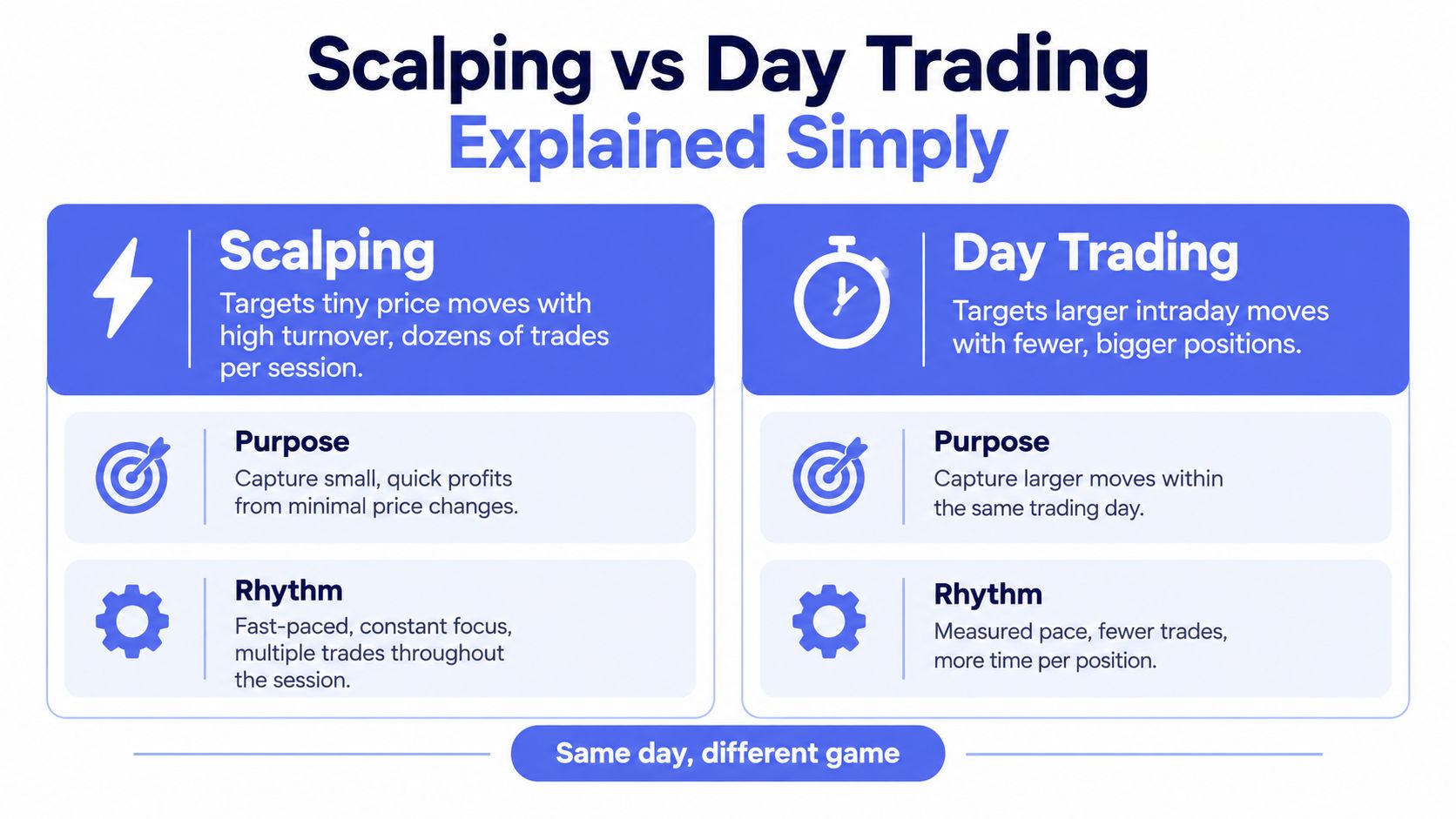
Table of Contents
- Scalping vs Day Trading Explained Simply
- How Scalping and Day Trading Differ by Design
- Why Execution Friction Decides Who Wins
- Which Trader Profile Fits Each Strategy
- Rules and Capital Requirements You Should Know
- Buying Power Constraints and Account Risk
- When Copytrading Makes More Sense Than Manual Trading
- How to Choose Between Scalping and Day Trading
Scalping vs Day Trading Explained Simply
The actual split is not speed. It is whether the trade can pay for itself after every cost is counted. Scalping aims for very small price moves, usually with positions held for seconds or minutes and many trades in a session, while day trading uses fewer positions held for minutes to hours, with all trades closed before the market ends SEC day trading study.
Same day, different break-even math
Both styles stay intraday, so neither carries overnight risk. Both can look similar on a chart. The difference is in the cost stack. Scalping depends on tight spreads, low slippage, and fast fills. A setup that looks profitable on the screen can fail once the round-trip cost takes a bite out of the target. Day trading still pays those costs, but a wider intraday move gives the trade more room to absorb them.
Practical rule: if the target is tiny, execution quality has to be cleaner than the chart signal.
Delay matters more when the profit target is small. A few seconds can change the fill price enough to turn a workable scalp into a loser, which is why understanding market structure matters so much here. In slower day trades, that same delay is often less damaging because the move has more room to develop.
For traders who want a broader starting point, trading strategies for beginners is a useful companion read.
How Scalping and Day Trading Differ by Design
The first difference is turnover. Scalpers keep repeating the same small-cycle process. Enter, manage, exit, reset. Day traders still work intraday, but they can wait for cleaner setups and hold a position long enough for the move to develop. That lowers the number of decisions, but it does not remove the cost of being wrong.
Edge, capital, and behavior
Scalping needs a narrow edge that appears again and again, because every trade has to survive the same friction. Day trading gives more room for a trade to breathe, yet it still depends on discipline. If a trader cannot follow the session plan, the extra holding time just becomes unmanaged risk. For a trader who wants to understand the market context behind those decisions, market structure basics are worth reading.
| Criterion | Scalping | Day Trading |
|---|---|---|
| Trade frequency | Very high | Moderate |
| Expected edge | Tiny but repeated | Larger per trade, fewer attempts |
| Capital pressure | Higher because costs stack fast | Lower friction per decision, still meaningful |
| Risk behavior | Fast losses if execution slips | More room for trade management, still session-bound |
Break-even math is where the difference shows up. Scalping has to beat spread, slippage, and commissions over and over. Day trading can still work with wider intraday moves, because the trade has more room to absorb those costs. The question is not whether a setup looks good on the chart. It is whether the edge survives the round trip.
In the Barber and Odean day trader profitability study, 116 traders, or 35.8%, achieved a net profit after commissions, while 208 traders, or 64.2% recorded a net loss, and only 19.4% earned more than $5,000 the Barber and Odean day trader profitability study. That is the part traders miss when they focus on signal quality alone. The turnover burden becomes harsher when costs hit every entry and exit, and persistence is rare once those costs keep repeating.
Trader's read: more trades do not mean more edge. They often mean more chances to pay the spread.
Why Execution Friction Decides Who Wins
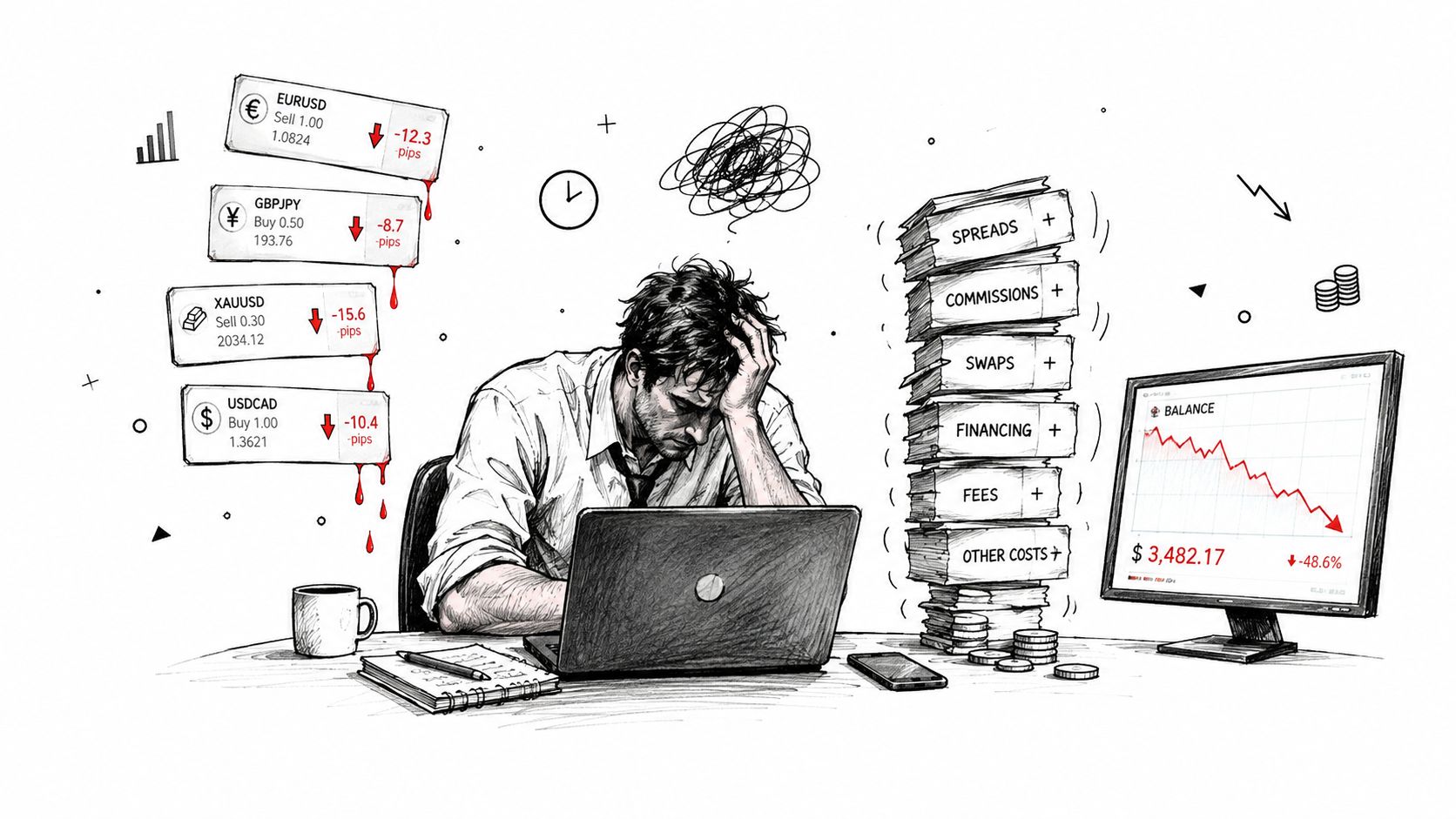
A trader can call direction correctly and still lose money. That happens when the edge is too small to survive the cost stack. Gross edge must beat round-trip fees, spread, expected slippage, and execution error. If it does not, the trade starts out behind FINRA guidance on trading costs.
The break-even problem
Scalping feels clean on the chart and messy in the account. Every entry and exit adds drag. In liquid markets, that drag may stay manageable. When liquidity thins out, the spread widens, fills get worse, and the setup loses room fast.
Day trading can survive wider intraday moves because the trade has more room to absorb costs. Fewer transactions also mean less cumulative friction. That is why a weaker-looking setup can still be the better trade if the positioning is right.
Crypto shows the same problem in sharper form. In thin markets, latency and order quality matter because fills can move away from you before the order is complete. For a closer look at that effect, what slippage is in crypto is worth reading. Short-horizon profit is often an execution problem first, a signal problem second.
Rule of thumb: if a trade only works when everything fills perfectly, it is fragile.
Which Trader Profile Fits Each Strategy
Some traders want action. Some want room to think. The market doesn't reward either personality on its own. It rewards consistency between the trader, the time window, and the cost structure. A fast style suits someone who can sit still, make a decision, and move on. A slower intraday style fits someone who can wait, manage a position, and avoid forcing a second entry out of boredom.
Who usually fits scalping
Scalping suits traders who are comfortable with screen time, fast input, and repeated decision-making. It also suits traders who know their platform well and can stay calm when a setup disappears in seconds. Newer traders often underestimate the mental drag. They see the speed and miss the repetition.
Who usually fits day trading
Day trading usually fits part-time traders better, especially people with jobs, family obligations, or time-zone constraints. It gives more room to review context before entry and more time to manage exits. That said, it still demands attention. The trade has to be closed before the session ends, and the trader has to respect the plan.
A large-scale academic study of day traders found that only a small group showed persistent skill, while most trading activity did not show consistent outperformance Berkeley day trader skill study. That makes the choice structural, not aspirational. Past performance doesn't predict future results, and copy trading carries risk.
If you can't monitor consistently, copying structured traders is often more realistic than forcing a high-frequency style. The main mistake is trying to look active instead of staying aligned with your actual schedule.
Rules and Capital Requirements You Should Know
Intraday trading lives inside a rulebook, and the rulebook changes how the account behaves. In U.S. securities margin accounts, FINRA defines a day trade as buying and selling, or selling and buying, the same security on the same day FINRA's notice 24-13 on day trading. That matters because repeated same-day activity can push an account into pattern day trader status.
The threshold that changes the account
A trader becomes a pattern day trader when they make four or more day trades within five business days, unless those trades are no more than 6% of total trades in that period. The same FINRA notice sets both the definition and the threshold FINRA's notice 24-13 on day trading. That rule is specific. It does not automatically apply to every crypto venue, but it does apply to U.S. margin accounts.
The practical point is simple. A trader who wants repeated intraday entries has to know the account limits before the first order goes in. If the account structure cannot support that pace, the strategy breaks down before skill matters. Scalping is usually the first style to feel that pressure because it depends on repeated execution with little room for friction.
Know the account rules before you build the trade plan.
Buying Power Constraints and Account Risk
Intraday trading hits account limits faster than many traders expect. Under the traditional U.S. pattern-day-trader framework, FINRA permits buying power of up to four times the trader's maintenance-margin excess as of the prior business day's close SEC day trading alert. That figure looks generous until execution slips or size creeps too far.
Once the account crosses the limit, the broker can issue a margin call and restrict activity. During the five-business-day period allowed to meet that call, day-trading buying power is generally cut to two times the maintenance-margin excess. If the call is not met, the account can face a 90-day cash-available restriction.
The actual risk is loss of flexibility. A trader can be right on direction and still lose the ability to use the account the way the strategy requires. Scalping feels this first, because its repeated entries leave little room for friction, slippage, or a rule breach.
These limits do not make intraday trading safe. They set the rails. The trader still has to control size, avoid forcing trades, and respect that faster trading puts more stress on the account.
When Copytrading Makes More Sense Than Manual Trading
Manual intraday trading asks a lot from the trader. It asks for screen time, fast reactions, and clean exits. That's where copy trading can be the more practical route, especially for traders who already follow fomo but can't sit at the chart all day. The point is simple. Structured execution can reduce missed entries, exit lag, and monitoring fatigue.

What structured copying solves
A trader who copies a defined source doesn't need to chase every move manually. The setup matters more than the adrenaline. That's a cleaner fit for time-constrained users, especially when trade timing, slippage awareness, and exit replication matter more than constant discretion. A good overview of the mechanics is copy trading strategies explained, which gives useful context on how disciplined copying differs from blind following.
Why the execution layer matters
The value isn't fantasy alpha. It's reducing operational mistakes. If a trader can't watch the screen, the market still moves. Automation doesn't remove risk, and it doesn't turn past performance into future results. It does, however, make a structured process possible when manual execution keeps breaking down. For a beginner-focused breakdown, copy trading for beginners is the more practical read.
Copy trading still carries risk. It's just a different kind of risk. The trader gives up some control and gains consistency. That trade-off makes sense only if the source trader and the execution quality are worth following.
How to Choose Between Scalping and Day Trading
Start with your schedule. If you can't monitor the market continuously, scalping is usually the wrong fit. If you can watch, react, and stay calm under speed, it may be workable. Then look at your account structure. Margin rules, buying power, and restrictions matter before the first trade, not after.
Next, think about friction tolerance. If every extra spread and fee bothers you, scalping will wear you down fast. If you prefer fewer, cleaner decisions and can hold through a trade's normal noise, day trading is usually more realistic. Both still carry risk, and past performance doesn't predict future results.
If you want the shortest decision tree possible, use this:
- Low time, low patience: don't force scalping.
- Moderate time, stronger patience: day trading is usually the better fit.
- No desire to babysit entries and exits: structured copying is often the cleaner route.
Intraday trading is high risk either way. The difference is whether your process can survive costs, account rules, and execution pressure. If you want a more structured way to follow traders on fomo without staring at the screen all day, visit copyfomo and start the bot on Telegram. It's built for traders who want fast, transparent copying without turning every session into manual babysitting.
stop reading. start copying.
pick a trader from the fomo leaderboard, set your size, and the entries and the exits land in your own wallet while you sleep.
open copyfomo on telegram →