Copy Trading Risks That Change Your Fill
copy trading risks stay with you after the bot copies a fill. market moves, slippage, allowances, and late exits can still lose money.

Picking the top trader isn't the hard part. That's the popular advice, and it's mostly wrong. The hard part starts after your swap fires. You don't get the leader's fill. You get a second fill, at a later time, in a pool the leader already moved. Copy Trading Risks live in that gap. Treat the gap as the product. The rank is just the label on it.
Table of Contents
- Copy Trading Risks Start After the Fill
- Market Risk the Leaderboard Cannot Remove
- Latency Slippage and Thin Liquidity
- Allowance Risk After You Stay Non-Custodial
- When Copied Results Drift From the Source
- Controls That Limit Copy Trading Losses
- What to Do Before You Mirror a Trader
Copy Trading Risks Start After the Fill
A leaderboard doesn't transfer anything to you. It records what already happened to someone else. A rank on fomo is a history of filled trades over a past window. Your copy is a new order. Different time. Different price. Different size, set by you, into whatever liquidity remains.
Say it plainly. Copy trading carries risk. Past performance does not predict results. Automation doesn't change either sentence. It only changes how fast you take the risk.
What the Rank Actually Proves
A Carnegie Mellon study of social trading found that copying top-ranked leaders did not produce substantial investment profits. Some portfolios were profitable for one week. Then PnL fell and turned negative.
The tail was worse. In one result from that study, the bottom 25% of portfolios promoted to Gold lost more than USD 15,000 within ten days of promotion. Promotion followed good performance. Losses followed promotion. That's the pattern to respect.
Translate that on chain. A trader prints a strong week on filled swaps. Followers arrive after the fact. They copy the next trades, not the ones that built the rank. If the window shifts, the follower owns the new window at follower prices.
A profitable leaderboard row is evidence of previous fills. It isn't a forecast, a guarantee, or a risk control.
The Risk Stack
Five separate problems stack on top of each other. Don't merge them.
- Market drawdown: the token and the tape move against both of you.
- Execution gap: your fill lands later, at a different pool state.
- Permission surface: the allowance you granted keeps working after you stop watching.
- Behavior: a visible rank pulls size in at the worst moment.
- Missing controls: no cap, no skip rule, no kill switch turns a bad copy into a bad book.
Each layer needs its own answer. Speed answers one layer partway. It answers none of the others. A bot that mirrors entries and exits shrinks missed-trade risk. It does not shrink the market. Read the rest with that split in mind. Some gaps can be narrowed. Some can only be capped.
Market Risk the Leaderboard Cannot Remove
Start with the base rate. Most retail crypto traders lost money before copy trading entered the picture. A Bank for International Settlements study of exchange app activity across 95 countries, covering August 2015 through December 2022, found that approximately 73% to 81% of retail investors likely lost money on their initial crypto investment as prices declined.
The modeled loss wasn't trivial. The BIS estimated the median investor lost about $431 by December 2022, nearly half of roughly $900 invested under its monthly purchase pattern. If users kept investing monthly, more than four fifths would have lost money. Persistence didn't fix the base rate. It extended exposure to it.
The flow pattern matters too. During stress episodes like the Terra/Luna collapse and the FTX bankruptcy, larger investors tended to sell. Smaller retail investors bought. Copy a buy into that kind of tape and you're reproducing a trade. You're also taking the other side of whoever's exiting.
Volatility and a Market That Can Vanish
The SEC investor alert on crypto asset securities warns these assets may be exceptionally volatile and speculative, with volatility and illiquidity as significant risks. It also says a market for a particular asset may disappear. The asset may stop being tradable anywhere.
The same alert names technical glitches, hacking, malware, fraud, default, and mistakes as risks that can leave an investor unable to be made whole. None of that cares who you copied.
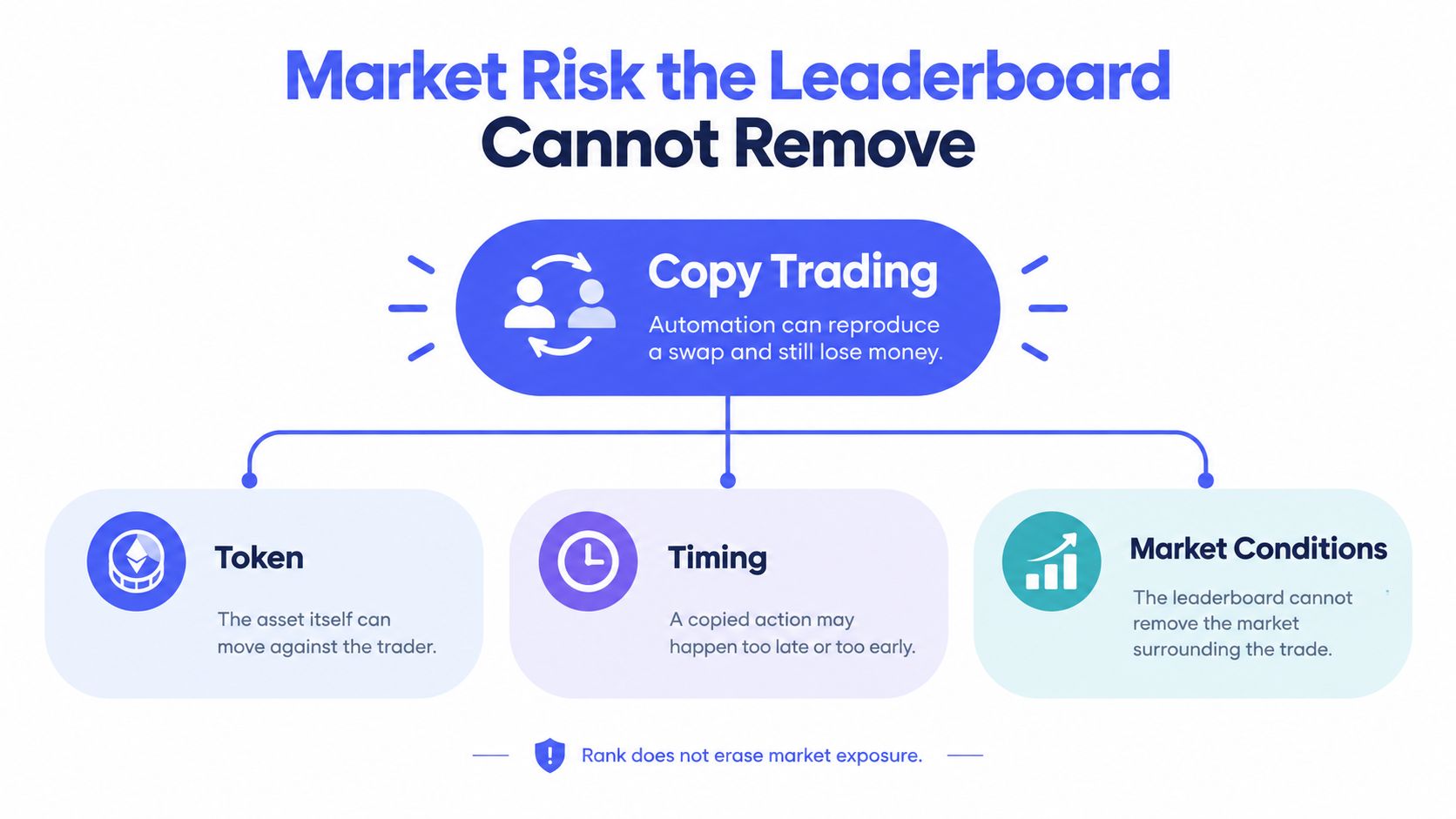
Think of it in three parts.
- Token risk: the asset itself drops, fast and far.
- Timing risk: your copy lands after the move that made the trade attractive.
- Market risk: the whole tape sells off and drags thin tokens with it.
A copied buy during a sharp move is still that token's risk. Holding your own wallet doesn't insure the position. Non-custodial control answers who holds the assets. It says nothing about what the assets do next.
Sizing is the only honest response at this layer. Expect drawdowns as the normal case, not the exception. Size like the base rate applies to you.
Latency Slippage and Thin Liquidity
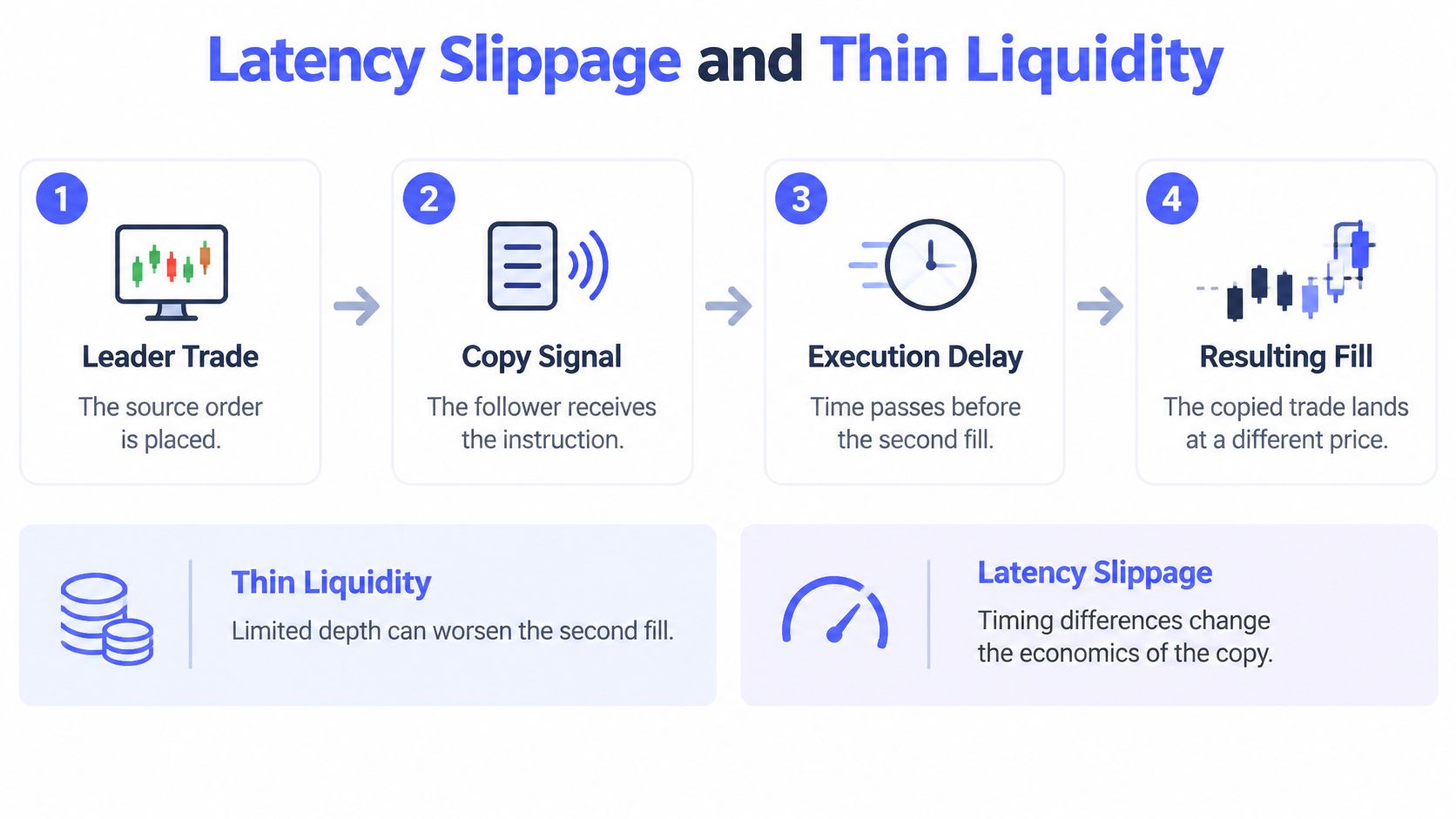
Your trade isn't the leader's trade with a delay added. It's a separate swap with its own economics. IOSCO's 2025 report on copy trading identifies timing and pricing as core risks. Followers enter after the lead trader. Their collective buying can push prices higher. Later exits can print lower.
On chain it's harsher. A lag of about one second can span blocks or mempool events. The leader's swap already changed the pool state. Your swap arrives to different liquidity, different price impact, and added fees. Add possible failed transactions and sandwich or other MEV exposure. The leader's realized PnL isn't your expected PnL.
The diagram below shows the sequence. Each step is a place where price leaks.
Track the Second Fill, Not the First
Record every copy as its own event. You need these fields before you can judge anything.
- Source timestamp and follower timestamp: the actual gap, not the advertised one.
- Quoted price versus executed price: what you saw against what you paid.
- Token amount and displayed slippage: how much the pool moved against you.
- Liquidity at execution: whether the pool could absorb your size.
- Failed or partial fills: copies that never landed or landed incomplete.
If you don't know what slippage means for your executed price, fix that before copying anything. A live feed showing slippage makes the gap visible. Visibility isn't the same as matching fills.
The short video below is worth watching before you set any tolerance. Thin pools punish forced trades.
Skip Rules Beat Forced Copies
Set a hard maximum slippage threshold. Pair it with a minimum liquidity rule. If either fails, skip the copy. Don't widen tolerance mid trade to make it land.
Fixed ticket sizing caps what one bad fill can do. Proportional sizing can amplify losses when the source trades a size the pool can't support at your scale. Their size is calibrated to their book. Not yours.
Exits carry the same risk in reverse. A delayed or failed sell leaves you in after the source is out. Frequent trading costs then grind what's left. Judge results net of costs, per fill. Leaderboard PnL is gross of your problem.
Allowance Risk After You Stay Non-Custodial
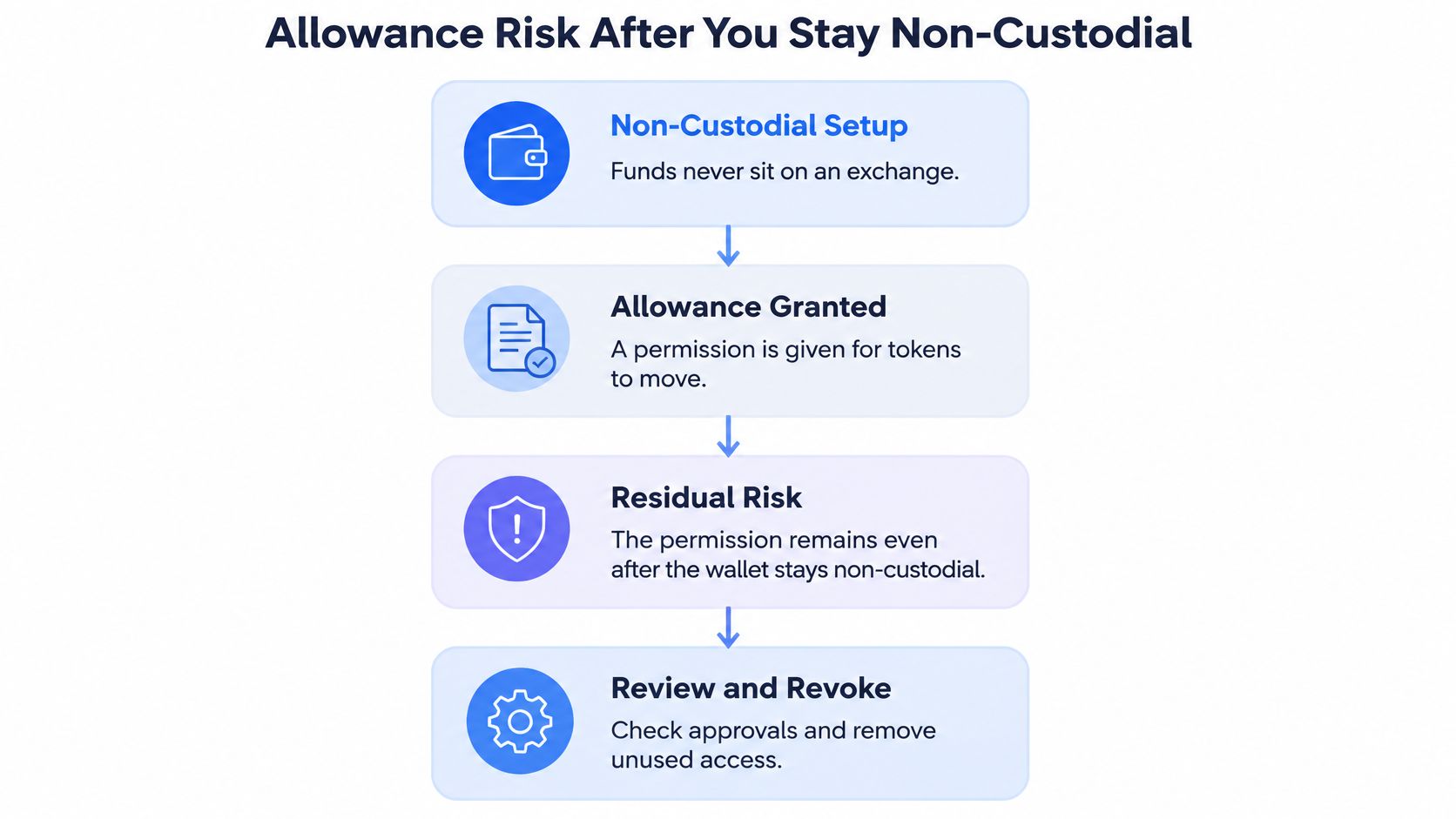
Non-custodial doesn't mean safe. It means your funds don't sit with a platform. The risk moves. It doesn't leave.
A copy tool that can't withdraw still needs permission to swap. That permission is the exposure. Ask three questions. What can the approved contract or router do. For how long. How fast can you revoke it if the system, the front end, or a dependency gets compromised.
Cannot Withdraw Is Not Cannot Cause a Loss
An unlimited allowance lets an approved contract spend up to your full token balance. A wrong token approval grants access you never meant to give. A compromised or buggy router can route your allowance into an unwanted swap. You keep custody the whole time. You still lose money.
The surrounding environment is hostile. 2025 reporting on phishing and DeFi approval abuse cited an estimate of approximately $410.7 million lost across 132 phishing incidents in the first half of the year. Separate 2025 reporting in the same piece said only 10.8% of users regularly checked unused wallet approvals.
Read those two numbers together. Revocation tools exist, but many users don't use them. An allowance you forget is an allowance that waits.
Permission rule: before raising size, confirm you can revoke the allowance yourself, from your own wallet, without asking anyone.
Demand these controls before you scale.
- Bounded or exact spend allowances: approve what's needed, with an expiration where possible.
- Verified contract and chain: confirm you're approving the right address on the right network.
- Regular allowance checks: audit approvals on a schedule, not after an incident.
- One tap pause: stop new copies immediately.
- Independent revocation: pull permission in the wallet itself.
- Defined close procedure: know how open mirrored positions get closed if copies stop.
The Fraud Boundary
The CFTC and SEC guidance on digital asset fraud treats promises of high guaranteed returns and claims of little or no risk as red flags. Apply that test to any copy service. A leaderboard display doesn't prove a service is legitimate. Automation framed as risk free is a warning, not a feature.
Keeping assets in your wallet cuts custody exposure. Contract risk, token risk, and fraud risk remain. If you're weighing how a DeFi trading bot handles wallet permissions, read the approval screen before you read the marketing. The approval is the agreement.
When Copied Results Drift From the Source
Drift isn't bad luck. It's the default outcome when behavior and execution compound. An experimental financial market study on copy trading and risk taking found that merely showing participants other traders' success significantly increased risk taking. The increase grew larger when participants could copy those traders directly. The researchers linked copy trading to excessive risk taking and reduced ex-ante welfare.
Now put that on a leaderboard. Realized PnL is backward looking. It doesn't show current concentration. It doesn't show liquidity exposure, holding time, or whether the result came from a handful of volatile bets. A temporary tail outcome looks like skill. It attracts size at exactly the wrong moment.
The Arithmetic of a Later Order
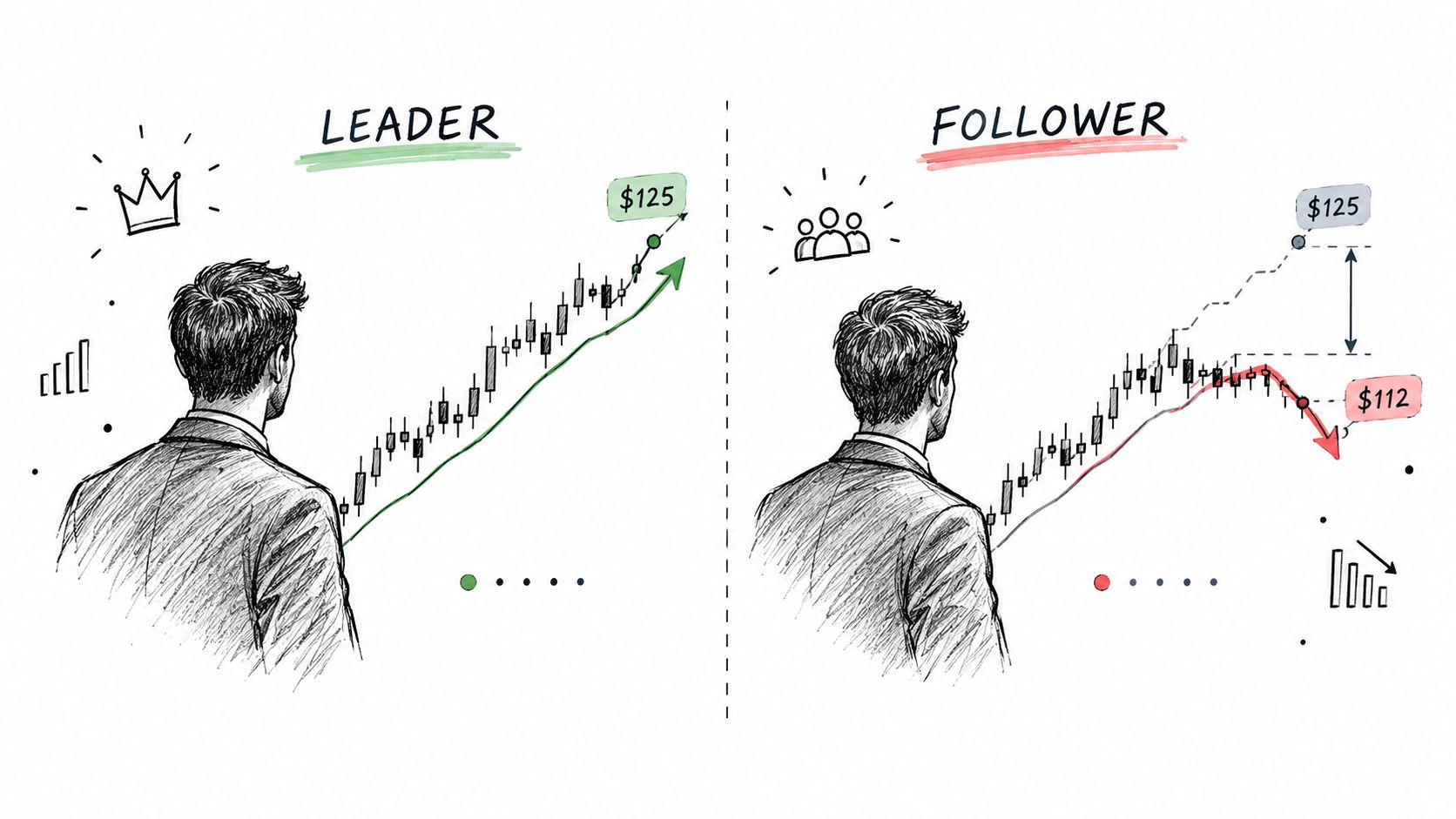
The source fills first. Your system detects it, sizes a separate order, and routes it. A copy trading platform comparison of follower execution costs gives a scale check from foreign exchange. Latency on liquid pairs can cost about half a pip. A strategy targeting 3 to 5 pips per trade could lose 20% to 30% of its edge from latency alone, before spread.
Followers also pay their own spread, commissions, or taker fees. Those figures come from a platform comparison, not a regulator. Treat them as an illustration of shape, not a crypto quote. The shape holds on chain. Your fill, your slippage, your failed exit. That's your result. The source wallet's price isn't.
A Wider Retail Warning
ESMA reported in its product intervention analysis on CFD trading losses that 74% to 89% of retail investor accounts lost money trading CFDs, with average losses per investor ranging from €1,600 to €29,000. Spot token copies aren't CFDs. Don't conflate them.
The warning still applies. Repeated short term trading, compounding costs, and small adverse moves produce losing accounts at scale. Borrowed funds made it worse there. Frequency and fees do similar work here.
So treat a hot rank as a prompt, not a trigger. Check drawdown. Check how concentrated the profits are. Check turnover. Then decide whether to watch longer instead of sizing up.
Controls That Limit Copy Trading Losses
Match each risk to one control. If a risk has no control, cap the size until it does. This table is the whole argument in one place.
| Risk | What changes your result | Control |
|---|---|---|
| Market drawdown | Token and tape fall after your copy lands | Per trade cap plus a book level daily loss limit |
| Latency and slippage | Pool state shifts before your swap executes | Maximum slippage skip rule |
| Thin liquidity | Your size moves the price against you | Minimum liquidity skip rule |
| Oversized proportional copy | Source size exceeds what the pool absorbs | Fixed ticket size with a hard cap |
| Missed exit | Source sells, your position stays open | Exit mirroring on sells, not entries only |
| Stuck open position | Failed exit or vanishing liquidity | Pause control plus one tap close |
| Allowance abuse | Approved contract spends beyond intent | Bounded, revocable allowance you can pull |
| Rank chasing | Size goes up after a hot window ends | Small starter size, more than one trader, drawdown review |
Where One Concrete Option Fits
copyfomo is a Telegram bot that mirrors filled buys and sells from traders ranked on the fomo leaderboard into your own wallet. You set the size, fixed or proportional, with optional per trade caps. Funds stay in your wallet under a spending allowance the service can't use to withdraw. You can revoke it.
Execution runs on chain about a second behind the source. A live feed shows timestamps and displayed slippage per copied trade. Pause stops new copies. An optional one tap close can shut open mirrored positions.
That design addresses specific rows in the table. Missed exits. Custody worry. Unattended hours. It doesn't touch other rows. Token volatility stays. MEV stays. A careless allowance stays your problem. A leader whose past PnL doesn't repeat stays your problem too.
Use public pages for context, not conviction. The /traders/ pages and /data metrics show activity and history. Existing /blog posts cover mechanics. None of it converts a rank into an outcome. Controls limit damage. They don't manufacture edge.
What to Do Before You Mirror a Trader
Decide before you open Telegram. Copy trading carries risk. A fomo rank is a history of filled trades, not a prediction. If that sentence gives you pause, don't copy yet.
Run the Pre Flight Check
Work through this list in order. Don't skip to the trader pick.
- Set a loss budget: pick a total amount you can lose without changing your plans.
- Cap each trade: one bad fill shouldn't decide your week.
- Start with a fixed ticket: hold off on proportional sizing until you've watched your own slippage across real copies.
- Verify the allowance: confirm it's bounded and revocable from your wallet.
- Rehearse the stop: find pause and close before you need them.
- Judge the trader properly: drawdown, turnover, holding time, and profit concentration over one headline PnL figure.
A tracker helps with step six. If you're deciding which wallet tracker fits your review process, use it to study history and concentration. Not to chase the latest entry.
Size is the decision. The trader pick is secondary. Get size wrong and a decent trader still hurts you.
Yes, a bot can open and exit at your preset size while you sleep. That solves attendance. You still own the market move and the fill. If an exit fails or liquidity vanishes, the plan is the kill switch and a manual close. Hope isn't a step.
When you're ready, there's one next step. Start the bot on Telegram via the bot start page. Setup and daily control run through the bot. Public trader and data pages are there to inspect activity, not to promise a result.
If you want entries and exits mirrored into your own wallet at a size you set, with per trade slippage shown and a pause control in reach, that's what the bot is built for. The market risk stays yours, so start small and watch your own fills first. Set it up through copyfomo and run the controls before you run the size.
stop reading. start copying.
pick a trader from the fomo leaderboard, set your size, and the entries and the exits land in your own wallet while you sleep.
open copyfomo on telegram →