Best Wallet Tracker for Safer Copy Trading
find the best wallet tracker by latency, allowances, exits, and custody. non-custodial copy trading still carries risk; past results do not predict future ones.
A holdings page is not a best wallet tracker. Chain count and a smooth chart do not tell you whether a wallet's filled history can be followed, or whether a standing approval can still move tokens.
Traders who already use fomo are not short of screens. They want less time on them without handing a custodian the keys. Copy trading carries risk. Past performance does not predict results. Nothing below is a profit promise, and a leaderboard rank is not a reason to buy a token.
Table of Contents
- What the Best Wallet Tracker Has to Show
- Criteria That Separate Tracking from Guesswork
- Comparing Trackers for Copy Trading Decisions
- Allowances Privacy and What You Still Control
- Wallet Tracking Use Cases That Change the Choice
- Running a Non-Custodial Mirror Without Guesswork
- Choosing a Wallet Tracker and Starting on Telegram
What the Best Wallet Tracker Has to Show
Popular roundups score polish. They ask how many networks load, how pretty the PnL line looks, and whether the token list is complete. That is the wrong test if the job is copying.
A balance answers what appears to sit in an address. It does not separate a filled swap from a transfer, an airdrop, dust, or a one-off send. It does not show whether the exit filled. It does not show who still has permission to spend. A wallet can look active, and even profitable on a chart, while the path that produced the chart cannot be mirrored.
The useful shift is from watching holdings to judging filled entries and exits, their timing, and the permissions around them. Timing matters because a fill you notice late is a story. Permissions matter because the address that looks rich may already have granted a spender the right to move tokens.
Ownership growth is context for that sorting job, not a user count for trackers. Triple-A estimated 562 million people owned digital currencies in 2024, versus 420 million in 2023, an increase of about 33.8%, or roughly 6.8% of the world's population, as reported by Kitco on that global estimate. The same estimate cited a 99% compound annual growth rate in ownership from 2018 through 2023, against about 8% for traditional payment methods. That figure is owners, not addresses, and not people running a tracker. It does mean dormant holdings and one-off transfers now sit beside wallets that trade, across many markets.
If you already know fomo, the point of automation is fewer hours on the leaderboard while funds stay in your wallet. A plain guide to understanding cryptocurrency wallets is worth reading before you treat an exchange balance and a self-custody address as the same thing.
The jobs a followable feed has to pass
Event visibility. The filled trade shows up soon enough to matter.
Exit coverage. Sells are in the history, not only buys.
Allowance scope. You can see what a spender may still move.
Displayed slippage. Execution quality is on the screen.
Custody. Funds remain in your wallet, under a permission you can revoke.
Copy trading can lose money on bad fills as easily as it can match a good stretch. A past run does not predict the next one.
Criteria That Separate Tracking from Guesswork
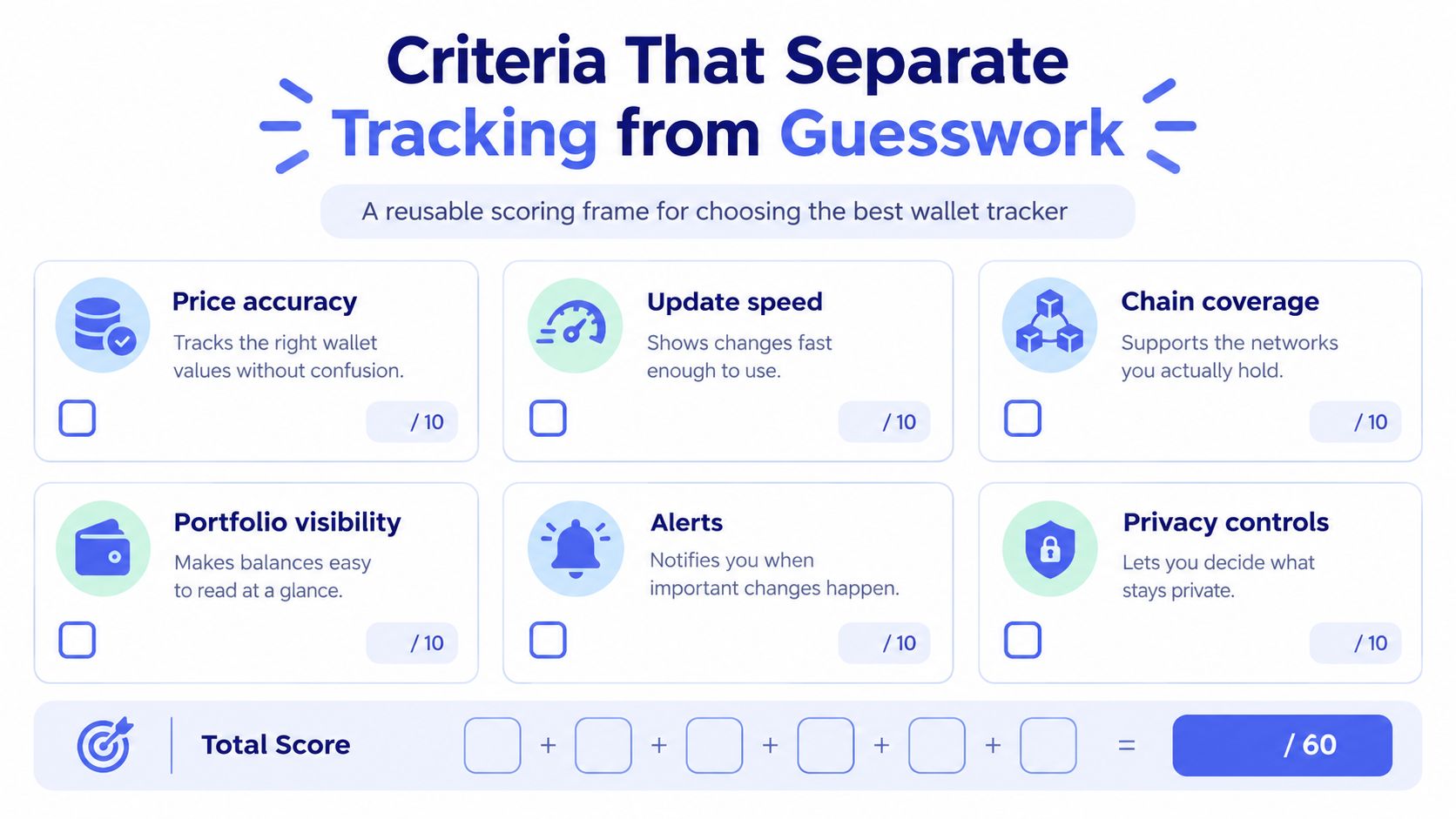
Score the feed by what you can decide from it. Dashboard speed is not the metric. Event-to-visibility latency is the gap between a block being seen by an RPC and the first moment the wallet API returns that transaction hash. A neutral benchmark treats transactions still missing after 120 seconds as failures. One published Base result put a leading p50 near 1.5 seconds, while provider head lag in a separate trading-data look ranged from roughly 707 milliseconds to more than 12 seconds, as summarized on OpenChainBench's indexing freshness benchmark. Compare p50, p95, p99, and missed events on cold wallets and new addresses. Warm-cache tests overstate speed.
What the history has to separate
Realized versus unrealized. A closed result is not an open bag.
Filled swaps versus noise. Pull out transfers, liquidity moves, airdrops, dust, and failed swaps before you treat a number as skill.
Both sides. Entries without exits are half a trade.
Slippage on the fill. The gap between the price you expected and the price you got is part of whether a copy was executable. The mechanics are laid out in this note on what slippage means in crypto.
Label confidence and regimes. A wallet tag you cannot trust, or a hot streak from one market, is a weak model.
People who study research for event-driven trading already treat the event, not the end-of-day balance, as the unit of work. The same habit belongs here.
Privacy as control of movement
A custodial balance view is not the same as a non-custodial allowance. Privacy, for this job, means who can move funds. A tracker can be right about holdings and still fail the question that matters: can an existing permission drain tokens?
Retail losses make that concrete. In 2025 the average phishing loss was reported at roughly $790, while large incidents became less frequent, per this TradingView recap of the year's phishing data. Smaller, repeated hits matter more to an ordinary wallet than a whale headline.
A high displayed return is the least reliable model when it depends on transfers, illiquid tokens, or positions that never closed.
Personal checklist: speed you can measure, filled-trade quality, both sides of the trade, allowance scope, and control you can revoke.
Comparing Trackers for Copy Trading Decisions
Three approaches decide different things. Pick by the decision, not by how many charts the product draws.
| Decision point | Balance tracker | Allowance-aware tracker | Non-custodial mirror |
|---|---|---|---|
| What you see | Assets, transfers, a history of movement | Holdings plus spender, scope, and revocation | Filled entries and exits you chose to mirror |
| Who acts | You, after you notice | You, after you audit permissions | The mirror, at a size you set |
| Exits | Often missing as a distinct event | Not the job | Copied with the entries |
| Funds | Stay where they already are | Stay in your wallet | Stay in your wallet under a revocable allowance |
| What it will not do | Place the trade | Place the exit for you | Withdraw your funds |
Where each row changes the choice
A balance tracker is enough when you only need assets and a transaction list. You still confirm every swap. Miss the sell, and the copy is only half done.
An allowance-aware tracker adds the spender, the scope, and a path to revoke. That closes a real hole. It still may not copy exits, so the trading job remains manual.
A non-custodial mirror is the third job. That is where copyfomo sits. It is a Telegram bot that mirrors filled entries and exits from traders ranked on the fomo leaderboard by realized PnL based on filled trades. You set the size. Funds stay in your wallet through a spending allowance you can revoke.
What you get is user-facing, not a tour of internals. Execution lands about a second behind the source trader. A live feed shows timestamps and displayed slippage. You do not confirm each swap. The service is not affiliated with listed traders. It uses public on-chain data and the fomo leaderboard.
Exits are copied, not only entries. The service cannot withdraw funds.
That line is the split from tools that ping you on a buy and leave the sell to you. It is not a claim that the next stretch matches the last. Copy trading carries risk either way. A mirror will also copy a bad fill.
Do not read this table as a ranking of other bots. If your need is a balance, stay with a balance view. If your need is unattended copying of both sides, the mirror row is the one that decides it.
Allowances Privacy and What You Still Control
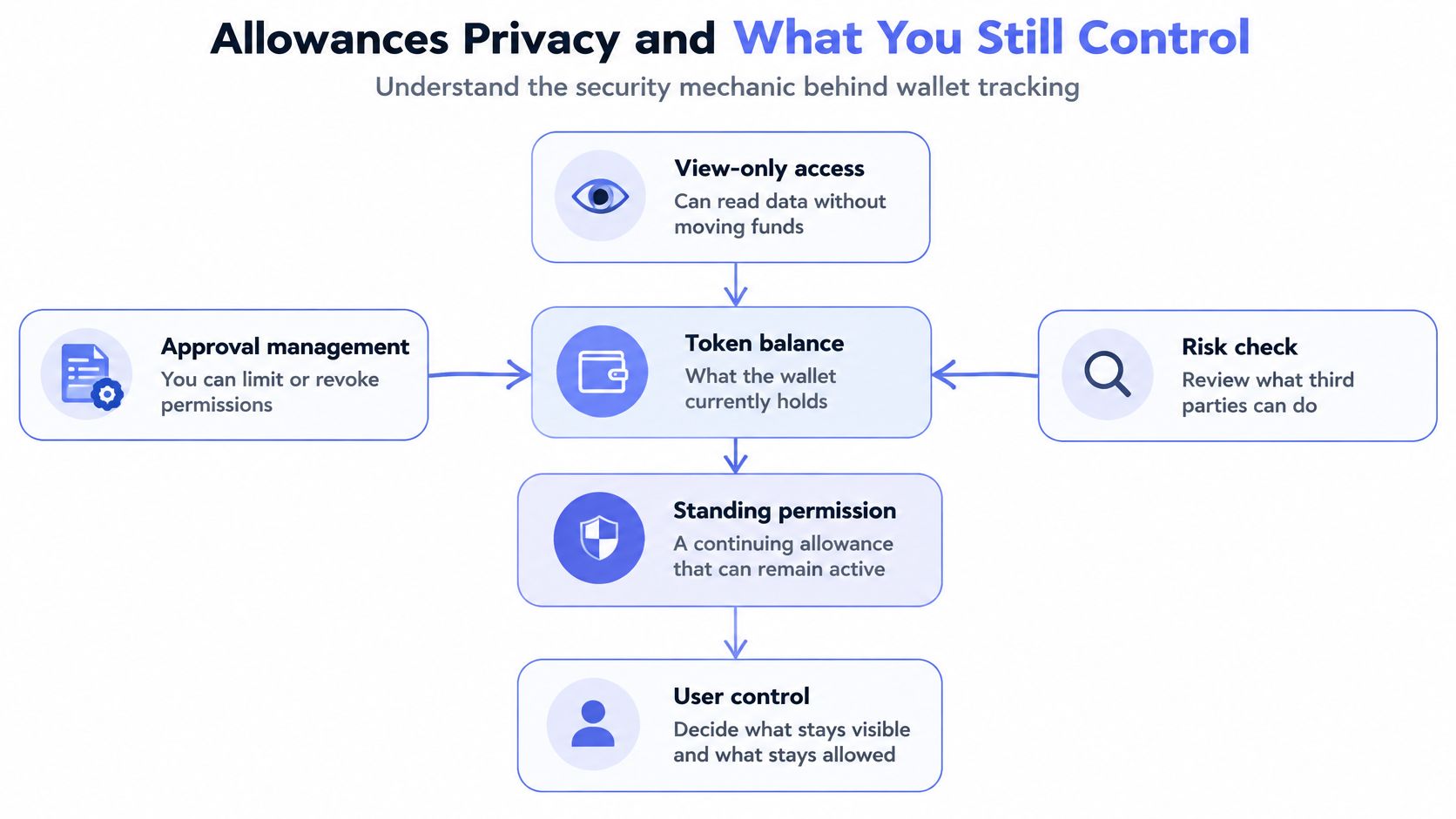
A token balance is what the wallet holds. A standing permission is something else. An ERC-20 allowance lets a named spender withdraw up to a set amount. Calling approval again replaces the old value with the new one. The permission stays active until it is used up or set to zero, which is the model described in the ERC-20 standard on ethereum.org.
Revoking means another on-chain transaction, usually a new approval with value zero. It is not a toggle inside an app. Until that transaction lands, the spender's remaining room is still there, as Fordefi's revoke-allowance notes spell out. Security write-ups such as this allowance primer make the same point: short-lived or tightly capped approvals shrink what a bad spender can do.
What the screen should list
Spender address. The contract or bot allowed to move the token.
Current allowance and utilization. What was granted, and how much is already used.
Approval transaction and age. When it was granted, so an old unlimited approval does not hide.
Not ownership. An allowance is not custody and not your balance.
What you still control on a mirror
On copyfomo the user-facing controls are the allowance, a fixed ticket or a proportional size, and an optional per-trade cap. A kill switch pauses new copies. You can also close open mirrored positions in one tap.
Pausing new copies does not revoke the allowance. If you want the spender stopped, you still send the zero-approval transaction. Narrow caps cut blast radius versus an unlimited approval. None of that removes trading risk. A tight cap can still buy a token that falls.
Headline phishing totals are smaller than they were, and the risk has not vanished. Scam Sniffer reported about $83.85 million stolen from 106,106 victims in 2025, and Permit and Permit2 approvals accounted for 38% of losses in cases over $1 million, according to Scam Sniffer's 2025 loss note. Spender visibility matters because ordinary wallets, not only large ones, sit on old approvals. Privacy here means funds stay in your wallet and permissions can be revoked. It does not mean anonymity.
Wallet Tracking Use Cases That Change the Choice
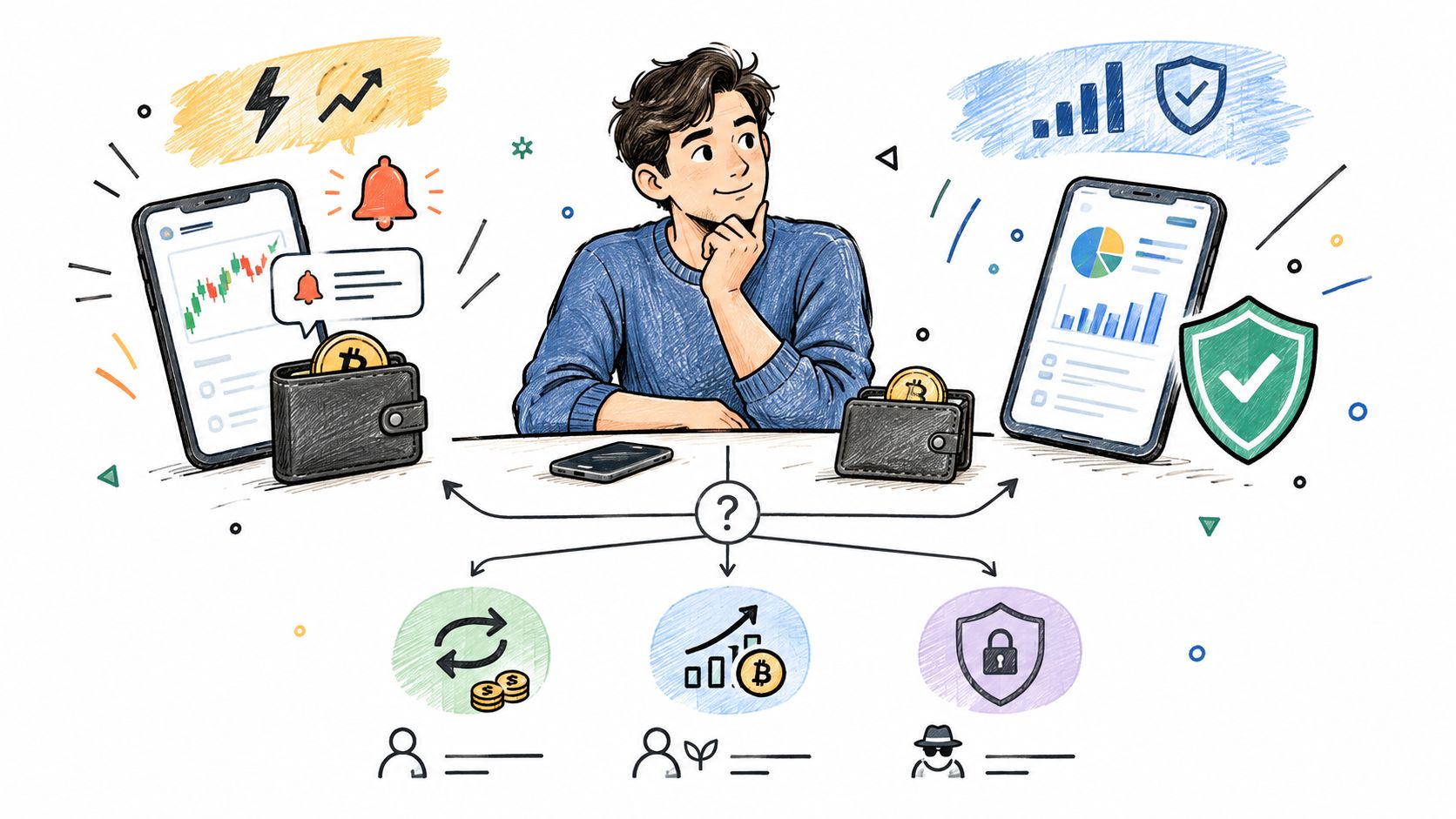
The same feed is the wrong tool for different hours of the day. Match the situation to the criterion that breaks.
You sleep across time zones. The job is unattended mirroring at a preset size so an entry is not missed because you were offline. Automation also copies bad fills. That is the risk, not a side note. A balance page will not open the trade while you sleep.
You are tired of leaderboard pings. The job is background execution, not another notification you confirm by hand. If you still want to tap every swap, you do not want a mirror.
You copied buys and missed sells. The job is exit mirroring. A tool that only opens positions leaves you managing the part that usually decides the result. The broader pattern is covered in this look at copy trading in crypto.
You will not deposit into a third-party wallet. The job is an allowance you can cap and later revoke. Custody stays with you. A pause button is not that revocation.
You are newer and following experienced traders. The job is watching filled activity, not treating a rank as advice to buy a token. A leaderboard is a list of past filled results. It is not a recommendation.
You trade from the data. The job is whether the displayed result was executable after fees and slippage. The highest number on a board can come from transfers, illiquid tokens, or positions that are still open.
A handle or a profile screenshot is enough, on the user side, to follow a fomo trader outside the top 100. You do not need a different product for that. You still judge the fills, not the rank.
The clip below is a plain walkthrough of why allowances surprise people who thought a balance was the whole story.
Running a Non-Custodial Mirror Without Guesswork
Setup is a short sequence. Skip a step and you are guessing again.
- Open the bot. Control sits in Telegram, including ongoing operation through the bot.
- Pick traders. Use the public fomo leaderboard, ranked by realized PnL on filled trades, or point at an address from a handle or a profile screenshot when the trader is outside the top 100.
- Set size. Fixed ticket or proportional to the source. Add a per-trade cap if you want a hard ceiling.
- Grant a spending allowance. You can revoke it later with an on-chain approval of zero. Until you do, the cap you set is the room the spender has.
Self-custody across chains is a separate habit from copying, but the same rule applies: funds should stay in a wallet you control. Gem Wallet's Mayan integration is a useful read on moving assets yourself instead of parking them with an intermediary.
What you watch after it is running
Pause new copies when you want the mirror quiet. That pause does not revoke the allowance. Optionally close open mirrored positions in one tap. Read the live feed. Each mirrored swap shows a timestamp and displayed slippage.
Slippage is the difference between the expected price and the price received. Volatility and thin liquidity widen it. A configured limit can revert the swap if the gap is too wide. It does not remove trading risk. The definition is the one used in Merchant Moe's note on price impact and slippage.
Execution is about one second behind the source and is built to run while you are offline. You are not in the loop for each confirm.
Documentation and the public dataroom list operating figures such as TVL and buyback numbers. Read those pages for the current figures rather than treating a recap as a forecast. If cashback appears there, call it cashback. It is not a return, and it is not a reason to size up.
Pre-flight check: size cap set, allowance understood, kill switch located, slippage visible after each copy.
No token on a leaderboard is a buy recommendation. A fast mirror of a bad trader is still a bad trade.
Choosing a Wallet Tracker and Starting on Telegram
Stay with a balance tracker if you only need holdings and history. Add allowance visibility if automation, or old spenders, are already in scope. Use a non-custodial mirror when you want unattended copying of filled entries and exits with funds left in your wallet.
copyfomo is built for that last job. You run it from Telegram, pick traders from a leaderboard ranked by realized PnL on filled trades, set size, and get exits as well as entries. The live feed shows slippage. Allowances are revocable. The service cannot withdraw funds. A pause is not the same thing as revocation.
Copy trading carries risk. Past performance does not predict results. This is not risk-free, and it is not a path to guaranteed gains.
If you want the operating detail before you start, read the notes on a Telegram bot for trading, then check trader pages and the data section on the same site. Do not outsource the allowance check to a screenshot.
copyfomo mirrors filled entries and exits from fomo leaderboard traders into your own wallet, at a size you set, while a revocable allowance keeps withdrawal power with you. That is the wallet-tracking job this piece scores: copyable fills, visible slippage, and permissions you can shut off. Start the bot on Telegram at copyfomo.
stop reading. start copying.
pick a trader from the fomo leaderboard, set your size, and the entries and the exits land in your own wallet while you sleep.
open copyfomo on telegram →