Crypto Trading Bot Free Options and Real Costs
evaluating a crypto trading bot free option requires checking hidden fees and security risks. learn what to expect before connecting your wallet.

The popular advice is simple: find a crypto trading bot free of monthly charges and let it run. That advice misses the important costs. Exchange fees, slippage, restricted features, slow execution, wallet permissions, and scam exposure can matter more than the subscription price.
Free automation can be useful for testing. It isn't automatically cheap, safe, or suitable for live funds. Copy trading carries risk, and past performance does not predict results. Judge a bot by its execution model, custody structure, permission scope, and reporting, not by the word “free” on its landing page.
Table of Contents
- The True Cost of Free Crypto Trading Bots
- Market Adoption and Capital Concentration
- Hidden Fees and Execution Tradeoffs
- Security Risks and Custody Models
- Evaluating Automation and Execution Speed
- Operating a Non-Custodial Telegram Bot
- Final Evaluation and Next Steps
The True Cost of Free Crypto Trading Bots
A free bot usually means no monthly software subscription. It doesn't mean no trading cost. You still pay normal exchange fees, accept market slippage, and deal with the limits imposed by the free tier. Some providers restrict trade size, strategy complexity, automation frequency, or access to advanced execution settings. Independent coverage of free crypto trading bots highlights this distinction clearly.
The cost becomes harder to see when a strategy trades often. A small fee on every transaction can become a serious drag when the bot repeatedly enters, exits, or rebalances. Thin liquidity creates another problem. The quoted price may look acceptable, but the actual fill can be worse once the order reaches the market.
Security is the other price. A free tool may ask for an exchange API key, wallet approval, or permission to activate a strategy. That request can be legitimate, but it creates an operational risk that monthly pricing has nothing to do with. A bot that can't explain what it can access shouldn't receive access to funds.
Practical rule: Treat “free” as a pricing description, not a risk assessment.
The right question is whether the complete setup is economical and controllable. Check the exchange fee schedule. Estimate likely slippage. Identify the free plan's caps. Read the permission request. Confirm whether the provider holds assets or uses a revocable allowance. Then decide whether the tool fits the strategy.
A useful starting point is this overview of how crypto trading bots work. It should lead to a cost and custody review, not an assumption that automation removes the hard parts of trading.
Market Adoption and Capital Concentration
Automated trading is established market infrastructure. The important detail is who uses it and where the capital sits. A major 2019 survey summarized in independent analysis found that 38.05% of users said they used automated trading bots, while 86.33% of the money represented in the sample was traded using bots. The same analysis reported bot use of 94.18% on spot exchanges, 65.74% in margin trading, and 3.97% in futures trading. These figures suggest that bot usage was concentrated among participants controlling more capital, even when fewer than half of users personally reported using bots. The underlying market analysis provides the historical basis for that comparison.
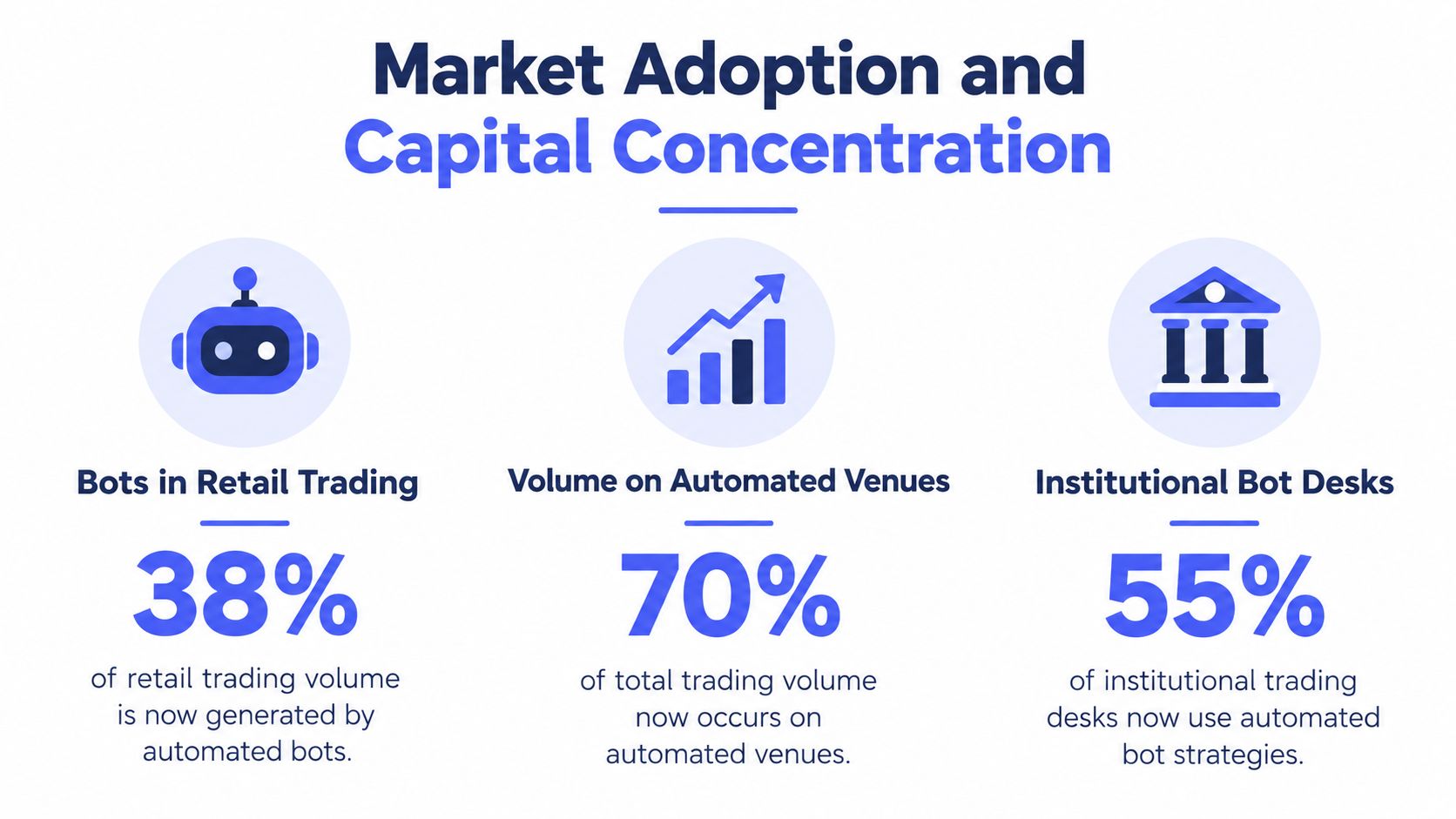
The distribution across venues was uneven. Only 20 of the top 150 exchanges in the same analysis had at least one bot with coverage, while 83.3% of bots supported Binance. That concentration matters because execution quality depends on liquidity, API reliability, available pairs, and the venue's order book. A free bot designed around a major exchange may behave very differently on a smaller venue.
Automation has moved beyond a niche
Independent market research published in 2026 estimated the crypto trading bot market at USD 54.08 billion in 2026 and projected growth to USD 200.14 billion by 2035, implying a 14% CAGR over that period. The same report said 42% of traders prefer bots for speed, accuracy, and reduced emotional decision-making. It also reported 46% adoption growth for cloud-based bots and 38% market preference for AI-powered models. These are market estimates and projections, not evidence that any individual strategy will perform well. The 2026 market report contains those estimates.
Regional concentration adds another layer. The report described North America as the largest market with 41% share, while Asia-Pacific followed at 37% adoption. Another 2026 market report cited in the same research area said Asia Pacific represented 33.7% of the broader automated crypto trading industry in 2025. The different measures aren't interchangeable, but both point to strong activity in major infrastructure-heavy regions.
The practical conclusion is narrow. Automation is common, but access to a free bot doesn't give a trader the same infrastructure, liquidity, or execution conditions used by larger participants. Evaluate the venue first. Then evaluate the bot.
Hidden Fees and Execution Tradeoffs
A zero-cost license and a low-cost trading operation are different things. The free model removes one visible expense while leaving the market expenses intact. Those expenses include exchange trading fees, slippage, network costs where applicable, and the opportunity cost of restricted features.
A free plan may also limit the very controls needed to manage execution. It might cap order size, limit the number of active strategies, remove advanced routing, or provide delayed monitoring. Those restrictions aren't always obvious until the strategy is already configured.
Compare the real cost structure
| Cost Factor | Free Tier Reality | Paid or Transparent Model |
|---|---|---|
| Software access | No monthly subscription, but features may be restricted | Broader controls may be available under a stated fee |
| Exchange fees | Still charged by the exchange on executed trades | Still charged, with the cost shown separately from software pricing |
| Slippage | User absorbs the difference between expected and actual fill | Better reporting can make the difference visible, but can't remove market impact |
| Trade size | Free plans may cap size or frequency | Limits and routing terms should be stated clearly |
| Strategy complexity | Advanced rules or multiple strategies may be unavailable | More configuration may be included, depending on the plan |
| Monitoring | Basic alerts or delayed data may be provided | More detailed execution and position reporting may be available |
The most common mistake is to compare subscription prices without calculating turnover. A bot that trades frequently can lose its edge through fee drag even when each individual fee looks small. Rebalancing, repeated entries, and exits can compound the problem. Thin liquidity makes it worse because the strategy pays more to enter and leave.
Read what slippage means in crypto before judging any bot's execution claims. A backtest using an expected price isn't the same as a live fill. A free tool that reports signals but hides actual fill quality isn't giving you enough information.
Use a break-even check
List every expected trade cost:
- Exchange charge: Confirm the applicable maker or taker fee.
- Expected slippage: Use observed fills where possible, not an optimistic assumption.
- Network cost: Include transaction expenses for on-chain execution.
- Subscription or feature cost: Add the software fee if the free tier isn't sufficient.
- Turnover: Estimate how often the strategy enters, exits, or rebalances.
Then compare the total cost with the strategy's intended edge. Don't assume a strategy survives because the software line says zero. If you can't measure the inputs, reduce the position size or test without committing meaningful funds.
Security Risks and Custody Models
A free Telegram bot can create a dangerous shortcut. Users often connect a wallet or exchange account before understanding what the bot can do. That reverses the correct order. First inspect custody and permissions. Only then consider whether the automation is useful.
Telegram trading bots can expose users to private-key theft, phishing, smart-contract vulnerabilities, and account takeover. Industry guidance recommends a separate wallet with limited funds because some bots may have wallet permissions without holding full custody. Binance's explanation of Telegram trading bots covers these risks and the value of isolating funds.
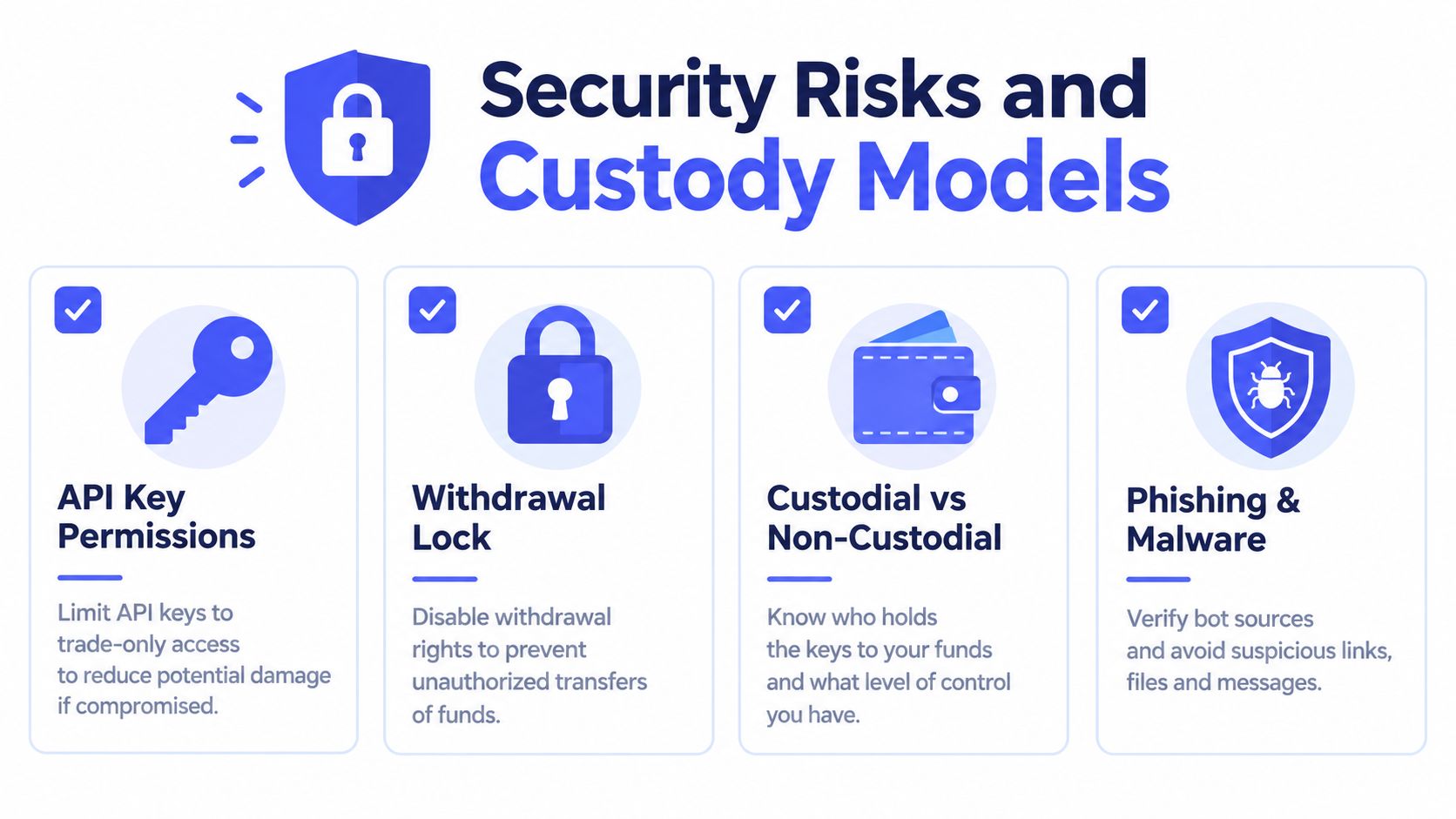
Run this permission checklist
- Protect the seed phrase: Never give a bot your seed phrase, private key, or one-time code. A service that requests any of these should be treated as unsafe.
- Limit API access: For exchange connections, use trade-only permissions where possible. Disable withdrawal rights.
- Inspect token approvals: Review which contracts can spend which assets. Revoke allowances you no longer need.
- Separate operating funds: Use a wallet dedicated to automation. Keep only the amount you can afford to lose there.
- Verify the custody model: Ask whether the provider holds your assets or acts through a user-granted allowance. The difference determines who controls withdrawals.
- Test the kill switch: Confirm that you can pause new copies and close positions without relying on support.
- Check the source: Use the bot's verified account and official documentation. Ignore unsolicited Telegram messages and cloned profiles.
Guidance on Telegram bot permissions and wallet safety specifically warns against sharing seed phrases, private keys, or one-time codes. It also recommends reviewing token approvals, API permissions, and withdrawal permissions before use.
Copy trading itself doesn't remove the risk. IOSCO defines it as an online imitative trading practice where a copy trader mirrors trades made by one or more lead traders, usually described as experienced or professional. IOSCO also notes that it's commonly used for short-term trading and higher-risk markets such as crypto-assets. The IOSCO report on copy trading is the relevant regulatory reference.
For a broader explanation of the operational questions to ask before connecting a wallet, see this guide to copy trading apps. The key test is simple. You should know exactly who controls the assets and exactly how to revoke access.
Evaluating Automation and Execution Speed
A bot can identify a trade correctly and still deliver a poor fill. The gap appears between signal detection and order execution. Network distance, exchange response time, congestion, and order-book movement all affect the price available when the order arrives.
Industry benchmarking for exchange-connected strategies reports that WebSocket feed latency under 30 ms and order round-trip time under 60 ms are generally adequate for most strategy types. Sub-10 ms feed latency is required for sub-second arbitrage, while retail or overseas network paths can sit well above 150 ms. That delay widens the gap between the detected signal and the executable price, increasing adverse-selection risk. The execution latency analysis provides those benchmarks.
Match latency to the strategy
Sub-second arbitrage is latency-sensitive by design. A slower retail connection may receive the signal after the available price has moved. The strategy can then execute at a worse level or fail to execute at all.
A slower strategy has different requirements. A position held for a longer period may tolerate more delay, but that doesn't make execution irrelevant. The bot still needs stable data, reliable order handling, accurate position state, and a clear response when an order fails.
Copy trading adds a separate timing problem. The source trader's filled transaction must be observed, interpreted, and mirrored. Copying only the entry leaves the user exposed when the source exits. A system that mirrors both sides of the trade gives the operator a more complete control loop, but it still can't produce the same fill as the original wallet.
Execution test: Compare the source transaction timestamp with the copied fill timestamp, then inspect the displayed slippage. Don't judge speed from a notification alone.
What to verify before live use
Ask whether the bot shows filled trades or only alerts. Check whether it reports timestamps and actual slippage. Confirm that it handles failed transactions and partial execution without leaving a position open. Finally, test pause and closure controls before allowing unattended operation.
Speed isn't a standalone feature. It has value only when the system reports what happened and lets the user control the result. A free interface that hides fills gives you less information precisely when execution quality matters most.
Operating a Non-Custodial Telegram Bot
A non-custodial Telegram bot should leave the assets in the user's wallet. The user grants a limited, revocable allowance for execution, rather than transferring funds to a provider-controlled account. That structure doesn't make trading safe, but it limits the custody risk and gives the user a direct way to revoke access.
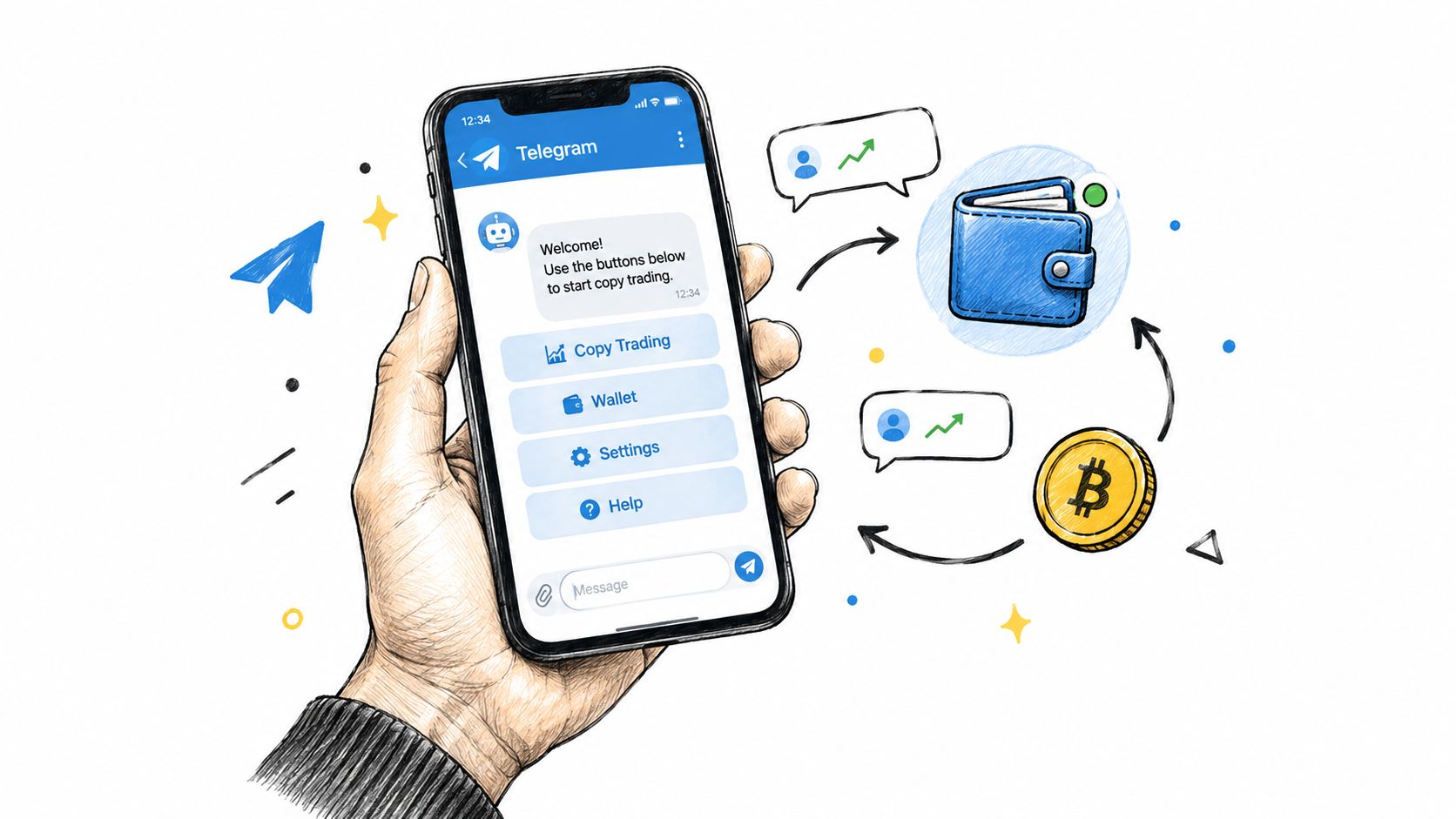
With copyfomo, the user selects traders from the public fomo leaderboard and chooses how copied trades should be sized. The available controls include a fixed ticket per trade or proportional sizing, optional per-trade caps, a pause control for new copies, and an option to close open mirrored positions. It mirrors filled entries and exits into the user's own wallet and displays the mirrored swaps with timestamps and slippage.
The practical setup should be deliberately boring. Choose a wallet dedicated to the activity. Grant only the required allowance. Set a modest trade size and a cap. Then watch the live feed before leaving the bot unattended.
Follow the trade from entry to exit
A trader appears on the public leaderboard. The user selects that trader and configures the copy size. When the source wallet completes an entry, the bot mirrors the transaction according to those settings. When the source wallet sells, the bot mirrors the exit rather than leaving the copied position open indefinitely.
The user can review the source activity and the copied execution through the displayed feed. That distinction matters. A notification says that something happened. A timestamp and slippage record show how the copy behaved.
Review the public trader data before selecting a source. Realized performance data can describe historical activity, but it can't predict future results. The leaderboard also isn't an endorsement of any listed trader. Users remain responsible for their wallet, permissions, sizing, and decisions.
The setup walkthrough is available below. Watch it for the control flow, then verify each permission yourself before connecting funds.
A kill switch should be part of normal operation, not an emergency feature you discover later. Pause new copies when conditions change. Close mirrored positions only when you understand what that action does. Recheck allowances after testing and revoke access when you stop using the service.
Final Evaluation and Next Steps
A free bot is acceptable only when its complete operating cost and security model make sense. The subscription price is the smallest part of the review. Start with the exchange or chain fees, then examine slippage, liquidity, execution delay, and feature restrictions.
Use this decision sequence:
- Define the strategy: Know whether you're automating spot activity, rebalancing, alerts, or copy trading. Different strategies need different execution quality.
- Measure the fill: Look for actual transaction records, timestamps, and slippage. Signals alone aren't enough.
- Confirm custody: Keep assets in a wallet you control when the product supports a non-custodial structure. Understand every allowance.
- Limit the damage: Use isolated funds, conservative sizing, caps, and a tested kill switch.
- Review the source: A public leaderboard can show historical activity. It can't remove market risk or forecast the next trade.
Copy trading is an imitative practice. It transfers timing and selection decisions to a lead trader, but it doesn't transfer responsibility. The source trader may enter a position that no longer has the same price or liquidity when the copy executes. Past performance does not predict results.
The practical benchmark is transparency. You should be able to identify the copied entry and exit, inspect the execution timing, see the slippage, understand the allowance, and stop the process yourself. If a free bot can't provide those basics, the absence of a subscription fee isn't a meaningful advantage.
For fomo users, a Telegram interface can reduce the need to monitor a leaderboard manually. That convenience still requires discipline. Review the public data, start with limited exposure, and treat every permission as a security decision.
copyfomo mirrors filled fomo leaderboard entries and exits into your own wallet through a revocable allowance, with configurable trade sizing and visible execution data. Visit the site to start the bot on Telegram, review the public trader data, and verify the custody and control settings before you connect funds.
stop reading. start copying.
pick a trader from the fomo leaderboard, set your size, and the entries and the exits land in your own wallet while you sleep.
open copyfomo on telegram →