10 Crypto Wallet Trackers Compared for 2026
compare 10 crypto wallet tracker tools by features, supported chains, alerts and privacy, with criteria for choosing one and picks by trader need.
The usual advice is to find a profitable wallet and follow it. That skips the hard part. Tracking a wallet is not the same as acting on it. A crypto wallet tracker shows what an address holds and where assets moved. It doesn't establish whether you could have traded at that price, or whether the opportunity was already gone.
The useful comparison starts after an entry or exit. Can you inspect the filled transaction? Does an alert reach a channel you monitor? Can you see a partial sell and the remaining position? Does the tool execute anything, or leave every decision and transaction to you?
The tools below serve different jobs. Some investigate counterparties. Others aggregate personal holdings, deliver notifications, or organize tax records. Treating them as interchangeable creates blind spots, especially when a portfolio dashboard gets mistaken for a trading system.
Research depth, alert delivery, chain coverage, exit visibility, custody, and privacy matter more than a polished balance chart. There's no common alert-speed benchmark in the available information, so none gets a fastest-tool claim. Public-address lookup also shouldn't require surrendering wallet keys. Copy trading carries risk, and past performance does not predict results.
Table of Contents
- 1. DeBank
- 2. Zerion
- 3. Arkham
- 4. Nansen
- 5. Cielo
- 6. CoinStats
- 7. Zapper
- 8. rotki
- 9. CoinTracker
- 10. Delta
- How the 10 crypto wallet trackers differ on focus, paid features and best use
- Matching the Tracker to Your Trading Role
1. DeBank
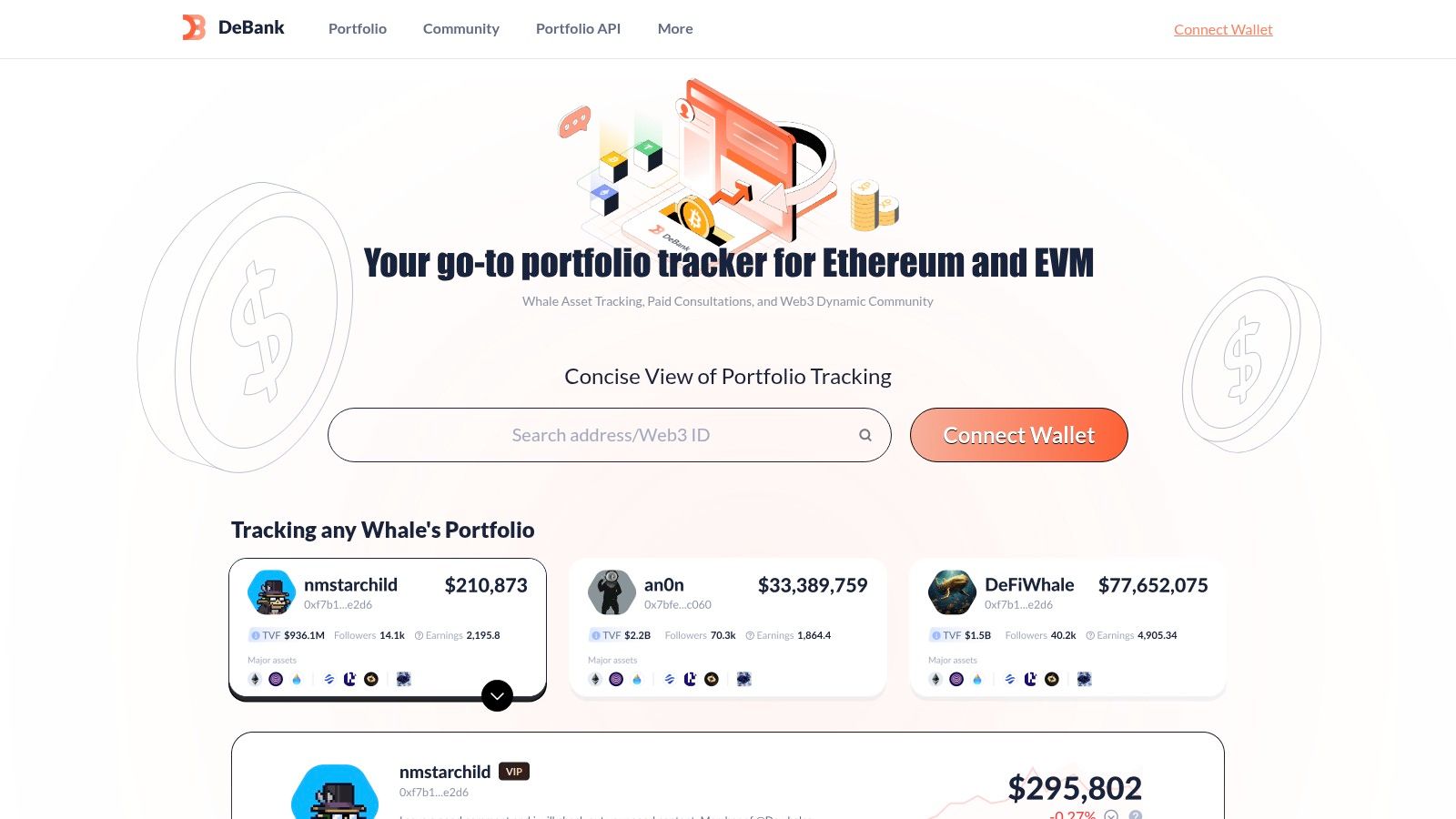
DeBank puts an EVM wallet's assets and DeFi positions into a readable view. Start with a public address, then inspect protocol exposure and transaction history. Wallet profiles and following features add context beyond a token list.
Its main value is separating what a trader holds from where those holdings sit. A position inside a lending protocol needs a different reading from tokens sitting idle in a wallet. Portfolio-change summaries help identify what deserves closer inspection.
Where it stops
- Coverage: Its EVM emphasis limits its usefulness as a single dashboard for non-EVM activity.
- Exit visibility: Transaction history supports reviewing reductions, but a transfer isn't automatically a sale.
- Access: Advanced historical and account tools can require paid VIP features.
Use public-address lookup for observation. That task doesn't require handing over custody or granting trading permissions. Keep any social profile separate from your confidence in the address attribution.
DeBank is a portfolio-research tool, not evidence that a trader's execution can be repeated. Check the underlying transaction before interpreting a falling token balance as an exit. Verify DeFi valuations too, particularly when the displayed position looks easier to liquidate than it really is.
2. Zerion
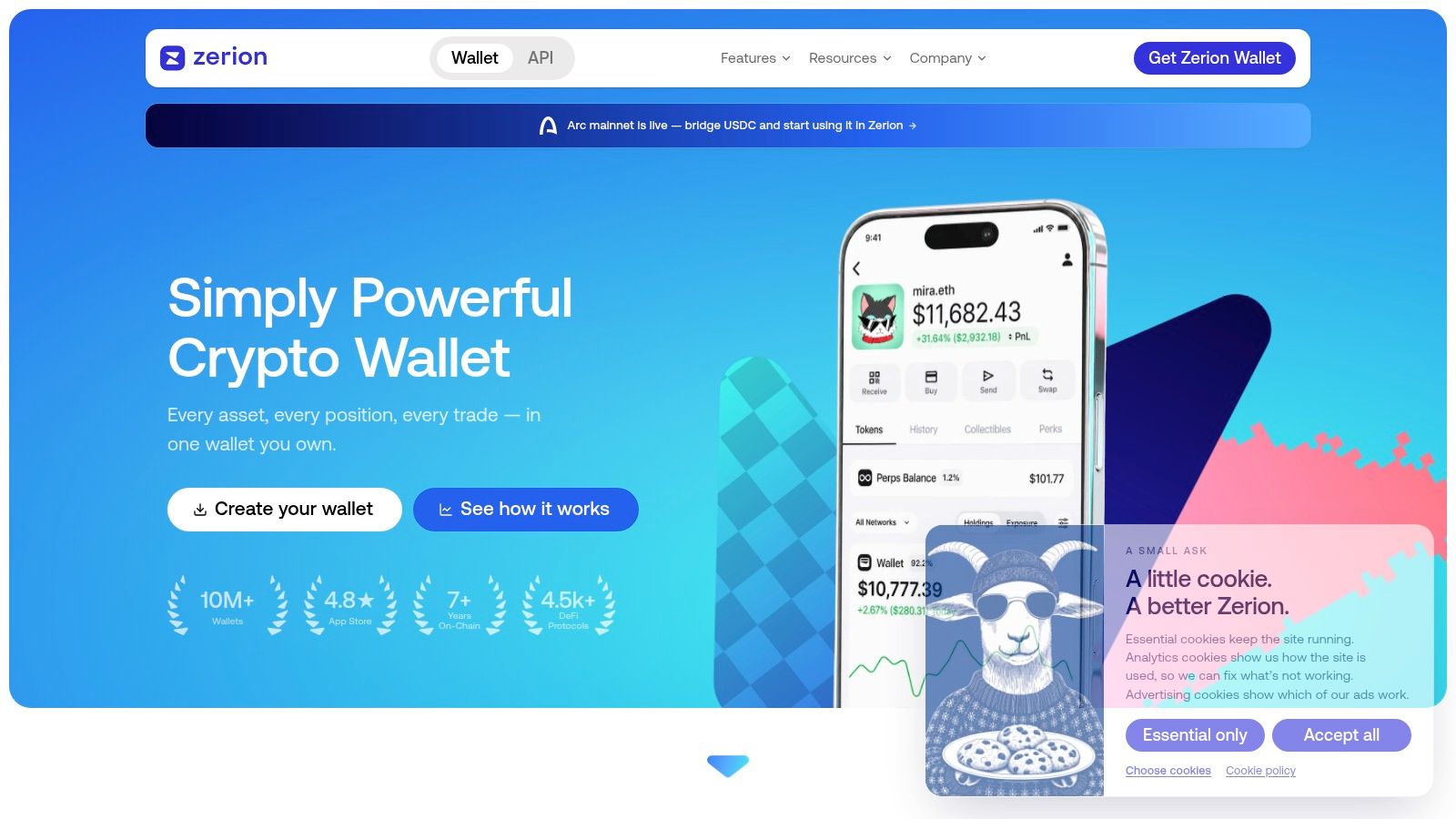
A wallet can show an attractive portfolio value while holding positions that would be difficult to sell. Zerion helps inspect the holdings and activity, but the displayed total isn't a liquidation quote.
The product combines a multichain portfolio dashboard with a self-custody wallet. You can monitor personal accounts or look up another address. Premium adds wallet alerts, P&L for arbitrary addresses, and CSV export.
Practical rule: Separate tracking access from wallet permissions. Looking at another address doesn't require giving a service authority over your tokens.
Research versus execution
Zerion's web app, mobile app, and browser extension offer different ways to review activity. Premium alerts can support ongoing monitoring, but don't assume notification delivery means you can reproduce the source transaction's price.
For exits, read transaction history alongside the remaining token balance. A partial disposal needs a different interpretation from a complete close. Transfers between addresses can complicate that reading.
The trade-off is subscription access and product scope. Some research functions sit behind Premium, while optional wallet and trading functions introduce decisions unrelated to passive observation. Confirm support for the trader's actual networks before relying on a consolidated view. Zerion stops short of proving that a tracked wallet's historical P&L represents an executable strategy for a follower.
3. Arkham
Arkham addresses a different question: where did the assets go, and which addresses appear connected? Wallet and entity profiles combine holdings, balance history, P&L, and transaction records. Its Visualizer helps examine relationships and fund flows.
That matters after an apparent exit. Tokens sent elsewhere might have been sold, moved into another wallet, or deposited into a service. Counterparty filters help narrow the investigation without making the destination label conclusive.
- Research depth: Address relationships provide context beyond a portfolio snapshot.
- Identity limits: Labels and entity attributions aren't independently verified identities.
- Execution limits: A fund-flow investigation doesn't place a corresponding trade for you.
The distinction between an address and a person matters here. Techpoint's explanation of crypto user counts notes that a person can control multiple addresses and that clustering can incorrectly merge unrelated wallets.
Keep the address, chain, transaction hash, and observation period attached to your conclusion. A label without provenance is a weak basis for action.
The practical workflow in how to track crypto wallets complements this approach. Arkham's investigative interface is more involved than a basic dashboard. It stops being useful when you need an alert or execution decision before you've finished checking the relationships.
4. Nansen
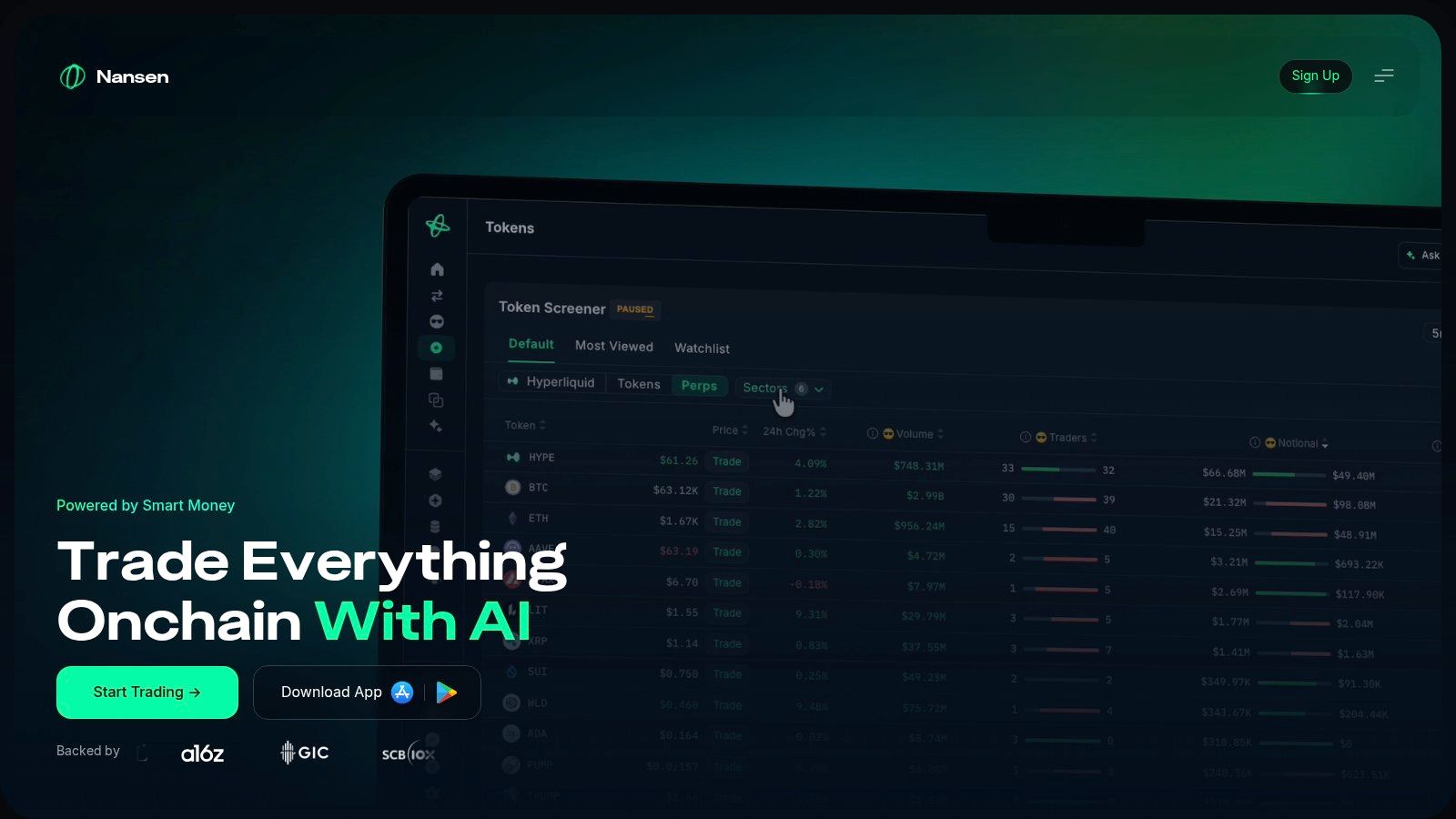
A profitable wallet deserves inspection, not automatic trust. Nansen supplies tools for that inspection through wallet holdings, activity, counterparties, transaction history, and P&L analysis.
Its Profiler and token-level views help distinguish a recent trade from a long-held position. Balance history also helps test whether a trader regularly reduces exposure or leaves residual tokens behind. Multichain analytics and mobile access extend the research workflow beyond a desktop session.
What the extra depth costs
Nansen can be excessive if you only need a balance check. Paid research access is a larger commitment than using a free address explorer. Labels and calculated P&L remain analytical aids rather than ground truth.
The warning applies to rankings too. A quantitative study published by ACM found that copy-trading leaderboard signals weren't reliably correlated with long-term performance. That's a reason to investigate behavior rather than outsource judgment to a ranking.
For large-wallet research, the crypto whale wallet tracker guide provides additional context.
Nansen's strength is examining behavior around entries and exits. That isn't the same as receiving an actionable notification or reproducing execution. Verify chain coverage for the address under review, and don't connect a funded wallet merely to inspect public activity.
5. Cielo
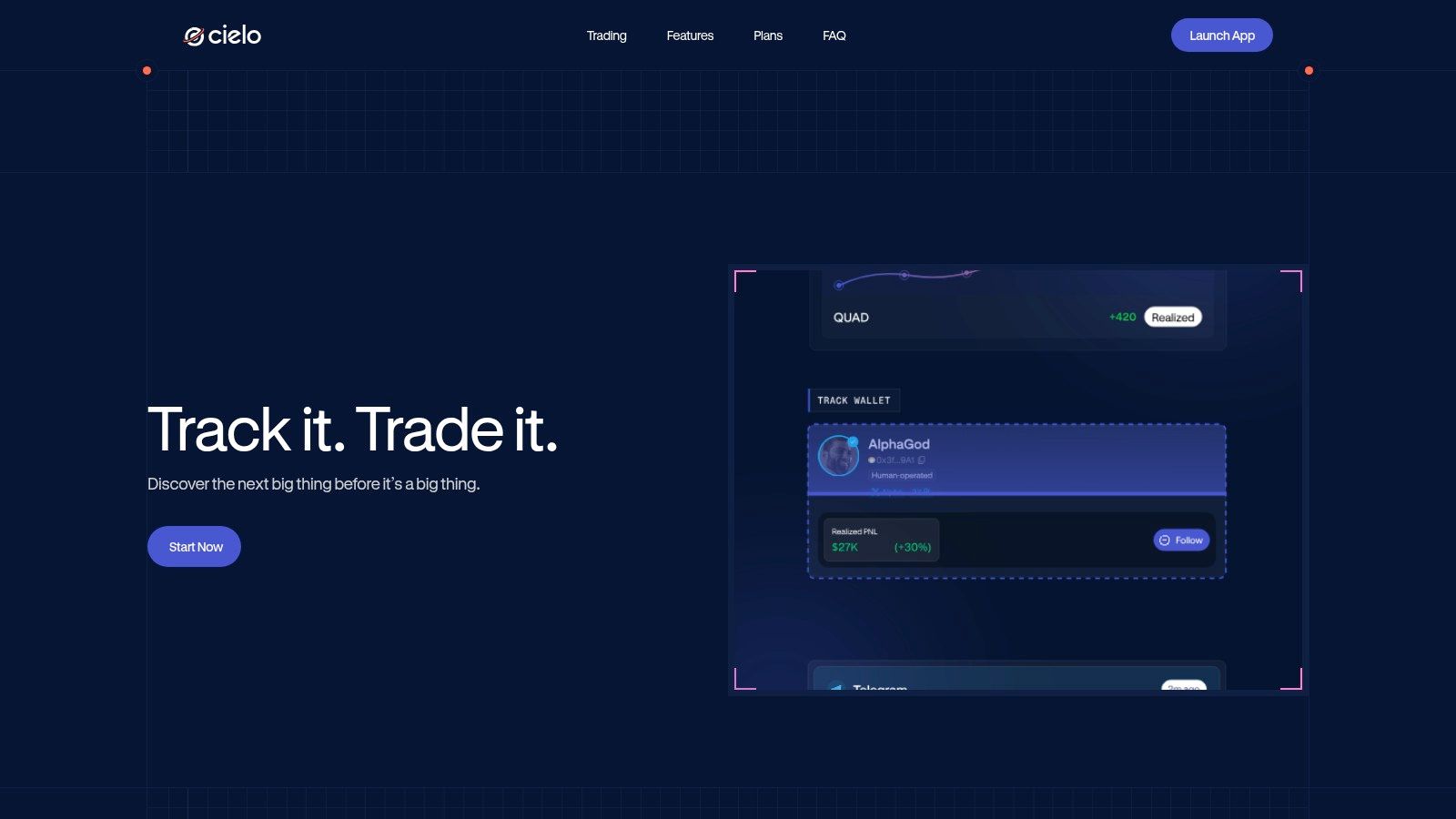
Cielo delivers wallet-activity feeds through its web app and Telegram or Discord bots. It offers wallet lists, activity filtering, and token tracking. Paid plans expand tracking limits and add discovery and analytics.
Its category is notification delivery, not automatic execution. An alert tells you that activity occurred. You still need to interpret the transaction, inspect current conditions, and decide whether to act.
- Delivery channel: Telegram and Discord put activity into messaging workflows.
- Feed quality: Broad filters can produce noise and make exits harder to notice.
- Timing limit: No comparable end-to-end speed benchmark establishes how quickly a usable alert reaches you.
A buy alert isn't an execution plan. A sell alert isn't proof that your position has closed.
When evaluating notifications, inspect entries and exits separately. Check whether a message makes the sold amount and remaining holding clear. Confirm that the relevant chain and transaction type are supported rather than assuming complete coverage.
GetBlock's wallet-RPC benchmarking guide identifies latency percentiles, request reliability, and block freshness as useful infrastructure measures. Those measures don't establish Cielo's delivery performance, but they explain why an average-speed claim would be insufficient.
Cielo leaves the action step to the reader. Adding a messaging channel also adds another account and notification surface to manage.
6. CoinStats
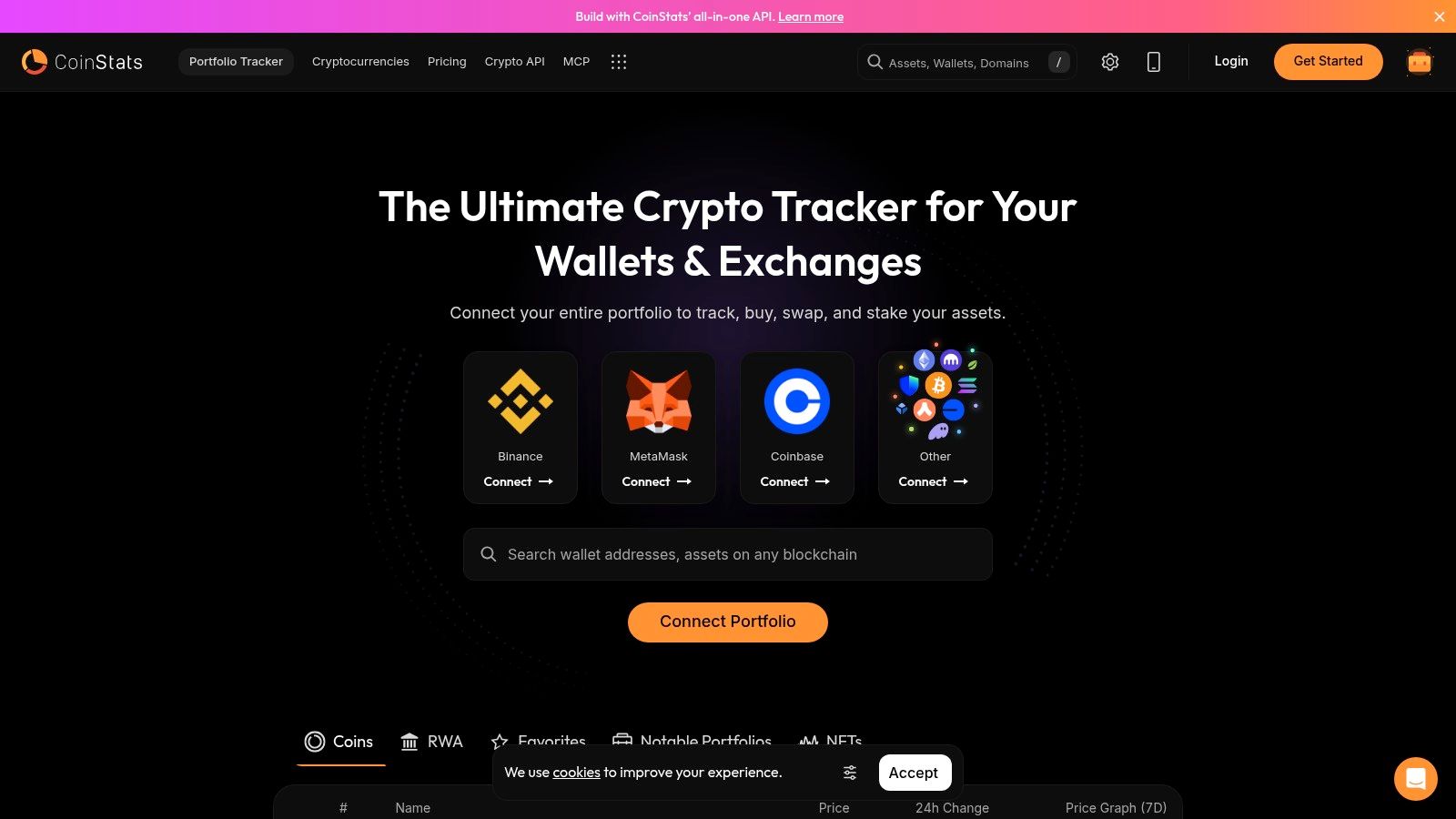
CoinStats makes more sense when your tracking problem includes exchange balances as well as on-chain wallets. It aggregates portfolio information and provides performance, P&L, allocation views, alerts, and wallet analysis.
Keep personal holdings separate from watched addresses. Otherwise, a trader's position can become visually mixed with your own exposure. Wallet watchlists help preserve that distinction.
The import problem
Portfolio P&L depends on the history imported and how transfers are interpreted. Missing acquisition records can make an ordinary disposal look unusually profitable. Internal transfers can also distort the picture if they're treated as purchases or sales.
- Scope: Exchange and wallet aggregation supports personal portfolio review.
- Privacy: Exchange connections disclose more than a standalone public-address lookup.
- Permissions: Use read-only exchange access for tracking, without trading or withdrawal authority.
Mobile and web access make the same portfolio available across devices. That convenience doesn't establish alert latency, complete chain coverage, or accurate interpretation of every DeFi transaction.
For exit monitoring, inspect the source transaction rather than relying on a change in portfolio value. Prices can fall without a sale, and balances can move without an exit. CoinStats stops being the right instrument when the task requires detailed counterparty investigation or precise reconstruction of another trader's execution.
7. Zapper
Zapper combines wallet lookup with broader Web3 exploration. Address search, wallet profiles, network selection, and portfolio views sit alongside exploration of DeFi apps, NFTs, and DAOs.
That breadth helps when a wallet's activity doesn't resemble straightforward token trading. A protocol deposit or NFT purchase changes the portfolio, but neither should be read as a conventional swap exit.
Read the transaction type first. A lower token balance doesn't establish that the trader sold into the market.
Exploration, not a copyable record
Zapper can help locate accounts, applications, and related activity. Its separate developer-facing API serves teams building portfolio or on-chain data features. Casual users don't need an API integration to inspect an address.
The limitation is wallet-performance depth. A broad explorer may leave you doing more manual work to reconstruct cost basis, partial exits, and remaining exposure. Some help materials may also describe an earlier interface, so confirm a feature exists in the current product before building a workflow around it.
For privacy, start with public-address search rather than unnecessary account connections. For coverage, select the actual network and confirm the position appears.
Zapper's portfolio views are observation tools. Don't treat them as a benchmark for alert delivery or as proof that an observed move can still be executed at comparable terms.
8. rotki
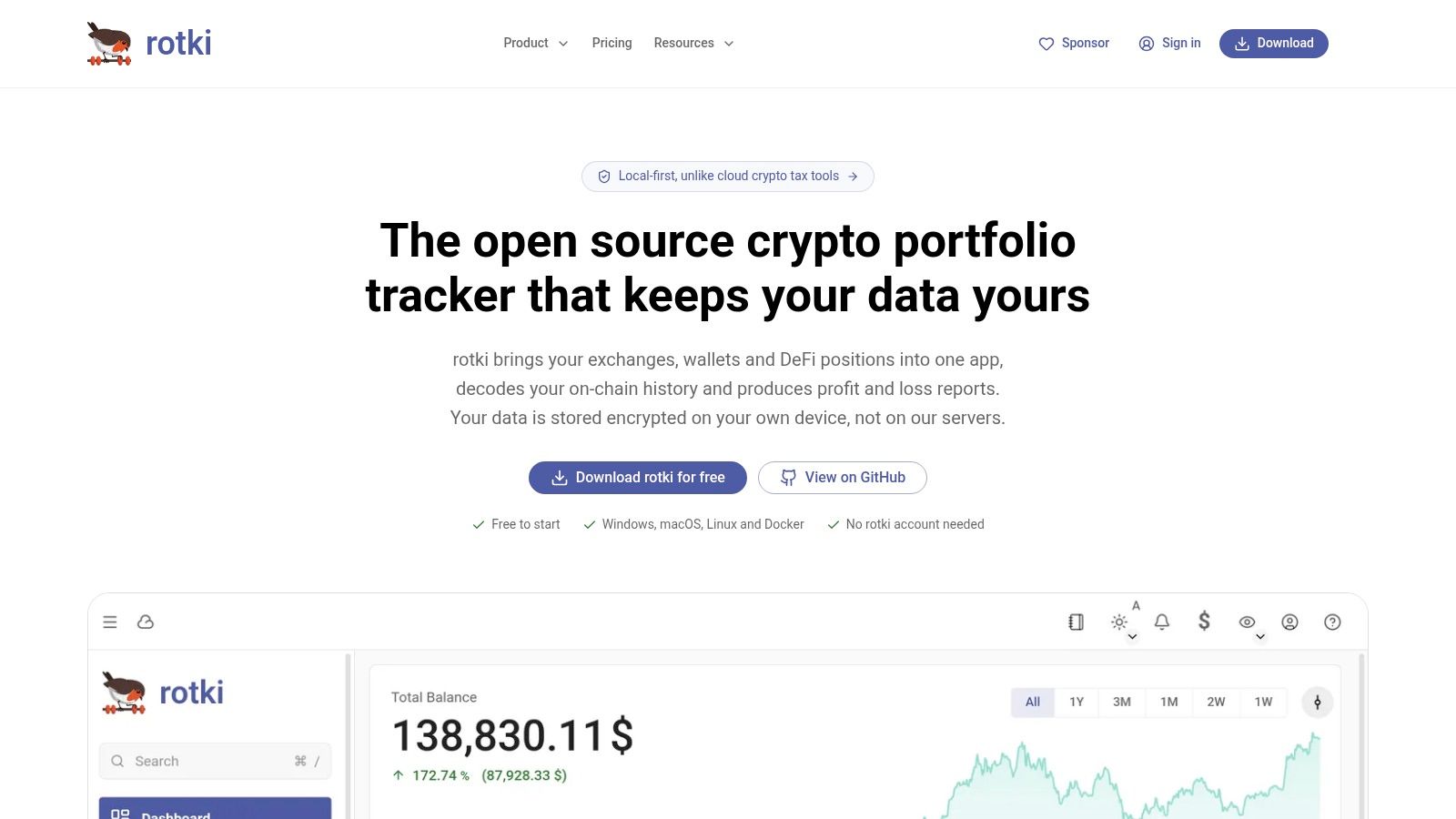
Local storage is the reason to consider rotki. It's an open-source portfolio and accounting application that runs on your computer, with data stored on your device.
It tracks wallets, exchange accounts, DeFi positions, and transaction history. Profit-and-loss reporting and optional encrypted sync support recordkeeping. The application is available for Windows, macOS, Linux, and Docker.
- Data ownership: Local storage reduces reliance on a hosted portfolio database.
- Custody: rotki is read-only by design and doesn't hold user funds.
- Maintenance: Desktop setup and history reconciliation require more involvement than opening a web dashboard.
Where local tracking fits
rotki suits reviewing what happened across your own accounts. It doesn't suit a workflow built around immediate notifications from another trader's wallet. Historical exit records and accounting aren't substitutes for timely sell alerts.
Open-source code offers inspectability, not automatic correctness. You still need to review imports, protocol interpretation, and missing transactions. Free and paid tiers also differ in event-history limits and available features.
Local storage doesn't eliminate every privacy consideration. Exchange integrations and external data queries still deserve attention. Keep credentials read-only and protect the computer holding the records.
Its stopping point is clear: use it to maintain a defensible portfolio history, not to catch an entry or mirror an exit while you're away.
9. CoinTracker
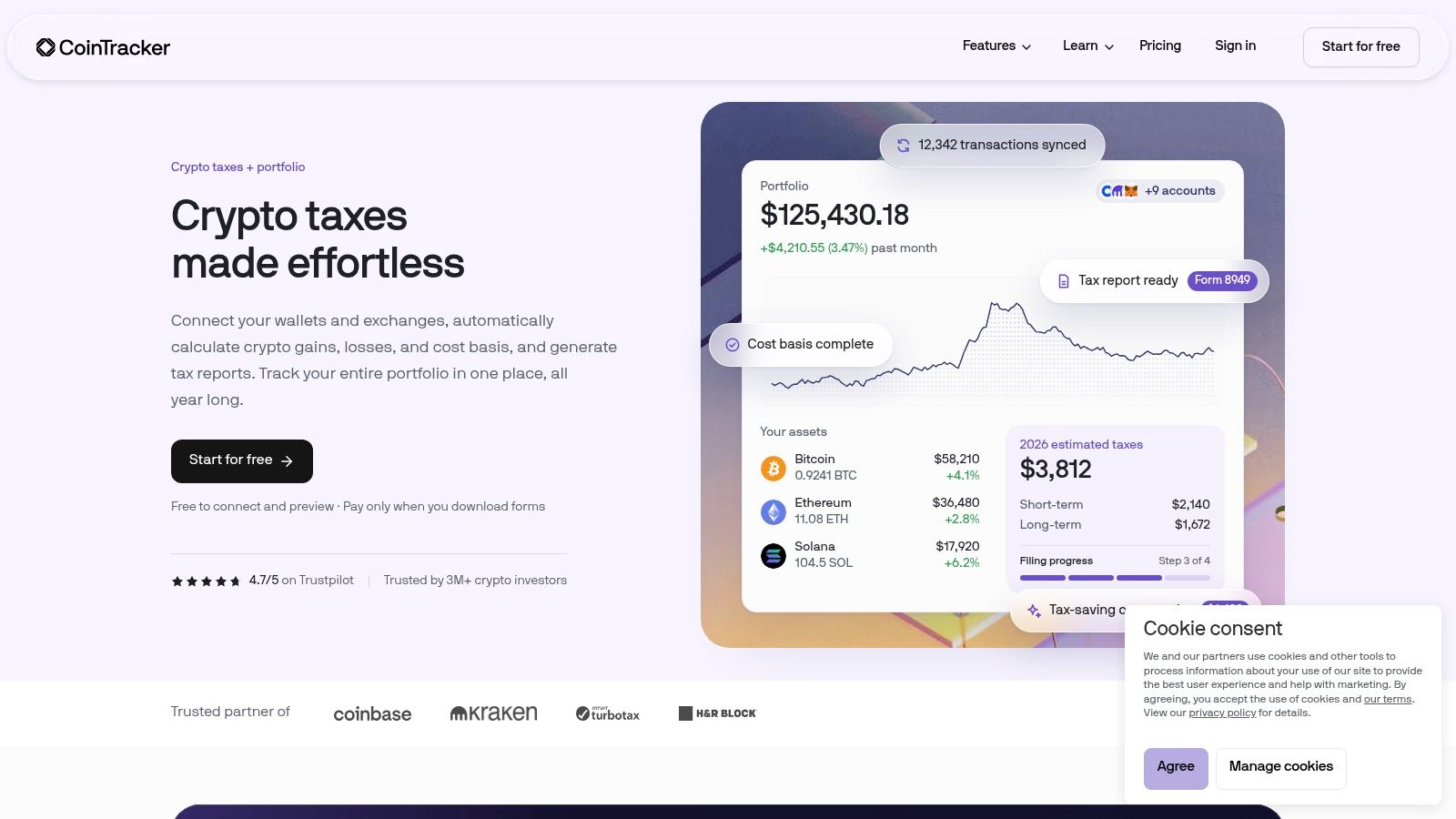
A sale creates a recordkeeping problem as well as a trading decision. CoinTracker focuses on that recordkeeping through wallet and exchange connections, transaction history, portfolio tracking, and tax reporting.
Automatic transfer matching helps organize movements between your accounts. Free portfolio access lets users inspect the product before purchasing tax features. Paid plans add tax forms and other reporting or performance functions.
Records aren't live intelligence
CoinTracker is better understood as a personal transaction ledger than a live window into another trader's next move. Mobile access doesn't change that distinction. A tax-ready disposal record arrives at a different stage of the workflow from a time-sensitive exit notification.
Complex DeFi activity can require correction. Review deposits, withdrawals, bridges, and transfers before trusting the final calculation. Active traders should also inspect plan limits before committing their history to a paid reporting workflow.
The crypto P&L tracker guide explains why a displayed profit figure needs interpretation. Cost basis and imported history matter as much as the final total.
Connecting exchange accounts centralizes more financial information than inspecting a public wallet. Use appropriate read-only permissions. CoinTracker stops being useful for this comparison when the question changes from “What did I dispose of?” to “Can I react to that trader's exit now?”
10. Delta
A portfolio that mixes BTC with equities needs a different tracker than a wallet you are watching for exits. Delta is built for the first job: a general investment-tracking app that puts crypto beside traditional holdings in one mobile-oriented view.
Connections to supported brokers, exchanges, and wallets consolidate that picture. Paid tiers expand capacity and analytics, while free plans cap how many assets and portfolios you can track. Confirm the current limits on Delta's site before committing your history to it.
- Portfolio context: crypto shows up as one slice of total investment exposure.
- Research limit: wallet attribution and counterparty tracing sit outside its scope.
- Execution limit: an allocation chart never confirms another trader's filled entry or exit.
Built for allocation
That framing is the trade-off. Delta answers "how much of my net worth sits in this asset" cleanly. It goes quiet on the questions that matter after a tracked wallet sells: how fast the alert fired, what share of the position is still open, and whether the tool can act on the move or only display it.
Broker and exchange imports expose more financial data than a public-address lookup, so connect only the accounts you actually need and keep permissions read-only where offered. Paid analytics add little when the task is inspecting one wallet's behaviour. Delta stops being useful once notification speed and exit visibility decide your next trade.
How the 10 crypto wallet trackers differ on focus, paid features and best use
A wallet tracker earns its keep after an entry or exit, not when it draws a balance chart. Read the table with three tests: how fast the alert reaches you, whether the exit is shown as a filled sale or only a lower balance, and whether the tool can act on the move or only display it.
| Item | Primary focus | Paid features | Best for |
|---|---|---|---|
| DeBank | EVM portfolio and DeFi activity tracking | VIP historical and account tools | Reviewing EVM wallets and DeFi positions |
| Zerion | Multichain portfolio tracking and self-custody wallet | Premium wallet P&L, alerts, and CSV export | Tracking portfolios and monitoring public addresses |
| Arkham | On-chain wallet and entity intelligence | Paid tiers for deeper entity intelligence and monitoring | Investigating wallet connections and fund flows |
| Nansen | Wallet research and trading analytics | Paid access to advanced wallet analytics | Comparing wallet activity and trading patterns |
| Cielo | Wallet monitoring and activity alerts | Higher tracking limits, wallet discovery, and analytics | Receiving wallet alerts through Telegram or Discord |
| CoinStats | Portfolio aggregation and wallet analysis | Plan-based limits on holdings, connections and analytics | Combining exchange and wallet holdings |
| Zapper | Wallet lookup and Web3 exploration | Developer-facing API access | Exploring wallets, DeFi apps, and broader Web3 activity |
| rotki | Local portfolio tracking and crypto accounting | Paid tiers with different history limits and features | Privacy-focused personal portfolio accounting |
| CoinTracker | Portfolio tracking and crypto tax reporting | Tax forms and advanced tax or performance features | Organizing holdings and preparing crypto tax records |
| Delta | Tracking crypto and traditional investments | More assets, portfolios, and analytics | Viewing crypto alongside other investments |
Watching and copying are different jobs. DeBank, Zerion, Cielo and Zapper can surface movement; Arkham and Nansen explain who moved and where funds went; rotki, CoinStats, CoinTracker and Delta organize records. Once the decision depends on getting the same entry or exit at your size, a tracker stops being enough.
Matching the Tracker to Your Trading Role
Match the tool to the job. Counterparty and fund-flow investigation points toward Arkham or Nansen. DeBank supports EVM portfolio review and wallet following, while Cielo provides activity delivery through Telegram and Discord. None of those functions establishes that a follower can execute at the source trader's price.
For personal records, rotki emphasizes local data ownership, while CoinTracker combines portfolio organization with tax reporting. CoinStats aggregates exchange and wallet holdings. Delta places crypto beside other investments. Zerion combines portfolio monitoring with optional wallet functions, and Zapper broadens the view into Web3 activity.
Check the exit before trusting the entry
Verify the underlying transaction, not just the label or P&L figure. Check whether a supposed exit was a swap, transfer, protocol withdrawal, or partial reduction. Preserve the chain and transaction hash so you can reproduce the finding.
Observed performance isn't copied performance. Delay, trade size, liquidity, fees, and unsuccessful sells change the outcome. An alert can arrive correctly and still leave you unable to obtain comparable execution.
For traders who already use fomo, copyfomo is a Telegram bot that mirrors a selected trader's filled buys and sells into a wallet they control, at their configured size. Our live trade reporting shows timestamps and slippage, along with filled sells, remaining positions, failed sells, and copies skipped by settings. Browse trader context and the public dataroom before setting anything up.
- Custody: Our users retain their keys and can revoke the trading allowance.
- Control: Pausing new copies and revoking spending permission are separate actions.
- Execution: Mirroring an exit doesn't ensure a token can be sold or that the source price remains available.
Non-custodial doesn't mean permission-free. Ethereum's token-approval guidance explains that approvals let contracts spend wallet tokens, recommends approving only the amount needed, and notes that revocation requires an on-chain transaction with a network fee.
The practical dividing line is watching versus acting. Choose research software for investigation, accounting software for records, and evaluate automation separately when you want trades executed. Copy trading carries risk, and past performance does not predict results.
copyfomo takes the step after wallet tracking by mirroring a chosen fomo trader's entries and exits at your configured size. Visit copyfomo to start the bot on Telegram, review the controls, and understand the trading allowance before enabling copies.
stop reading. start copying.
pick a trader from the fomo leaderboard, set your size, and the entries and the exits land in your own wallet while you sleep.
open copyfomo on telegram →