10 Honeypot Token Checker Tools for 2026: Pros and Cons
compare 10 honeypot token checker tools for evm and solana, with features, pros, cons, and safe-use steps. learn what each scanner can and cannot tell you.
The scan said clean. The sell still failed. You bought a token that a checker passed, watched the price move, hit sell, and got a revert, a slippage error, or proceeds close to zero.
That is the gap this list is built around. A honeypot token checker can answer different questions, and they are not the same question. One tool simulates a buy and a sell. Another reads contract flags. A Solana scanner checks mint and freeze authority instead. Treating any one answer as a verdict is how traders get trapped.
The trap itself is simple. Buying succeeds. Selling fails. The HoneyBadger academic study analyzed 151,935 unique Ethereum smart contracts and identified 460 honeypots, with transaction analysis of 282 honeypots finding 240 victims and more than $90,000 in cumulative attacker profit. Manual validation confirmed 87% of the reported contracts were genuine honeypots.
Those numbers are old. The pattern is not. Owners can change taxes, blacklist wallets, pause transfers, or remove liquidity after your check. A pass is a snapshot, not clearance for the next hour.
Use the tools below in order. Sell simulation first. Contract flags second. Chain-specific authority checks where they apply. If the answers disagree, believe the worse one until you understand why. Do not size up on a single green label.
Table of Contents
- 1. Honeypot.is
- 2. DEXTools Token Safety Checker
- 3. Token Sniffer
- 4. GoPlus Token Security
- 5. CertiK Token Scan
- 6. De.Fi Scanner
- 7. ApeSpace Honeypot Checker
- 8. RugCheck
- 9. Solsniffer
- 10. HoneypotShield
- How the honeypot token checkers compare on chain coverage, sell simulation, free access, and best use
- Where to Go From Here
1. Honeypot.is
Start here when the question is narrow. Can this EVM token be sold right now. Honeypot.is is built for that test, and that focus is its value.
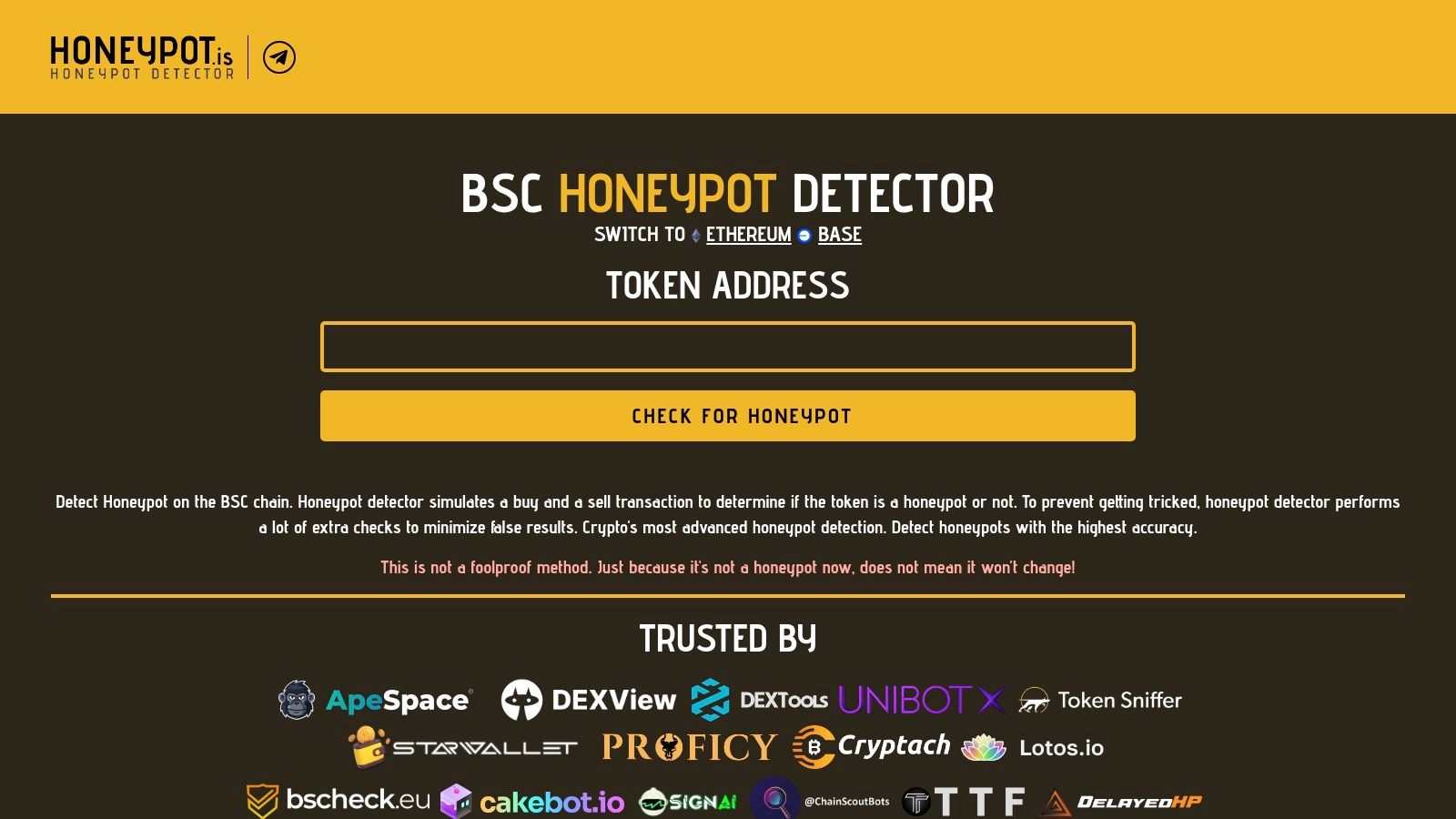
The checker simulates a buy and a sell against a pair. Reports can include buy tax, sell tax, gas details, and token or pair information. You can check by token address or by pair or pool address, which matters because the same token can behave differently across pools.
A 2025 study in the EPJ Data Science journal examined 17,194 Ethereum tokens launched between October 2 and December 2, 2024 and classified about 15,114 tokens, roughly 88%, as honeypots, while Honeypot.is detected 91.6% of them and GoPlus Labs detected 81.6%. Strong detection is not complete detection.
- Pros: Purpose-built sell simulation, public checker and API documentation, direct tax output.
- Cons: Chain documentation lists Ethereum, BNB Chain, and Base, availability depends on supported exchanges and pairs, and a passing simulation does not lock in future sellability.
Use it as your first filter, then read the copy trading risk breakdown before you assume a clean result protects a copied position. It does not.
2. DEXTools Token Safety Checker
DEXTools answers a broader question. What do the contract and the market look like together. You get honeypot risk, buy and sell taxes, contract verification, mintability, ownership indicators, and the combined DEXT Score beside pair and liquidity data.
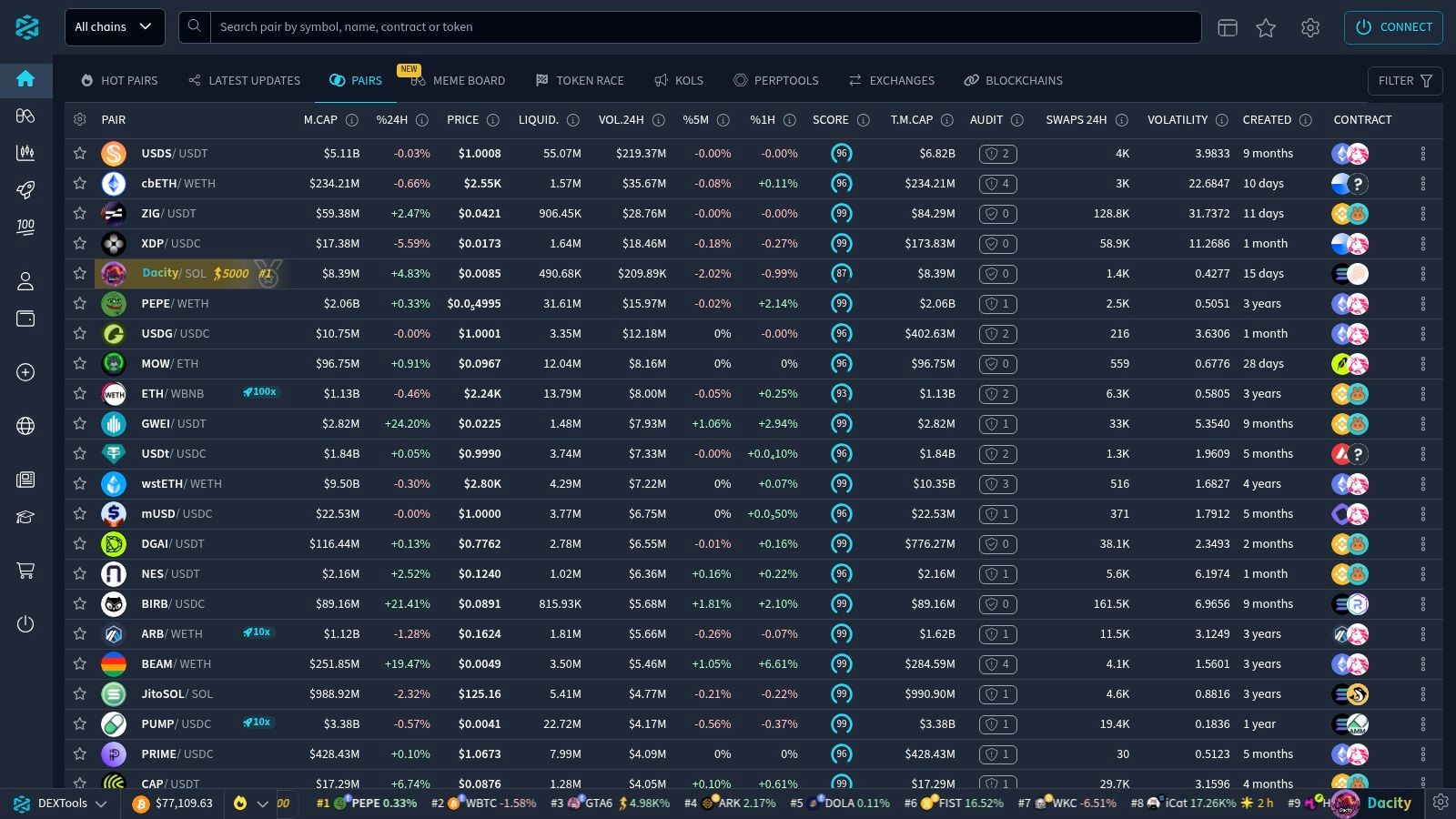
That combination is convenient if you're already on the pair page checking liquidity and recent trades. It's also where traders make a lazy mistake. They read the score and skip the line items underneath it.
Where the Score Stops Helping
A combined score can hide one bad flag inside several acceptable ones. Open the findings. Check whether ownership is renounced, whether minting is still possible, and whether taxes can change. A token that lets you sell but takes most of the exit is not a usable exit.
Research on bait-and-trap tokens summarized by Atomic Wallet's honeypot guide describes fees above 90% as economically prohibitive, in a dataset with 2,629 suspected operations representing 71.5% of operations analyzed.
- Pros: Safety data sits beside trading context, several contract checks in one report, checker described as free to use.
- Cons: Indicators are not a dedicated sell simulation, and safety data does not establish legitimacy.
3. Token Sniffer
Paste an address. Get a fast second opinion. That is the job Token Sniffer does best, and you shouldn't ask it to do more than that.
The scanner runs automated contract and scam-pattern screening and returns a token score and scam-status result. Its site describes address-based lookup across 16 supported chains and API documentation for token results. Its monitored-token database makes it useful when you want a quick read before you spend time on a deeper report.
A score tells you where to look. It doesn't tell you the exit works.
Automated pattern matching has a ceiling. It can miss novel behavior, and it can miss what an owner does after launch through privileged functions. Checks may also differ by chain, so a familiar layout does not mean identical depth on every network.
- Pros: Fast address-based screening, large monitored database, website describes the scanner as free.
- Cons: A score is not a substitute for reviewing flags or testing live trading, and owner-controlled changes can arrive after the scan.
Pair it with a sell simulation, not instead of one. If you're trading fast-moving launches, the meme coin trading guide covers the context a scanner cannot check for you, including thin liquidity and copycat contracts.
4. GoPlus Token Security
GoPlus Token Security is the flag reader in this list. Use it when you want to know what the contract permits, not only whether one simulated swap went through.
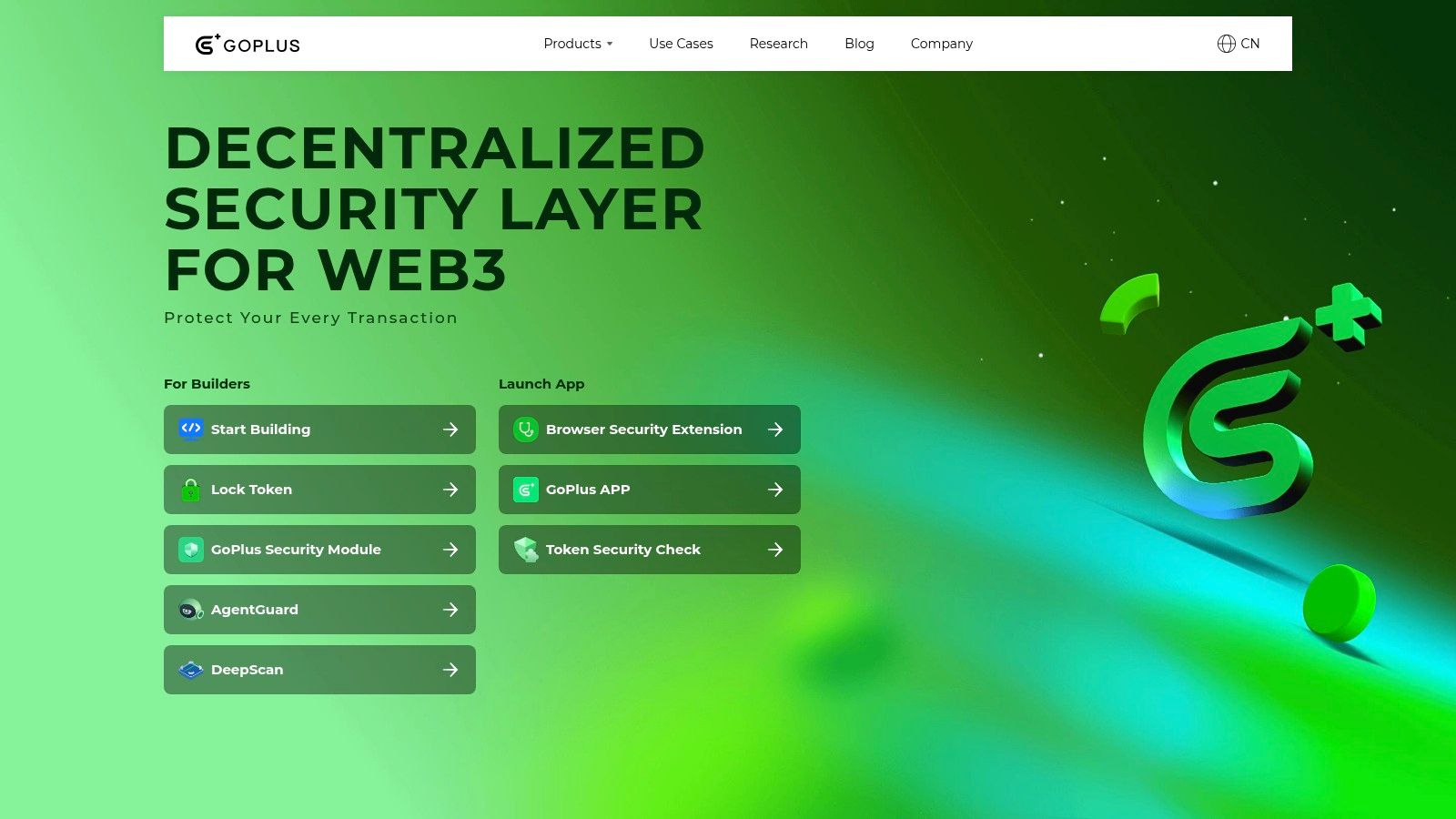
Security documentation summarized by Web3.new's GoPlus protocol page lists explicit indicators including is_honeypot, cannot_sell_all, blacklist status, buy tax, and sell tax. It also notes some owners can set sell tax as high as 100% after launch. That single flag, whether taxes are changeable, is worth more than a headline verdict.
What to Read First
Check honeypot flags, then whether all holders can sell, then blacklist and ownership risks. Then look at the wider contract, trading, and token-information signals. The web checker suits manual checks. The developer API, plus transaction simulation and approval-security APIs, suits workflows that screen tokens automatically.
- Pros: Covers risks beyond sell restrictions, API fits trading workflows, free plan available for lower-volume use.
- Cons: Flags do not guarantee a live swap succeeds, and the output takes more interpretation than a pass or fail label.
5. CertiK Token Scan
CertiK Token Scan is useful when another tool has flagged something and you want the detail behind the warning. Its multi-chain lookup returns a structured report with alerts and passed checks across several risk categories.
Findings can cover honeypot alerts, taxes, contract permissions, holder concentration, and liquidity. Holder concentration matters more than many traders admit. A token can be technically sellable and still be one large wallet away from a collapse you cannot exit through.
Read the report in a fixed order. Permissions first. Taxes second. Holders and liquidity third. That order stops a long list of passed checks from softening one serious alert sitting at the bottom.
- Pros: Multiple risk categories in one report, helps you examine why a token received a warning, basic public scans accessible online.
- Cons: Scores and alerts can be hard to interpret without contract knowledge, data completeness may vary by token and chain, and a favorable scan does not guarantee safe trading or future behavior.
I treat CertiK as an investigation tool, not a quick gate. It slows you down in a useful way when the first two checks disagree.
6. De.Fi Scanner
De.Fi Scanner looks at the contract from a security angle rather than a trading angle. It scans for vulnerabilities and risk signals and produces reports you can work through line by line.
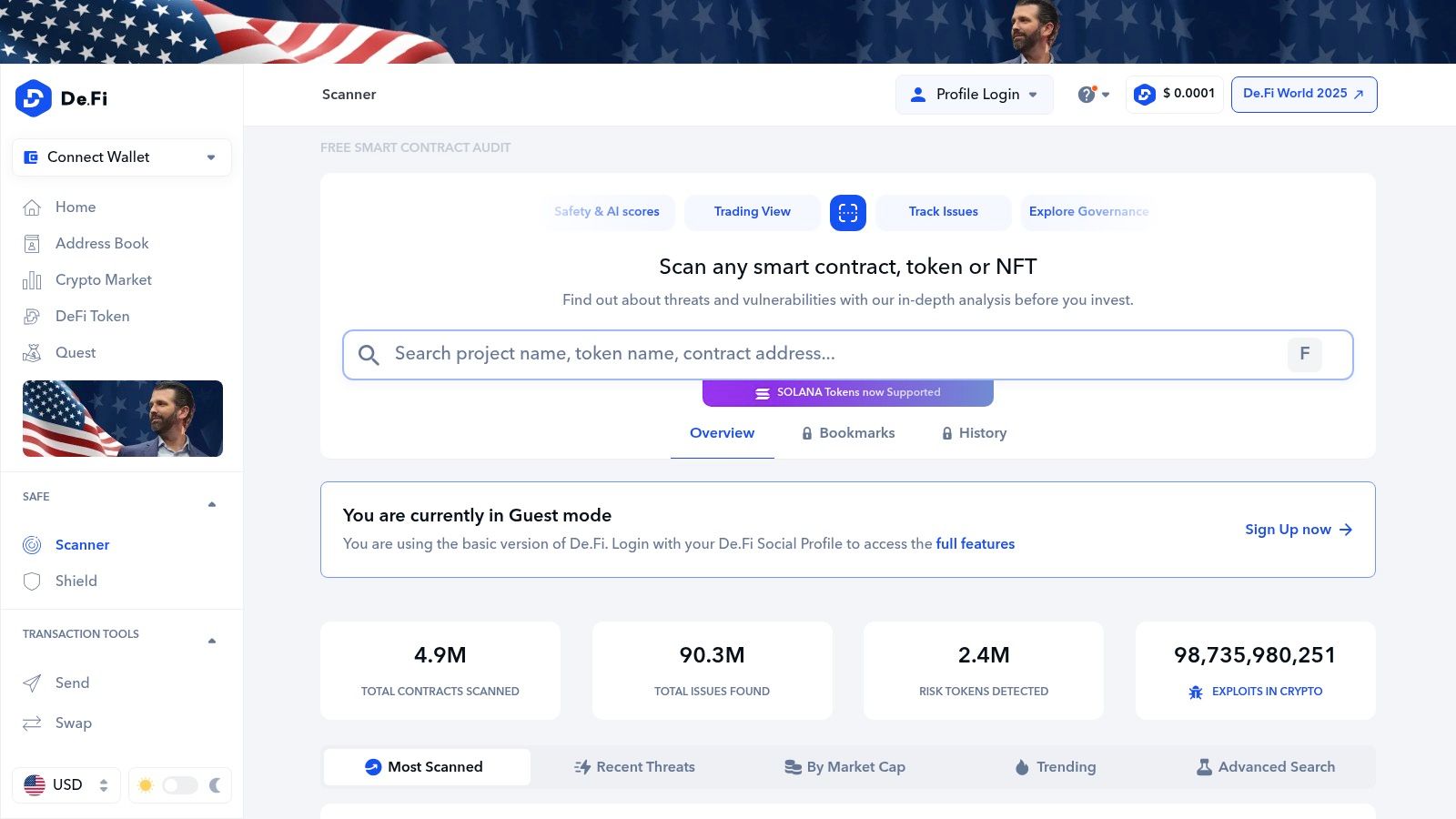
That makes it a complement to a honeypot token checker, not a replacement. A vulnerability scan is not the same as simulating a buy and a sell on the exact pair you're about to trade. Run both if the size justifies the time.
The wider suite adds something traders neglect. De.Fi Shield handles separate wallet-approval checks in the same ecosystem. Ethereum's guide to revoking token access advises approving only what is needed, avoiding unlimited allowances where possible, and regularly revoking access, noting revocation requires an on-chain transaction with a network fee. An allowance stays live until you revoke it.
- Pros: Contract analysis beyond sellability, approval review in the same ecosystem, useful for broader DeFi due diligence.
- Cons: The wider suite is less direct for a quick honeypot check, and some features may depend on account or product conditions.
7. ApeSpace Honeypot Checker
ApeSpace gives you a direct honeypot check: paste a token address and review the token-specific report. Indexed checks cover EVM networks such as BNB Chain and Ethereum.
Use it as an extra read when you need a quick cross-check. A report page lets you revisit the result, but the check does not tell you everything about a token's risk.
Practical rule: If you cannot explain how a checker reached its result, treat that result as a lead, not evidence.
ApeSpace documents its detection method less fully than some larger platforms. Treat its result as a cross-check, not a verdict. Its apparent chain coverage is also narrower than that of broader multi-chain platforms.
- Pros: Simple workflow, useful extra check for EVM tokens, reports are easy to revisit.
- Cons: Limited public detail on methodology, narrower apparent chain coverage, and no safety certification.
Use ApeSpace after a sell simulation and a contract-flag check. If the results disagree, investigate the reason rather than letting one score settle the question.
8. RugCheck
A Solana token can carry risks that an EVM-style sell simulation will not catch. RugCheck analyzes Solana tokens and surfaces authority, holder distribution, and liquidity signals.
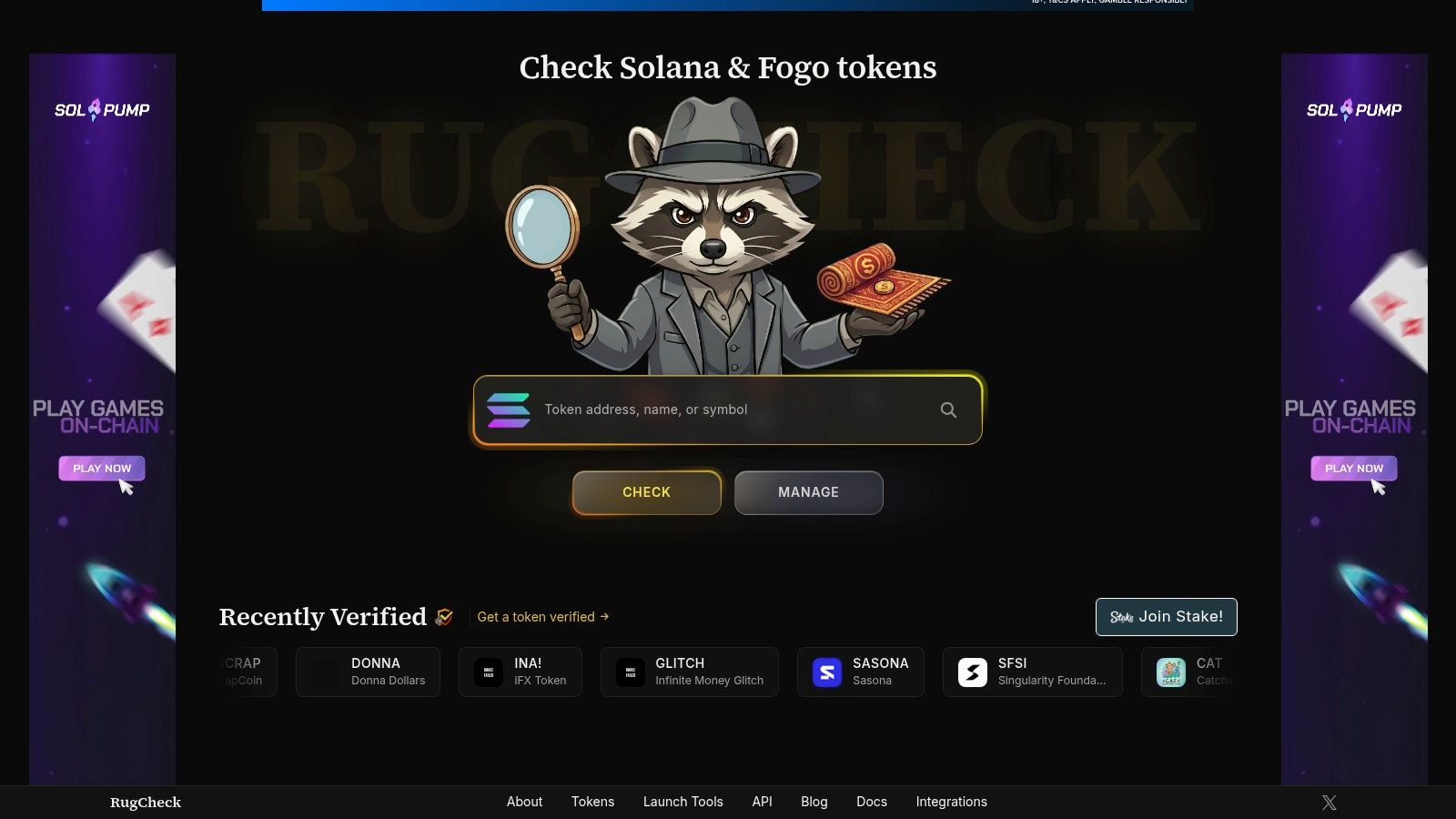
Start with mint authority: if it remains active, the supply can increase. Then check freeze authority, which can prevent token accounts from moving their holdings. Holder concentration and thin liquidity matter too. A token may be transferable yet difficult to sell without significant price impact.
As an independent verifier, RugCheck adds another signal, not a promise of safety. Very new or low-activity tokens may have limited holder and liquidity analysis because there is little history to assess.
- Pros: Focuses on Solana risks, including authority settings, holder distribution, and liquidity.
- Cons: It is not a universal EVM buy-and-sell simulator, and no verification signal proves a token is safe.
Use RugCheck alongside a sellability check and a contract-risk scan. For a broader checklist, see the rug pull checker guide.
9. Solsniffer
A high Snifscore can speed up screening, but it cannot tell you whether a token will sell. Solsniffer gives Solana tokens a single score alongside indicators for mint and freeze status, liquidity-pool status, holders, supply, and deployment details.
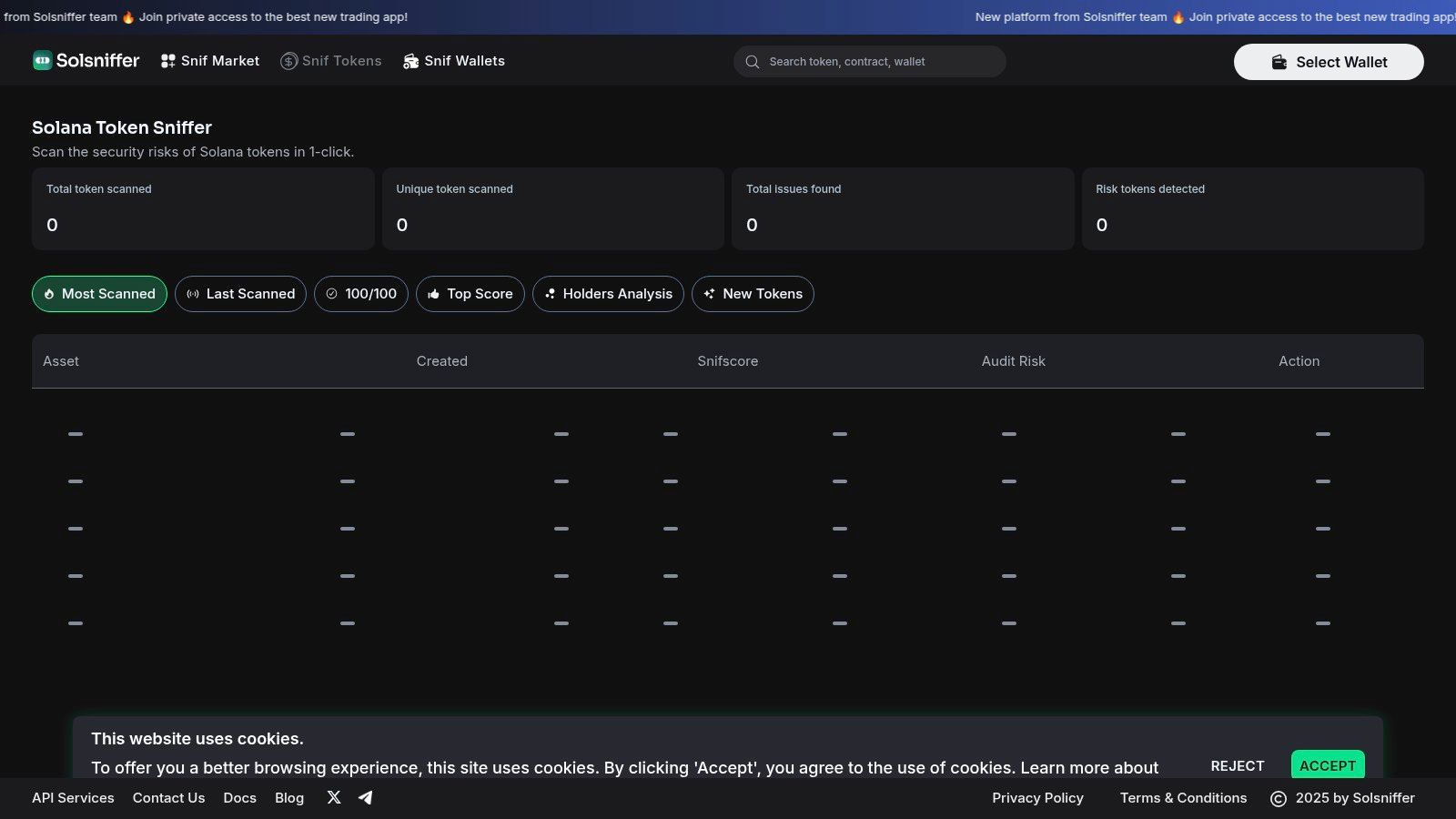
Use the score to sort a list, then open the underlying flags. The score is a heuristic: a serious authority risk and a minor signal can be combined into one number. Tokens with the same score may have different risk profiles.
Solsniffer also offers data and API access for adding Solana screening to other tools. Its API pricing and usage terms can change, so check the provider's current pricing page before you build on it.
- Pros: Solana-focused indicators in a compact report, with API access for developers.
- Cons: The score does not simulate a buy and sell, and it cannot determine whether your position size fits available liquidity.
Cross-check its flags against the actual question you need answered. Solsniffer can help assess Solana token signals; it is not a sellability verdict.
10. HoneypotShield
HoneypotShield aggregates instead of detecting on its own. Its documentation says EVM checks use GoPlus and Honeypot.is, while Solana analysis uses RugCheck. One multi-chain address lookup returns a combined report.
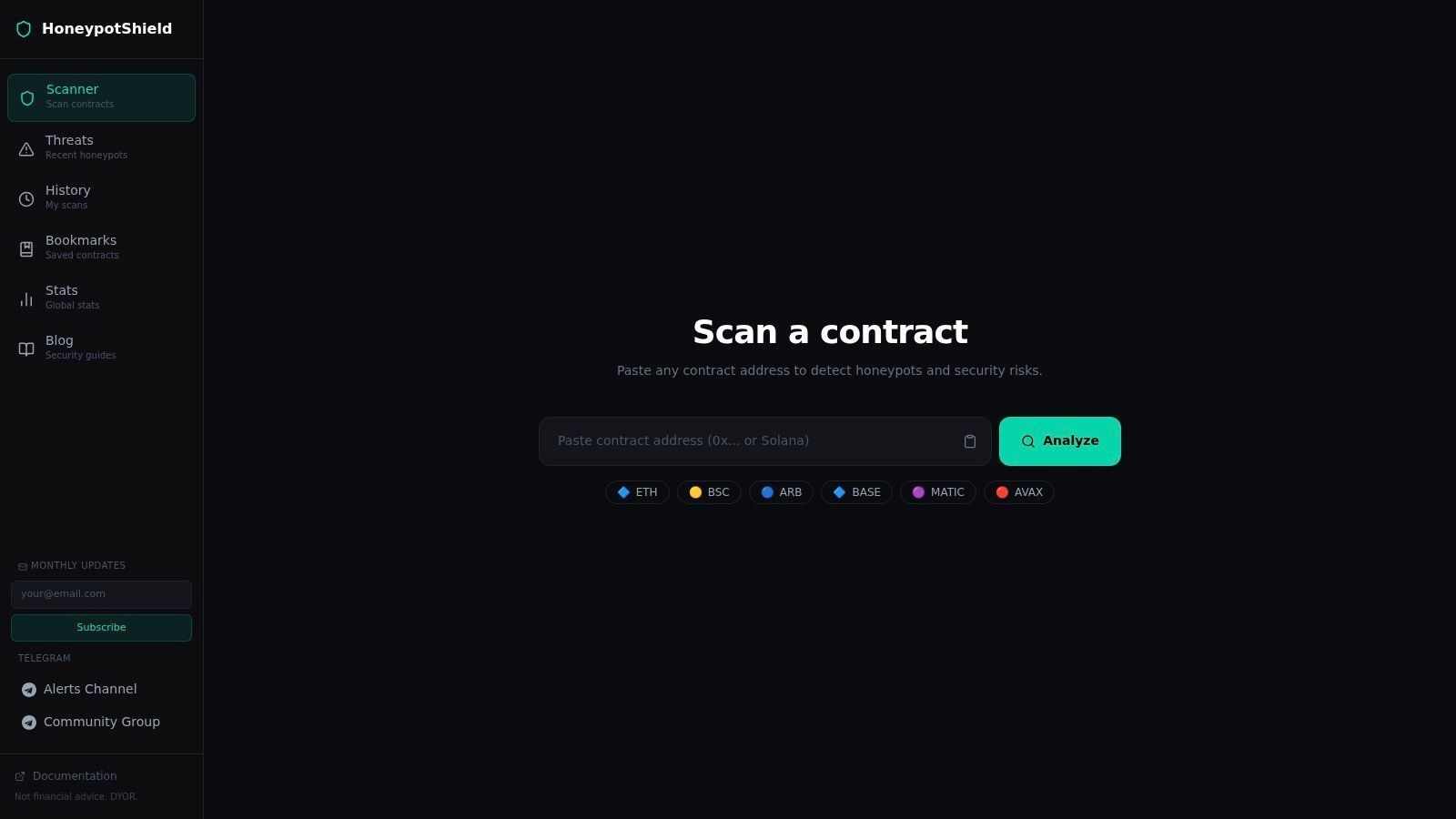
Reports can include taxes, contract permissions, holder concentration, and liquidity-related signals. For a trader moving between EVM and Solana tokens, one interface covering both saves tab switching and keeps the workflow consistent.
Aggregation has a clear cost. Results inherit the coverage limits of the external providers behind them. Extended Honeypot.is simulation is documented for Ethereum, BNB Chain, and Base. The documentation also identifies blind spots, including bundled launches and coordinated-holder patterns that may not be detected.
- Pros: Combines several security providers, convenient overview across EVM and Solana, documentation names known blind spots.
- Cons: Provider limits carry through, and an aggregated green result can look more independent than it is.
Use it as an overview. When something looks off, go to the underlying provider and read the original report.
How the honeypot token checkers compare on chain coverage, sell simulation, free access, and best use
| Item | Chain focus | Sell simulation | Free access | Best for |
|---|---|---|---|---|
| Honeypot.is | Ethereum, BNB Chain, Base | Yes, simulates buys and sells | Public checker and API documentation | Checking whether an EVM token can be sold |
| DEXTools Token Safety Checker | DEX-listed tokens; chain coverage not specified | No dedicated sell simulation stated | Checker described as free | Safety indicators alongside DEX market data |
| Token Sniffer | 16 supported chains, according to its site | No dedicated sell simulation stated | Scanner described as free | Fast contract and scam-pattern screening |
| GoPlus Token Security | Multi-chain; specific coverage not stated | No live swap simulation stated | Free plan for initial or lower-volume use | Broader token-security checks and API integrations |
| CertiK Token Scan | Multiple chains | No dedicated sell simulation stated | Basic public scans available | Reviewing structured token-risk findings |
| De.Fi Scanner | Chain coverage not specified | No exact-pair buy-and-sell simulation stated | Access may depend on account or product conditions | Broader contract and DeFi security checks |
| ApeSpace Honeypot Checker | EVM tokens, including BNB Chain and Ethereum | Honeypot check; simulation details not specified | Access terms not specified | A straightforward additional EVM token check |
| RugCheck | Solana | No EVM-style buy-and-sell simulation | Access terms not specified | Checking Solana authority, holder, and liquidity risks |
| Solsniffer | Solana | No EVM-style buy-and-sell simulation | API terms not established | Compact Solana token-risk reports |
| HoneypotShield | EVM and Solana | Extended EVM simulation via Honeypot.is on Ethereum, BNB Chain, and Base | Access terms not specified | Combined multi-provider token-risk overview |
Where to Go From Here
Run the checks in a fixed order and stop improvising it per token. First, simulate the sell with Honeypot.is on supported EVM chains, because blocked exits are the defining honeypot failure. Second, read the contract flags on GoPlus, DEXTools, Token Sniffer, or CertiK, with attention to changeable taxes, blacklists, minting, and ownership. Third, on Solana, check authority settings on RugCheck or Solsniffer, because mint and freeze authority matter more there than an EVM simulation that does not apply.
Then do the step most traders skip. Recheck after you are in. A result is only a snapshot of current contract state, a point made in CryptoLinks' honeypot checker listing, which argues for freshness indicators, change alerts, and explicit post-scan assumptions. An owner can raise a sell tax, activate a blacklist, pause transfers, or upgrade proxy logic after your scan. Liquidity can also leave without any contract change at all.
Separate binary sellability from economic exit. A sell that completes after a heavy tax, severe price impact, gas, and approval costs can still return almost nothing. Look at net proceeds at your actual size, not at a test amount. If you cannot estimate what you'd receive, you don't have an exit plan. You have a hope.
Scale is the reason this cannot be optional. Reporting on GoPlus Security via Whale Alert's October security summary said honeypot tokens increased 600% month over month in October 2025, reaching 2,189 identified tokens. New tokens arrive faster than anyone can review them by hand.
Copying another trader does not remove any of this. The SEC investor alert on crypto asset securities states crypto asset investments can be exceptionally volatile and speculative, with significant risk of loss, illiquidity, technical failures, and fraud. State it plainly. Copy trading carries risk, and past performance does not predict results. Timing, slippage, taxes, and contract changes can make your outcome differ from the trader you copied. That also means telling users promptly when a sell does not go through matters, and when a token cannot be sold we check repeatedly from more than one source over at least a day before marking the position can't be sold and booking its cost as a loss.
If you want a Telegram bot that mirrors buys and sells of a top fomo trader into your own wallet at your chosen size, start at the copyfomo homepage. Founders building in this space should also read up on regulatory planning for crypto founders before they ship.
Check the exit before you copy the entry, then let copyfomo mirror the buys and sells of a top fomo trader you pick into your own wallet at your chosen size through its Telegram bot. You keep custody, you set the size, and you can pause new copies when a token no longer looks right. Start the bot on Telegram and run your checker sequence on every new token before you let it trade.
stop reading. start copying.
pick a trader from the fomo leaderboard, set your size, and the entries and the exits land in your own wallet while you sleep.
open copyfomo on telegram →