How to Copy Trade Without Giving Up Your Wallet
see how to copy trade from your own wallet: bot setup, size caps, exits, slippage checks, and how to revoke an allowance. results are not guaranteed.
You open fomo and find that a trader you follow bought while you were asleep. By the time you check the chart, the price has moved and you don't know whether they're still holding. Learning how to copy trade starts with fixing that execution gap without handing over control of your wallet or letting someone else's position size become yours.
copyfomo is a Telegram bot that automatically copies trades from top traders on the fomo app. You choose the trader, size, and limits. The automation handles execution, but you still carry the loss when a copied position goes against you.
Table of Contents
- How to Set Up Copy Trading in the Bot
- Check the Trader's History Before You Copy
- Set Size Caps and Your Own Exits
- Why Your Fill Differs and How to Read It
- Keep Allowances Finite and Revocable
- Open the Bot and Start Copying
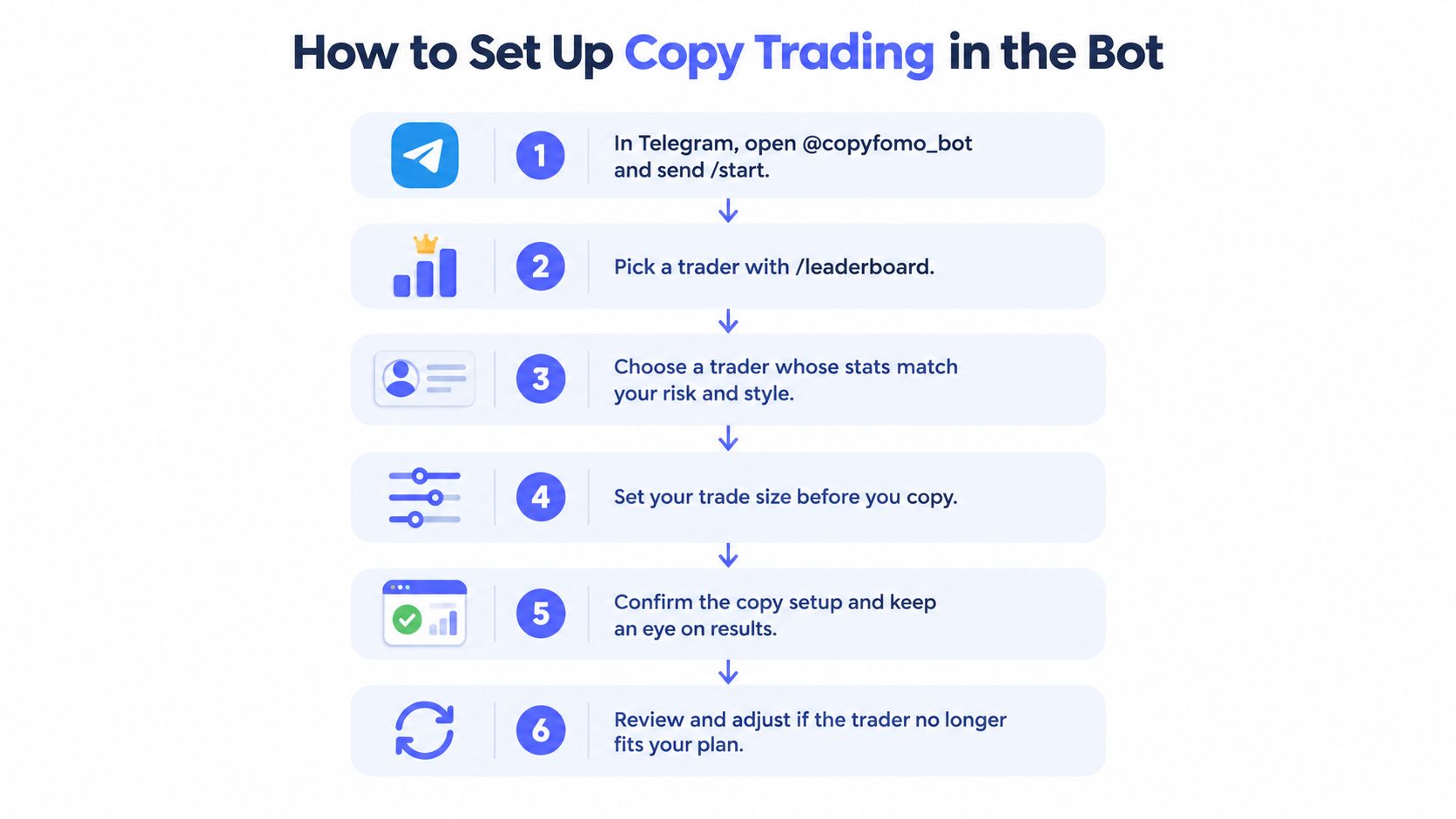
How to Set Up Copy Trading in the Bot
In Telegram, open @copyfomo_bot and send
/start. This opens the setup flow and gives you the commands you'll use to manage copying. Keep the bot conversation available so you can inspect trade messages instead of relying on the source trader's profile.Pick a trader with
/leaderboard, or use/find. The leaderboard gives you candidates ranked by realized PnL, not a recommendation to copy the first name. Run the history checks below before enabling copying. There's no affiliation between copyfomo and any listed trader.Open that trader's copy flow and set your size and cap before any buy can fire. Size is configured per trader, while the cap limits each fill. Choose settings you can leave unattended without needing to intervene because the source trader suddenly takes a larger position.
Fund your wallet with
/deposit. Supported chains are Robinhood Chain, Base, BNB, and Solana. Check the selected chain before sending funds, and keep its native asset available for transaction fees. A token balance alone isn't enough to pay those fees.When the flow requests spending permission, approve a finite amount. Check the token, full spender address, and amount before confirming. You're authorizing spending, not transferring wallet ownership. Disconnecting your wallet doesn't remove that authorization.
Leave the bot running after completing the copy flow. Before copying a buy, copyfomo checks that the trader actually paid for it. An unverified buy is skipped. A verified buy is copied within seconds and you receive a message, without tapping to approve each swap. Funds stay in your wallet.
Understand What You're Approving
On an ERC-20 network, an allowance authorizes a designated spender to withdraw tokens up to a specified amount, as defined in the ERC-20 standard. The allowance function reads that permission, while approve sets or replaces it. A new approval overwrites the existing amount rather than adding to it.
That distinction matters when you increase a trading budget. A spending approval isn't just a setup confirmation you can forget after closing Telegram. It's an active on-chain permission until you reduce or revoke it.
The ERC-20 allowance model also shouldn't be treated as a description of every permission on every supported chain. Read the actual authorization presented by your wallet. Don't approve a transaction just because its timing matches the setup flow.
Keep the First Session Small
The first session should test the workflow, not your willingness to take risk. Use a small ticket and inspect the selected chain, available balance, and trade messages before increasing size.
- Check the wallet balance. Leave room for fees instead of allocating everything to copied buys.
- Read the active settings. Confirm the trader and cap you intended to use.
- Inspect the first message. Make sure you understand what opened and what it cost.
If something doesn't match your intended setup, resolve it before allowing more exposure. Automation makes an incorrect setting repeatable too.
Check the Trader's History Before You Copy
| Check | What to look for | Why it matters |
|---|---|---|
| Trade history length | Record spans more than one market phase | A short streak can hide drawdown |
| Win rate with average win and loss | Win rate read next to average win and average loss | A high win rate with small wins can still lose money |
| Maximum drawdown | Largest peak-to-trough loss over the record | Shows the historical loss a follower may have had to sit through |
| Holding time | Spread of holding periods, not only the average | Short holds face different fills than long holds |
| Token concentration | Results spread across several tokens | One token carrying most results is one bet |
| Results after costs | PnL after gas, swap fees, and slippage | Costs sit on the follower's fill, not on the leaderboard number |
A clean record is more useful than an impressive headline. Read losing trades alongside winning trades, and check whether the trader's activity remains consistent across the record. A trader who recently changed from longer holds to rapid entries and exits needs a fresh assessment.
Don't treat missing information as a passing result. If you can't establish drawdown, costs, or how positions closed, you don't have enough information to judge those parts of the strategy.
Test Whether the Trades Are Copyable
The replication test asks a narrower question than whether the trader made money: could those trades still make sense at your execution price, size, and cost? Compare the source's holding periods with the delay and price differences you should expect from a separate transaction.
IOSCO's review of imitative trading identifies timing and pricing gaps, strategy changes, frequent trading costs, unsuitable products, and operational failures as reasons follower results can differ from leader results. A ranking doesn't account for your ability to tolerate those differences.
Exits belong in this assessment. Copying an entry without its exit can leave you exposed after the source has already reduced risk. Check completed position lifecycles, not just a stream of buys or a collection of profitable closes.
Read Concentration Beyond the Token Count
Several tokens don't automatically mean several independent bets. Check whether the trader repeatedly takes similar exposure, trades the same market theme, or relies on a single unusually successful position.
- Review ordinary trades. Ask whether the record still looks coherent without its standout winner.
- Inspect losing holds. Look for positions the trader kept while closing winners quickly.
- Check exit completeness. Establish whether the history includes partial sales and remaining exposure.
A strong realized-PnL rank shows a historical result. It doesn't show whether that result survives copying at your size. Past performance does not predict results.
Set Size Caps and Your Own Exits
Start with a flat ticket or a share of the trader's size, then set a cap. Your copy uses your configured sizing, not an obligation to match the leader's dollars. The cap prevents a source trader's larger order from turning into an oversized fill in your wallet.
I would start with a flat ticket while testing execution. It's easier to compare costs and price differences when your own trade amount isn't changing with every source order. Proportional sizing still needs a cap because the source trader can change their size.
Larger tickets face worse prices more often when liquidity is limited. Treat the cap as a risk limit, not a profit tool. Also decide how much total exposure you're willing to leave open, since repeated capped fills can still create a large portfolio.
A controlled copy-trading experiment found that offering direct copying increased participants' risk-taking beyond providing performance information alone. That's a reason to choose limits before watching a leaderboard, rather than increasing them after a trader's winning streak.
Separate Your Exits From the Trader's Exits
Take profit and stop loss use the levels you set, not the source trader's levels. They apply to copied positions and may trigger before the source trader sells.
The scope of each setting matters:
- Inside a trader's copy flow. A stop loss applies only to that trader.
- From
/settings. A stop loss applies to every trader you're copying. - Account-wide controls. Minimum trade and max chase apply across the account.
Changing take profit or stop loss affects positions already held, not only the next trade. Read the existing exposure before changing either setting. A change intended for a future entry can also alter how a current holding is managed.
The take profit and stop loss guide explains these controls in more detail. Don't assume the source trader's exit plan matches the loss you're prepared to accept.
Know What Happens to Existing Positions
When the source trader sells, your copy sells the same fraction. If you selected all at once, it sells the full position instead. That choice changes how much exposure remains after a partial source exit.
If you add to a token you're already copying, the whole position stays under your take profit and stop loss levels. A token bought by hand is yours to sell by hand from /portfolio.
Position check: Stopping a trader isn't a sell order.
If you stop copying that trader, nothing is sold. The position keeps its PnL, and your own take profit and stop loss remain active. That's different from pausing copying, which also pauses those automated exits.
Test with one trader and one cap. Read the first closed position before adding another trader, and check whether the entry, exit, and costs behaved as intended. A completed test establishes that you understand the workflow, not that future trades will work out.
Why Your Fill Differs and How to Read It
A ranked wallet buys while you're asleep. With copying active, copyfomo can open the position at your configured size, capped at your limit, without waiting for a tap. A verified source buy is copied within seconds, and sells follow the source unless one of your own exits fires first.
You receive a message for each mirrored entry and exit, including your PnL. Those messages describe your execution, which is the result you need to evaluate. The source trader's result is a reference, not your account statement.
| What can differ | Why | Control you keep |
|---|---|---|
| Entry price | Copy lands seconds later, into different liquidity | Ticket size and per-trade cap |
| Exit | Sell mirrors the trader's fraction, or all at once if you chose that | Your take profit and stop loss can fire first |
| Costs | Gas, swap fees, and slippage sit on your fill | Minimum trade and max chase |
| Risk | Realized PnL is history, not your size or your future | Pause switch and manual sells from /portfolio |
A Fast Copy Still Gets a Separate Price
A copied swap is a separate transaction. Between the source fill and yours, other traders can trade, liquidity can change, and the price can move. Copying the same token doesn't mean receiving the same entry.
A study of decentralized-exchange execution reports that roughly 90% of transactions in its dataset waited less than 12 seconds before confirmation in a block. The same study finds that slippage increases with time spent in the mempool, larger orders can face more adversarial slippage, and liquidity reduces that effect.
That finding is context, not a timing benchmark for your wallet or a measurement of copyfomo. Your trade message is the relevant evidence. Read the printed slippage rather than assuming that execution within seconds means an identical price.
If printed slippage is wide, lower the ticket or max chase before the next copy. Don't increase size to compensate for a poor fill. That exposes more capital to the same execution problem.
The guide to slippage in crypto explains the distinction between a quoted price and the price you receive. Use that distinction when comparing a copied entry with the leader's entry.
Judge the Full Position, Not the Buy Message
Entry quality is only part of the result. The source may sell in fractions while you use all-at-once exits, or your take profit may close before their sale. Even when both accounts finish trading the token, they may have held different amounts through each price move.
The overview of copy-trading evidence describes mixed findings, including smaller gains on successful copied trades than on successful independent trades in later research. The practical conclusion is limited: copying a trade doesn't establish that a leader's performance transfers to the follower.
Read a closed position as a sequence:
- Entry. What amount went in, and what slippage was printed?
- Position changes. Did the source reduce exposure, or did your own exit trigger?
- Close. What amount came out after your actual execution?
A profitable source trade can still be a poor copy if your price and costs consume the available margin. The reverse comparison isn't a useful operating plan either. Judge the system on your completed trades, not occasional favorable differences.
Respond to the Status You Actually Have
An unverified source buy is skipped. That means there's no copied position to manage for that event. Don't treat an observed source buy as proof that your wallet entered too.
Pausing has a different consequence. No new mirrors open, existing positions stay open, and take profit and stop loss pause too. They resume when copying resumes.
If you pause with exposure still open, decide what to do with it. Resume copying if you want those automated controls active again, or sell by hand from /portfolio. A paused position isn't a closed position.
Read the pause state as an execution state, not as protection from price movement.
Use /copies to break PnL down per trader. Trade history lists closed positions with the amount in, amount out, and market cap at entry and exit. These fields help explain a completed fill; they don't predict the next one.
Review a Session Before Adding Size
Compare a few printed slippage lines with the ticket sizes used. Look for whether larger copies had less acceptable fills and whether the closed result matches the exits you intended.
Keep the review concrete. Record the size, printed slippage, exit behavior, and completed PnL rather than writing that a trader looked strong. Pause if copies repeatedly chase prices you don't want, while remembering that pausing also suspends your automated exits.
Copy trading can lose money. Past performance does not predict results. Fast execution reduces the need for manual action, but it doesn't remove the difference between the leader's trade and yours.
Keep Allowances Finite and Revocable
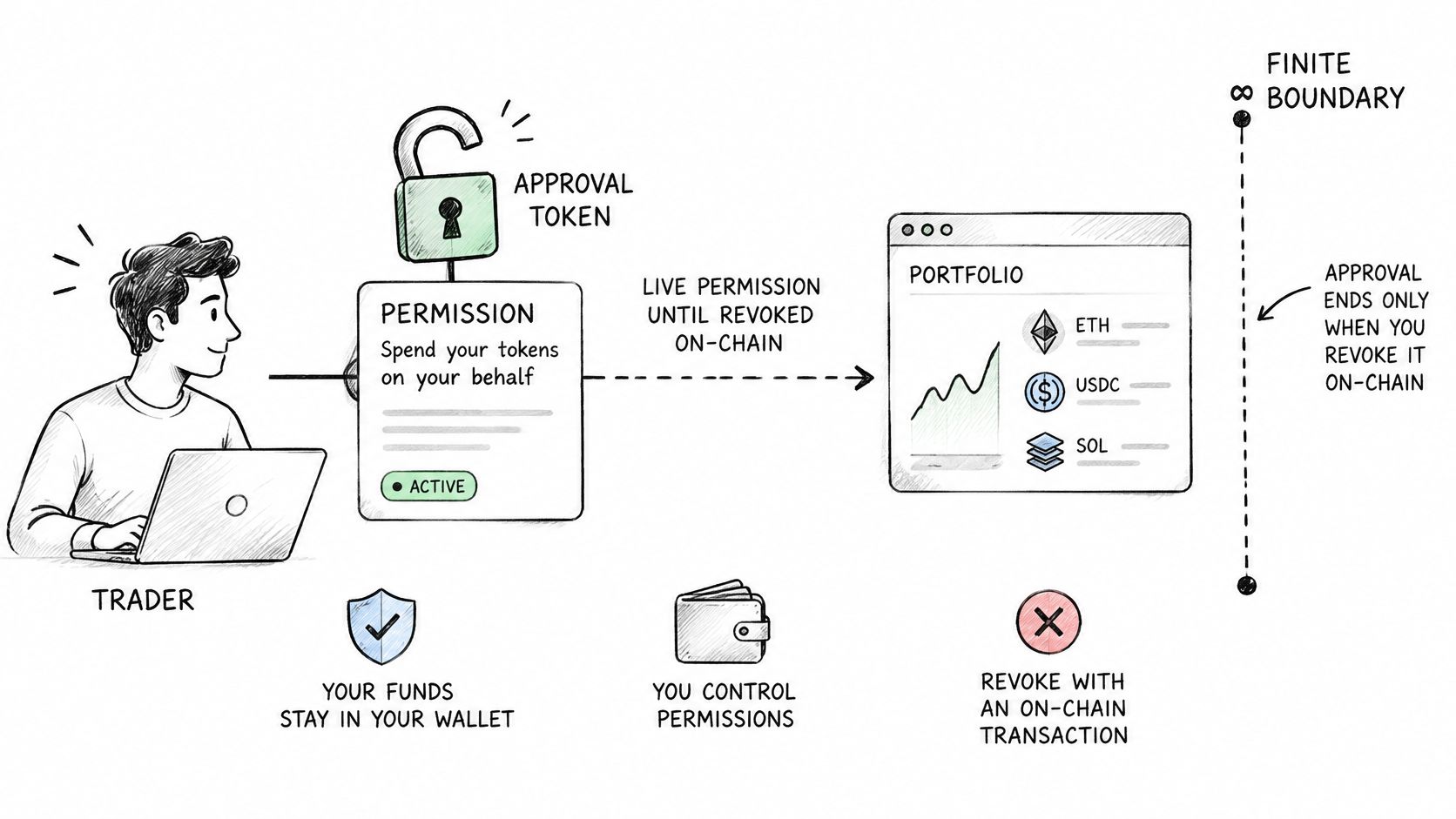
Prefer a finite allowance over an unlimited approval. Non-custodial means the service cannot withdraw at will, but an approval is still a live spending permission until an on-chain transaction reduces or removes it.
For ERC-20 tokens, an unlimited approval can expose the full token balance if the authorization or spender is compromised. Ethereum's annotated ERC-20 guidance also explains the transaction-ordering risk when changing an existing nonzero allowance directly to another nonzero amount.
Set the allowance to zero first. Wait for confirmation, then set the new finite amount. Otherwise, the spender may use the old permission before the replacement transaction confirms.
Revoke Through a Confirmed Transaction
Revocation isn't an interface preference. It changes the authorization recorded on-chain. The Gem Wallet approval-revocation guide specifies that removing an ERC-20 approval requires an on-chain transaction and the network's native asset to pay its fee.
Use a deliberate sequence:
- Inspect approvals. Find the relevant token and network in your wallet's approval-management interface.
- Match the spender. Compare the full address, not just the opening and closing characters.
- Submit the revocation. Change the allowance to zero and confirm the transaction details.
- Wait and verify. Read the allowance back after confirmation and confirm that it's zero.
Keep enough native asset available to complete this process. If you've spent the fee balance, you'll need to replenish it before submitting the revocation.
Disconnecting Telegram or disconnecting your wallet doesn't complete those steps. Neither does closing the browser or removing a shortcut to the bot.
Separate Pausing From Removing Permission
Pause stops copying. Revoke removes spending permission. They solve different problems, so don't use one as evidence that the other happened.
If you're winding down the setup, pause first and inspect the remaining positions. Sell anything you still want closed from /portfolio, then revoke the relevant permission. Check transaction confirmations rather than assuming that pressing a button completed the action.
The guide to a non-custodial DeFi trading bot provides more context on automation through wallet permissions. The useful distinction is between retaining your keys and limiting what an approved spender can do.
Keeping keys in your wallet doesn't remove smart-contract risk, approval risk, or bad fills. A finite allowance limits authorized spending, but it doesn't limit how far an acquired token can fall. Nothing about revocation changes the market risk of positions you continue holding.
Open the Bot and Start Copying
The decision isn't whether a leaderboard looks convincing. It's whether you're prepared to let the setup execute at your chosen size when you aren't watching. If that prospect makes the ticket feel too large, reduce it before starting.
If your wallet is funded, your ticket and cap are set, and you understand how to revoke permission, start the Telegram flow through the copyfomo website. Copy trading can lose money, past performance does not predict results, and this is not financial advice. Don't begin with money you need for bills or other commitments.
Decide What Would Make You Stop
Write down the conditions that would make you stop before the first copied trade. They should describe your account and execution, not whether the trader remains popular. Unacceptable slippage, exposure beyond your intended budget, or a trading style you no longer understand are concrete reasons to reassess.
- Keep trading disabled if the record is incomplete. A high rank doesn't fill gaps in exit history or costs.
- Keep size unchanged while testing. A favorable first close doesn't establish repeatable execution.
- Review open exposure before walking away. Know which positions remain and whether automated exits are active.
You don't need to force a decision because a source trader is active now. Missing an entry is different from entering with settings you haven't checked.
Study First if You Need More Evidence
Use the trader pages to examine candidates, the public data page to inspect published figures, and the blog to understand controls before enabling them. None of those pages replaces a review of your own fills.
Keep cashback separate from the trading decision. $COPY cashback is paid into your copyfomo wallet once your total reaches $5. Seasons last 10 days each, and the share steps down through 30%, then 20%, then 10%.
That's cashback, not evidence that a copied trade is worth taking. Don't increase turnover or accept a worse fill just to reach a payment threshold.
Your size, your exits, your allowance, your loss if the fill goes against you.
The useful outcome of a first session is operational clarity. You should know what opened, what closed, what remains exposed, and how to stop further activity. If any of those answers is unclear, keep the setup small or leave copying off until you've resolved it.
copyfomo automates verified buys and mirrored sells from selected fomo traders while your funds remain in your wallet. Visit copyfomo to start the bot on Telegram, set a small ticket and cap, and inspect your own fills before increasing exposure.
stop reading. start copying.
pick a trader from the fomo leaderboard, set your size, and the entries and the exits land in your own wallet while you sleep.
open copyfomo on telegram →