Best Meme Coin Tracker Tools for 2026: 8 Options Compared
compare eight meme coin tracker options for dex charts, new pairs, wallet activity and liquidity checks, with usage tips and risk notes.
It's 3 a.m. and a new token shows up on your feed. Volume is climbing. A wallet you follow on fomo is already in. You paste the contract into a meme coin tracker and get a green candle, a market cap, and a holder count. None of that tells you if you can sell.
That's the true test for these tools. A price line is cheap. What matters is whether a tracker shows liquidity you can exit into, separates buys from transfers, flags concentrated holders, and tells you what its labels don't cover. A trending badge is not vetting.
Scale makes the checks harder, not easier. The CoinGecko 2025 State of Memecoins report put total meme coin market capitalization at an all-time high of $150.6 billion in December 2024. It then fell to $47.2 billion by November 2025. Rankings built at the top mean little in that kind of drawdown.
Below are eight trackers compared on what happens after a token looks interesting. Each is judged on liquidity context, trade detail, cost for useful data, and where its signals stop. None of them make a token safe. Copy trading carries risk and past performance does not predict results.
Table of Contents
- 1. DEX Screener
- 2. GeckoTerminal
- 3. DEXTools
- 4. Birdeye
- 5. Solscan
- 6. CoinMarketCap DexScan
- 7. GMGN
- 8. Ave.ai
- How the eight meme coin trackers differ on access, chain scope and main limits
- Use Trackers for Research, Then Own the Risk
1. DEX Screener
DEX Screener is usually the first tab opened when someone drops a contract address. It's a multichain DEX market tracker built for new pair discovery and pair level charts. You search by contract, land on the pair, and get price, liquidity, volume, and recent transactions in one view.
That speed is the point. You can check whether a pool exists, how old it is, and whether trades are printing. Mobile apps and a public API extend the same data beyond the browser, and the public tracker doesn't require a paid subscription to be useful.
What it does not verify
Listings are automatically indexed. They aren't vetted or endorsed, and trending placement doesn't establish quality. A token can look liquid on the headline number and still be thin at your size. A cross-chain analysis of 34,988 meme coins cited by MemeAssist's meme coin tracker guide found 88.1% had liquidity below 0.1% of reported market capitalization. Market cap is not exit depth.
- Pair data first: Check liquidity against the size you'd trade, not against the chart.
- Transaction feed: Look for real two way flow, not only buys.
- Contract search: Confirm you're on the right pair before trusting any number.
Used that way, it's a solid first pass. For deeper wallet work, pair it with the checks in our guide to onchain analysis tools. Just don't treat visibility here as approval.
2. GeckoTerminal
GeckoTerminal is the DEX tracker from the CoinGecko team. It covers real time prices, volume, transactions, and liquidity across many blockchains. The layout is calmer than a trading terminal, which suits comparison work across pools.
It's handy when a token trades in several pools at once. You can see which pool carries the volume and which ones are stale copies with thin liquidity. That matters because the wrong pool gives you the wrong price and worse execution.
Where it fits in a check
Think of it as a market data and charting layer, not an automated copy trading service. It won't mirror anyone for you and it won't validate a project. You're expected to verify data yourself and understand the risk of relying on it.
History shows why that caution is structural. CoinGecko's memecoin supercycle overview estimated sector market capitalization at approximately $90 billion in May 2021, then below $15 billion within the following year. A tracker that only shows today's ranking hides that regime change.
Practical rule: Compare pools side by side before you compare tokens. The active pool is the market. The rest is decoration.
Public tracker and API access are available, and listings for tokens, chains, and DEXs are free. For a clean read on pool activity without extra trading features, it does the job.
3. DEXTools
DEXTools leans toward active monitoring. Live new pair views, a pair explorer, a big swap explorer, multicharts, and favorites let you watch several markets at once. Desktop alerts and Telegram price bots add pings when you're away from the screen.
That layout suits traders who track a shortlist rather than one token at a time. Big swaps stand out faster in a dedicated feed than in a raw transaction list. Multicharts save tab juggling during fast moves.
The cost question
A free tier covers core features, so you can test the workflow first. Some advanced tools, including wallet tracking and additional analytics, sit behind paid tiers or a DEXT holding. That makes the true cost of the data you need less straightforward than with an all free tracker.
Check current plan details before upgrading. Ask a plain question. Which exact feature are you paying for, and would a free pool view plus an explorer give you the same answer.
- Discovery plus monitoring: New pairs, favorites, and alerts in one place.
- Multicharts: Useful when correlated tokens move together.
- Tier friction: Wallet features may require payment or token holdings.
It's a capable workstation if you'll use the monitoring layer daily. If you only check a pair now and then, the free tier is likely enough and the upsell is noise.
4. Birdeye
Birdeye connects token pages to wallet activity, with a strong Solana focus. Token and wallet watchlists, wallet labels, charts, and market activity sit in one research view. Real time streams cover prices, new pairs, large transactions, and wallet moves.
That connection is its strength. You find a token, then you can see which labeled wallets hold or trade it. Labels help organize monitoring, but they're a starting point for questions, not an answer about intent.
Labels and what they miss
A profitable wallet isn't automatically a skilled one. Reporting summarized by ChainCatcher's investigation into bundled launches found 21% of Pump.fun projects had wallets associated with developers participating in issuance bundling. Early allocation can look like talent on a leaderboard. It isn't replicable for followers who buy later.
A wallet label tells you how a platform classifies an address. It doesn't tell you whether its entry was available to you.
Access splits two ways. The trader facing tracker is separate from developer API plans, which include a free Standard tier and paid tiers. Some advanced functions require Pro or paid API access. For a quick price check, the full feature set may be more than you need. For ongoing wallet research, the depth earns its place.
5. Solscan
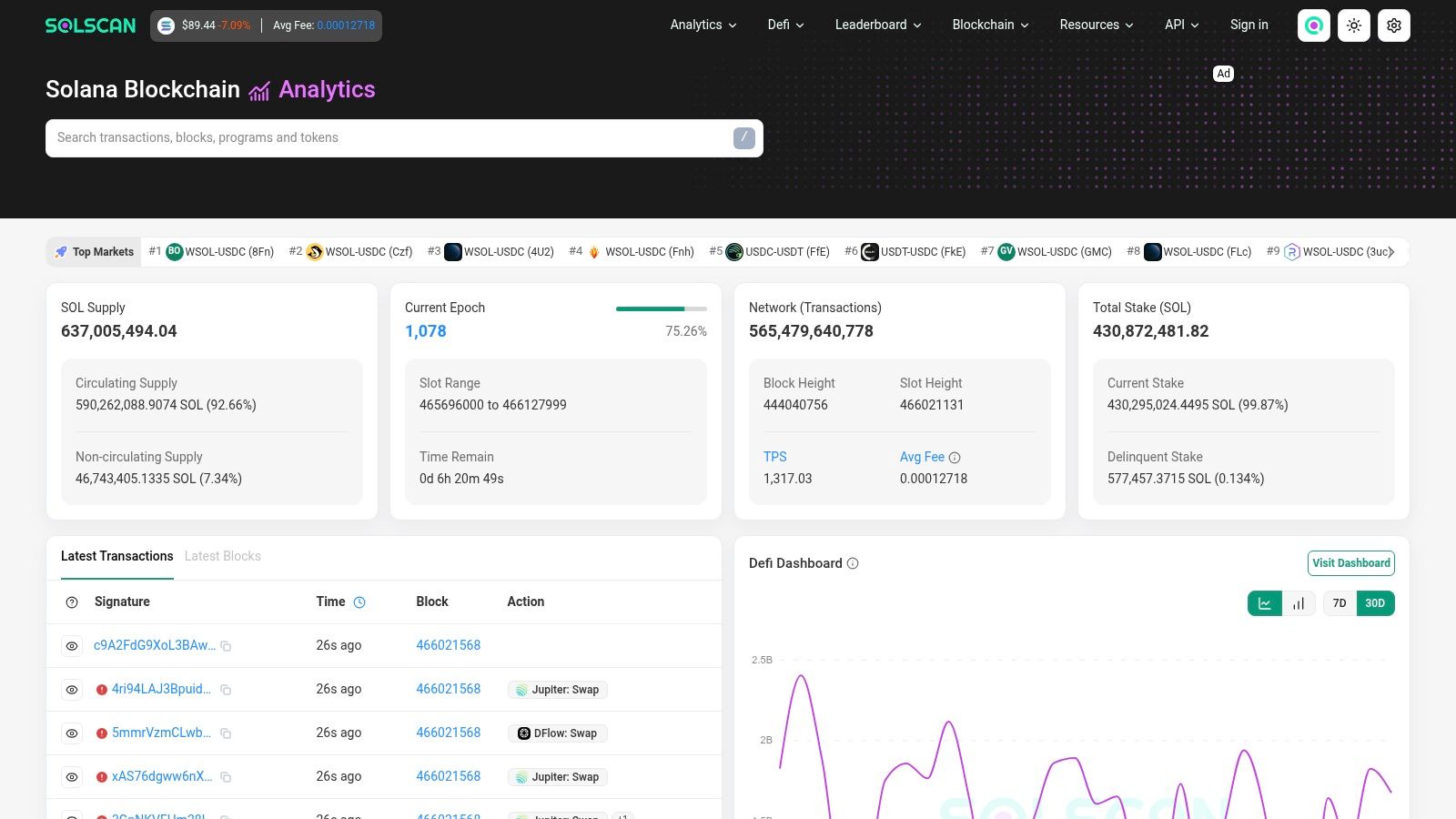
Solscan is a Solana blockchain explorer first and a tracker second. Token pages show holders, transactions, and market information straight from chain records. Its token leaderboard includes Meme, Trending, and New views with timeframes and filters.
Use it to cross check what aggregators show you. If a chart claims heavy activity, the explorer record should support it. Holder distribution and trading activity analytics help you see whether supply sits in a few wallets.
Ground truth with limits
Explorer data is direct, but interpretation is on you. Solscan applies token reputation labels and states their limitations. Those labels aren't guarantees and may not be accurate. Treat them as one signal beside holder concentration and transaction history.
- Holder pages: Check how concentrated supply is before anything else.
- Transaction records: Verify transfers and trades at the source.
- Leaderboard filters: Narrow Solana tokens by activity instead of hype.
The constraint is scope. It's Solana specific, not multichain. If your tokens live on Base or BNB, you'll need another explorer for the same ground level check. Within Solana, though, it's the record other tools should match.
6. CoinMarketCap DexScan
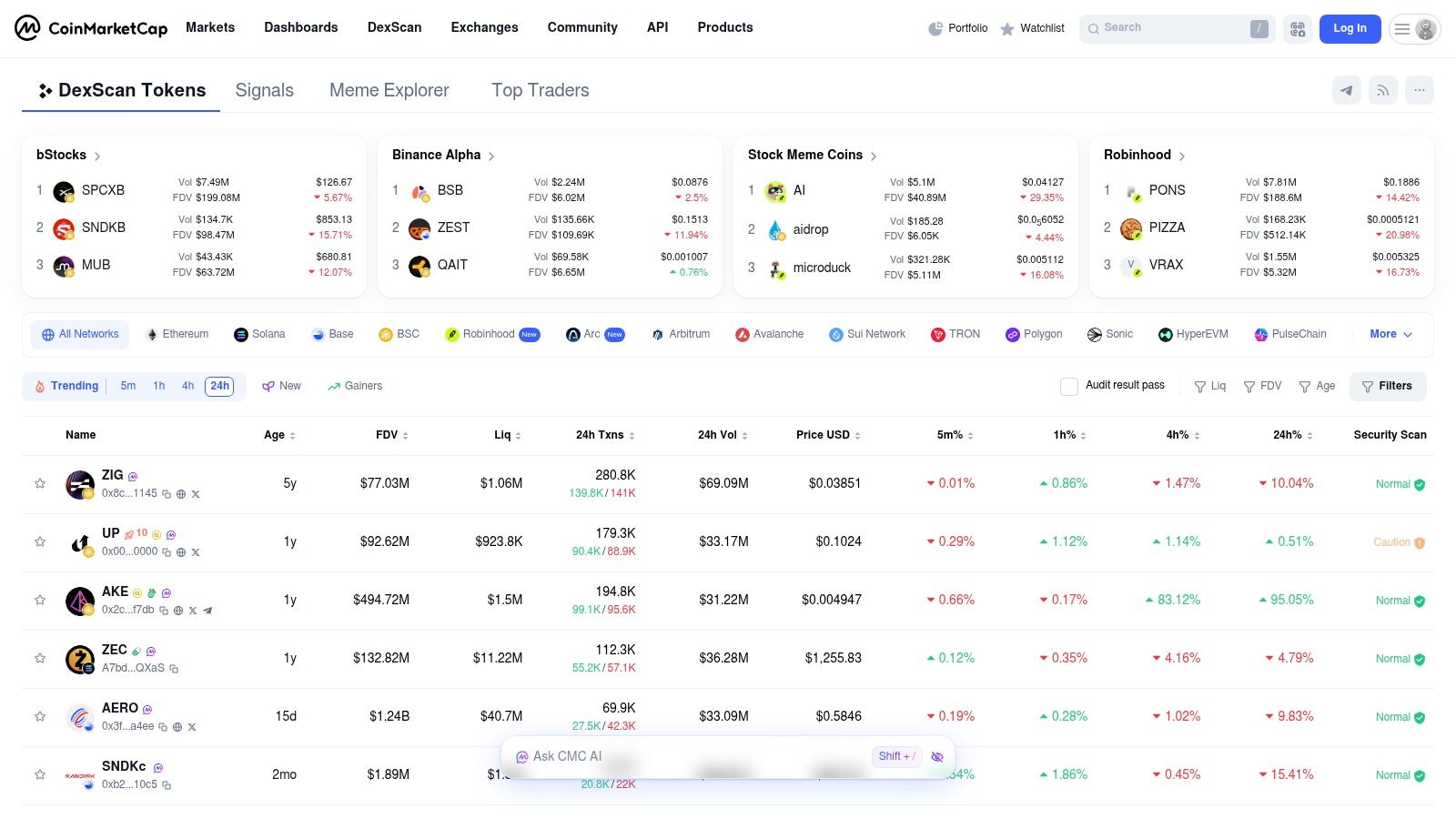
CoinMarketCap DexScan puts DEX discovery inside a platform many traders already know. A dedicated Meme Explorer sits beside new token and trending views. Pair pages surface liquidity, age, transactions, and volume.
Familiarity is the draw. If you already use CoinMarketCap for broad market checks, DexScan keeps meme token discovery in the same environment. It bridges conventional market tracking and on chain token hunting without a new interface to learn.
Discovery is not diligence
That convenience carries a trap. Automatically indexed or unverified assets still require independent checks, and discovery rankings don't establish legitimacy or safety. A polished listing page can make a thin, new pool feel established. It isn't.
Pair age and liquidity deserve more weight than trending order. A token that appeared an hour ago with shallow liquidity is a different risk from one with sustained two way trading, whatever the ranking says. Our breakdown of what a rug pull checker can and can't prove covers the same gap from the contract side.
Use DexScan to build a candidate list. Then verify each candidate in an explorer and a pair level tracker before you act. Discovery is step one, not the decision.
7. GMGN
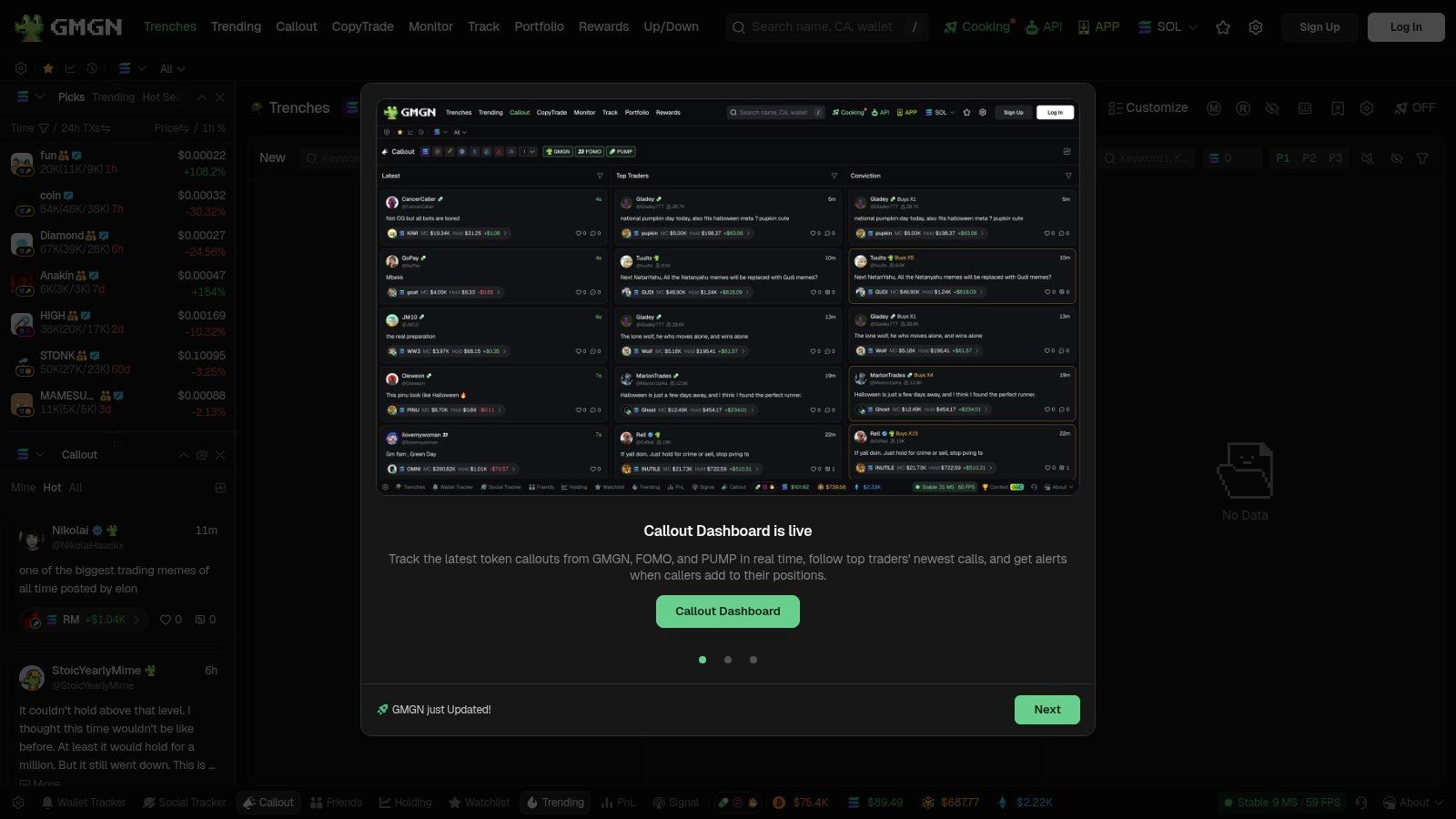
GMGN is built specifically for meme coin discovery and public wallet research. New pair scanning, wallet activity views, and token checks target traders who live in early stage tokens. It's more specialized than a general market tracker.
One detail matters more than most. Its documented workflow distinguishes buys and sells from token transfers. Transfers between wallets can inflate apparent activity if a feed lumps them together. Separating them gives a cleaner read on actual trading.
Checks, then execution reality
Token checks surface factors such as liquidity, permissions, and holder concentration. They flag risk. They don't make a token safe. Wallet activity here is research input, not a reliable signal to copy trades, and trading features and costs should be checked before use.
Execution gap is the other blind spot. Research in a Springer study of Uniswap trading costs found the probability of adversarial slippage when trading PEPE was about 80% higher than when trading a mature asset such as USDC. A wallet's entry price isn't the price you'll get seconds later in a thin pool.
GMGN earns its place for specialized scanning and wallet context. Price impact at your size is still your problem to estimate before you trade.
8. Ave.ai
Ave.ai describes itself as an on chain trading platform with token analytics and a meme token dashboard across many chains and DEXs. Desktop and mobile availability are covered in its documentation. Discovery, analytics, and trading tools sit under one roof.
Wallet and token labels are central here, including smart money and developer related categories. Used carefully, labels speed up investigation. You can spot whether developer linked wallets are active around a token and dig from there.
Corroborate every label
Those labels are platform classifications. Another tool may tag the same wallet differently, and neither is ground truth. Corroborate against explorer records before you act on a label.
Leaderboard style signals deserve the same skepticism. A 2024 quantitative study of two major copy trading platforms found users predominantly followed the ranking scheme shown, while rankings were not directly correlated with long term performance. Popularity and recent results drove placement more than consistent returns.
- Breadth: Many chains and DEXs according to the provider.
- Label context: Developer and smart money tags to investigate, not obey.
- Complexity: More surface area than a basic tracker, plus wallet and execution considerations where trading is involved.
If you trade across chains daily, the breadth helps. If you need a fast check, it may be heavy. Either way, the workflow in our guide on how traders trade meme coins keeps verification ahead of labels.
How the eight meme coin trackers differ on access, chain scope and main limits
Access splits the eight before anything else does. DEX Screener and GeckoTerminal hand over the tracker and an API with no paid subscription. DEXTools keeps core features on the free tier and puts some tools behind DEXT or a paid plan. Birdeye runs a free Standard API tier with paid plans above it. That is the free end of the list. The practical question is blunt: if the number you need to make a decision sits behind a plan, you are comparing budgets, not tools.
Chain scope narrows the field faster than any feature count. DEX Screener covers multichain DEX markets. GeckoTerminal spans multiple blockchains. Birdeye leans Solana and reaches wider. Solscan is Solana only, and it is the one entry where holder and transaction records come before price charts. DEXTools and Ave.ai both claim multiple chains and DEXs by their own count. Provider chain lists are a starting filter, so confirm the pair you care about trades there before you plan around it.
| Tool | Best for | Main limitation |
|---|---|---|
| DEX Screener | New-pair discovery and quick pair checks | Indexed tokens are not vetted or endorsed |
| GeckoTerminal | Comparing DEX pairs, pools, and liquidity | Market-data tool, not a copy-trading service |
| DEXTools | Pair discovery, charting, and monitoring | Some features require DEXT or paid access |
| Birdeye | Token research combined with wallet activity | Advanced functions and API plans cost money |
| Solscan | Checking Solana token holders and transactions | Reputation labels are not guarantees |
| CoinMarketCap DexScan | Meme-token discovery inside CoinMarketCap | Rankings do not establish legitimacy or safety |
| GMGN | Meme-token discovery and public-wallet research | Wallet activity and token checks do not guarantee a good trade |
| Ave.ai | Multichain discovery and trading-oriented analytics | Labels need corroboration, and trading adds wallet and execution risk |
Free access buys breadth, not depth. DEX Screener and GeckoTerminal give the widest read for nothing. DEXTools and Birdeye charge for the sharper view. The wallet-first tools come with a cost that never shows on a pricing page: a tag on GMGN or Ave.ai means little until an explorer confirms the address behind it.
Use Trackers for Research, Then Own the Risk
Every tool above does a version of the same job. They show prices, pairs, volume, holders, and labels. None of them make a token safe, liquid tomorrow, or sellable at the price on screen. That gap is where most losses in this market happen.
Liquidity deserves the last word because it's the check traders skip. A token can print a rising chart while its pool stays too thin for your exit. Liquidity can also disappear. When that happens to a mirrored position, we check repeatedly, from more than one source, over at least a day before marking the position as can't be sold and booking its cost as a loss. That outcome is reported to the user, not hidden behind a stale price.
Execution settings carry their own trade offs. A Springer study of DEX slippage tolerance estimated sandwich attacks cost the ecosystem more than $100 million annually. It also found Uniswap's newer default slippage setting reduced trader losses by approximately 54.7% overall. Looser tolerance fills more trades at worse prices. Tighter tolerance fails more trades in fast markets. There's no setting that removes the risk.
Permissions need the same plain treatment. Ethereum's official guidance on revoking token access explains that token approvals let a contract spend a specified amount from your wallet. It recommends approving only what's needed and regularly reviewing or revoking permissions. Assets can stay in your wallet while an allowance exists, but that allowance still needs monitoring.
Social noise adds one more layer. Traders who spot useful Twitter trends early still face the same pool depth and holder checks once a ticker surfaces. Attention explains volume spikes. It doesn't verify a token.
copyfomo is a Telegram bot that mirrors the trades of top fomo traders into your own wallet at your chosen size. It reports filled buys and sells, skipped copies, and tokens that can no longer be sold. That's automation of execution, not a promise about outcomes. Copy trading carries risk and past performance does not predict results. This article is research guidance, not financial advice, and it doesn't recommend any specific token.
Pick the tracker that matches your chain and your workflow. Verify on an explorer. Size for the exit, not the entry. Then, if automated mirroring fits how you trade, start the bot on Telegram via copyfomo.com.
copyfomo mirrors buys and sells from fomo traders you pick into your own wallet at your size, with a message on every filled trade, skip, and unsellable token. If you've done your tracker checks and automation fits your approach, visit copyfomo to start the Telegram bot.
stop reading. start copying.
pick a trader from the fomo leaderboard, set your size, and the entries and the exits land in your own wallet while you sleep.
open copyfomo on telegram →