What Is Copy Trading? How Mirrored Trades Work in 2026
what is copy trading? see how a copied buy and sell work, how custodial and non-custodial models differ, and the risks to weigh first.

Copy trading automatically repeats another trader's buys and sells in your own account, without you placing each order. But if you copy the same trade, why can your account show a different result?
The gap is execution. You choose who to follow, but your account trades at your size, under your settings, at the price available when your order lands. The source trader's position and your copied position aren't the same transaction.
For traders who already use fomo, the useful question isn't just what is copy trading. It's what gets copied, what stays under your control, and where your position can drift from the source.
Table of Contents
- Copy Trading Defined in Plain Terms
- How a Copied Trade Opens and Closes, Step by Step
- Custodial and Non-Custodial Copy Trading Compared
- Who Uses Copy Trading and What It Solves
- Where Copy Trading Helps and Where It Breaks Down
- Slippage, Exits and Pauses That Change Your Results
- Set Up a Copy Trade on Telegram With a Clear Plan
Copy Trading Defined in Plain Terms
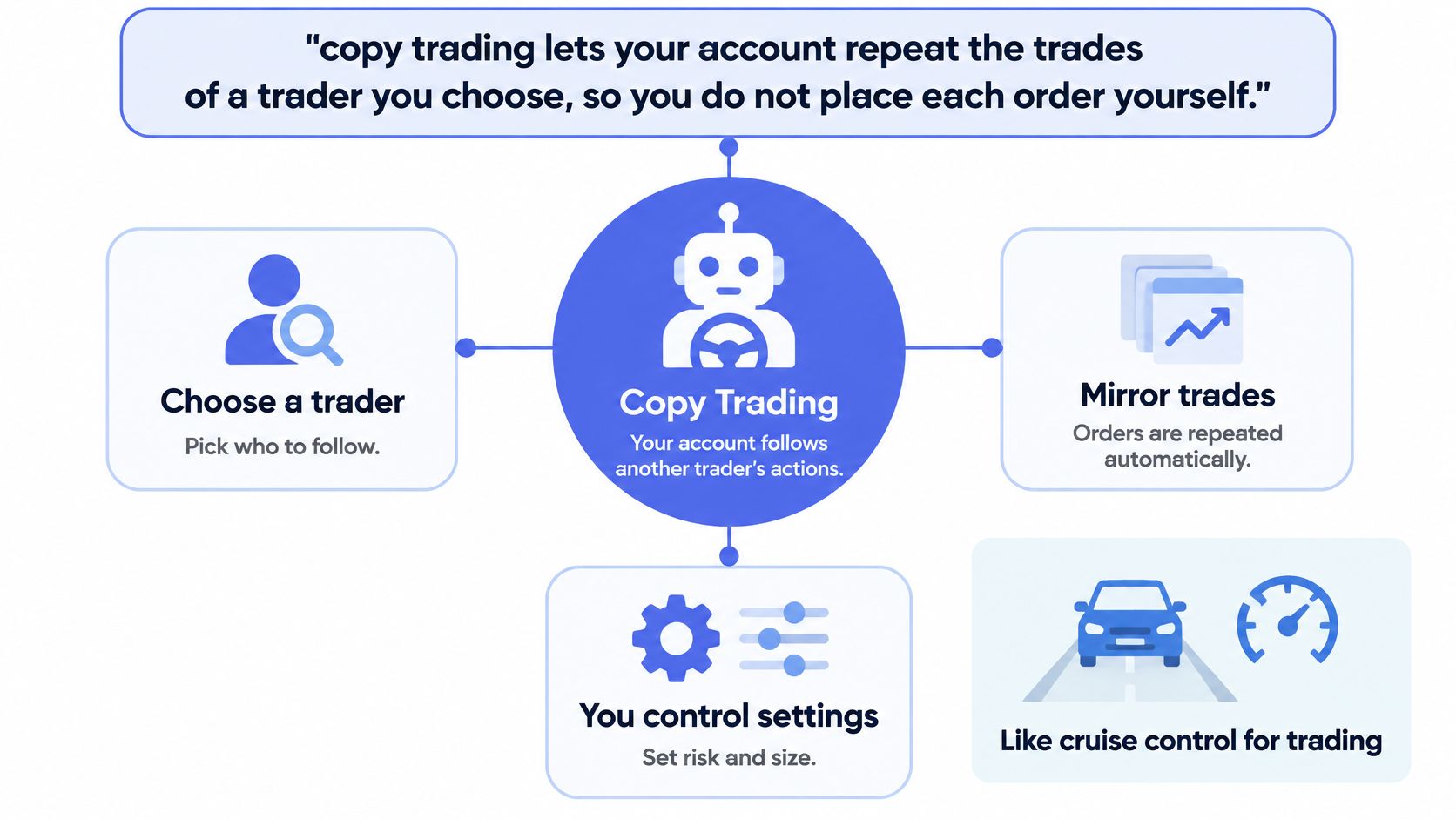
Copy trading lets your account repeat the trades of a trader you choose, so you do not place each order yourself.
Think of autopilot on a boat. You pick the captain and keep ownership of the boat, but the system follows that captain's route. You still decide how much capital is exposed and when to stop following.
The distinction is execution, not access to information. Seeing a trader's activity doesn't mean your account has acted on it.
Watching, Signals and Automatic Copying
These activities can look similar in a feed, but they produce different account behavior:
- Watching a trader: You see a buy or sell. Your wallet doesn't change unless you place a trade.
- Receiving a signal: You get an alert or instruction. You still choose whether and when to submit the order.
- Automatic replication: The service places a corresponding trade using the settings you've already chosen.
Colibri Trader's guide to copying other traders' positions explained provides another plain-language explanation of that distinction. The practical test is simple: does the trade require your approval each time?
The relationship between trader selection, execution and account controls looks like this.
The Same Mechanism in a Different Market
The model grew out of automated forex trading in the mid-2000s and reached mainstream platforms through eToro CopyTrader in 2010, as described in Arkham's copy-trading explainer.
Automation also changes the regulatory question. The UK Financial Conduct Authority's copy-trading guidance classifies copying without manual account-holder input as portfolio or investment management. That doesn't establish the regulatory status of every crypto service. It explains why automatic execution is more than a social feed.
In crypto, the copied action is often an on-chain swap. Your account exchanges one asset for another rather than merely recording the leader's decision.
Copying doesn't transfer the trader's skill to you. It reproduces actions. Execution delay, available liquidity and your own sizing rules matter from the first position.
How a Copied Trade Opens and Closes, Step by Step
A copied position has an entry, a size and an exit path. Check all of them before treating it as a complete copy.
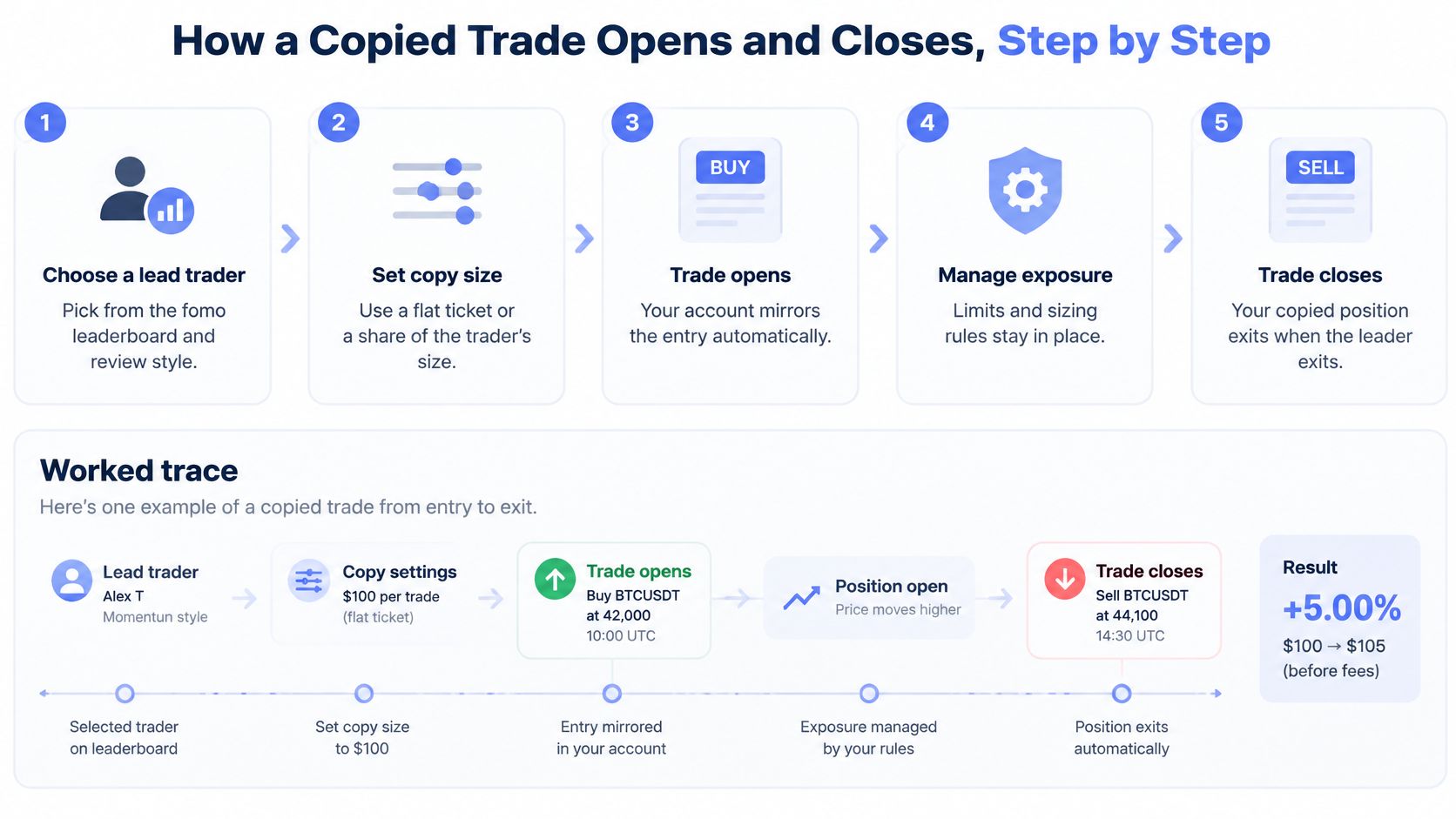
The flow below shows the user-facing sequence, from choosing a trader to closing the position.
From Trader Selection to the Final Sell
Choose a lead trader and set your size. Pick from the fomo leaderboard. Choose a flat ticket amount or a share of the trader's size, then set a per-trade cap. This decides your exposure before anything is bought. Proportional copying doesn't mean using the trader's full position size.
The lead trader buys. Only verified buys are copied. If a buy can't be verified, it's skipped rather than opening a position in your account. Following a trader isn't permission to copy every apparent token movement.
Your copied position opens. A copied buy lands within seconds of the trader's buy. Your configured ticket determines the amount, and the copy won't exceed your cap. You'll hold your own position with its own entry price, not a claim on the trader's position.
The trader sells some or all of their holding. Your copy sells the same fraction they sold. If you selected all at once, your copy sells in full instead. Fractional exits matter because selling a fixed amount rather than the corresponding fraction would leave you with a different exposure.
The position closes. We mirror exits as well as buys. Your copy opens and closes with the trader unless one of your own exits, such as a take profit or stop loss, fires first. Those exits use your levels, not the trader's levels.
A Worked Position Trace
Say your configured ticket is 300 units, but your per-trade cap is 200 units. This is a hypothetical sizing example, not a trade recommendation or a performance illustration.
The trader buys a token. Your cap reduces the copy's opening allocation to 200 units, so the larger ticket doesn't override the limit.
The trader later sells half their holding. Your copy sells half its token quantity, leaving the portion associated with the remaining 100 units of the original allocation. That isn't necessarily worth 100 units at the current market price.
When the trader exits fully, your remaining tokens close with them unless your stop loss has already triggered. Each fill belongs to your account. Different entry and exit prices mean your realized result won't exactly match the source trader's result.
Custodial and Non-Custodial Copy Trading Compared
Custodial copy trading means the provider holds your funds or controls the account holding them. Non-custodial copy trading means funds stay in your wallet, with execution authorized through permissions you grant.
The difference is who controls the assets, not whether the trades are sensible. A service can leave withdrawal authority with you while still executing a losing swap.
What Changes for Your Account
With custody, you rely on the provider's withdrawal process, internal controls and solvency to recover your assets. Your account balance is something the provider must honor.
With allowance-based non-custodial execution, you authorize spending from your wallet. You can revoke that permission. Our service cannot withdraw your funds, and the assets remain in your wallet.
That permission still matters. An allowance authorizes actions involving assets, so inspect what you've granted rather than treating a wallet connection as harmless. Our non-custodial wallet explanation covers the relationship between ownership and execution permissions.
Custodial and non-custodial copy trading compared
| Model | Who holds the funds | Who can move them | If the provider fails | What it does not protect against |
|---|---|---|---|---|
| Custodial | The provider or its account | The provider, under its terms | Recovery depends on the provider's solvency and controls | Losing trades and poor trader selection |
| Non-custodial | Your own wallet | You, with service execution restricted to granted permissions you can revoke | Your funds stay in your wallet | Losing trades, slippage, market moves and smart-contract risk |
A provider failure doesn't necessarily mean the assets disappear from a non-custodial wallet. It can still mean the automation stops working. You need to know how to inspect your holdings and manage them without relying on the copy service.
Checks Before Granting Permission
- Identify the holder: Confirm whether the assets sit in your wallet or a provider-controlled account.
- Separate spending from withdrawal: Understand what the service can execute and whether it can transfer funds out.
- Confirm revocation: Know how to remove permissions yourself, rather than relying on support to disable access.
If you're also unfamiliar with acquiring and transferring crypto, NexaPay's guide can help you avoid first-time crypto buying mistakes. Funding and permission errors are separate from trader selection.
Keeping control of withdrawals addresses custody exposure. It doesn't make the positions in that wallet safe from losses.
Who Uses Copy Trading and What It Solves
It's 3 a.m. where you live. A trader you follow opens a position in another time zone, while your phone sits untouched beside the bed. A copied trade can still open while you're asleep, at your configured size and capped at your limit.
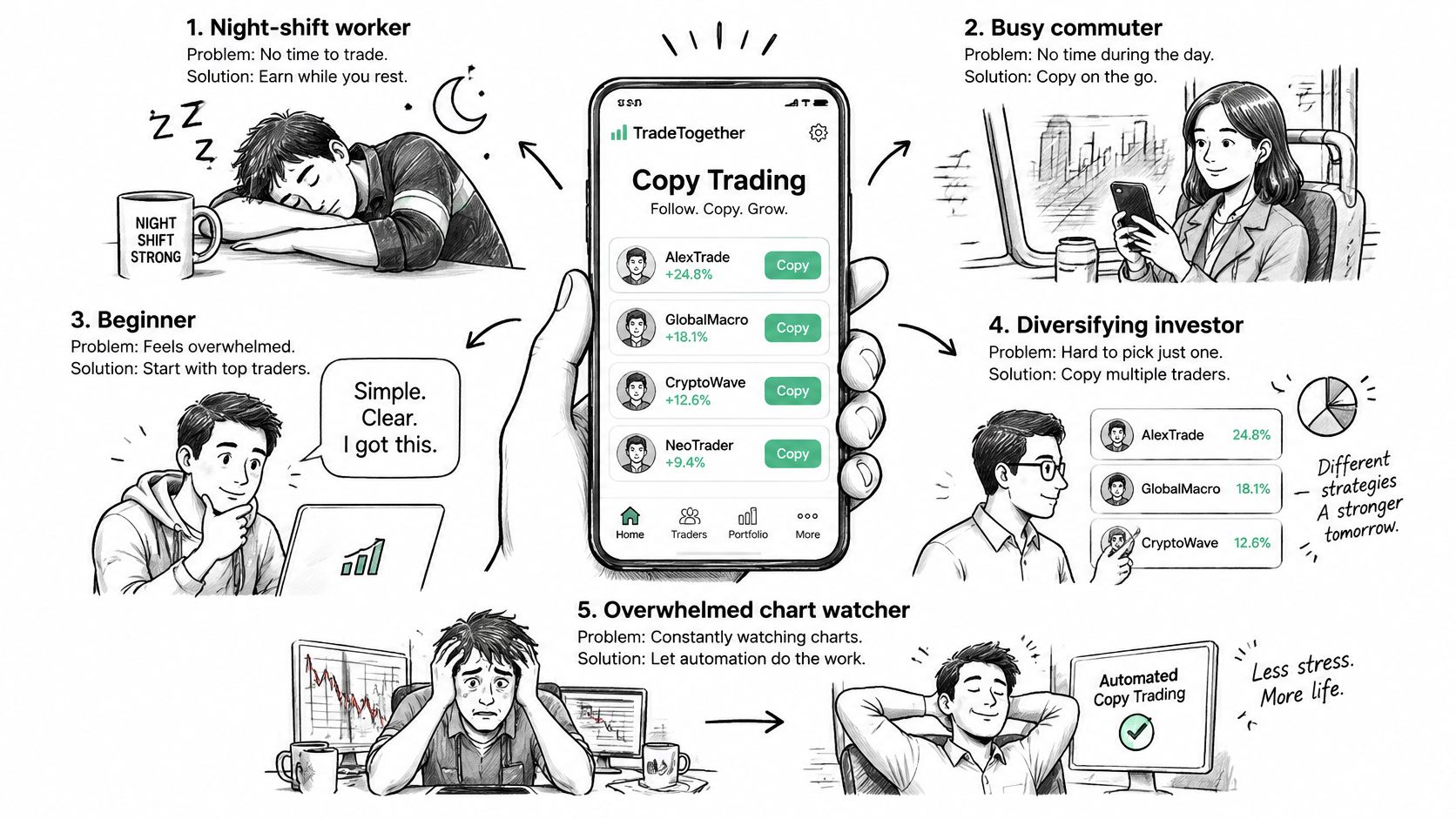
The common use cases differ, but each starts with a gap between observing a trade and acting on it.
Different Traders, Different Execution Problems
- Part-time and time-zone-constrained traders: You're at work or asleep when the source trader acts. Preset execution removes the need to be present for each entry.
- Traders tired of watching feeds: You keep refreshing leaderboards and checking alerts. Background execution replaces that repeated manual action, although account review remains your responsibility.
- Manual copiers who miss sells: You catch the entry, then discover the trader has already reduced or closed their holding. Mirrored sells address the gap between opening a position and following its exit.
- Newer market participants: You want to observe an experienced trader's activity with a capped allocation. The account history gives you actual entries and exits to review, but it won't necessarily explain the trader's reasoning.
- DeFi users who retain wallet control: You want execution from your own wallet rather than a provider-held balance. The relevant decision is which permissions you're willing to grant.
These use cases don't require the same trading style. Someone copying short holding periods needs to pay particular attention to execution details, while someone following longer positions still needs to monitor concentration and changes in the trader's behavior.
The embedded video provides additional context for understanding copy trading.
Copying can solve an availability problem. It can't choose a suitable trader for you.
A trader's realized PnL on filled trades is a starting point for evaluation. It doesn't tell you whether their next position fits your account, or whether you could tolerate the same losses they can.
Where Copy Trading Helps and Where It Breaks Down
Automation removes manual monitoring from the execution path. Preset sizing keeps each copy tied to a rule, and mirrored exits make the process more complete than copying entries alone.
You also need an inspectable record. Timestamps and displayed slippage let you review what your account did. Before copying a buy, we check that the trader paid for it; a buy that can't be confirmed isn't copied.
Those features solve specific operational problems. They don't settle the risks below.
Misconceptions That Change Account Behavior
Copying removes risk. Showing people others' success increased risk-taking, and allowing direct copying increased it further; a supervisory review summarized by IOSCO also reported that participants offered copying of a high-performing user made 18% more trades than a control group. Removing manual steps can make it easier to take exposure, not just easier to manage it.
A leader's past performance predicts future results. It doesn't. A trading history describes previous positions under previous conditions, and a strong period doesn't establish how the trader will behave during a different market.
A copy matches the leader's result. Your order size, execution timing, fees and available liquidity affect your outcome. A matching buy or sell direction isn't a matching account result.
Non-custodial means no losses. It limits who can withdraw funds. It doesn't prevent the assets you hold from falling in value or make a copied decision suitable for your capital.
Copy trading automates decision replication, not risk elimination.
Weigh the Benefit Against the Remaining Exposure
Ask what each convenience leaves unresolved. Faster participation still leaves you exposed to a bad entry. A fixed ticket still permits repeated losses across separate trades.
Likewise, a transparent record helps you identify poor execution after it happens. It doesn't reverse the fill. Verification confirms that a buy was paid for, not that the token or trade is sound.
Treat the source trader as someone who can be wrong. Before copying, decide what a losing position and a sequence of losing positions would mean for your account.
That distinction matters more than whether the interface feels simple. A short setup flow can authorize ongoing decisions with real consequences. Ease of execution isn't evidence of lower risk.
Slippage, Exits and Pauses That Change Your Results
A copy's fill can differ from the source trade. Your transaction follows the source action, so the available price and liquidity can change before your swap completes.
The SEC's crypto-asset investor alert identifies volatility, illiquidity and operational failures among material crypto-market risks. In your account, those risks can appear as an unfavorable fill, a delayed exit or an inability to sell as intended.
Read the Fill, Not Just the Trade Direction
We print slippage on every copied trade. Use that figure with the transaction timestamp to inspect your actual execution rather than assuming you received the trader's price.
Our guide to slippage in crypto explains the price difference in more detail. Check sells as closely as buys, because liquidity can change before a mirrored exit completes.
Copy trading controls and their limits
| Control | What it limits | What it cannot stop |
|---|---|---|
| Fixed ticket or proportional sizing | Size of each copied position | A losing trade at that size |
| Per-trade cap | Exposure on any single copied trade | Total losses across many trades |
| Take profit and stop loss | Gains and losses on copied positions, at levels you set | A fast move that passes your stop before it fills |
| Pause copying | New mirrored trades, and your take profit and stop loss | Open positions, which stay open and can be sold by hand |
| Allowance revocation | The service's permission to spend from your wallet | Losses on positions already held |
Stopping and Pausing Aren't the Same Action
Stopping copying a trader doesn't sell anything. Your existing position stays open and keeps its PnL. Your own take profit and stop loss keep protecting it.
Pausing copying stops all mirroring and pauses your take profit and stop loss too. Those controls resume the moment you resume copying. While paused, positions remain open, and you can sell them manually from /portfolio.
That difference matters when you want to stop new exposure without abandoning management of existing holdings. Don't assume every switch labeled around copying has the same effect.
Your take profit and stop loss also need deliberate review. Changing either applies to positions already held, not just the next trade. A stop loss entered inside a trader's copy flow applies to that trader, while one entered through /settings applies to every trader you copy.
Before changing size: Inspect the slippage on each copied trade and check whether exits are completing as intended.
A larger allocation changes the amount exposed. It doesn't repair poor execution.
Set Up a Copy Trade on Telegram With a Clear Plan
Review the trader before configuring the bot. The ACM study of cryptocurrency copy-trading interfaces found that copiers heavily followed default leaderboard rankings, which makes the ranking itself part of the selection risk.
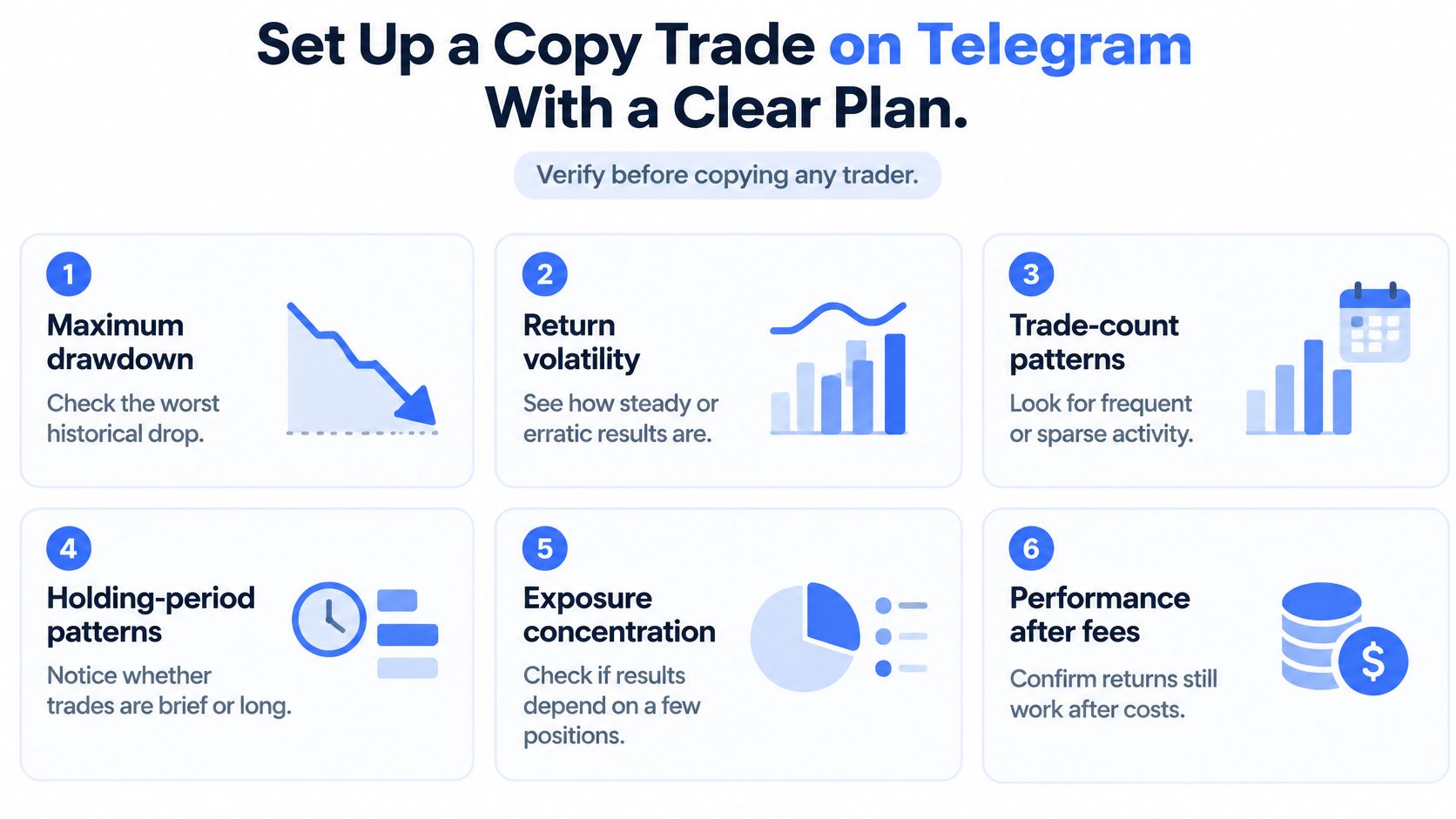
Use a broader checklist than headline PnL:
- Maximum drawdown: Check the worst historical decline.
- Return volatility: Look for erratic results rather than judging only the endpoint.
- Trade count and holding periods: Review how often the trader acts and how long positions remain open.
- Exposure concentration: Check whether results rely on a narrow group of positions.
- Results after costs: Account for fees and copied execution, including slippage.
The evaluation points belong in your plan before any position opens.
Define Your Rules, Then Start
Write down your per-trade cap, total exposure ceiling for a token and rule for pausing. Base your loss budget on capital you can afford to lose, not on the assumption that a stop will fill exactly at its trigger.
- Open the bot from the copyfomo site. Send
/startto@copyfomo_bot. - Pick a trader. Use
/leaderboardor/find, then review the activity behind the ranking. - Run the copy flow. Set fixed or proportional sizing, a per-trade cap and your own exit levels.
- Fund your wallet. Use
/depositand confirm which spending permissions you've granted. - Review trade messages. Inspect slippage before considering any increase in size.
We copy trades on Robinhood Chain, Base, BNB and Solana. The Telegram copy-trading guide provides more setup context.
Copy trading carries risk, and past performance does not predict results.
copyfomo is a Telegram bot that automatically copies the buys and sells of top traders you select from fomo, using your configured size in your own wallet. Visit copyfomo to start the bot on Telegram and set your limits before the first copied trade.
stop reading. start copying.
pick a trader from the fomo leaderboard, set your size, and the entries and the exits land in your own wallet while you sleep.
open copyfomo on telegram →