Automated Copy Trading: A Practical Guide for Crypto Traders
learn how automated copy trading works on-chain, the real benefits and risks, and what to look for before letting a bot mirror another wallet's trades for you.
The most popular advice about automated copy trading is to find the trader with the highest realized PnL and let the bot follow. That skips the hard part. A follower doesn't get the source trader's fills, and a leaderboard rank doesn't show how much risk sits behind the result.
Automated copy trading removes some screen-watching and manual timing. It also moves decisions about trader selection, trade size, execution and exits into a system that can act while you're away. That makes it an execution tool, not a shortcut to the leaderboard.
Table of Contents
- What Automated Copy Trading Does
- How Trade Mirroring Works on Chain
- Custodial vs Non-Custodial Copy Trading
- Latency, Slippage, and Allowances in Practice
- Why a High PnL Trader Is Not a Safe Trader to Copy
- A Concrete Example With copyfomo
- Best Practices Before You Turn the Bot On
What Automated Copy Trading Does
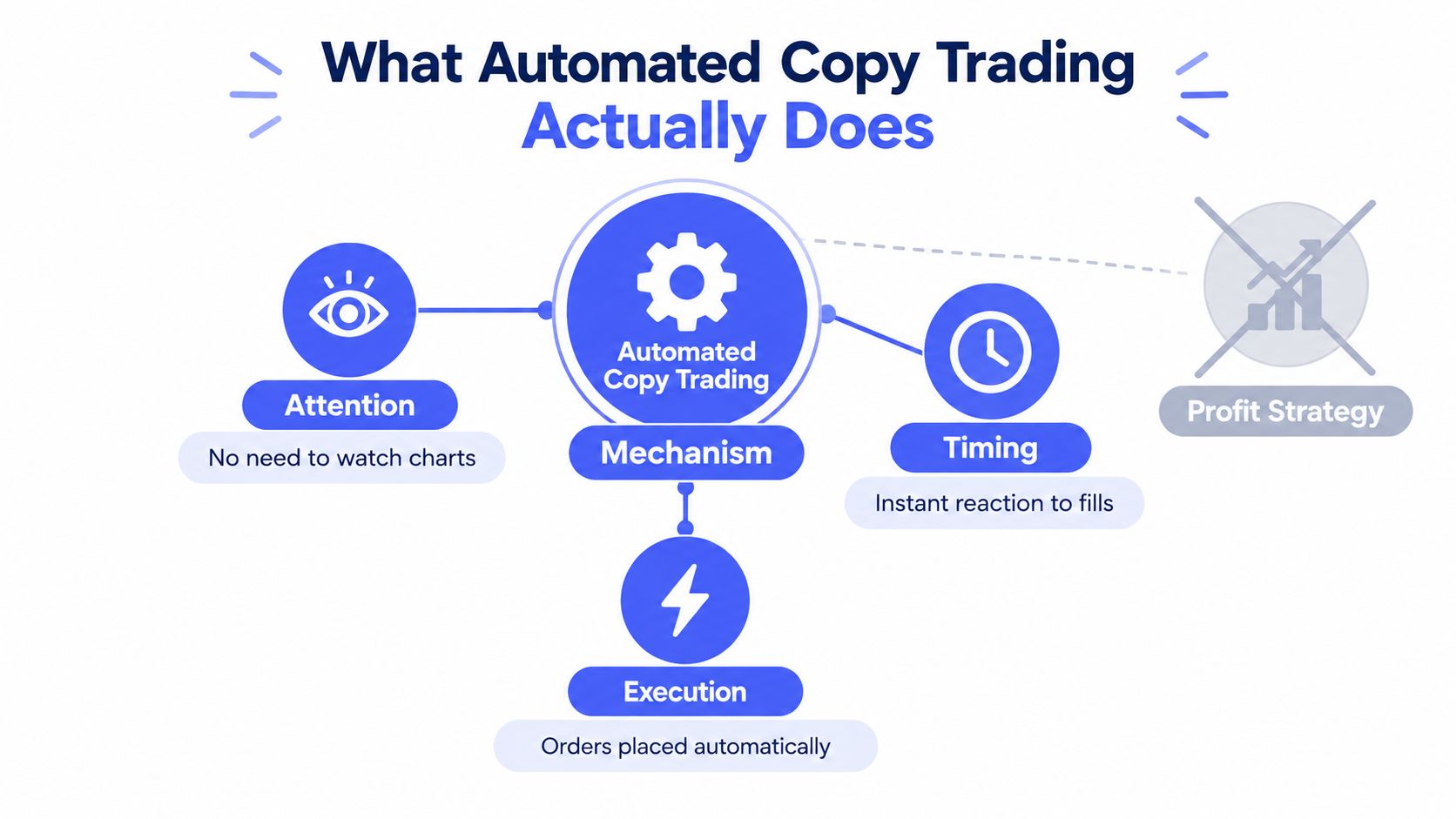
The copy button does not move the lead trader's fill into your account. It starts a second trade, under your permissions, at whatever price the market gives you when that instruction lands. Automated copy trading is an execution mechanism: a lead trader makes a trade, the follower system relays the instruction, and the follower account attempts a corresponding trade.
The model grew out of social-trading communities and then hardened into software. Records from the Activetrader public chat room covering 2000 to 2003 show nearly 9,000 trades involving 676 traders, with subsequent traders becoming 40.7% more likely to move in the same direction after a buy or sell signal; the same timeline has ZuluTrade launching a signal-provider arrangement in 2007 and MetaQuotes adding Trading Signals to MetaTrader 5 in 2012 before MetaTrader 4 (the Activetrader study and platform timeline). Imitation is old. Cleaner plumbing is newer.
What changes with automation is who or what touches each decision. Trader selection still sits with you. Size can be fixed, proportional or capped. Entries may mirror while exits lag, fail or never copy, which means two accounts can show the same idea and carry different risk. The system can reduce screen-watching and timing costs; it can also multiply a bad choice faster than a manual follower could react.
Working rule: Automate the mechanics only after you have checked selection, sizing, exit mirroring, permissions and the gap between source fills and your expected execution.
When comparing tools, look past the word “automated.” Check how a product handles sizing, exits, spending limits and execution visibility. This guide to copy trading software features and pricing can help frame that evaluation, but a feature list cannot tell you whether the trader being copied is taking risks you can afford.
How Trade Mirroring Works on Chain
On-chain mirroring starts with a source trade and ends only when the follower's transaction is confirmed or fails. Those events aren't simultaneous. Between them, the pool can change.
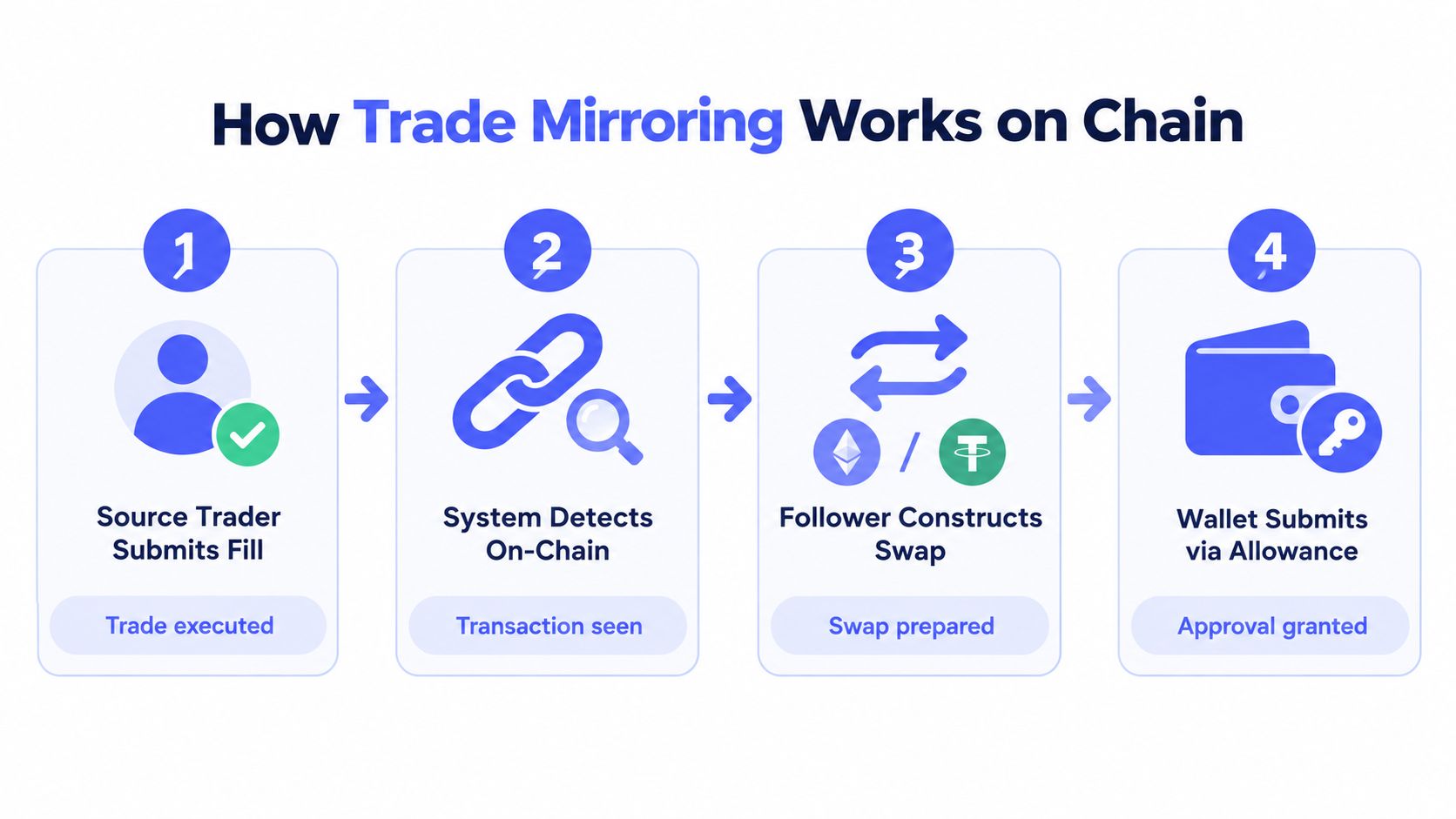
A typical flow looks like this:
- The source trader gets a fill. An order has executed. A posted intention or an unfilled limit order isn't the same thing as a completed trade.
- The follower's system sees the trade. It prepares a corresponding swap using the follower's configured sizing and trade rules.
- The follower wallet submits the swap. The wallet's approved spending permission lets the transaction use the relevant tokens.
- The network includes the transaction. The swap either executes within the follower's slippage limit or fails under the configured conditions.
The important distinction is between copying entries and copying both entries and exits. If the system mirrors a buy but not the source trader's sell, the follower may remain exposed after the lead trader has reduced or closed the position. Entry-only copying isn't full mirroring. It can leave two accounts holding different risks while appearing to follow the same strategy.
Decentralized exchange trades don't execute at the instant they're submitted. The liquidity pool can change before block inclusion, so slippage tolerance sets how much price movement a swap can accept before it fails (research on transaction ordering and slippage). A tighter limit can reject a trade that moved too far; a looser one can accept a worse price.
Here's a short visual explainer on the transaction flow and the practical gap between a source trade and its copy.
For another plain-language explanation of automated execution in decentralized markets, see this overview of a DeFi trading bot. The key operational question remains the same: does the follower copy the source trader's actual fills and exits, or only selected parts of the activity?
Custodial vs Non-Custodial Copy Trading
Custodial and non-custodial copy trading differ on one question: whose wallet holds the funds when a trade goes wrong. In a custodial setup, a platform or broker holds funds, or routes orders through an account it operates. That simplifies onboarding, but you rely on the platform to safeguard assets, execute faithfully and remain solvent when you want to withdraw.
A non-custodial setup keeps funds in your wallet. Instead of custody, you grant a spending allowance: a permission set through a wallet transaction that lets a contract spend approved tokens for trades. Disconnecting the wallet from the application does not cancel that permission. The contract can keep spending approved tokens until you revoke access (Ethereum's guide to revoking token access).
That matters when you stop a bot. Closing a Telegram session is not the same as removing token permission. Revoking access requires another wallet transaction and a network fee.
| Model | What the user gives up | Main operational consideration |
|---|---|---|
| Custodial | Direct control of funds or order routing | Assess platform and counterparty risk |
| Non-custodial | Some permission over approved tokens | Review, limit and revoke allowances when appropriate |
Read the permission prompt before you approve it. Check which tokens it covers and whether the allowance is limited or unlimited. If you cannot tell how to revoke it, you do not yet understand the system you are authorizing.
Neither model makes the copied trades better. Custody describes who controls the assets. It says nothing about whether the leader's strategy, position sizing or execution conditions match your risk tolerance, and it does nothing to close the gap between their fills and yours.
Latency, Slippage, and Allowances in Practice
A source trader's fill and a follower's fill are separate executions. The delay includes more than a bot reacting to an event. The system has to detect the trade, construct a transaction, propagate it, wait for validator inclusion and receive confirmation. In a volatile or thin pool, even a roughly one-second gap can matter.
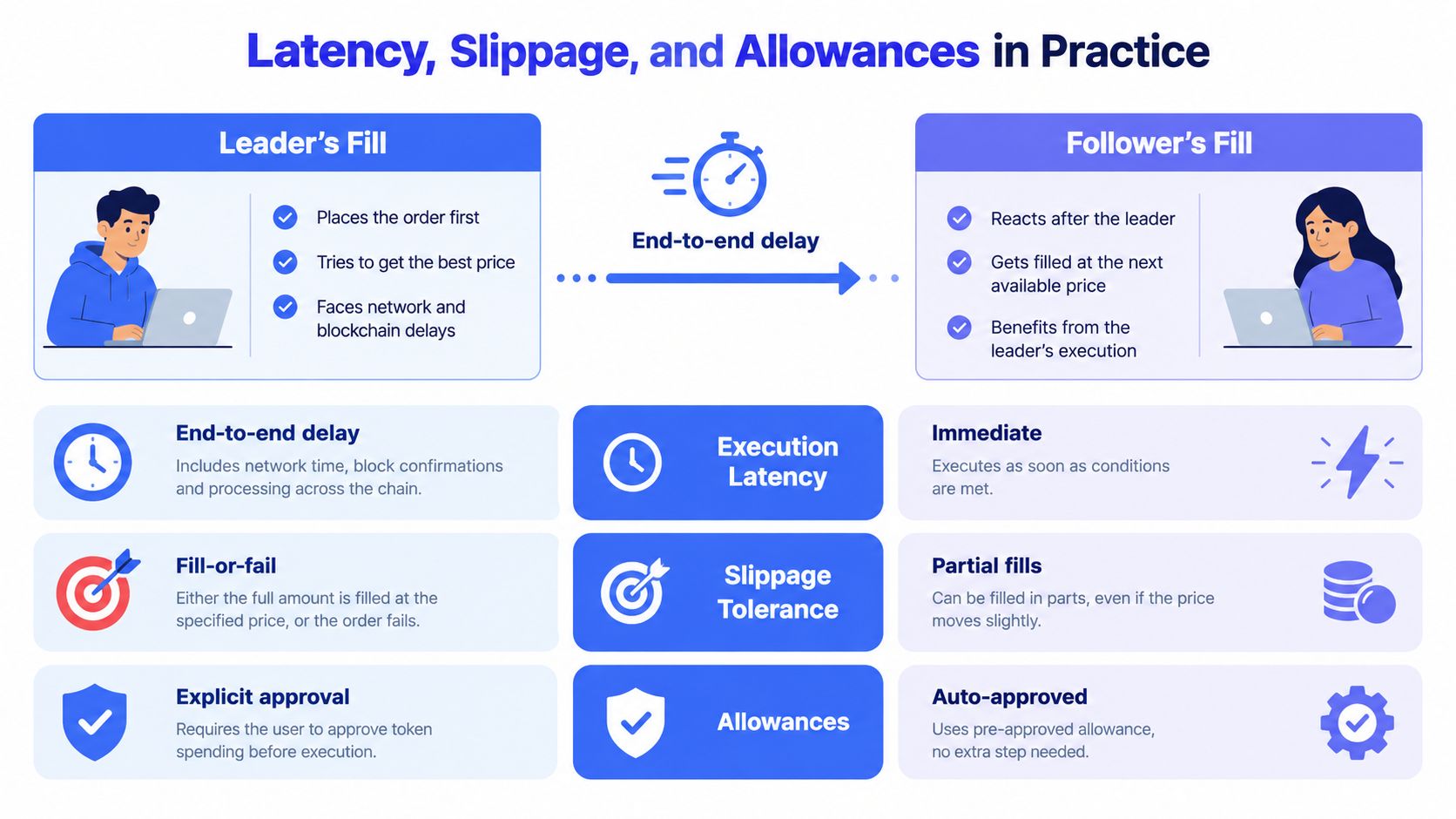
IOSCO identifies timing and pricing as core copy-trading risks. When multiple followers react to a lead trader's transaction, their combined demand can move the market. Later followers may buy at a higher price or sell at a lower one than the leader (IOSCO's report on copy trading and related risks).
What to inspect on a copied trade
- Timestamp: Compare the source fill time with the follower's execution time. A fast reaction doesn't guarantee the same price.
- Slippage: Look at the follower's actual execution price, not only the source trader's fill. Slippage tolerance is a fill-or-fail boundary, not a promise of execution at the source price.
- Trade size and liquidity: A size that looks small against the source trader's wallet may still be large relative to a thin pool. Price impact can worsen as liquidity changes.
- Failed or partial transactions: Check whether the system reports rejected, expired or incomplete swaps and what happens to open exposure afterward.
A useful control set includes a maximum slippage parameter, per-trade notional caps, minimum liquidity thresholds and rejection of stale signals. These controls won't make a trade profitable. They can stop the system from blindly accepting conditions that differ too much from the source fill.
See this explainer on slippage in crypto for the mechanics behind the setting. The practical test is to review actual timestamps and follower slippage together. A bot that reacts quickly can still get poor execution if the pool moves, the order affects market depth or the transaction fails.
Operational rule: A kill switch should stop new copies clearly. If it can also close open mirrored positions, understand exactly what that action will submit and how it handles failed swaps.
Why a High PnL Trader Is Not a Safe Trader to Copy
A leaderboard ranked by realized PnL answers a narrow question: who has recorded the largest gains under that ranking's rules? It doesn't show how those gains were made or how much risk the trader took to get them.
Research on a simulated, dynamically changing stock market tested 807 experienced retail investors. Participants shown the outcomes of high-performing peers took more risk, traded more actively and reported lower satisfaction with their own performance (the study in Scientific Reports). That doesn't prove every copy-trading user will behave the same way. It does show why visible success can push people toward more risk rather than more careful analysis.
Look past the leaderboard number
Before mirroring a trader, examine the shape of the result:
- Drawdown: How far has the account fallen from a peak, and how long did it take to recover?
- Concentration: Does the trader repeatedly depend on a small group of tokens or a single market condition?
- Holding time: Are trades held briefly, or can positions stay open while conditions change?
- Loss size: How large are losing trades compared with winning trades?
- Realized versus unrealized performance: Are the displayed gains from closed trades, open positions or a mixture?
- Execution after slippage: Would the strategy still look similar after follower prices and failed transactions are included?
Recent gains can reflect skill, but they can also reflect concentrated exposure, survivorship bias or a short speculative streak. A high realized PnL doesn't tell you which explanation fits. Nor does copying a trader remove the need to decide how much of your own wallet can be exposed to that strategy.
The behavioral risk matters too. A frictionless copy button can make it easy to follow a trader because their recent results look good, then increase allocation without independently checking losses or concentration. Treat leader selection as an ongoing risk decision, not a one-time reaction to rank.
For a focused discussion of what leaderboard results can and can't tell you, read whether copying the fomo leaderboard works. Past performance doesn't predict future results. Copy trading carries risk, and a leaderboard is a discovery tool, not a safety rating.
A Concrete Example With copyfomo
copyfomo is a Telegram bot for users who want to mirror selected traders from the fomo app. The user selects a trader, chooses a fixed trade size or proportional sizing, and can set a per-trade cap. The trades are mirrored into the user's own wallet through spending allowances, rather than by transferring wallet custody.
The distinction between entries and exits is visible in how the service works. It mirrors filled buys and sells, so the follower can copy a source trader's exit as well as the initial entry. That still doesn't mean both wallets get the same price. The follower's swap happens later and may face different liquidity and slippage.
Follow the execution, not just the rank
The trader leaderboard is based on realized PnL from filled trades. That can help with discovery, but it shouldn't be treated as a verdict on future performance. A user still needs to check how the trader handles losses, what assets dominate the activity and whether the follower's chosen size is appropriate for the available liquidity.
The live feed shows mirrored swaps with timestamps and slippage for each copied trade. That gives users a way to inspect the gap between a source trade and their own execution. The service also offers a kill switch to pause new copies, with an option to close open mirrored positions. Users should understand the effect of that closure before relying on it, since the exit itself is another on-chain swap.
Trade size matters. Research on Uniswap found the probability of adversarial slippage when trading PEPE was roughly 80% higher than when trading a more mature asset such as USDC (the Uniswap study on trade costs and adversarial slippage). That result supports checking slippage and using size limits; it doesn't establish how any individual copied trade will execute.
A public dataroom provides operational metrics, while the Telegram interface provides access to trade controls and the activity feed. Those details help a user inspect the service, but they don't remove market risk or turn historical results into a forecast. The useful question is still whether the leader's trades, the follower's configured size and the actual execution conditions make sense together.
Best Practices Before You Turn the Bot On
Set limits before enabling automation. A bot will follow the rules you configure, not the risk tolerance you meant to have. Start by checking wallet permissions, trade sizing, slippage settings and what the stop control does.
- Keep sizing bounded: Use a fixed amount or proportional sizing with a firm per-trade cap. Check how several copied positions could add up across the wallet.
- Set a realistic slippage limit: A tight limit can cause swaps to fail; a loose one can accept a worse price. Review actual follower execution rather than assuming the configured limit equals the final price.
- Review the allowance: Approve only what's needed where possible. Know how to revoke access, and remember that disconnecting a wallet doesn't revoke an existing allowance.
- Test the kill switch: Confirm how to pause new trades and whether closing open positions creates new swaps. Don't wait for a live problem to learn what the control does.
- Check exit behavior: Verify that the system mirrors sells as well as buys, and understand what happens when a copied exit fails or arrives after the source trade.
- Monitor the feed: Use timestamps and per-trade slippage to separate strategy results from execution drag. Watch for repeated failures or materially worse follower prices.
Treat cashback as cashback. Don't confuse it with trading returns, and don't build expectations around it. The U.S. SEC's investor alert describes crypto-asset investments as exceptionally volatile and speculative, and lists technical glitches, hacking, malware, insolvency and asset losses among relevant risks (the SEC's investor alert on crypto-asset securities).
Automated copy trading reduces attention costs. It doesn't remove market risk, trader-selection risk or the possibility that copied behavior amplifies losses. Past performance, realized PnL and leaderboard rank don't predict future results.
copyfomo offers Telegram-based mirroring of selected fomo traders' filled entries and exits, with configurable sizing, per-trade caps and a live feed showing timestamps and slippage. Review the controls and wallet permissions before starting, then visit copyfomo to start the bot on Telegram.
stop reading. start copying.
pick a trader from the fomo leaderboard, set your size, and the entries and the exits land in your own wallet while you sleep.
open copyfomo on telegram →